
Leviticus 19 · Deuteronomy 22 · Subject · Featured Study
The Three Forbidden Mixtures
What Moses forbade Israel to mix, and how the rabbis, Josephus, Maimonides and the church have explained it.
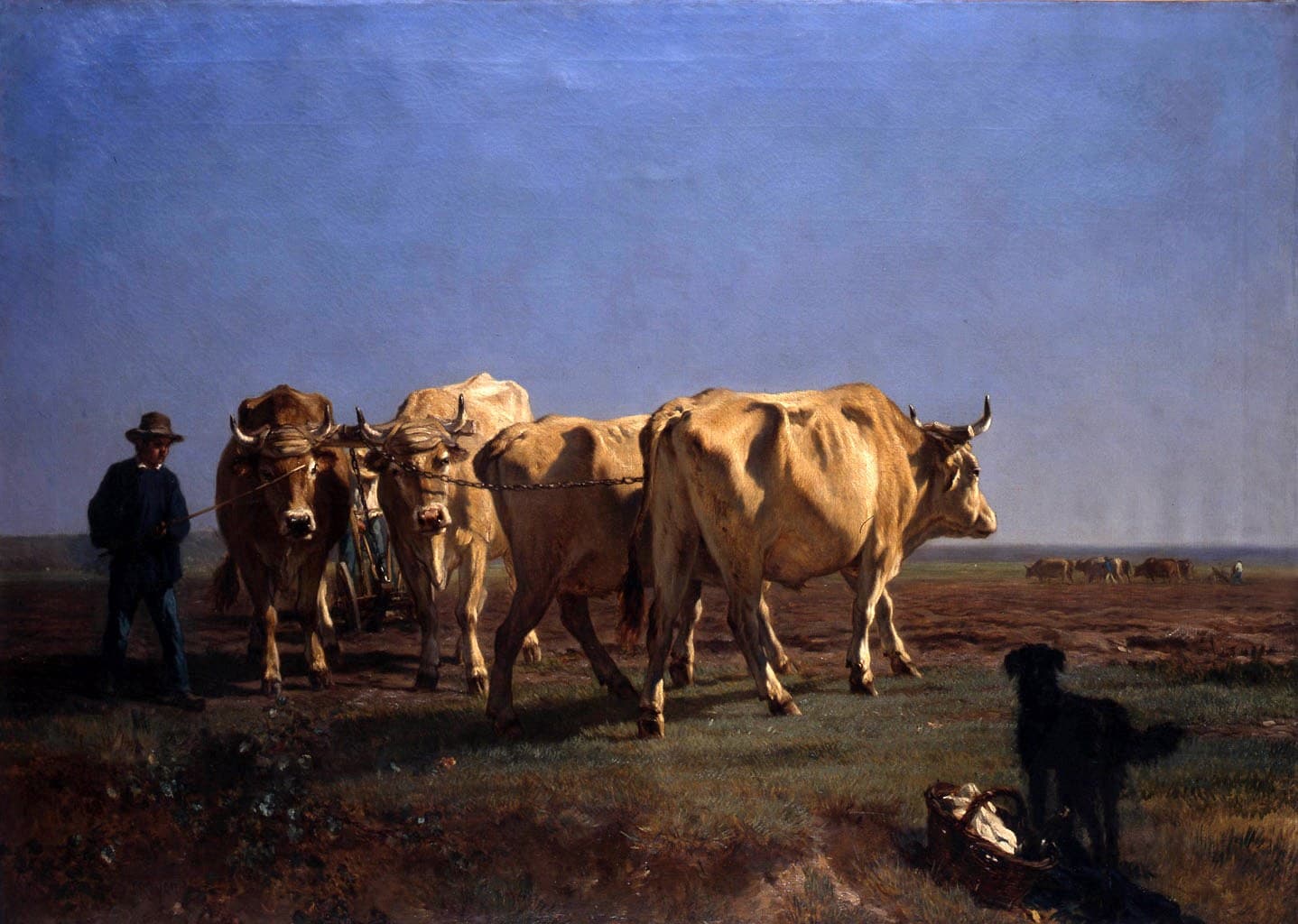
Constant Troyon, Oxen Ploughing (Boeufs au labour), about 1859. Public domain by date (the painter died in 1865), via Wikimedia Commons, File:Troyon_Constant_-_Boeufs_au_labour_(c_1859).jpg
THE ARTWORKTroyon painted two pairs of oxen yoked by the horns and drawing a plough, a team of one kind such as Deuteronomy 22:10 allows.
Absalom rode a mule, and Solomon was set on David's own mule, though Leviticus 19:19 forbids the breeding of one.
Summary
The law of mixtures forbids Israel to join two kinds of seed, two kinds of animal, or wool and linen in one cloth.
- Leviticus 19:19 sets three of the laws in one verse, and Deuteronomy 22:9 to 11 adds the vineyard and the yoke and names the wool and the linen.
- The Mishnah gives the law a tractate of its own, Kilayim, and holds that only wool and linen together make the forbidden cloth.
- Josephus and the Mishnah say the priests wore wool and linen together, and Keil and Delitzsch hold that this cannot be proved.
- Readers have taken the laws as the order of creation, as a guard against idolatry, as a statute given without a reason, or as a lesson in a figure.
The Law in Two Passages
Moses gives the law once in Leviticus 19 and again, with more named, in Deuteronomy 22
You are to keep My statutes. You shall not crossbreed two different kinds of livestock; you shall not sow your fields with two kinds of seed; and you shall not wear clothing made of two kinds of material.The call to keep the LORD's statutes opens the verse, and all three laws stand under it.
Do not plant your vineyard with two types of seed; if you do, the entire harvest will be defiled—both the crop you plant and the fruit of your vineyard.Deuteronomy names a vineyard where Leviticus names a field, and it adds what becomes of the harvest.
Do not plow with an ox and a donkey yoked together.Deuteronomy adds a law of the yoke, which Leviticus does not give.
Do not wear clothes of wool and linen woven together.The word sha'atnez of Leviticus 19:19 stands again in this verse, with its two fibres named beside it.
The Three Mixtures Drawn
Deuteronomy adds the vineyard and the yoke to what Leviticus 19:19 names
Three panels point out the six things the law keeps apart, each with its verse.
One panel for seed, one for animals and one for cloth
- A fieldTwo kinds of seedLeviticus 19:19
- A vineyardTwo types of seedDeuteronomy 22:9
- An ox and a donkeyYoked togetherDeuteronomy 22:10
- LivestockTwo different kinds crossbredLeviticus 19:19
- ClothingTwo kinds of materialLeviticus 19:19
- ClothesWool and linen woven togetherDeuteronomy 22:11
One panel for seed, one for animals and one for cloth
The text gives no sizes, so the three panels are drawn the same width.
In every panel the shaded shape stands for one kind and the open shape for the other.
From the Vineyard to the Loom
The vineyard, the yoke and the cloth as the rabbis and the commentators read them
The vineyard sown with two kindsDeuteronomy 22:9
Rashi reads the law of the vineyard as a ban on sowing wheat and barley with a grape kernel in one throw of the hand. Keil and Delitzsch read the end of the verse to mean that the whole crop would fall to the sanctuary for its servants.
Two kinds under one yokeDeuteronomy 22:10, Mishnah Kilayim 8:2
Rashi carries the law to any two kinds of animal, and to driving two kinds yoked together with a load when no plowing is done. The Mishnah, in Kilayim 8:2, forbids two kinds of beast for plowing and for pulling or leading together.
Albert Barnes held that the law was also given out of kindness, since the ox and the donkey differ so much in size and strength. Adam Clarke gave a like reason, that two beasts of different species never pull pleasantly together.
Spun and woven clothDeuteronomy 22:11, Mishnah Kilayim 9:8
The Mishnah, in Kilayim 9:8, holds that only what is spun or woven falls under the law. It reads sha'atnez as three words joined, combed, spun and woven.
What the Law Says and What Is Often Said
Three claims often made about the mixtures, each answered from a verse
IT IS SAID THAT EVERY BLENDED CLOTH IS FORBIDDEN.
Deuteronomy names wool and linen, and the Mishnah, in Kilayim 9:1, holds that nothing else is forbidden as a mixture of cloth.
IT IS SAID THAT AN ISRAELITE FARM COULD GROW ONLY ONE CROP.
The plowman of Isaiah 28 sows caraway, cumin, wheat, barley and rye on one farm, each in its own place.
IT IS SAID THAT AN OX AND A DONKEY COULD NOT WORK ONE FARM.
Isaiah blesses those who let the ox and the donkey range freely. John Gill notes that the two might be used apart, though not together.
The Linen and Yarn of the Sanctuary
Josephus and the Mishnah make the priests' dress the one exception to the law of cloth
“You are to construct the tabernacle itself with ten curtains of finely spun linen, each with blue, purple, and scarlet yarn, and cherubim skillfully worked into them.This verse is the ground of the claim that the sanctuary itself joined wool with linen.
and the sash of finely spun linen, embroidered with blue, purple, and scarlet yarn, just as the LORD had commanded Moses.The claim for the priests' dress rests on the coloured yarn of garments such as this sash.
Josephus wrote that the garment of wool and linen "is appointed to be for the priests alone" (Antiquities 4.8.11). The Mishnah, in Kilayim 9:1, says the priests served in the Temple in wool and linen.
Keil and Delitzsch hold that shesh, the word the Berean text renders finely spun linen, names byssus, and that no one can establish that byssus was linen.
The Words of the Mixtures
Four Hebrew words from the lexicon, each in a verse where it stands
KIL'AYIM, TWO KINDS (HEBREW, H3610)
The lexicon gives two heterogeneities and counts four uses, three of them in Leviticus 19:19 and the fourth in this verse.
SHA'ATNEZ, MIXED STUFF (HEBREW, H8162)
The lexicon gives linsey-woolsey, cloth of linen and wool carded and spun together, and the word stands only here and in Leviticus 19:19. Keil and Delitzsch call its origin obscure and think it probably Egyptian.
RAVA, TO MATE (HEBREW, H7250)
The lexicon gives to lie out flat, and specifically to mate, and counts three uses. The Berean text renders it crossbreed in this verse.
QADASH, TO BE SET APART (HEBREW, H6942)
The lexicon gives to be clean in the ceremonial or moral sense, with uses that run from consecrate to hallow. In Deuteronomy 22:9 the word says the harvest would be set apart, and the Berean text renders it defiled.
What the Law Leaves Unsaid
The whole law of mixtures stands in four verses of Scripture
The reason and the penaltyLeviticus 19:19, Deuteronomy 22:9 to 11
Neither passage gives a reason for the laws. Deuteronomy 22:9 names the loss of the harvest, and neither passage names a penalty for the breeding, the yoke or the cloth. Maimonides, in The Guide for the Perplexed 3:37, reports that the law of the rabbis punished the grafting of one tree into another with forty stripes.
Where Israel's mules came from1 Kings 10:25
Scripture does not say where Israel's mules were bred. Keil and Delitzsch suggest that they were brought in from abroad.
Year after year, each visitor would bring his tribute: articles of silver and gold, clothing, weapons, spices, horses, and mules.Keil and Delitzsch draw their suggestion from this verse, where mules come to Solomon among the tribute.
Kept Apart and Made Holy
Leviticus grounds its laws in the holiness of the LORD, and Paul draws on the yoke
“Speak to the whole congregation of Israel and tell them: Be holy because I, the LORD your God, am holy.The law of mixtures stands in the chapter this verse opens.
You are therefore to distinguish between clean and unclean animals and birds. Do not become contaminated by any animal or bird, or by anything that crawls on the ground; I have set these apart as unclean for you. You are to be holy to Me because I, the LORD, am holy, and I have set you apart from the nations to be My own.The law of clean and unclean animals is tied here to Israel's separation from the nations.
Jamieson, Fausset and Brown set 2 Corinthians 6:14 beside the law of the yoke as the moral lesson it may have been given to teach, and they leave the question open.
Do not be unequally yoked with unbelievers. For what partnership can righteousness have with wickedness? Or what fellowship does light have with darkness?Paul uses the picture of an unequal yoke for the bond of a believer with an unbeliever.
Why the Mixtures Are Forbidden
Four readings, held by Keil and Delitzsch, Maimonides, Rashi, Augustine and Wesley
The order of creationC. F. Keil and F. Delitzsch, The Pentateuch, volume 2, 1866
Keil and Delitzsch hold that the laws make the natural order and separation of things a duty, founded in the creation itself. They call the other proposed reasons foreign to the spirit of the law. Josephus gave a like reason in Antiquities 4.8.20, that "nature does not rejoice in the union of things that are not in their own nature alike."
And God said, “Let the earth bring forth living creatures according to their kinds: livestock, land crawlers, and beasts of the earth according to their kinds.” And it was so. God made the beasts of the earth according to their kinds, the livestock according to their kinds, and everything that crawls upon the earth according to its kind. And God saw that it was good.Keil and Delitzsch rest the reading on the kinds of the creation week, among them these verses.
The objection, from the idolatry reading, is that cloth of wool and linen joins no two kinds of living creature.
A guard against idolatryMoses Maimonides, The Guide for the Perplexed, 3:37, 1190
Maimonides holds that the idolaters grafted one tree into another in rites of magic, and that the law forbids the sowing of mixed seed as a guard against grafting. He says the heathen priests wore garments of vegetable and animal material, and he counts the ban on wool and linen among the laws that "are directed against idolatry."
Adam Clarke reports this reading as the one generally held.
The objection is that the law names none of the rites, and Maimonides takes them from a later book, the Nabatean Agriculture.
A statute with no reason givenRashi on Leviticus 19:19, eleventh century
Rashi counts the laws of this verse among "those enactments of the King for which no reason is given."
The objection, from the other readings, is that reasons can be found for the laws in Genesis 1 and in the customs of the nations.
A lesson given in a figureAugustine, Reply to Faustus, 6.9, about 400; John Wesley, Explanatory Notes upon the Old Testament, 1765
Augustine wrote of the cloth of wool and linen, "So it is sin whenever inconsistent things are combined in any man's life. This, which is now a moral truth, was then symbolized in dress."
Augustine read the law of the yoke with 1 Corinthians 9:9 to 10, where Paul says of the law of the ox, "this was written for us."
Wesley read the small precepts of Deuteronomy 22 as given "to forbid all mixture of their inventions with God's institutions in doctrine or worship."
The objection, from Rashi's reading, is that the text gives the laws as statutes and names no lesson in them.
Books on the Mixtures
The Mishnah, Josephus, Maimonides and Keil and Delitzsch, each free to read online
The Mishnah, tractate Kilayim
The rabbis of the Mishnah · about 200
Tractate Kilayim sets out the rules of seeds, animals and cloth as the rabbis taught them.
Read it on SefariaAntiquities of the Jews
Flavius Josephus, translated by William Whiston · about 93
Book 4, chapter 8 sets out the laws of Moses as Josephus gave them, the mixtures among them.
Read it on Project GutenbergThe Guide for the Perplexed
Moses Maimonides, translated by M. Friedländer · 1190
In book 3, chapter 37 Maimonides treats the laws he ties to the ways of the Amorite.
Read it on the Internet ArchiveBiblical Commentary on the Old Testament, The Pentateuch, volume 2
C. F. Keil and F. Delitzsch · 1866
This volume is the commentary on Exodus and Leviticus, verse by verse.
Read it on the Internet ArchiveSet Apart to the LORD
Peter writes to those redeemed by the precious blood of Christ, and he carries to them the call that stands over the law of mixtures.
But just as He who called you is holy, so be holy in all you do, for it is written: “Be holy, because I am holy.”Peter quotes Leviticus and asks the church to be holy in all it does.
Therefore, beloved, since we have these promises, let us cleanse ourselves from everything that defiles body and spirit, perfecting holiness in the fear of God.Paul closes his charge on the unequal yoke with this call to perfect holiness.