

Matthew 17 · Mark 9 · Luke 9 · An Iconic Story
The Transfiguration
Raphael, The Transfiguration, 1516-1520. Public domain.
THE ARTWORKRaphael's last painting, left on his easel when he died in 1520 and carried behind his coffin. He does something no other painter of this scene attempts: he splits the canvas. Above, Christ rises weightless in white light with Moses and Elijah beside Him and the three disciples flattened by it. Below, in shadow, the other nine argue helplessly over a boy they cannot heal, which is the very next paragraph of Matthew 17. The glory on the mountain and the failure at the foot of it are one story, and Raphael refuses to paint either without the other.
Summary
Summary
This page walks Matthew 17, Mark 9, and Luke 9 through six beats: the story, what the three accounts say against smoothed-over retellings, the unnamed mountain, what none of the Gospels tell, the Father's two declarations, and how the church has read it.
- Six places the retellings smooth over differences between the three Gospel accounts
- Three candidate mountains are weighed with their case, who holds it, and the honest difficulty, and none is settled
- Five things the text leaves silent are named, including what Moses and Elijah actually said
- The Father's words at the Jordan and on the mountain are set side by side, with one command added the second time
- 2 Peter 1:16-18 is read as an eyewitness's own claim about the scene
Six Days Later, on a Mountain
Matthew 17:1–13 · Mark 9:2–13 · Luke 9:28–36, told plainly
Six days earlier Peter had said out loud what none of them had dared say: You are the Christ. And six days earlier Jesus had answered it with the worst news they had ever heard: that He was going to Jerusalem to suffer and be killed. Then He took Peter, James and John, and went up a high mountain, by themselves.
And He changed in front of them. His face shone like the sun. His clothes went white past anything a cloth can be. Two men were standing there talking with Him (Moses and Elijah), and Luke alone says what the conversation was about: the departure He was about to accomplish at Jerusalem.
After six days Jesus took with Him Peter, James, and John the brother of James, and led them up a high mountain by themselves. There He was transfigured before them. His face shone like the sun, and His clothes became as white as the light.The verb is metamorphoō: changed from the inside out. It appears four times in the New Testament, and twice of us.
And as He was praying, the appearance of His face changed, and His clothes became radiantly white.Luke supplies the detail the others leave out: He had gone up to pray, and the change happened while He was praying.
Peter, who had been fighting sleep and by his own Gospel's admission did not know what to say, said something anyway: it is good for us to be here; let me put up three shelters, one for you, one for Moses, one for Elijah. He was still talking when a bright cloud came down over them, and they were terrified, and a voice came out of it.
While Peter was still speaking, a bright cloud enveloped them, and a voice from the cloud said, “This is My beloved Son, in whom I am well pleased. Listen to Him!”The same words spoken at the Jordan, with one thing added that had never been said before.
They fell on their faces. Jesus came over and touched them and told them to get up and not be afraid. And when they looked, the two men were gone and the light was gone, and there was no one there but Jesus.
And when they looked up, they saw no one except Jesus.Six words that are the whole point of the Father's command: when the cloud lifts, one figure is left standing.
His face shone with Divine majesty, like the sun in its strength; and all his body was so irradiated by it, that his clothes could not conceal its glory, but became white and glittering as the very light, with which he covered himself as with a garment.
John Wesley · Explanatory Notes upon the New Testament (1755), on Matthew 17:2
Six Places the Retellings Smooth It Over
what the three accounts actually say, side by side
PETER IS CORRECTED, NOT SCOLDED
Luke says outright that he did not know what he was saying. And the Father's answer is not a rebuke but a single word with a singular object: listen to HIM. Three shelters would have made three equals on one mountain. The cloud settles it by taking two of them away.
SIX DAYS, OR ABOUT EIGHT
Matthew and Mark say the scene comes after six days; Luke says about eight days after. Inclusive reckoning (counting the first and last day of a span, which is how the ancient world counted) accounts for the difference exactly, and Jamieson-Fausset-Brown say so. It is worth showing rather than hiding: two writers counting the same week two ordinary ways.
LUKE'S WORD IS “EXODUS”
The three men were not discussing His death in the abstract. Luke's noun is exodos (a going out, a departure), the same word behind the book of Exodus. Moses led one exodus out of Egypt; the conversation on the mountain is about the one Jesus was going to accomplish at Jerusalem.
THEY WERE STRUGGLING TO STAY AWAKE
Luke 9:32 says the three were heavy with sleep. The most glorious moment of the ministry, and the witnesses were fighting their own eyelids, as they would again in the garden. The Gospels are strikingly unflattering about the men who wrote them and travelled with them.
“MY SON, MY CHOSEN”
Matthew and Mark record the voice saying beloved Son. Luke records my Son, my Chosen One, a different Greek word, eklelegmenos. Both are given here and neither is corrected by the other; the accounts of a voice heard once, by three frightened men, in a cloud, differ in exactly the way honest testimony does.
THE VOICE ADDS A COMMAND
At the Jordan the voice made a declaration and stopped. On the mountain it makes the same declaration and adds an imperative: hear Him. That is the sentence God gave Moses to say about a prophet who would come, and it is spoken here with Moses himself standing on the hillside.
Was transfigured - That fullness of the Godhead, which dwelt bodily in Christ, now shone forth through the human nature, and manifested to his disciples not only that Divinity which Peter had before confessed, Mat 16:16, but also the glorious resurrection body, in which they should exist in the presence of God to eternity. White as the light - But the Cod. Bezae, some of the ancient versions, and several of the fathers, read ως χιων, as snow; and this is the reading in Mar 9:3.
Adam Clarke · Commentary on the Bible (1832), on Matthew 17:2
Peter said to Jesus, “Lord, it is good for us to be here. If You wish, I will put up three shelters—one for You, one for Moses, and one for Elijah.”Peter's offer, in his own words, and the fourth-century reader below hears in it the one mistake the mountain will not allow.
Yet art thou wrong, Peter, and as another Evangelist says, knowest not what thou sayest. (Luke 9:33.) Think not. of three tabernacles, when there is but one tabernacle of the Gospel in which both Law and Prophets are to be repeated. But if thou wilt have three tabernacles, set not the servants equal with their Lord, but make three tabernacles, yea make one for the Father, Son, and Holy Spirit, that They whose divinity is one, may have but one tabernacle, in thy bosom.
Jerome · Catena Aurea by Aquinas (1264), on Matthew 17:4
The Mountain They Could Not Name
three candidates, their holders, and their honest difficulties
No Gospel names the mountain
Mount Tabor
575 m · lower Galilee
THE CASE
The traditional site, and by a long way the oldest. It stands alone above the Jezreel valley, a distinct dome visible for miles: exactly the kind of hill a story like this attaches itself to.
WHO HOLDS IT
Held since at least the fourth century: Cyril of Jerusalem and Jerome both attest it, and Byzantine and later Crusader churches were built on the summit to mark it.
THE DIFFICULTY
Two difficulties, and the page does not hide them. Tabor lies roughly 90 km from Caesarea Philippi, where the previous scene happened six days earlier. And Josephus records the summit fortified and occupied in the first century (Wars 4.54-61), which sits awkwardly with a Gospel that says they went up by themselves.
Mount Hermon
2,814 m · the northern border
THE CASE
The geographical reading. Hermon rises immediately above Caesarea Philippi, where Peter had just made his confession, and it is by any measure a high mountain, the highest ground in the region by a wide margin.
WHO HOLDS IT
Favoured by many modern commentators, chiefly on the strength of where the previous scene leaves the party standing.
THE DIFFICULTY
The upper slopes hold snow much of the year and the ascent is severe. Nothing in the Gospels describes that kind of climb, and nothing rules it out either.
Another Galilean height
Mount Meron and others proposed
THE CASE
A middle option: somewhere high, somewhere quiet, somewhere between the two, Meron is the usual candidate.
WHO HOLDS IT
Proposed by commentators who find Tabor too far and too crowded and Hermon too high, and who note that the text asks only for a high mountain and privacy.
THE DIFFICULTY
It has no ancient tradition behind it at all. It is an inference from the difficulties of the other two, and it should be named as one.
Three positions, held by serious readers, none of them settled. The page names them and stops, and nothing in the scene depends on the answer.
What the mountain is for, the Bible has already said many times. Moses went up Sinai and the cloud covered it six days before God called to him out of it. Elijah ran to the same range and stood at the mouth of a cave while the LORD went past. Both of the men standing on this hillside had been up a mountain into a cloud before, and both had heard a voice there.
and the glory of the LORD settled on Mount Sinai. For six days the cloud covered it, and on the seventh day the LORD called to Moses from within the cloud.Moses' mountain: the cloud covers it, and on a numbered day the voice calls out of the middle of it.
Then the LORD said, “Go out and stand on the mountain before the LORD. Behold, the LORD is about to pass by.” And a great and mighty wind tore into the mountains and shattered the rocks before the LORD, but the LORD was not in the wind. After the wind there was an earthquake, but the LORD was not in the earthquake. After the earthquake there was a fire, but the LORD was not in the fire. And after the fire came a still, small voice.Elijah's mountain: the same range, the wind and the fire, and then the voice that was neither.
So when the cloud comes down on this unnamed hill, three fishermen are standing inside the oldest scene in their own Scriptures, and this time the voice in the cloud is talking about the man beside them.
What None of the Three Accounts Will Tell You
the silences, named as silence and left alone
Three Gospels report this scene and all three stop at the same places. The gaps are not accidents of length: Mark is the shortest Gospel and still finds room for the argument on the way down. What the accounts withhold, they withhold together, and this page leaves it withheld.
Which mountain was it?
Matthew and Mark say “a high mountain.” Luke says “the mountain.” That is the whole geographical record. The traditions and their difficulties are laid out above; Tabor is the oldest and Hermon the most defensible on the map, and both are traditions and inferences, not data from the text. Peter, who was there and later wrote about it, called it only the holy mount, and did not name it either.
How did they know it was Moses and Elijah?
No introduction is recorded, and no explanation offered. Matthew, Mark and Luke all name the two men as if the disciples recognised them on sight, and none of the three writers thinks the reader will ask how. Every answer that has been proposed (overheard names, the conversation itself, direct revelation) is an answer the text does not give.
What did Moses and Elijah actually say?
Luke gives the subject of the conversation in a single clause and not one word of its content. Two of the greatest figures in Israel's history are talking to the Messiah about His death, and the record we have is the topic heading. It is one of the most tantalising silences in the Gospels, and filling it in is exactly what this page will not do.
Why Peter, James and John?
They are the three taken into Jairus's house, the three taken up here, and the three taken deeper into Gethsemane. No Gospel ever explains the selection. It is a pattern the reader can see and no writer comments on.
What were the other nine told?
Coming down, Jesus told the three to say nothing about it until the Son of Man had risen from the dead. Mark adds the human detail: they kept it, and then argued among themselves about what “rising from the dead” could possibly mean. They had just been given the clearest sight of His glory anyone received before the resurrection, and they walked down the hill puzzling over a phrase.
An Eyewitness Wrote It Down
the New Testament's own use of this scene comes first
Most Gospel scenes are read back through the church's reflection on them. This one comes with something rarer: a man who was standing on the hillside wrote about it decades later, in a letter, and offered it as evidence.
For we did not follow cleverly devised fables when we made known to you the power and coming of our Lord Jesus Christ, but we were eyewitnesses of His majesty. For He received honor and glory from God the Father when the voice came to Him from the Majestic Glory, saying, “This is My beloved Son, in whom I am well pleased.” And we ourselves heard this voice from heaven when we were with Him on the holy mountain.The New Testament's own claim about this scene: not a legend told about Him, but a thing heard by men who were there.
34, 35. a cloud--not one of our watery clouds, but the Shekinah-cloud (see on Mt 23:39), the pavilion of the manifested presence of God with His people, what Peter calls "the excellent" of "magnificent glory" (2Pe 1:17). a voice--"such a voice," says Peter emphatically; "and this voice [he adds] we heard, when we were with Him in the holy mount" (2Pe 1:17, 18).
Jamieson, Fausset & Brown · Commentary Critical and Explanatory on the Whole Bible (1871), on Luke 9:33
The cloud is not weather. It is the cloud of Sinai and of the tabernacle (the visible place where God met His people), and Peter, reaching for words thirty years later, calls it the Majestic Glory. The one thing he insists on is the plainest thing: we heard this.
The Father speaks twice
At the Jordan · Matthew 3:17
And a voice from heaven said, “This is My beloved Son, in whom I am well pleased!”
A declaration, and it stops there.
On the mountain · Matthew 17:5
While Peter was still speaking, a bright cloud enveloped them, and a voice from the cloud said, “This is My beloved Son, in whom I am well pleased. Listen to Him!”
The same declaration, and then, for the first time, a command.
Everything the second sentence adds is the imperative. Moses is standing on that hillside when it is spoken, and it is Moses who was told a prophet would come whom Israel must hear.
The LORD your God will raise up for you a prophet like me from among your brothers. You must listen to him.The promise of a prophet like Moses, with the same command attached, spoken by Moses, and answered on the mountain by the Father.
And a voice came from the cloud, saying, “This is My Son, whom I have chosen. Listen to Him!”Luke's wording of the voice: my Son, my Chosen One. Listen to Him.
And behold there appeared unto them Moses and Elias - Moses, a distinguished servant of God, by whom the law was given, and whose institutions typified the Messiah. It was particularly proper that he should appear, when his prophecies and types were about to be fulfilled, and the rites which he had instituted were about to be done away. Elias, or Elijah, a distinguished prophet, taken to heaven without seeing death. See 2Ki 2:
Albert Barnes · Notes, Explanatory and Practical, on the Old and New Testaments (1832-1869), on Matthew 17:3
Moses stands for the Law and Elijah for the Prophets, and both of them had a strange ending (a grave no one has ever found, and a chariot). Both of them had met God on a mountain. And both of them are here to talk about a death. Luke's word for that death makes the shape unmistakable.
They appeared in glory and spoke about His departure, which He was about to accomplish at Jerusalem.The conversation on the mountain, in Luke's own noun: the exodus He was about to accomplish at Jerusalem.
His decease - Την εξοδον αυτον, That going out (or death) of his. That peculiar kind of death - its nature, circumstances, and necessity being considered. Instead of εξοδον, thirteen MSS. have δοξαν, glory. They spoke of that glory of his, which he was about to fill up (πληρουν) at Jerusalem. The Ethiopic unites both readings. The death of Jesus was his glory, because, by it, he gained the victory over sin, death, and hell, and purchased salvation and eternal glory for a lost world.
Adam Clarke · Commentary on the Bible (1832), on Luke 9:31
Moses led one people out of one Egypt. The conversation on this mountain is about the greater going-out that Jesus was about to lead, and the man who led the first one is standing there discussing it. The Exodus carries that study in full.
How the Church Has Read the Mountain
two readings, each offered as the reader's own
A light from inside, not a light shone on Him
When Moses came down Sinai his face shone, and the shine was borrowed: it faded, and he veiled it so Israel would not watch it go. Matthew says Jesus's face shone like the sun, and the accounts describe light coming out rather than falling on. That is Clarke's reading of what the disciples saw: not a glory added to Him for the occasion, but the glory that was always there, allowed through for a moment.
And when Moses came down from Mount Sinai with the two tablets of the Testimony in his hands, he was unaware that his face had become radiant from speaking with the LORD. Aaron and all the Israelites looked at Moses, and behold, his face was radiant. And they were afraid to approach him.Moses' face after forty days with God, a shine he did not know he had, and afterwards covered.
Why He went up at all
The oldest English commentator on Luke read the climb itself as instruction: the disciples are being shown where a person who expects the resurrection ought to keep his mind, and in what posture. Bede's reckoning of the world in ages is his own century's way of counting time and is offered here as his; the point he draws from the climb needs no arithmetic to stand.
For as He rose from the dead after the seventh day of the Sabbath, during which He lay in the tomb, we also after the six ages of this world, and the seventh of the rest of souls, which meanwhile is passed in another life, shall rise again as it were in the eighth age. Hence He ascends the mountain to pray and be transfigured, to show that those who expect the fruit of the resurrection, and desire to see the King in His glory, ought to have the dwelling place of their hearts on high, and be ever on their knees in prayer.
Bede · Catena Aurea by Aquinas (1264), on Luke 9:28
The Elijah question, on the way down
Walking down, the three ask the obvious thing: the scribes say Elijah has to come first, so what was that? Jesus answers with a name. The prophet Malachi's last promise had already been kept, and the man who kept it had already been executed.
Behold, I will send you Elijah the prophet before the coming of the great and awesome Day of the LORD.The last promise in the Old Testament, and the question the disciples bring down the mountain.
But I tell you that Elijah has already come, and they did not recognize him, but have done to him whatever they wished. In the same way, the Son of Man will suffer at their hands.”His answer, and the shadow in it: what they did to the forerunner, they will do to the Son.
The full study lives at The Forerunner and the Refiner.
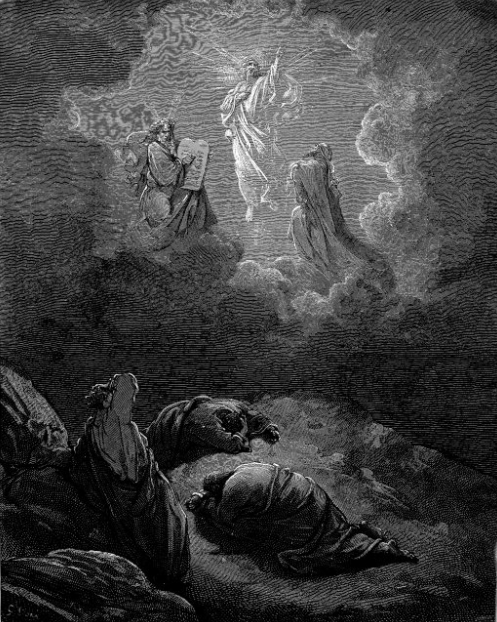
THE ARTWORK
Doré takes the opposite decision from Raphael: he gives almost the whole plate to the three disciples on the rock, thrown flat with their arms over their faces, and puts the light where you cannot look at it directly. The engraving is really a picture of what it is like to be underneath this scene rather than in it, which is where the Gospels put their readers.
Gustave Doré, The Transfiguration (1866). Public domain, via Wikimedia Commons.
Read the Great Books
the works that have carried this teaching: go further than this page
Explanatory Notes upon the New Testament
John Wesley · 1755
Wesley is at his best on the light: a few lines on Matthew 17:2 that do more than most chapters, and the source of the description quoted above.
READ IT FREE AT CCEL →Commentary on the Bible
Adam Clarke · 1832
Clarke carries the manuscript detail and the Greek without losing the reader: his note on Luke's exodos is one of the finest short paragraphs written on this scene.
READ IT FREE AT CCEL →Notes, Explanatory and Practical, on the New Testament
Albert Barnes · 1832-1869
The plainest guide in English to why these two men and no others stood on the mountain, and what their presence was saying about the Law and the Prophets.
READ IT FREE AT CCEL →Commentary Critical and Explanatory on the Whole Bible
Jamieson, Fausset & Brown · 1871
Three scholars working together, and the ones who tie the cloud on this mountain to the cloud over the tabernacle, and then let Peter's own letter finish the sentence.
READ IT FREE AT CCEL →No One There but Jesus
They had come up a mountain with a man they had just called the Christ, six days after He told them He was going to die. They came down having seen what He looks like with the veil off, having watched the Law and the Prophets stand beside Him and then step away, and having heard the Father say the one thing He had never said before. The last image is the sparest in the story and the one that carries it: the cloud lifts, the two great men are gone, and there is no one there but Jesus.
And then they walked down into an argument at the bottom of the hill, which is where Raphael left the whole thing when he died.
Keep studying
On this page
Studies3
Symbols2
Doctrines4
Go further1