
Place
Edom
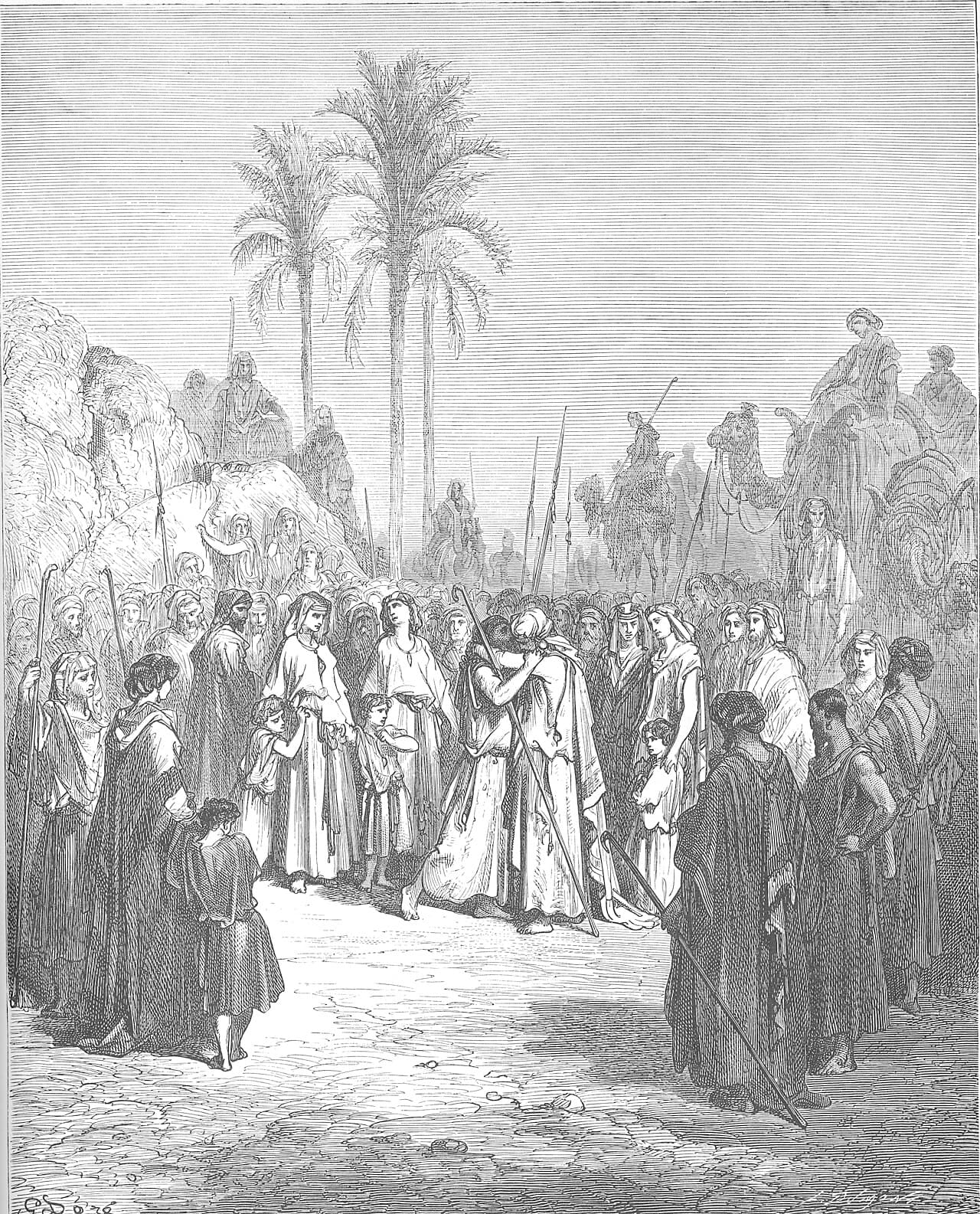
Gustave Doré, La Sainte Bible (Tours: Alfred Mame et fils, 1866). Public domain.
Summary
The highland nation descended from Esau that refused Israel passage on the King's Highway, and whose pride the prophets answered.
- Edom descends from Esau, Jacob's twin brother, and its territory lay south and east of the Dead Sea along the King's Highway.
- When Israel asked only for peaceful passage on that highway, Edom answered with an army and turned them away.
- Deuteronomy still calls the Edomite a brother, even after the refusal, and later kings of Israel and Judah fought Edom repeatedly across the centuries.
- Obadiah, the Bible's shortest book, is addressed to Edom alone, charging it with standing aloof, and worse, on the day Jerusalem fell to Babylon.
- "Jacob I loved, but Esau I hated" is spoken of two nations before either twin was born, and Paul quotes it inside his own argument about God's sovereign election in Romans 9.
On this page
In Scripture
- Verses
- 110
- Books
- 20
Where it is
- Region
- Transjordan
- Kind of place
- Region
Why Edom matters
Edom refuses Israel passage
Numbers 20:14-21, in the order it happens
Read Numbers 20:14-21, in the order it happens
- Moses appeals to Edom as a brother nationNumbers 20:14From Kadesh, Moses sent messengers to tell the king of Edom, “This is what your brother Israel says: You know all the hardship that has befallen us,
- The request: passage on the King's Highway onlyNumbers 20:17Please let us pass through your land. We will not cut through any field or vineyard, or drink water from any well. We will stay on the King’s Highway; we will not turn to the right or to the left until we have passed through your territory.”
- Edom's first refusalNumbers 20:18But Edom answered, “You may not travel through our land, or we will come out and confront you with the sword.”
- Israel offers to pay for anything usedNumbers 20:19“We will stay on the main road,” the Israelites replied, “and if we or our herds drink your water, we will pay for it. There will be no problem; only let us pass through on foot.”
- Edom turns out an armyNumbers 20:20But Edom insisted, “You may not pass through.” And they came out to confront the Israelites with a large army and a strong hand.
- Israel turns awayNumbers 20:21So Edom refused to allow Israel to pass through their territory, and Israel turned away from them.
What happened here, in order
in the order the canon tells it
- Two nations in the womb, before either twin is bornGenesis 25:23and He declared to her: “Two nations are in your womb, and two peoples from within you will be separated; one people will be stronger than the other, and the older will serve the younger.”
- Esau named Edom for the red stewGenesis 25:30He said to Jacob, “Let me eat some of that red stew, for I am famished.” (That is why he was also called Edom.)
- Esau settles Mount Seir as EdomGenesis 36:8So Esau (that is, Edom) settled in the area of Mount Seir.
- Edom's land is Esau's own possessionDeuteronomy 2:5Do not provoke them, for I will not give you any of their land, not even a footprint, because I have given Mount Seir to Esau as his possession.
- "Do not despise an Edomite, for he is your brother"Deuteronomy 23:7Do not despise an Edomite, for he is your brother. Do not despise an Egyptian, because you lived as a foreigner in his land.
- David garrisons Edom2 Samuel 8:14He placed garrisons throughout Edom, and all the Edomites were subject to David. So the LORD made David victorious wherever he went.
- Hadad the Edomite raised up against Solomon1 Kings 11:14Then the LORD raised up against Solomon an adversary, Hadad the Edomite, from the royal line of Edom.
- Edom rebels against Judah2 Kings 8:20In the days of Jehoram, Edom rebelled against the hand of Judah and appointed their own king.
- Edom remembered at Jerusalem's fallPsalms 137:7Remember, O LORD, the sons of Edom on the day Jerusalem fell: “Destroy it,” they said, “tear it down to its foundations!”
- "Because of the violence against your brother Jacob"Obadiah 1:10Because of the violence against your brother Jacob, you will be covered with shame and cut off forever.
- "As you have done, it will be done to you"Obadiah 1:15For the Day of the LORD is near for all the nations. As you have done, it will be done to you; your recompense will return upon your own head.
- "Who is this coming from Edom, from Bozrah"Isaiah 63:1Who is this coming from Edom, from Bozrah with crimson-stained garments? Who is this robed in splendor, marching in the greatness of His strength? “It is I, proclaiming vindication, mighty to save.”
- "Edom will become an object of horror"Jeremiah 49:17“Edom will become an object of horror. All who pass by will be appalled and will scoff at all her wounds.
- "He pursued his brother with the sword"Amos 1:11This is what the LORD says: “For three transgressions of Edom, even four, I will not revoke My judgment, because he pursued his brother with the sword and stifled all compassion; his anger raged continually, and his fury flamed incessantly.
- "Jacob I have loved, but Esau I have hated"Malachi 1:2“I have loved you,” says the LORD. But you ask, “How have You loved us?” “Was not Esau Jacob’s brother?” declares the LORD. “Yet Jacob I have loved,
- Paul quotes the same line in his argument on electionRomans 9:13So it is written: “Jacob I loved, but Esau I hated.”
Edom in Scripture
110 verses name it, in 20 books
Open a book to read its mentions here. Text: Berean Standard Bible.
Old TestamentNew Testamentsegment width = share of mentions
Old Testament20 books · 110 mentions
Genesis11 mentions
- Genesis 25:30He said to Jacob, “Let me eat some of that red stew, for I am famished.” (That is why he was also called Edom.)
- Genesis 32:3Jacob sent messengers ahead of him to his brother Esau in the land of Seir, the country of Edom.
- Genesis 36:1This is the account of Esau (that is, Edom).
- Genesis 36:8So Esau (that is, Edom) settled in the area of Mount Seir.
- Genesis 36:16Korah, Gatam, and Amalek. They are the chiefs of Eliphaz in the land of Edom, and they are the grandsons of Adah.
- Genesis 36:17These are the sons of Esau’s son Reuel: Chiefs Nahath, Zerah, Shammah, and Mizzah. They are the chiefs descended from Reuel in the land of Edom, and they are the grandsons of Esau’s wife Basemath.
- Genesis 36:19All these are the sons of Esau (that is, Edom), and they were their chiefs.
- Genesis 36:21Dishon, Ezer, and Dishan. They are the chiefs of the Horites, the descendants of Seir in the land of Edom.
3 further mentions in Genesis, read them in the book.
Exodus1 mention
Numbers9 mentions
- Numbers 20:14From Kadesh, Moses sent messengers to tell the king of Edom, “This is what your brother Israel says: You know all the hardship that has befallen us,
- Numbers 20:18But Edom answered, “You may not travel through our land, or we will come out and confront you with the sword.”
- Numbers 20:20But Edom insisted, “You may not pass through.” And they came out to confront the Israelites with a large army and a strong hand.
- Numbers 20:21So Edom refused to allow Israel to pass through their territory, and Israel turned away from them.
- Numbers 20:23And at Mount Hor, near the border of the land of Edom, the LORD said to Moses and Aaron,
- Numbers 21:4Then they set out from Mount Hor along the route to the Red Sea, in order to bypass the land of Edom. But the people grew impatient on the journey
- Numbers 24:18Edom will become a possession, as will Seir, his enemy; but Israel will perform with valor.
- Numbers 33:37They set out from Kadesh and camped at Mount Hor, on the outskirts of the land of Edom.
1 further mention in Numbers, read them in the book.
Joshua2 mentions
Judges3 mentions
- Judges 5:4O LORD, when You went out from Seir, when You marched from the land of Edom, the earth trembled, the heavens poured out rain, and the clouds poured down water.
- Judges 11:17Then Israel sent messengers to the king of Edom, saying, ‘Please let us pass through your land,’ but the king of Edom would not listen. They also sent messengers to the king of Moab, but he would not consent. So Israel stayed in Kadesh.
- Judges 11:18Then Israel traveled through the wilderness and bypassed the lands of Edom and Moab. They came to the east side of the land of Moab and camped on the other side of the Arnon. But they did not enter the territory of Moab, since the Arnon was its border.
2 Samuel5 mentions
- 2 Samuel 6:10So he was unwilling to move the ark of the LORD to the City of David; instead, he took it aside to the house of Obed-edom the Gittite.
- 2 Samuel 6:11Thus the ark of the LORD remained in the house of Obed-edom the Gittite for three months, and the LORD blessed him and all his household.
- 2 Samuel 6:12Now it was reported to King David, “The LORD has blessed the house of Obed-edom and all that belongs to him, because of the ark of God.” So David went and had the ark of God brought up from the house of Obed-edom into the City of David with rejoicing.
- 2 Samuel 8:12from Edom and Moab, from the Ammonites and Philistines and Amalekites, and from the spoil of Hadadezer son of Rehob, king of Zobah.
- 2 Samuel 8:14He placed garrisons throughout Edom, and all the Edomites were subject to David. So the LORD made David victorious wherever he went.
1 Kings6 mentions
- 1 Kings 9:26King Solomon also assembled a fleet of ships at Ezion-geber, which is near Eloth in Edom, on the shore of the Red Sea.
- 1 Kings 11:1King Solomon, however, loved many foreign women along with the daughter of Pharaoh—women of Moab, Ammon, Edom, and Sidon, as well as Hittite women.
- 1 Kings 11:14Then the LORD raised up against Solomon an adversary, Hadad the Edomite, from the royal line of Edom.
- 1 Kings 11:15Earlier, when David was in Edom, Joab the commander of the army had gone to bury the dead and had struck down every male in Edom.
- 1 Kings 11:16Joab and all Israel had stayed there six months, until he had killed every male in Edom.
- 1 Kings 22:47And there was no king in Edom; a deputy served as king.
2 Kings8 mentions
- 2 Kings 3:8Then he asked, “Which way shall we go up?” “By way of the Desert of Edom,” replied Joram.
- 2 Kings 3:9So the king of Israel, the king of Judah, and the king of Edom set out, and after they had traveled a roundabout route for seven days, they had no water for their army or for their animals.
- 2 Kings 3:12Jehoshaphat affirmed, “The word of the LORD is with him.” So the king of Israel and Jehoshaphat and the king of Edom went down to him.
- 2 Kings 3:20The next morning, at the time of the morning sacrifice, water suddenly flowed from the direction of Edom and filled the land.
- 2 Kings 3:26When the king of Moab saw that the battle was too fierce for him, he took with him seven hundred swordsmen to break through to the king of Edom, but they could not prevail.
- 2 Kings 8:20In the days of Jehoram, Edom rebelled against the hand of Judah and appointed their own king.
- 2 Kings 8:22So to this day Edom has been in rebellion against the hand of Judah. Likewise, Libnah rebelled at the same time.
- 2 Kings 14:10You have indeed defeated Edom, and your heart has become proud. Glory in that and stay at home. Why should you stir up trouble so that you fall—you and Judah with you?”
1 Chronicles17 mentions
- 1 Chronicles 1:43These are the kings who reigned in the land of Edom before any king reigned over the Israelites: Bela son of Beor. His city was named Dinhabah.
- 1 Chronicles 1:51Then Hadad died. Now the chiefs of Edom were Timna, Alvah, Jetheth,
- 1 Chronicles 1:54Magdiel, and Iram. These were the chiefs of Edom.
- 1 Chronicles 13:13So he did not move the ark with him to the City of David; instead, he took it aside to the house of Obed-edom the Gittite.
- 1 Chronicles 13:14Thus the ark of God remained with the family of Obed-edom in his house for three months, and the LORD blessed his household and everything he owned.
- 1 Chronicles 15:18and with them their brothers next in rank: Zechariah, Jaaziel, Shemiramoth, Jehiel, Unni, Eliab, Benaiah, Maaseiah, Mattithiah, Eliphelehu, Mikneiah, and the gatekeepers Obed-edom and Jeiel.
- 1 Chronicles 15:21And Mattithiah, Eliphelehu, Mikneiah, Obed-edom, Jeiel, and Azaziah were to lead the music with lyres according to Sheminith.
- 1 Chronicles 15:24Shebaniah, Joshaphat, Nethanel, Amasai, Zechariah, Benaiah, and Eliezer—the priests—were to blow the trumpets before the ark of God. Obed-edom and Jehiah were also to be guardians of the ark.
9 further mentions in 1 Chronicles, read them in the book.
2 Chronicles8 mentions
- 2 Chronicles 8:17Then Solomon went to Ezion-geber and to Eloth on the coast of Edom.
- 2 Chronicles 20:2Then some men came and told Jehoshaphat, “A vast army is coming against you from Edom, from beyond the Sea; they are already in Hazazon-tamar” (that is, En-gedi).
- 2 Chronicles 21:8In the days of Jehoram, Edom rebelled against the hand of Judah and appointed their own king.
- 2 Chronicles 21:9So Jehoram crossed into Edom with his officers and all his chariots. When the Edomites surrounded him and his chariot commanders, he rose up and attacked by night.
- 2 Chronicles 21:10So to this day Edom has been in rebellion against the hand of Judah. Likewise, Libnah rebelled against his rule at the same time, because Jehoram had forsaken the LORD, the God of his fathers.
- 2 Chronicles 25:19You have said, ‘Look, I have defeated Edom,’ and your heart has become proud and boastful. Now stay at home. Why should you stir up trouble so that you fall—you and Judah with you?”
- 2 Chronicles 25:20But Amaziah would not listen, for this had come from God in order to deliver them into the hand of Jehoash, because they had sought the gods of Edom.
- 2 Chronicles 25:24He took all the gold and silver and all the articles found in the house of God with Obed-edom and in the treasuries of the royal palace, as well as some hostages. Then he returned to Samaria.
Psalms6 mentions
- Psalms 60:8Moab is My washbasin; upon Edom I toss My sandal; over Philistia I shout in triumph.”
- Psalms 60:9Who will bring me to the fortified city? Who will lead me to Edom?
- Psalms 83:6the tents of Edom and the Ishmaelites, of Moab and the Hagrites,
- Psalms 108:9Moab is My washbasin; upon Edom I toss My sandal; over Philistia I shout in triumph.”
- Psalms 108:10Who will bring me to the fortified city? Who will lead me to Edom?
- Psalms 137:7Remember, O LORD, the sons of Edom on the day Jerusalem fell: “Destroy it,” they said, “tear it down to its foundations!”
Isaiah6 mentions
- Isaiah 11:14They will swoop down on the slopes of the Philistines to the west; together they will plunder the sons of the east. They will lay their hands on Edom and Moab, and the Ammonites will be subject to them.
- Isaiah 34:5When My sword has drunk its fill in the heavens, then it will come down upon Edom, upon the people I have devoted to destruction.
- Isaiah 34:6The sword of the LORD is bathed in blood. It drips with fat—with the blood of lambs and goats, with the fat of the kidneys of rams. For the LORD has a sacrifice in Bozrah, a great slaughter in the land of Edom.
- Isaiah 34:9Edom’s streams will be turned to tar, and her soil to sulfur; her land will become a blazing pitch.
- Isaiah 34:11The desert owl and screech owl will possess it, and the great owl and raven will dwell in it. The LORD will stretch out over Edom a measuring line of chaos and a plumb line of destruction.
- Isaiah 63:1Who is this coming from Edom, from Bozrah with crimson-stained garments? Who is this robed in splendor, marching in the greatness of His strength? “It is I, proclaiming vindication, mighty to save.”
Jeremiah9 mentions
- Jeremiah 9:26Egypt, Judah, Edom, Ammon, Moab, and all the inhabitants of the desert who clip the hair of their temples. For all these nations are uncircumcised, and the whole house of Israel is uncircumcised in heart.”
- Jeremiah 25:21Edom, Moab, and the Ammonites;
- Jeremiah 27:3Send word to the kings of Edom, Moab, Ammon, Tyre, and Sidon through the envoys who have come to Jerusalem to Zedekiah king of Judah.
- Jeremiah 40:11When all the Jews in Moab, Ammon, Edom, and all the other lands heard that the king of Babylon had left a remnant in Judah and had appointed Gedaliah son of Ahikam, the son of Shaphan, over them,
- Jeremiah 49:7Concerning Edom, this is what the LORD of Hosts says: “Is there no longer wisdom in Teman? Has counsel perished from the prudent? Has their wisdom decayed?
- Jeremiah 49:17“Edom will become an object of horror. All who pass by will be appalled and will scoff at all her wounds.
- Jeremiah 49:19Behold, one will come up like a lion from the thickets of the Jordan to the watered pasture. For in an instant I will chase Edom from her land. Who is the chosen one I will appoint for this? For who is like Me, and who can challenge Me? What shepherd can stand against Me?”
- Jeremiah 49:20Therefore hear the plans that the LORD has drawn up against Edom and the strategies He has devised against the people of Teman: Surely the little ones of the flock will be dragged away; certainly their pasture will be made desolate because of them.
1 further mention in Jeremiah, read them in the book.
Lamentations2 mentions
- Lamentations 4:21So rejoice and be glad, O Daughter of Edom, you who dwell in the land of Uz. Yet the cup will pass to you as well; you will get drunk and expose yourself.
- Lamentations 4:22O Daughter of Zion, your punishment is complete; He will not prolong your exile. But He will punish your iniquity, O Daughter of Edom; He will expose your sins.
Ezekiel7 mentions
- Ezekiel 16:57before your wickedness was uncovered? Even so, you are now scorned by the daughters of Edom and all those around her, and by the daughters of the Philistines—all those around you who despise you.
- Ezekiel 25:12This is what the Lord GOD says: ‘Because Edom acted vengefully against the house of Judah, and in so doing incurred grievous guilt,
- Ezekiel 25:13therefore this is what the Lord GOD says: I will stretch out My hand against Edom and cut off from it both man and beast. I will make it a wasteland, and from Teman to Dedan they will fall by the sword.
- Ezekiel 25:14I will take My vengeance on Edom by the hand of My people Israel, and they will deal with Edom according to My anger and wrath. Then they will know My vengeance, declares the Lord GOD.’
- Ezekiel 32:29Edom is there, and all her kings and princes, who despite their might are laid among those slain by the sword. They lie down with the uncircumcised, with those who descend to the Pit.
- Ezekiel 35:15As you rejoiced when the inheritance of the house of Israel became desolate, so will I do to you. You will become a desolation, O Mount Seir, and so will all of Edom. Then they will know that I am the LORD.
- Ezekiel 36:5Therefore this is what the Lord GOD says: Surely in My burning zeal I have spoken against the rest of the nations, and against all Edom, who took My land as their own possession with wholehearted joy and utter contempt, so that its pastureland became plunder.
Daniel1 mention
Joel1 mention
Amos5 mentions
- Amos 1:6This is what the LORD says: “For three transgressions of Gaza, even four, I will not revoke My judgment, because they exiled a whole population, delivering them up to Edom.
- Amos 1:9This is what the LORD says: “For three transgressions of Tyre, even four, I will not revoke My judgment, because they delivered up a whole congregation of exiles to Edom and broke a covenant of brotherhood.
- Amos 1:11This is what the LORD says: “For three transgressions of Edom, even four, I will not revoke My judgment, because he pursued his brother with the sword and stifled all compassion; his anger raged continually, and his fury flamed incessantly.
- Amos 2:1This is what the LORD says: “For three transgressions of Moab, even four, I will not revoke My judgment, because he burned to lime the bones of Edom’s king.
- Amos 9:12that they may possess the remnant of Edom and all the nations that bear My name,” declares the LORD, who will do this.
Obadiah2 mentions
- Obadiah 1:1This is the vision of Obadiah: This is what the Lord GOD says about Edom—We have heard a message from the LORD; an envoy has been sent among the nations to say, “Rise up, and let us go to battle against her!”—
- Obadiah 1:8In that day, declares the LORD, will I not destroy the wise men of Edom and the men of understanding in the mountains of Esau?
Common questions
Who founded Edom, and why is Esau called Edom?
Esau, Isaac and Rebekah's firstborn twin, is named Edom in Genesis for trading his birthright for a bowl of red stew, and Genesis restates the same identification once he settles in Seir. Edom's own name carries the sense of "red," which later tradition also connects to the region's red sandstone country.
Why did Edom refuse Israel passage in Numbers 20?
The text records only the refusal itself. Moses asked for peaceful transit on the King's Highway, offering to pay for anything used, and Edom answered by threatening the sword and turning out an army. Scripture gives no reason on Edom's side beyond what is written.
How does "do not despise an Edomite, for he is your brother" fit with all the judgment oracles against Edom?
Deuteronomy states the family relationship as law, distinguishing Edom from the other nations named in the same passage. The later prophetic oracles against Edom answer specific later conduct, above all Edom's actions at Jerusalem's fall, and are not a blanket hostility toward the people as such.
What is Obadiah about, and why is it addressed only to Edom?
Obadiah is the shortest book in the Old Testament and the only prophetic book addressed to Edom alone. It charges Edom with standing aloof, and worse, on the day Jerusalem fell to Babylon, and answers that conduct with a plain reversal: as you have done, it will be done to you.
What does "Jacob I loved, but Esau I hated" mean?
Readers differ; the positions are named
Its immediate sense in both places it appears is national and covenantal. The oracle to Rebekah is spoken of two nations before either twin is born, and Malachi restates Israel's continuing place in that covenant against Edom's continuing ruin. Paul quotes the same line inside a larger argument about God's sovereign election in Romans 9, a question that page addresses at length rather than this one.
Where were Bozrah, Sela, and Teman, and how do they relate to Edom?
All three are Edomite cities the prophets name directly as centers of Edom's pride and its judgment. Sela, meaning rock, is traditionally identified with the rock-cut region later known as Petra. Modern archaeologists have also proposed es-Sela, a fortified rock about three miles from Bozrah with occupation layers from the Iron Age, as the biblical site; the identification is not settled by full excavation of either location. Each has its own page on this site.
Sources cited
- Berean Standard BibleThe translation used for every verse quoted on this page.
- Gustave Doré, La Sainte Bible (Tours: Alfred Mame et fils, 1866)The engraving on this page, showing Esau, Edom's own father. Public domain.
- Brown-Driver-Briggs Hebrew Lexicon and Strong's Concordance, h123The sense of Edom's name, "red."
- Glenn J. Corbett, "The Edomite Stronghold of Sela," Biblical Archaeology SocietyEs-Sela, three miles from Bozrah, proposed as a candidate for biblical Sela alongside Umm el-Biyara at Petra; neither is confirmed by full excavation.
Keep studying
On this page
Studies21
- 1 Chronicles: the Study Guide
- 2 Samuel: the Study Guide
- Deuteronomy: the Study Guide
- Habakkuk, the Study Guide
- Jeremiah, the Study Guide
- Joel, the Study Guide
Show the next 6 titles
Every page that names it1
Lives that run through it6
Doorway2
Keep this page