
Exodus 1 to 8 · Place · Featured Study
The Nile
The Berean text names the Nile in 33 verses, 15 of them in Exodus, from Pharaoh's dream in Genesis 41 to Zechariah 10.
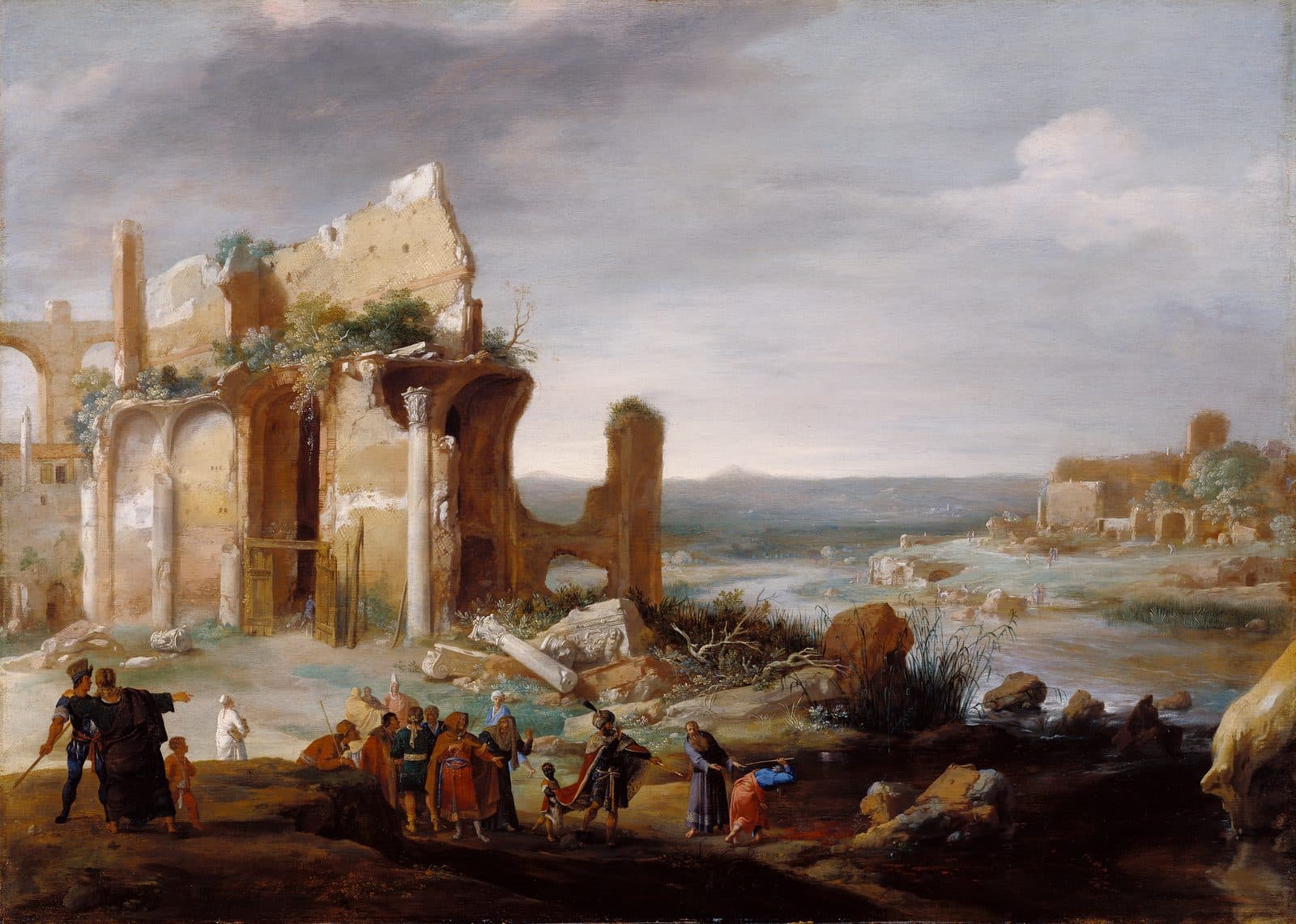
Bartholomeus Breenbergh, Moses and Aaron Changing the Rivers of Egypt to Blood, 1631, J. Paul Getty Museum. Public domain, via Wikimedia Commons.
THE ARTWORKBreenbergh painted the first plague of Exodus 7 as a scene on a broad river, with the staff striking the water at the front of the picture and a court in rich robes looking on.
Pharaoh gave the river the sons of Israel, and the river gave one of them back to Pharaoh's daughter.
Summary
The Nile is the one river of Egypt, and in Exodus it is the water of Pharaoh's decree, the water Moses was drawn out of and the water the first plague struck.
- Moses was drawn out of the Nile in a basket of papyrus, and his name recalls it.
- The first two plagues fell on the river, the first as blood and the second as frogs.
- Egypt lived by the river's yearly flood, and Deuteronomy sets the promised land, watered by rain, against it.
- The prophets judged Egypt through its river, and Ezekiel quotes Pharaoh's boast that the Nile is his own.
The River of the Decree
Exodus 1 and 2 make the Nile the place of Pharaoh's order and of the child it spared.
Then Pharaoh commanded all his people: “Every son born to the Hebrews you must throw into the Nile, but every daughter you may allow to live.”This verse turns the river of Egypt into the means of Pharaoh's plan against Israel's sons.
But when she could no longer hide him, she got him a papyrus basket and coated it with tar and pitch. Then she placed the child in the basket and set it among the reeds along the bank of the Nile. And his sister stood at a distance to see what would happen to him.The child is put into the Nile as Pharaoh ordered, yet inside a basket made to keep the water out.
The lexicon gives yeor, the Hebrew word for the Nile, as the one river of Egypt with its trenches. It gives tevah, the word for the basket, as a box, the word the King James Bible renders ark, and suf, the reeds, as a reed, especially the papyrus.
Soon the daughter of Pharaoh went down to bathe in the Nile, and her attendants were walking along the riverbank. And when she saw the basket among the reeds, she sent her maidservant to retrieve it. When she opened it, she saw the child, and behold, the little boy was crying. So she had compassion on him and said, “This is one of the Hebrew children.”The rescuer is the child of the king whose order put the boy in the river.
When the child had grown older, she brought him to Pharaoh’s daughter, and he became her son. She named him Moses and explained, “I drew him out of the water.”Pharaoh's daughter adopts the child, and the last words of the verse explain his name.
The Nile in Pharaoh's dreamGenesis 41:1 to 4
Before Exodus opens, the Nile stands in Genesis as the place of the dream Joseph interpreted.
After two full years had passed, Pharaoh had a dream: He was standing beside the Nile, when seven cows, sleek and well-fed, came up from the river and began to graze among the reeds. After them, seven other cows, sickly and thin, came up from the Nile and stood beside the well-fed cows on the bank of the river. And the cows that were sickly and thin devoured the seven sleek, well-fed cows. Then Pharaoh woke up,The years of plenty and of famine come up out of the river in the dream, because the harvest of Egypt came from the Nile.
The Nile's Places in Scripture
Scripture sets seven places on and beside the Nile, from Syene in the south to Migdol in the north.
| Place | What the text says of it | Site in the record | Certainty | Verse |
|---|---|---|---|---|
| Syene | Egypt's southern limit when the LORD lays the land waste | Essuan, the last city of Egypt toward Ethiopia, in Adam Clarke's commentary | Known | Ezekiel 29:10 |
| Thebes | A city stationed by the Nile with water around her | No, which the lexicon gives as Thebes, the capital of Upper Egypt | Known | Nahum 3:8 |
| Memphis | Its princes are deceived, in Isaiah's word against Egypt | Not given | Not located here | Isaiah 19:13 |
| On | Joseph married Asenath, daughter of Potiphera, priest of On | Not given | Not located here | Genesis 41:45 |
| Zoan | God worked wonders before Israel's fathers in the region of Zoan | Tanis, in the Targum, the Septuagint and the Vulgate, after John Gill | Probable | Psalm 78:12 |
| Goshen | Pharaoh lets Jacob's family dwell in the land of Goshen | A region, called the best part of the land | Probable, as a region | Genesis 47:6 |
| Migdol | Egypt's northern limit in the same verse, set against Syene | Not given | Not located here | Ezekiel 29:10 |
- Place
- Syene
- What the text says of it
- Egypt's southern limit when the LORD lays the land waste
- Site in the record
- Essuan, the last city of Egypt toward Ethiopia, in Adam Clarke's commentary
- Certainty
- Known
- Verse
- Ezekiel 29:10
- Place
- Thebes
- What the text says of it
- A city stationed by the Nile with water around her
- Site in the record
- No, which the lexicon gives as Thebes, the capital of Upper Egypt
- Certainty
- Known
- Verse
- Nahum 3:8
- Place
- Memphis
- What the text says of it
- Its princes are deceived, in Isaiah's word against Egypt
- Site in the record
- Not given
- Certainty
- Not located here
- Verse
- Isaiah 19:13
- Place
- On
- What the text says of it
- Joseph married Asenath, daughter of Potiphera, priest of On
- Site in the record
- Not given
- Certainty
- Not located here
- Verse
- Genesis 41:45
- Place
- Zoan
- What the text says of it
- God worked wonders before Israel's fathers in the region of Zoan
- Site in the record
- Tanis, in the Targum, the Septuagint and the Vulgate, after John Gill
- Certainty
- Probable
- Verse
- Psalm 78:12
- Place
- Goshen
- What the text says of it
- Pharaoh lets Jacob's family dwell in the land of Goshen
- Site in the record
- A region, called the best part of the land
- Certainty
- Probable, as a region
- Verse
- Genesis 47:6
- Place
- Migdol
- What the text says of it
- Egypt's northern limit in the same verse, set against Syene
- Site in the record
- Not given
- Certainty
- Not located here
- Verse
- Ezekiel 29:10
The River Struck
The sign of Exodus 4 and the first two plagues of Exodus 7 and 8 all fall on the Nile.
When the LORD sent Moses back to Egypt, He gave him a sign drawn from the same river.
But if they do not believe even these two signs or listen to your voice, take some water from the Nile and pour it on the dry ground. Then the water you take from the Nile will become blood on the ground.”The third sign shows in a little water what the first plague will do to the whole Nile.
Moses was sent to wait for Pharaoh on the bank of the Nile in the morning, as Pharaoh walked out to the water.
This is what the LORD says: By this you will know that I am the LORD. Behold, with the staff in my hand I will strike the water of the Nile, and it will turn to blood.The LORD states the purpose of the plague before it falls, so that Pharaoh will know that He is the LORD.
Moses and Aaron did just as the LORD had commanded; in the presence of Pharaoh and his officials, Aaron raised the staff and struck the water of the Nile, and all the water was turned to blood. The fish in the Nile died, and the river smelled so bad that the Egyptians could not drink its water. And there was blood throughout the land of Egypt.The stroke falls in front of Pharaoh and his officials, and each thing verses 17 and 18 foretold comes to pass.
The Egyptians dug around the Nile for water to drink.
The Nile will teem with frogs, and they will come into your palace and up to your bedroom and onto your bed, into the houses of your officials and your people, and into your ovens and kneading bowls.The second plague comes up out of the same river the first plague struck.
Two Things Often Said of the Nile
Each common saying stands beside the verse that answers it.
THE FIRST PLAGUE TURNED ONLY THE RIVER
The LORD told Moses to have Aaron stretch out his hand over the rivers, canals, ponds and reservoirs of Egypt, and there was blood even in the vessels of wood and stone.
MOSES DRIFTED DOWNSTREAM TO THE PALACE
Exodus sets the basket among the reeds along the bank, where the sister watches from a distance and Pharaoh's daughter sees it. The drifting basket is the telling of Josephus, in his Antiquities, book 2.
A Land Watered by the River
Egypt's fields were watered by the river's yearly flood rather than by rain.
Herodotus, in book 2 of his Histories, calls the Egypt the Greeks reach by ship a gift of the river.
The Egyptians told him that the river rose of itself and watered their fields. They also said the Greeks, who lived by rain, would one day starve if the god held the rain back.
For the land that you are entering to possess is not like the land of Egypt, from which you have come, where you sowed your seed and irrigated on foot, like a vegetable garden. But the land that you are crossing the Jordan to possess is a land of mountains and valleys that drinks in the rain from heaven.Moses sets the land of promise against Egypt, whose fields depended on the river and not on the sky.
The flood and the canalsHerodotus, book 2, section 19; Exodus 7:19
Herodotus was told that the river rose from the summer solstice for a hundred days and then fell, and he found no one in Egypt who could tell him why.
Albert Barnes explains the four kinds of water Exodus 7:19 names, from the branches of the river to the great reservoirs.
“The ‘streams’ mean the natural branches of the Nile in Lower Egypt. The word ‘rivers’ should rather be ‘canals’; they were of great extent, running parallel to the Nile, and communicating with it by sluices, which were opened at the rise, and closed at the subsidence of the inundation. The word rendered ‘ponds’ refers either to natural fountains, or more probably to cisterns or tanks found in every town and village. The ‘pools’, literally ‘gathering of waters,’ were the reservoirs, always large and some of enormous extent, containing sufficient water to irrigate the country in the dry season.”
Albert Barnes · Notes, Explanatory and Practical, on the Old and New Testaments (1832-1869) · on Exodus 7:19Evangelical
The Nile in the Record
Josephus, Rashi and Herodotus add to what Exodus tells of the river.
Josephus on the riverAntiquities of the Jews, book 2, chapters 9 and 14
Josephus writes that the Egyptians set the Hebrews to cut channels for the river and to build walls to hold it back.
He derives the name Moses from an Egyptian word for water and a word for those saved out of it.
Of the first plague he writes that the river ran with blood for the Egyptians and stayed sweet for the Hebrews.
Rashi on the first plagueRashi on Exodus 7:17 and 7:19
Rashi, in his commentary on Exodus 7:17, says that God struck the Nile first because rain does not fall in Egypt and the Egyptians worshipped the river that watered their land.
On verse 19 he says that Aaron struck the water because the river had sheltered Moses when he was put into it.
And the LORD said to Moses, “Walk on ahead of the people and take some of the elders of Israel with you. Take along in your hand the staff with which you struck the Nile, and go.Exodus gives the stroke to Moses here and to Aaron in 7:20, and Rashi's reason answers that tension.
Herodotus on SyeneHerodotus, book 2, section 28
Herodotus places Syene beside Elephantine in the district of Thebes, where a scribe told him the sources of the Nile lay between two mountains.
What Exodus Leaves Unsaid
Later readers answer these questions about the river, and Exodus leaves them open.
Whether Egypt worshipped the NileExodus 12:12
Exodus never says that the Egyptians worshipped the river, and the worship of the Nile comes from Rashi and Albert Barnes.
On that night I will pass through the land of Egypt and strike down every firstborn male, both man and beast, and I will execute judgment against all the gods of Egypt. I am the LORD.The nearest words of Exodus are this judgment on all the gods of Egypt, and the verse names none of them.
The name of Pharaoh's daughterExodus 2:5
Exodus does not name the princess who drew Moses out of the water, and Josephus calls her Thermuthis. Albert Barnes weighs such names against what is known of the princesses of Egypt.
“The traditions which give a name to the daughter of Pharaoh are merely conjectural. Egyptian princesses held a very high and almost independent position under the ancient and middle empire, with a separate household and numerous officials. This was especially the case with the daughters of the first sovereigns of the 18th Dynasty.”
Albert Barnes · Notes, Explanatory and Practical, on the Old and New Testaments (1832-1869) · on Exodus 2:5Evangelical
The water of GoshenExodus 7:21 and 8:22
Exodus puts blood throughout the land of Egypt and does not say whether the water of Goshen was spared.
But on that day I will give special treatment to the land of Goshen, where My people live; no swarms of flies will be found there. In this way you will know that I, the LORD, am in the land.Goshen is first set apart from a plague in this verse, at the fourth plague, the swarms of flies.
The LORD of the River
The prophets judged Egypt through the river Egypt trusted.
The first plague told Pharaoh who ruled the water Egypt lived by. Centuries later the LORD answered a Pharaoh through Ezekiel.
Speak to him and tell him that this is what the Lord GOD says: Behold, I am against you, O Pharaoh king of Egypt, O great monster who lies among his rivers, who says, ‘The Nile is mine; I made it myself.’Pharaoh's boast in this verse is the claim the LORD answers through the rest of the chapter.
The land of Egypt will become a desolate wasteland. Then they will know that I am the LORD. Because you said, ‘The Nile is mine; I made it,’ therefore I am against you and against your rivers. I will turn the land of Egypt into a ruin, a desolate wasteland from Migdol to Syene, and as far as the border of Cush.The LORD repeats the boast as the reason for the judgment, and the judgment runs the length of the land.
Zechariah, Isaiah, Amos and the Psalms on the riverZechariah 10:11; Isaiah 19:5 to 8; Amos 9:5; Psalm 78:44
Zechariah 10:11 foretells that all the depths of the Nile will dry up, and Isaiah 19 spells out what that would cost Egypt.
The waters of the Nile will dry up, and the riverbed will be parched and empty. The canals will stink; the streams of Egypt will trickle and dry up; the reeds and rushes will wither. The bulrushes by the Nile, by the mouth of the river, and all the fields sown along the Nile, will wither, blow away, and be no more. Then the fishermen will mourn, all who cast a hook into the Nile will lament, and those who spread nets on the waters will pine away.When the river fails, every trade that lives by it fails with it, from the fields to the fishermen.
Amos, a prophet to the northern kingdom of Israel, drew on the river of Egypt too.
The Lord GOD of Hosts, He who touches the earth and it melts, and all its dwellers mourn—all the land rises like the Nile, then sinks like the river of Egypt—The yearly flood and fall of the Nile become the picture of a whole land heaving under the LORD's hand.
He turned their rivers to blood, and from their streams they could not drink.Israel's song remembers the first plague among the wonders the fathers forgot.
Voices on the Nile
Prudentius wrote of Moses in the river in the fifth century, John Wesley of the river of blood in 1765, and Albert Barnes of the papyrus basket in the nineteenth century.
Prudentius on Exodus 2:3Hymns for Every Day, hymn 12
Prudentius sings of the child saved from Pharaoh's law as a figure of Christ.
“Thus Moses in a former age Escaped proud Pharaoh's foolish law, And as the savior of his race Prefigured Christ who was to come. A cruel edict had been passed Forbidding Hebrew mothers all, When sons were born to them, to rear These virile pledges …”
Prudentius · Hymns for Every Day 12.141-52 · on Exodus 2:3Patristic
John Wesley on Exodus 7:20Explanatory Notes upon the Old Testament (1765)
John Wesley ties the river of blood to the Hebrew sons drowned in it.
“Also they had stained the river with the blood of the Hebrew children, and now God made that river all bloody; thus he gave them blood to drink, for they were worthy, Rev. xvi, 6. Every creature is that to us which he makes it to be, water or blood.”
John Wesley · Explanatory Notes upon the Old Testament · on Exodus 7:20Evangelical
Albert Barnes on Exodus 2:3Notes, Explanatory and Practical (1832 to 1869)
Albert Barnes describes the papyrus of the basket and where it grew.
“The ark was made of the papyrus which was commonly used by the Egyptians for light and swift boats. The species is no longer found in the Nile below Nubia. It is a strong rush, like the bamboo, about the thickness of a finger, three cornered, and attains the height of 10 to 15 feet. It is represented with great accuracy on the most ancient monuments of Egypt.”
Albert Barnes · Notes, Explanatory and Practical, on the Old and New Testaments (1832-1869) · on Exodus 2:3Evangelical
What the First Plague Was
Readers give the first plague two readings, and each reading has its holders.
A natural reddening, sent and timed by GodAlbert Barnes, Notes (1832 to 1869), on Exodus 7:17 and 7:25
Albert Barnes holds that the plague bore a resemblance to the Nile before its rise, when the water turns green and then reddish like ochre. Pharaoh could see it with dismay and still not be convinced.
The objection rests on verse 19, which reaches every store of water in Egypt, and on Barnes himself, who gives the natural discoloration about 20 days.
And seven full days passed after the LORD had struck the Nile.The seven full days of this verse answer Barnes, who gives the river's natural discoloration about twenty days.
Water made blood by a direct act of GodAdam Clarke, Commentary on the Bible, on Exodus 7:20; Josephus, Antiquities 2.14.1
Adam Clarke holds that the waters became real blood, since the fish died and the water could not be drunk. Josephus, in Antiquities 2.14.1, holds the same reading.
The objection is that the word blood can name a colour, and Scripture uses it so elsewhere.
When they got up early in the morning, the sun was shining on the water, and it looked as red as blood to the Moabites across the way.In this verse the word names a colour seen at sunrise, so the word alone does not settle what the Nile became.
Books on the Nile
These works are in the public domain and can be read free.
The Histories, book 2
Herodotus, translated by G. C. Macaulay · 1890
Book 2 records what the Egyptians told Herodotus about the river, its flood and its cities.
Read at Project GutenbergAntiquities of the Jews
Flavius Josephus, translated by William Whiston · 1737
Josephus retells the birth of Moses and the plagues in book 2, chapters 9 to 14, with the Jewish tradition of the first century.
Read at Project GutenbergRashi on Exodus
Rashi, translated by M. Rosenbaum and A. M. Silbermann · 1929 to 1934
Rashi comments on Exodus verse by verse and names the midrash he draws on, as Exodus Rabbah on chapter 7.
Read at SefariaThe Staff and the Rock
The staff that turned the Nile to blood went with Moses into the wilderness.
Behold, I will stand there before you by the rock at Horeb. And when you strike the rock, water will come out of it for the people to drink.” So Moses did this in the sight of the elders of Israel.The staff that left Egypt with no water to drink brings water out of the rock for Israel.
and drank the same spiritual drink; for they drank from the spiritual rock that accompanied them, and that rock was Christ.Paul reads the water from the rock as Christ's own gift to Israel in the wilderness.
Egypt put its trust in the gift of its river. The text asks the reader to know that He is the LORD, and to drink from the rock He gives.
Keep studying
Studies6
Symbols2