
Genesis 4 to 49 · Subject · Featured Study
The Younger Set Before the Elder
Abel and Seth, Isaac, Jacob, Perez, Joseph and Judah, and Ephraim are the younger sons Genesis raises over the firstborn.
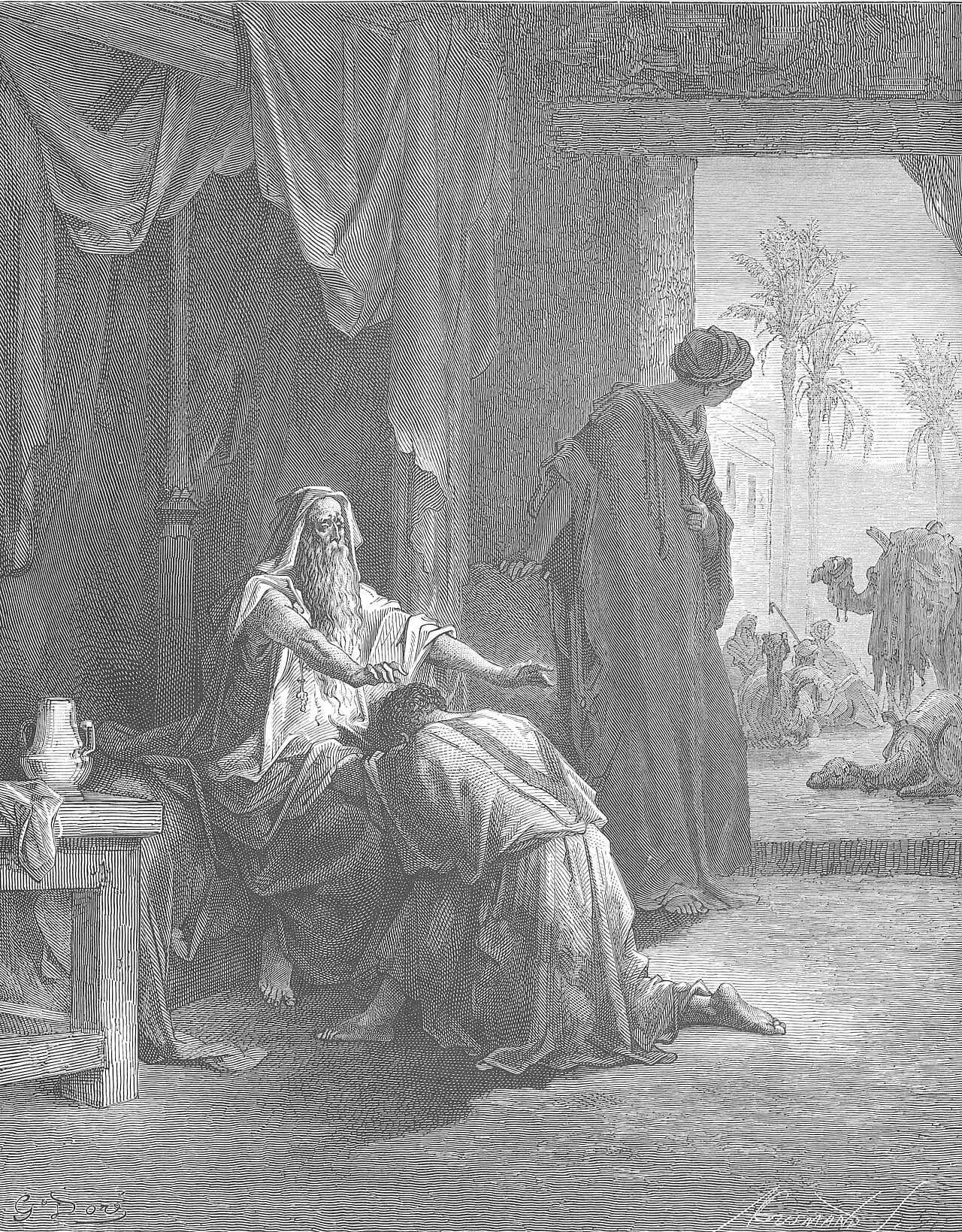
A father who could no longer see blessed the twin he had not called.
Gustave Doré, Isaac Blesses Jacob, 1866. Public domain, via Wikimedia Commons.
THE ARTWORKDoré engraved Genesis 27:27, where Isaac smells the clothing of the son who kneels before him and blesses him.
Summary
In six families of Genesis a younger son receives what custom gave the firstborn: the LORD's favor, the covenant, the blessing, the birthright or the right hand.
- The LORD told Rebekah before her twins were born that the older would serve the younger.
- Reuben lost the birthright for defiling his father's bed, and 1 Chronicles 5 gives it to Joseph's sons and the ruler to Judah.
- Jacob crossed his hands to set Ephraim before Manasseh and refused Joseph's correction.
- Paul cites Genesis 25:23 in Romans 9:12, and readers divide over whether it speaks of two men or of two nations.
- The New Testament calls the Son the firstborn over all creation.
The Oracle and the Crossed Hands
Rebekah's twins in Genesis 25 and Joseph's two sons in Genesis 48
The LORD spoke of the younger son to Rebekah before her twins were born.
But the children inside her struggled with each other, and she said, “Why is this happening to me?” So Rebekah went to inquire of the LORD, and He declared to her: “Two nations are in your womb, and two peoples from within you will be separated; one people will be stronger than the other, and the older will serve the younger.”Joseph's sons were born in Egypt before the years of famine, Manasseh first and Ephraim second.
And Joseph took both of them—with Ephraim in his right hand toward Israel’s left hand, and Manasseh in his left hand toward Israel’s right hand—and brought them close to him. But Israel stretched out his right hand and put it on the head of Ephraim, the younger; and crossing his hands, he put his left on Manasseh’s head, although Manasseh was the firstborn. Then he blessed Joseph and said: “May the God before whom my fathers Abraham and Isaac walked, the God who has been my shepherd all my life to this day, the angel who has redeemed me from all harm—may He bless these boys. And may they be called by my name and the names of my fathers Abraham and Isaac, and may they grow into a multitude upon the earth.” When Joseph saw that his father had placed his right hand on Ephraim’s head, he was displeased and took his father’s hand to move it from Ephraim’s head to Manasseh’s. “Not so, my father!” Joseph said. “This one is the firstborn; put your right hand on his head.” But his father refused. “I know, my son, I know!” he said. “He too shall become a people, and he too shall be great; nevertheless, his younger brother shall be greater than he, and his offspring shall become a multitude of nations.”Hebrews 11:21 says Jacob was dying when he gave this blessing, and he still chose the order of the boys himself.
Six Families of Genesis
The firstborn and the younger son in six families, from Adam's sons to Joseph's
| Family | Firstborn | Younger | Reference | How the younger is raised |
|---|---|---|---|---|
| Adam and Eve | Cain | Abel, then Seth | Genesis 4:4 to 5 and Genesis 4:25 | The LORD regards Abel's offering and not Cain's, and Seth is given in Abel's place. |
| Abraham | Ishmael, son of Hagar | Isaac, son of Sarah | Genesis 17:19 to 21 and Genesis 21:12 | God establishes His covenant with Isaac, and Abraham's offspring is reckoned through him. |
| Isaac and Rebekah | Esau | Jacob | Genesis 25:23 and Genesis 27:29 | The LORD says the older will serve the younger, and Isaac blesses Jacob as master of his brothers. |
| Judah and Tamar | Zerah, whose hand came out first | Perez | Genesis 38:27 to 30 | Perez breaks out ahead of his brother, and Matthew 1:3 carries the line through him. |
| Jacob | Reuben | Joseph and Judah | Genesis 49:3 to 4 and 1 Chronicles 5:1 to 2 | Reuben loses the birthright for his father's bed, Joseph's sons receive it, and the ruler comes from Judah. |
| Joseph | Manasseh | Ephraim | Genesis 48:14 to 20 | Jacob crosses his hands and puts Ephraim before Manasseh. |
- Family
- Adam and Eve
- Firstborn
- Cain
- Younger
- Abel, then Seth
- Reference
- Genesis 4:4 to 5 and Genesis 4:25
- How the younger is raised
- The LORD regards Abel's offering and not Cain's, and Seth is given in Abel's place.
- Family
- Abraham
- Firstborn
- Ishmael, son of Hagar
- Younger
- Isaac, son of Sarah
- Reference
- Genesis 17:19 to 21 and Genesis 21:12
- How the younger is raised
- God establishes His covenant with Isaac, and Abraham's offspring is reckoned through him.
- Family
- Isaac and Rebekah
- Firstborn
- Esau
- Younger
- Jacob
- Reference
- Genesis 25:23 and Genesis 27:29
- How the younger is raised
- The LORD says the older will serve the younger, and Isaac blesses Jacob as master of his brothers.
- Family
- Judah and Tamar
- Firstborn
- Zerah, whose hand came out first
- Younger
- Perez
- Reference
- Genesis 38:27 to 30
- How the younger is raised
- Perez breaks out ahead of his brother, and Matthew 1:3 carries the line through him.
- Family
- Jacob
- Firstborn
- Reuben
- Younger
- Joseph and Judah
- Reference
- Genesis 49:3 to 4 and 1 Chronicles 5:1 to 2
- How the younger is raised
- Reuben loses the birthright for his father's bed, Joseph's sons receive it, and the ruler comes from Judah.
- Family
- Joseph
- Firstborn
- Manasseh
- Younger
- Ephraim
- Reference
- Genesis 48:14 to 20
- How the younger is raised
- Jacob crosses his hands and puts Ephraim before Manasseh.
The Right of the Firstborn
The birthright in the households of Genesis and in the law of Deuteronomy 21
Adam Clarke, in his Commentary on the Bible, lists four rights commonly held to belong to the firstborn. They are authority over the family, a double portion of the inheritance, the father's particular blessing, and the priesthood before Aaron.
So Esau declared, “Is he not rightly named Jacob? For he has cheated me twice. He took my birthright, and now he has taken my blessing.” Then he asked, “Haven’t you saved a blessing for me?”Genesis keeps the birthright and the blessing apart: Esau sold the first in Genesis 25:33 and lost the second by deceit.
The law of Moses later forbade a father to pass over the firstborn son of a wife he did not love.
If a man has two wives, one beloved and the other unloved, and both bear him sons, but the unloved wife has the firstborn son, when that man assigns his inheritance to his sons he must not appoint the son of the beloved wife as the firstborn over the son of the unloved wife. Instead, he must acknowledge the firstborn, the son of his unloved wife, by giving him a double portion of all that he has. For that son is the firstfruits of his father’s strength; the right of the firstborn belongs to him.Albert Barnes takes the double portion named here as the share that passed from Reuben to Joseph.
Chronicles gives the reason Reuben lost the birthright and divides the firstborn's rights between two of his brothers.
These were the sons of Reuben the firstborn of Israel. Though he was the firstborn, his birthright was given to the sons of Joseph son of Israel, because Reuben defiled his father’s bed. So he is not reckoned according to birthright. And though Judah prevailed over his brothers and a ruler came from him, the birthright belonged to Joseph.John Wesley reads these verses as the reason Chronicles ranks Judah's line before Reuben's.
The Hebrew for Elder and Younger
Six words of Genesis 25, 43, 48 and 49: bekhor, bekhorah, rav, tsa'ir, qatan and yamin
| Word | Meaning | Where it stands |
|---|---|---|
| Bekhor | The firstborn son, said of Reuben and of Manasseh | Genesis 49:3 and Genesis 48:18 |
| Bekhorah | The birthright | Genesis 25:31 |
| Rav | The great one, said of Esau | Genesis 25:23 |
| Tsa'ir | The young one, said of Jacob and of Ephraim | Genesis 25:23 and Genesis 48:14 |
| Qatan | The younger, said of Ephraim | Genesis 48:19 |
| Yamin | The right hand | Genesis 48:14 and Genesis 48:18 |
- Word
- Bekhor
- Meaning
- The firstborn son, said of Reuben and of Manasseh
- Where it stands
- Genesis 49:3 and Genesis 48:18
- Word
- Bekhorah
- Meaning
- The birthright
- Where it stands
- Genesis 25:31
- Word
- Rav
- Meaning
- The great one, said of Esau
- Where it stands
- Genesis 25:23
- Word
- Tsa'ir
- Meaning
- The young one, said of Jacob and of Ephraim
- Where it stands
- Genesis 25:23 and Genesis 48:14
- Word
- Qatan
- Meaning
- The younger, said of Ephraim
- Where it stands
- Genesis 48:19
- Word
- Yamin
- Meaning
- The right hand
- Where it stands
- Genesis 48:14 and Genesis 48:18
Genesis 43:33 holds bekhor, bekhorah and tsa'ir together, where the brothers are seated before Joseph in order by age.
Sforno, in his commentary on Genesis, explains Joseph's protest at the crossed hands: the right hand was held the stronger and gave the fuller blessing.
What Genesis Leaves Unsaid
Isaac's knowledge of the oracle, a verdict on Jacob's deceit, and which of Tamar's twins was first
Genesis never says whether Rebekah told Isaac the word she received, and in Genesis 27:1 to 4 Isaac sends for Esau, his older son, to bless him.
Genesis tells how Jacob deceived his blind father and gives no verdict on the deceit.
Clarke calls Jacob's words in Genesis 27:19 palpable falsehoods. Matthew Henry holds that the fraud was meant to keep the oracle of God from being thwarted.
Genesis does not say which of Tamar's twins counted as the firstborn.
And as she was giving birth, one of them put out his hand; so the midwife took a scarlet thread and tied it around his wrist. “This one came out first,” she announced. But when he pulled his hand back and his brother came out, she said, “You have broken out first!” So he was named Perez. Then his brother came out with the scarlet thread around his wrist, and he was named Zerah.Clarke holds that the scarlet thread kept the right of the firstborn for Zerah. John Wesley holds that Perez gained it.
The Older Will Serve the Younger
Genesis 25:23 in Malachi 1, Romans 9 and Hebrews 11
Malachi speaks of the two brothers as the peoples descended from them.
“I have loved you,” says the LORD. But you ask, “How have You loved us?” “Was not Esau Jacob’s brother?” declares the LORD. “Yet Jacob I have loved, but Esau I have hated, and I have made his mountains a wasteland and left his inheritance to the desert jackals.”Paul turns to Rebekah's twins in Romans 9.
Not only that, but Rebecca’s children were conceived by one man, our father Isaac. Yet before the twins were born or had done anything good or bad, in order that God’s plan of election might stand, not by works but by Him who calls, she was told, “The older will serve the younger.” So it is written: “Jacob I loved, but Esau I hated.”Paul quotes the oracle and Malachi 1:2 together, so the word given to one mother and the word about two peoples stand in one argument.
By faith Isaac blessed Jacob and Esau concerning the future. By faith Jacob, when he was dying, blessed each of Joseph’s sons and worshiped as he leaned on the top of his staff.“‘By faith Isaac invoked future blessings on Jacob and Esau.’ First he gave it to Jacob, then to Esau, not according to the sequence of their birth but according to the order of spiritual blessing.”
Severian of Gabala · Fragments on the Epistle to the Hebrews 11.2 · on Hebrews 11:20Patristic
Three Voices on the Younger Son
Three readers from the fourth and the eighteenth centuries, earliest first
Ephrem the Syrian on the sale of the birthrightThe Syriac church, fourth century
Ephrem reads Jacob's purchase of the birthright as trust in the oracle.
“Jacob saw that the right of the firstborn was despised by Esau, and he contrived to take it from him, trusting in God who had said, ‘The elder shall serve the younger.’”
Ephrem the Syrian · Commentary on Genesis 23:2 · on Genesis 25:34Patristic
Ambrose of Milan on a father's and a mother's favoriteThe Latin church, fourth century
“However, even parents should not be excused for abandoning us, because they have preferred a younger son to an older one. At the same time, care must be taken that no one, while following their example, has an unfair judgment between their children; so that they think one should be loved, the other should be disregarded. For from this fraternal hatred is aroused, and a crime of parricide is made from the despicable gain of money. The same measure of piety should nourish offspring.”
Ambrose of Milan · On Jacob and the Blessed Life, Book 2, Chapter II, Section 5 · on Genesis 25:28Patristic
John Wesley on the tribe of EphraimMethodism, eighteenth century
Wesley explains why Ephraim's tribe grew greater than Manasseh's.
“Joshua was of that tribe. The tribe of Manasseh was divided, one half on one side Jordan, the other half on the other side, which made it the less powerful and considerable. God, in bestowing his blessings upon his people, gives more to some than to others, more gifts, graces and comforts, and more of the good things of this life.”
John Wesley · Explanatory Notes upon the Old Testament · on Genesis 48:19Evangelical
Whom the Oracle Concerns
Two readings of Genesis 25:23 and Romans 9:12
Readers divide over whether the oracle speaks of God's choice of one man over another or of the history of two peoples.
God's free choice of the younger sonMatthew Henry; Theophylact of Ohrid
Matthew Henry answers Joseph's protest with God's freedom to choose.
“Grace observes not the order of nature, nor does God prefer those whom we think fittest to be preferred, but as it pleases him.”
Matthew Henry · Commentary on the Whole Bible · on Genesis 48:17 to 18Puritan
Theophylact of Ohrid carries the same reading into Paul's verse.
“One was chosen and loved, and the other hated, so that everything might be the work of God and of His election and foreknowledge, and not from works, but from Him who calls.”
Theophylact of Ohrid · Commentary on Romans · on Romans 9:12Patristic
The objection: the oracle itself speaks of two nations and two peoples, and Malachi 1:3 speaks of Edom's land laid waste.
A word about two nationsJohn Wesley; Adam Clarke after Bishop Newton
John Wesley, in his Explanatory Notes upon the Old Testament, reads the oracle as a word about two nations that would differ and contend. Adam Clarke, on the same verse, quotes Bishop Newton: what was foretold of Esau and Jacob was fulfilled in their descendants.
“Nor does it relate to the eternal state either of them or their posterity. Thus far the apostle has been proving his proposition, namely, that the exclusion of a great part of the seed of Abraham, yea, and of Isaac, from the special promises of God, was so far from being impossible, that, according to the scriptures themselves, it had actually happened.”
John Wesley · Explanatory Notes upon the New Testament · on Romans 9:13Evangelical
The objection: Paul cites the oracle for the time before the twins were born or had done anything good or bad, and that time belongs to the two men.
Books on the Younger Son
Three commentaries that read Genesis 25 to 27 and Romans 9 at length
Commentary on the Whole Bible, on Genesis 25 and Romans 9
Matthew Henry · 1710
Henry reads the oracle as God's free grace and draws from it the struggle of grace within the soul.
Explanatory Notes upon the New Testament, on Romans 9
John Wesley · 1755
Wesley reads Romans 9 as a word about the promised seed and the exclusion of part of Abraham's descendants from the special promises.
Commentary on the Bible, on Genesis 25 to 27
Adam Clarke · 1832
Clarke weighs the rights of the birthright and the deceit of Genesis 27 verse by verse.
The Firstborn over All Creation
The genealogy of Jesus in Matthew 1 passes through the sons Genesis set over their brothers.
Abraham was the father of Isaac, Isaac the father of Jacob, and Jacob the father of Judah and his brothers. Judah was the father of Perez and Zerah by Tamar, Perez the father of Hezron, and Hezron the father of Ram.Isaac, Jacob and Judah each had an elder brother, and Perez had a twin whose hand came out first.
Paul gives the title of the firstborn to Christ, the Son.
The Son is the image of the invisible God, the firstborn over all creation.Colossians 1:18 calls Him the firstborn from among the dead as well.
Cyril of Alexandria reads Isaac's blessing of Jacob as a word about Christ.
“Afterward the power of blessing is transferred again to the Immanuel himself. ‘And let nations serve you, and princes bow down to you, and be lord of your brother.’ The Immanuel was called ‘the firstborn’ when he became so with reference to us, ‘among many brothers.’ But for this reason we must not forget that he is God and the Lord of the universe. We worship him as God, and he has reigned as God over those who are called from the brothers through grace.”
Cyril of Alexandria · Glaphyra on Genesis, 3.173B-C · on Genesis 27:29Patristic
Hebrews ends the story of the birthright with a warning drawn from Esau.
See to it that no one is sexually immoral, or is godless like Esau, who for a single meal sold his birthright. For you know that afterward, when he wanted to inherit the blessing, he was rejected. He could find no ground for repentance, though he sought the blessing with tears.Hebrews 12:23 calls the church the congregation of the firstborn, enrolled in heaven, and the warning is addressed to that congregation.
Keep studying
Read it1
Places2
Symbols5