
Genesis 38:8 · Subject · Featured Study
Levirate Marriage
A custom of family and inheritance told in Genesis 38, written into the law at Deuteronomy 25 and carried out in the book of Ruth.
Tamar outlived two husbands, both sons of Judah, and waited for a third who never came.
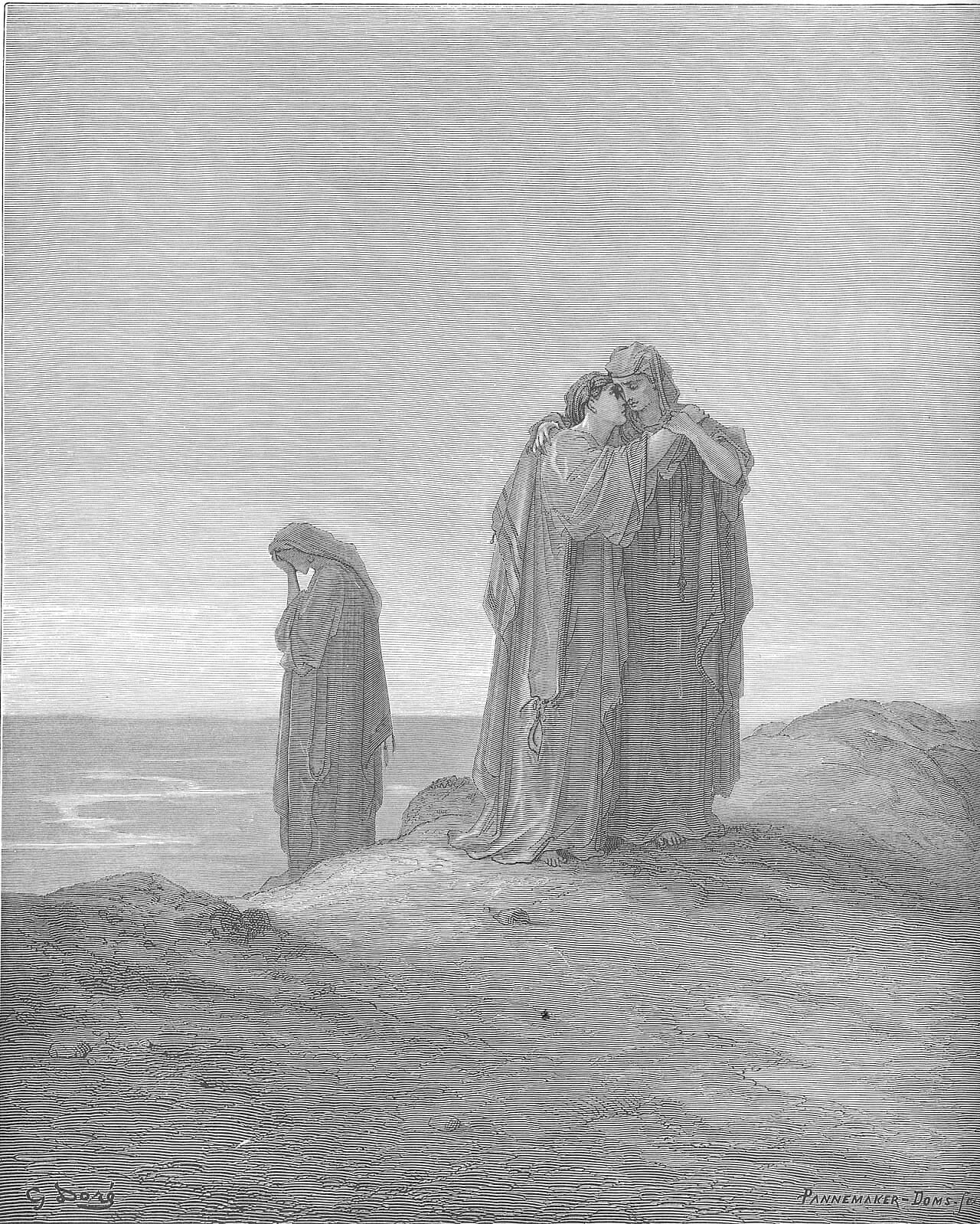
Gustave Doré, Naomi and Her Daughters-in-Law, The Holy Bible, Tours, 1866. Public domain.
THE ARTWORKDoré drew Ruth 1:14, where Ruth clings to Naomi and Orpah turns back to Moab. Ruth and Orpah had married Mahlon and Chilion, and both men died in Moab.
Summary
When a married man died with no son, his brother took the widow as his wife, and the first son she bore carried on the dead man's name.
- Judah lays the duty on Onan in Genesis 38, before any law of Moses states it.
- Deuteronomy 25 lets a brother refuse, and the widow then shames him before the elders at the city gate.
- In Ruth a nearer kinsman declines, and Boaz takes up both the field and the widow.
- The Sadducees built a question about the resurrection on this law, and Jesus answered them from the book of Exodus.
The Duty in Judah's House
Genesis 38:6 to 30, from Er's death to the birth of Perez and Zerah
Judah chose Tamar as the wife of Er, his firstborn, and the LORD put Er to death.
Then Judah said to Onan, “Sleep with your brother’s wife. Perform your duty as her brother-in-law and raise up offspring for your brother.” But Onan knew that the offspring would not belong to him; so whenever he would sleep with his brother’s wife, he would spill his seed on the ground so that he would not produce offspring for his brother. What he did was wicked in the sight of the LORD, so He put Onan to death as well.This is the first refusal of the duty in Scripture, and the LORD judges it.
Judah then sent Tamar to live as a widow in her father's house until Shelah, his third son, grew up, because he feared Shelah would die like his brothers.
When Shelah had grown and was still not given to her, Tamar veiled herself on the road to Timnah. Judah took her for a prostitute and left his seal, his cord and his staff with her as a pledge.
Judah recognized the items and said, “She is more righteous than I, since I did not give her to my son Shelah.” And he did not have relations with her again.Judah judges himself by the son he withheld, and Tamar is called the more righteous.
Tamar bore twins. Perez broke out first, and Zerah, with the scarlet thread on his wrist, came after him.
Four Texts of the Duty
The account, the law, the worked case and the question, in the order of the canon
| Text | Who owed the duty | Who refused | How it ends |
|---|---|---|---|
| Genesis 38 | Onan, and after him Shelah | Onan, and then Judah, who held Shelah back | Judah fathers Perez and Zerah by Tamar |
| Deuteronomy 25 | The brother who lived with the dead man | A brother who will not marry the widow | The widow removes his sandal before the elders, and his house is named for it |
| Ruth 4 | The nearer kinsman, and after him Boaz | The nearer kinsman | Boaz acquires Elimelech's land and Ruth, and Obed is born |
| Matthew 22 | Seven brothers in the Sadducees' case | No one in the case | The woman dies, and the Sadducees ask whose wife she will be in the resurrection |
- Text
- Genesis 38
- Who owed the duty
- Onan, and after him Shelah
- Who refused
- Onan, and then Judah, who held Shelah back
- How it ends
- Judah fathers Perez and Zerah by Tamar
- Text
- Deuteronomy 25
- Who owed the duty
- The brother who lived with the dead man
- Who refused
- A brother who will not marry the widow
- How it ends
- The widow removes his sandal before the elders, and his house is named for it
- Text
- Ruth 4
- Who owed the duty
- The nearer kinsman, and after him Boaz
- Who refused
- The nearer kinsman
- How it ends
- Boaz acquires Elimelech's land and Ruth, and Obed is born
- Text
- Matthew 22
- Who owed the duty
- Seven brothers in the Sadducees' case
- Who refused
- No one in the case
- How it ends
- The woman dies, and the Sadducees ask whose wife she will be in the resurrection
The Law in Deuteronomy 25
Deuteronomy 25:5 to 10, the duty, the refusal and the sandal
When brothers dwell together and one of them dies without a son, the widow must not marry outside the family. Her husband’s brother is to take her as his wife and fulfill the duty of a brother-in-law for her. The first son she bears will carry on the name of the dead brother, so that his name will not be blotted out from Israel.The law gives the reason for the duty, a dead man's name kept in Israel.
The second half of the law turns to the man who will not do it.
But if the man does not want to marry his brother’s widow, she is to go to the elders at the city gate and say, “My husband’s brother refuses to preserve his brother’s name in Israel. He is not willing to perform the duty of a brother-in-law for me.” Then the elders of his city shall summon him and speak with him. If he persists and says, “I do not want to marry her,” his brother’s widow shall go up to him in the presence of the elders, remove his sandal, spit in his face, and declare, “This is what is done to the man who will not maintain his brother’s line.” And his family name in Israel will be called “The House of the Unsandaled.”A refusal is answered in public, and the shame stays on the brother's house.
John Gill, on Deuteronomy 25:7, held that no such release stood before the law was given, or Onan would have used it and refused the marriage openly.
How Rashi reads the ceremonyRashi on Deuteronomy 25:5 to 10 · Jewish commentary, eleventh century
Rashi gives the duty to the eldest brother, citing the Sifrei and the Talmud tractate Yevamot.
On verse 7 he reads the gate as the gate of the court, and on verse 8 he says the brother must make his refusal standing.
On verse 9 he reads the widow's spitting as before his face, on the ground, after Yevamot 106b. The Hebrew reads be-fanav, in his face, and the Berean text renders it so.
On verse 10 he says it is the duty of all who stand there to call out the name the verse gives the man.
The Custom Beyond Israel
What the law took up, and the widows of Moab
Albert Barnes, on Deuteronomy 25:5, holds that the law took up a custom older than itself and set limits on it.
“The law of levirate marriage. The law on this subject is not unique to the Jews, but is found (see Gen 38:8) in all essential respects the same among various Oriental nations, ancient and modern. The rules in these verses, like those upon divorce, do but incorporate existing immemorial usages, and introduce various wise and politic limitations and mitigations of them.”
Albert Barnes · Notes, Explanatory and Practical, on the Old and New Testaments (1832-1869) · on Deuteronomy 25:5Evangelical
But Naomi replied, “Return home, my daughters. Why would you go with me? Are there still sons in my womb to become your husbands? Return home, my daughters. Go on, for I am too old to have another husband. Even if I thought there was hope for me to have a husband tonight and to bear sons, would you wait for them to grow up? Would you refrain from having husbands? No, my daughters, it grieves me very much for your sakes that the hand of the LORD has gone out against me.”Barnes, on Ruth 1:11, takes Naomi's question to her Moabite daughters-in-law as a sign that the custom probably stood among the Moabites as well.
The Words of the Duty
The Hebrew and Greek words behind the English of these verses
YIBBEM (HEBREW, H2992)
A verb meaning to act as a husband's brother for a widow, the word of Judah's command to Onan.
YABAM AND YEBIMAH (HEBREW, H2993 AND H2994)
The husband's brother and the brother's widow, the two parties the law names.
CHALATS NAAL (HEBREW, H2502 AND H5275)
To draw off the sandal, the act that later Jewish law calls halitzah, the release from the duty.
GOEL (HEBREW, H1350)
The kinsman-redeemer, the near relative who buys back a family's land and, in Ruth, its widow.
EPIGAMBREUO (GREEK, G1918)
A verb meaning to marry as next of kin, the Sadducees' word for the duty.
What the Texts Leave Unsaid
Where Judah learned the duty, Tamar's family, Er's sin, the nearer kinsman's name and the seven brothers
Genesis does not say where Judah learned the duty he laid on Onan.
Genesis names no father and no home for Tamar.
Genesis 38:7 calls Er wicked in the sight of the LORD, and Adam Clarke, on that verse, notes that the text does not say what his wickedness was.
Ruth does not give the nearer kinsman's name. Rashi, on Ruth 4:1, says his name was left out because he would not redeem.
Matthew does not say whether such a family ever lived. Clarke judged that the questioners had likely raised the number to make the question harder.
A Name Kept in Israel
The line from Perez to David, and Matthew's line to Christ
“We are witnesses,” said the elders and all the people at the gate. “May the LORD make the woman entering your home like Rachel and Leah, who together built up the house of Israel. May you be prosperous in Ephrathah and famous in Bethlehem. And may your house become like the house of Perez, whom Tamar bore to Judah, because of the offspring the LORD will give you by this young woman.”The elders bless Boaz's marriage by the house of Perez, the son of the first levirate story.
John Wesley, on Deuteronomy 25:5, gives the law a reason beyond one family. In his reading it kept the tribes and families distinct, so that the Messiah might be known by the family from which he was to come.
- PerezHis father is Judah and his mother is Tamar, Matthew 1:3
- HezronThe generations of Perez begin with his son, Ruth 4:18
- Ram, Amminadab and NahshonThree generations stand between Hezron and Salmon, Ruth 4:19 to 20
- SalmonHe is the father of Boaz, Ruth 4:21
- BoazHis mother is Rahab, and Ruth is the mother of his son Obed, Matthew 1:5
- Obed and JesseThe neighbor women named Obed, who became the father of Jesse, Ruth 4:17
- DavidThe generations of Perez end with David, the tenth name, Ruth 4:22
- Jesus, who is called ChristTwenty-eight generations run from David to the Christ, Matthew 1:17
The ten names of Ruth 4:18 to 22 from Perez to David, with the three mothers Matthew 1 adds and the end of the line in Christ.
Voices on the Duty
Ambrose and Matthew Henry on the marriage of Ruth
Ambrose of Milan, in his Exposition of the Christian Faith, explains why a Moabite widow could claim a kinsman in Bethlehem.
“For, by the law, when a man died, the marriage bond with his wife was passed on to his brother or other male next of kin, in order that the seed of the brother or next of kin might renew the life of the house. And so it was that Ruth, though she was foreign-born, had possessed a husband of the Jewish people who had left a kinsman of near relation.”
Ambrose of Milan · Exposition of the Christian Faith 3.69-70 · on Ruth 4:5Patristic
Matthew Henry, on Deuteronomy 25:8 to 10, notes the one change Ruth makes to the ceremony of the law.
“In the case of Ruth we find this law executed ( Ruth iv. 7 ), but because, upon the refusal of the next kinsman, there was another ready to perform the duty of a husband's brother, it was that other that plucked off the shoe, and not the widow--Boaz, and not Ruth.”
Matthew Henry · Commentary on the Whole Bible · on Deuteronomy 25:8 to 10Puritan
Two Questions the Commentators Divide On
What Onan's sin was, and how far the duty reached beyond a brother
Onan's sin was his refusal of the dutyAdam Clarke · Methodist commentary, 1832
Adam Clarke, on Genesis 38:9 to 10, says Onan knew the child would be counted as his dead brother's and would not stand in the genealogies under his own name. In Clarke's reading the crime was the refusal to raise up seed to his brother, and the act of verse 9 was how he carried out the refusal.
John Wesley, in his Explanatory Notes on Genesis 38:10, sets the weight on the act itself. He counts it among the sins that dishonour the body and fears that thousands in his own day, especially single persons, displeased the Lord by the same thing.
The duty reached the nearest kinsmanAlbert Barnes; Jamieson, Fausset and Brown · Protestant commentary
Barnes, on Ruth 1:11, holds that in Israel the law reached past the brother to the nearest relations, since Boaz was only a kinsman of Elimelech. Jamieson, Fausset and Brown, on Deuteronomy 25, read it the same way and cite Ruth 4:4.
Rashi, on Deuteronomy 25:5, leaves a half-brother on the mother's side outside the duty. Ibn Ezra, on Ruth 1:11, says the ancestors handed down that the duty falls on brothers by the father. Keil and Delitzsch read Ruth 3 and 4 as two laws joined, the redemption of land in Leviticus 25:25 and the duty of Deuteronomy 25:5, which no statute lays on one man together.
The Sadducees' Question and the Brothers of Christ
Jesus answered the Sadducees from the books of Moses, the only part of Scripture they received, as Clarke notes on Matthew 22:31.
But concerning the resurrection of the dead, have you not read what God said to you: ‘I am the God of Abraham, the God of Isaac, and the God of Jacob’? He is not the God of the dead, but of the living.”The God who named Himself to Moses at the bush is the God of the living.
Onan and the nearer kinsman each guarded his own inheritance, and the duty asked each to spend it on a brother's name.
For both the One who sanctifies and those who are sanctified are of the same family. So Jesus is not ashamed to call them brothers.Christ owns as brothers the family He sanctifies, the tie Onan would not keep.
Keep studying
Peoples and groups3