
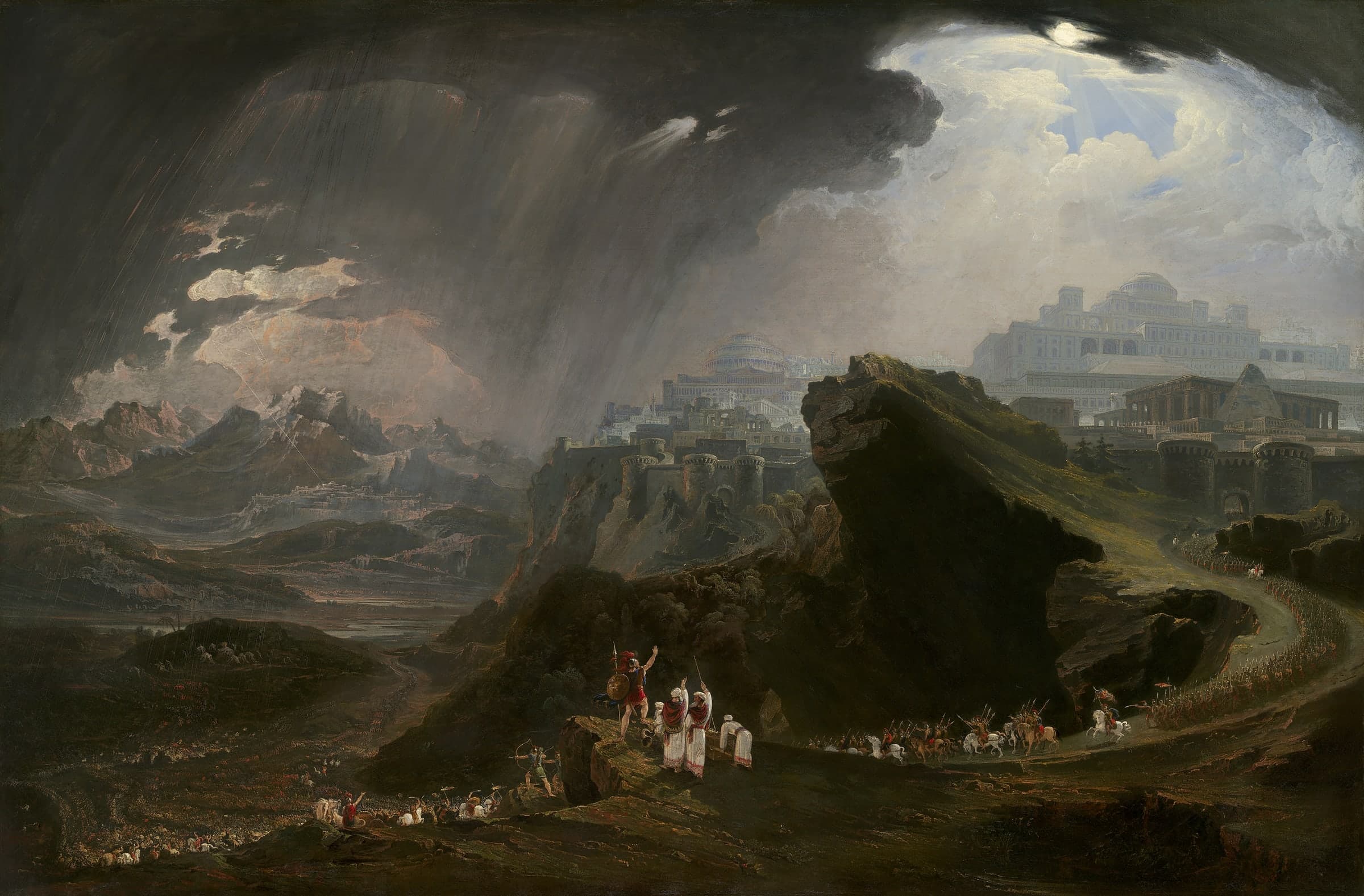
John Martin, Joshua Commanding the Sun to Stand Still upon Gibeon, 1816. CC0.
Genesis 15 to Joshua 11 · Story · Featured Study
The Canaanite Conquest
Joshua 6 to 11 tells how Israel took Canaan, from the fall of Jericho to the burning of Hazor, and why the text says the land changed hands.
Jericho fell under the ban, a command to destroy the city, yet one woman's household came through the ban alive.
So Joshua took the entire land, in keeping with all that the LORD had spoken to Moses. And Joshua gave it as an inheritance to Israel according to the allotments to their tribes. Then the land had rest from war.
- Where
- Jericho, Gilgal, Hazor
- Who
- Joshua, Rahab, Caleb
- When
- the wars of Joshua 6 to 11, which Caleb's ages in Joshua 14:7 to 10 put at about seven years; the century is disputed (proposed)
Jericho fell under the ban, a command to destroy the city, yet one woman's household came through the ban alive.
Summary
The Canaanite conquest is Israel's taking of Canaan under Joshua, and Scripture names its cause four hundred years ahead: the iniquity of the Amorites, which was not yet complete. The text denies Israel any credit, spares Rahab and the Gibeonites, and leaves Anakim in Gath, the town Goliath would come from.
- Deuteronomy 9:4 to 5 forbids Israel twice to read the victory as a reward for its righteousness.
- Leviticus 18 and Deuteronomy 12 and 18 name the practices: children sacrificed to Molech, divination, the consulting of the dead and a list of sexual offences.
- Rahab by her confession and the Gibeonites by a covenant both outlive the ban.
- Joshua 11:22 leaves Anakim in Gath, and generations later the champion who defies Israel comes out of Gath (1 Samuel 17:4).
From Jericho to Hazor
Joshua 6 to 11 told plainly, each campaign with its verse
Israel crossed the Jordan and camped at Gilgal. Jericho fell first. Ai fell on the second attempt, once Achan's theft from the devoted things was judged.
Gibeon won a treaty by a trick, and when five kings marched on it, Joshua came up overnight to defend it. The southern towns fell after that battle. In the north, Jabin of Hazor gathered the kings at the waters of Merom, and Joshua routed them and took his city.
So Joshua took the entire land, in keeping with all that the LORD had spoken to Moses. And Joshua gave it as an inheritance to Israel according to the allotments to their tribes. Then the land had rest from war.The narrator ends the war chapters on a note of peace.
Israel crossed the Jordan and camped at Gilgal. Jericho fell first. Ai fell on the second attempt, once Achan's theft from the devoted things was judged.
Gibeon won a treaty by a trick, and when five kings marched on it, Joshua came up overnight to defend it. The southern towns fell after that battle. In the north, Jabin of Hazor gathered the kings at the waters of Merom, and Joshua routed them and took his city.
Where the Conquest Ran
The campaigns in order, and the cities on a 1915 atlas plate
The text counts days at Jericho and Gibeon and leaves the length of the whole war unstated.
- The crossingThe tenth day of the first monththe people go up from the riverJoshua 4:19
- JerichoThe seventh day of the marchthe walls fall and the city burnsJoshua 6:15 to 24
- AiNot givena heap of ruinsJoshua 8:28
- The Gibeonite treatyThree days later the trick comes outthe oath holdsJoshua 9:16
- The battle at GibeonOne day lengthenedthe five kings fleeJoshua 10:13 to 14
- The southern townsNot givenMakkedah to Debir in turnJoshua 10:28 to 39
- MeromA long time of warthe northern kings struck downJoshua 11:7 to 8
- What remainedIn Joshua's old agemuch land still to possessJoshua 13:1
A timeline of eight events from Joshua 4:19 to 13:1; where the text gives no time, the cell says so.
Merom, What remained
Joshua's towns stand in the hills, and the three towns where the Anakim lived on stand on the coast.
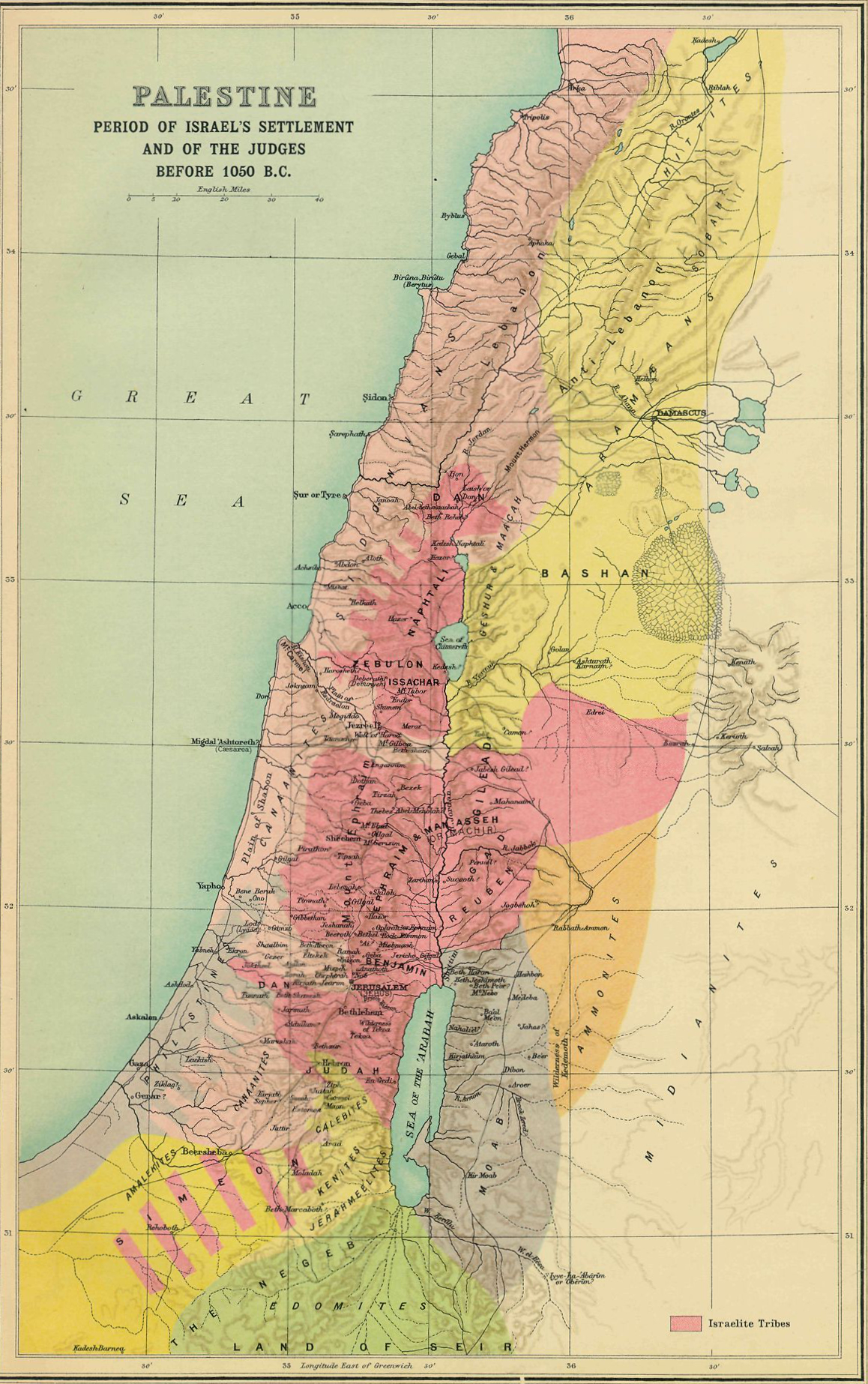
- Known: the site is identified
- Probable: the leading identification
- Proposed: one candidate among several
- 1Jericho, First city taken; Rahab's household lived. The mound is Tell es-Sultan, beside the spring north of the Dead Sea. Joshua 6:25
- 2?Ai, Taken at the second attack. Et-Tell is the usual candidate, and Khirbet el-Maqatir has been proposed against it. Joshua 8:28
- 3Gibeon, Bound to Israel by a sworn treaty. OpenBible places it at el-Jib, north of Jerusalem. Joshua 9:15
- 4Hebron, A town of the Anakim in the hills, given to Caleb, who drove out the three sons of Anak (Judges 1:20). Joshua 11:21
- 5Debir, A second town of the Anakim. OpenBible's best candidate is Khirbet Rabud, south-west of Hebron. Joshua 11:21
- 6Hazor, Head of the northern kingdoms. The mound is Tel Hazor, north of the Sea of Galilee. Joshua 11:10
- 7Gaza, Philistine coast; the Anakim lived on. OpenBible puts the ancient town at Tell Harube. Joshua 11:22
- 8Gath, Philistine coast and Goliath's home. OpenBible's best candidate is Tell es-Safi, in the lowland. 1 Samuel 17:4
- 9Ashdod, Philistine coast; the Anakim lived on. OpenBible puts it at Tel Ashdod, near the sea. Joshua 11:22
Base map: Israel's settlement and the period of the Judges, George Adam Smith, Atlas of the Historical Geography of the Holy Land (1915), public domain. Places with a place page stand at its coordinates and the others at the point cited for each, set on the plate by Jerusalem and Damascus, as the plate prints them.
The plate is George Adam Smith's map of the settlement and the judges, printed in 1915. Six towns stand at OpenBible's identifications, graded by its scores: 800 or more known, 500 to 799 probable.
Gaza, Gath, Ashdod
The Cup of Iniquity
Genesis 15:16, and the warning of Deuteronomy 9
Then the LORD said to Abram, “Know for certain that your descendants will be strangers in a land that is not their own, and they will be enslaved and mistreated four hundred years. But I will judge the nation they serve as slaves, and afterward they will depart with many possessions. You, however, will go to your fathers in peace and be buried at a ripe old age. In the fourth generation your descendants will return here, for the iniquity of the Amorites is not yet complete.”The delay has one stated cause, given in the last clause.
When the LORD your God has driven them out before you, do not say in your heart, “Because of my righteousness the LORD has brought me in to possess this land.” Rather, the LORD is driving out these nations before you because of their wickedness. It is not because of your righteousness or uprightness of heart that you are going in to possess their land, but it is because of their wickedness that the LORD your God is driving out these nations before you, to keep the promise He swore to your fathers, to Abraham, Isaac, and Jacob.Moses forbids the people to credit their own goodness.
Amorite stands here for all the peoples of Canaan, as the strongest people often names the rest. The land was to change hands at a moral threshold, and the centuries before it were patience.
Moses shuts the other door before Israel can walk through it. The judgment falls on what the nations did, and Israel's descent earns it nothing.
Israel held to the same ruleLeviticus 18:27 to 28
The chapter that lists the offences turns the warning on Israel. Centuries later Israel was carried out of the same land in two stages, on the same charge.
For the men who were in the land before you committed all these abominations, and the land has become defiled. So if you defile the land, it will vomit you out as it spewed out the nations before you.The sentence on the earlier nations is spoken over Israel too.
Henry and Clarke on the long patienceMatthew Henry, 1710; Adam Clarke, 1832
“The righteous God has determined that they shall not be cut off till they have persisted in sin so long, and arrived at such a pitch of wickedness, that there may appear some equitable proportion between their sin and their ruin; and therefore, till it come to that, the seed of Abram must be kept out of possession. Note, (1.) The measure of sin fills gradually.”
Matthew Henry · Commentary on the Whole Bible · on Genesis 15:16Puritan
“For the wickedness of these nations - So then it was not by any sovereign act of God that these people were cast out, but for their wickedness; they had transgressed the law of their Creator; they had resisted his Spirit, and could no longer be tolerated. The Israelites were to possess their land, not because they deserved it, but first, because they were less wicked than the others; and secondly, because God thus chose to begin the great work of his salvation among men.”
Adam Clarke · Commentary on the Bible · on Deuteronomy 9:5Evangelical
What the Wickedness Was
The practices the Torah names, and what the ground outside the text can carry
The charge is specific. The law lists the acts, in more than one book.
You must not give any of your children to be sacrificed to Molech, for you must not profane the name of your God. I am the LORD.Molech stands in a chapter otherwise given to sexual sins.
You must not worship the LORD your God in this way, because they practice for their gods every abomination which the LORD hates. They even burn their sons and daughters in the fire as sacrifices to their gods.Moses gives this as the cause Israel may not borrow the local worship.
When you enter the land that the LORD your God is giving you, do not imitate the detestable ways of the nations there. Let no one be found among you who sacrifices his son or daughter in the fire, practices divination or conjury, interprets omens, practices sorcery, casts spells, consults a medium or spiritist, or inquires of the dead. For whoever does these things is detestable to the LORD. And because of these detestable things, the LORD your God is driving out the nations before you.Nine practices stand in one list, joined to the nations' removal.
Do not defile yourselves by any of these practices, for by all these things the nations I am driving out before you have defiled themselves. Even the land has become defiled, so I am punishing it for its sin, and the land will vomit out its inhabitants.The law speaks of the ground itself as sick of its people.
What the excavated evidence carries on child sacrificeSolid in the text, contested in scale
The ritual texts of Ugarit list cattle, small livestock and birds as offerings, with no child sacrifice among them. Paul Mosca's 1975 Harvard dissertation, Child Sacrifice in Canaanite and Israelite Religion, is the standard starting point. He argues that a cult of child sacrifice existed in the region and was Canaanite in origin, while the direct evidence from Ugarit is thin.
The strongest physical case is the tophet at Carthage, a colony of Tyre that carried Canaanite religion west. It holds more than twenty thousand urns of cremated infants and animals under stelae vowed to Baal Hammon and Tanit. A 2010 study read it as an infant cemetery. A 2014 study of the ages of the dead found a pattern ordinary infant deaths do not produce. A 2024 review in the Bryn Mawr Classical Review shows the question still open. Carthage is also centuries later than Joshua, and Punic rather than Canaanite proper.
A popular claim, checked: temple prostitutionThe words and the prohibitions are solid; the fertility rite is disputed
Popular teaching has long said that Canaanite temples ran ritual sex as a fertility rite. Both the Hebrew terms and the laws against the practice stand firm. Hosea 4:14 describes men sacrificing with shrine prostitutes, and 1 Kings 14:24 says the nations had done the same.
No daughter or son of Israel is to be a shrine prostitute. You must not bring the wages of a prostitute, whether female or male, into the house of the LORD your God to fulfill any vow, because both are detestable to the LORD your God.Israel's own law forbids the practice by name.
Stephanie Budin, The Myth of Sacred Prostitution in Antiquity (Cambridge, 2008), argues that the picture of organized temple sex grew out of hostile Greek writers and mistranslated temple titles. Her work is widely cited. The prohibition is certain, and the reconstruction around it stays a claim.
The defiled land in older commentaryAdam Clarke, 1832; John Gill, 1748 to 1763
“The land itself vomiteth out her inhabitants - This is a very nervous prosopopoeia or personification; a figure by which any part of inanimate nature may be represented as possessing the passions and reason of man. Here the land is represented as an intelligent being, with a deep and refined sense of moral good and evil: information concerning the abominations of the people is brought to this personified land, with which it is so deeply affected that a nausea is produced, and it vomits out its abominable and accursed inhabitants.”
Adam Clarke · Commentary on the Bible · on Leviticus 18:25Evangelical
“But of the cities of those people, which the Lord thy God doth give thee for an inheritance,.... The cities of the seven nations, six of which are mentioned by name in the next verse: thou shalt save alive nothing that breatheth; the reason of this severity was because of their wickedness, the capital crimes and gross abominations they were guilty of, and for which they deserved to die; and on account whereof they were reserved to this destruction, when the measure of their iniquities was full, such as idolatry, incest, witchcraft, soothsaying, necromancy, &c. see Lev 18:3.”
John Gill · Exposition of the Old Testament (1748-1763) · on Deuteronomy 20:16Reformed
Deuteronomy 18:9 to 12, Leviticus 18:24 to 25
The Anakim in the Land
Numbers 13:33 and Deuteronomy 2 and 3: who the spies said was there
The spies brought back two reports, one on the fruit and one on the people. The second used a word met once before, in the chapter before the flood.
So they gave the Israelites a bad report about the land that they had spied out: “The land we explored devours its inhabitants, and all the people we saw there are great in stature. We even saw the Nephilim there—the descendants of Anak that come from the Nephilim! We seemed like grasshoppers in our own sight, and we must have seemed the same to them!”The spies tie the line of Anak to a people Genesis names once.
The Nephilim were on the earth in those days—and afterward as well—when the sons of God had relations with the daughters of men. And they bore them children who became the mighty men of old, men of renown.Genesis places them before the flood and after it.
(The Emites used to live there, a people great and many, as tall as the Anakites. Like the Anakites, they were also regarded as Rephaim, though the Moabites called them Emites.Moses breaks off the march to note the peoples Moab displaced.
(For only Og king of Bashan had remained of the remnant of the Rephaim. His bed of iron, nine cubits long and four cubits wide, is still in Rabbah of the Ammonites.)A king's bed is measured out, the detail a witness gives.
Deuteronomy twice stops its story for notes like these, and it measures a bed where it expects to be doubted. On the Watchers reading of Genesis 6, set out on the Watchers page, the chapter tells of a real incursion, and Numbers 13:33 draws the line from it to the sons of Anak.
Where the text goes silentThe silence named as silence
The clause "and afterward as well" is all Scripture gives on how the same line stands on both sides of the flood. It names no mechanism, no second incursion and no genealogy. Readers have filled the gap in several directions, and each answer stands outside the text.
The full case for the incursion of Genesis 6, with its positions and holders, is set out in Watchers and Nephilim. Here it is taken only as far as Numbers 13:33 states it.
Clarke on the spies' giantsAdam Clarke, 1832, on Numbers 13:33
“There we saw the giants - נפלים nephilim. It is evident that they had seen a robust, sturdy, warlike race of men, and of great stature; for the asserted fact is not denied by Joshua or Caleb. Tales of gigantic men are frequent in all countries, but they are generally of such as have lived in times very remote from those in which such tales are told.”
Adam Clarke · Commentary on the Bible · on Numbers 13:33Evangelical
Deuteronomy 2:10 to 11, Deuteronomy 3:11
Drive Out, and Destroy
Two kinds of command standing side by side, which the text leaves unreconciled
Read straight through, the conquest texts give two pictures of one event and never reconcile them. Every serious argument about the conquest starts from this tension.
When the LORD your God brings you into the land that you are entering to possess, and He drives out before you many nations—the Hittites, Girgashites, Amorites, Canaanites, Perizzites, Hivites, and Jebusites, seven nations larger and stronger than you— and when the LORD your God has delivered them over to you to defeat them, then you must devote them to complete destruction. Make no treaty with them and show them no mercy.The command is total, with no covenant and no pity.
I will send the hornet before you to drive the Hivites and Canaanites and Hittites out of your way. I will not drive them out before you in a single year; otherwise the land would become desolate and wild animals would multiply against you. Little by little I will drive them out ahead of you, until you become fruitful and possess the land.God sets a slow pace on purpose, to keep the country tame.
However, in the cities of the nations that the LORD your God is giving you as an inheritance, you must not leave alive anything that breathes. For you must devote them to complete destruction—the Hittites, Amorites, Canaanites, Perizzites, Hivites, and Jebusites—as the LORD your God has commanded you, so that they cannot teach you to do all the detestable things they do for their gods, and so cause you to sin against the LORD your God.The total command is limited to these towns, and verse 18 says why.
The LORD your God will drive out these nations before you little by little. You will not be enabled to eliminate them all at once, or the wild animals would multiply around you.The slow pace returns in the chapter of the total command.
So Joshua conquered the whole region—the hill country, the Negev, the foothills, and the slopes, together with all their kings—leaving no survivors. He devoted to destruction everything that breathed, just as the LORD, the God of Israel, had commanded.The narrator sums up the south in the sweeping terms of war reports.
I sent the hornet ahead of you, and it drove out the two Amorite kings before you, but not by your own sword or bow.Joshua's last speech credits the hornet with the victory.
Both columns come from the same speakers: Moses in one speech, and Joshua looking back on his own wars. Any reading of the conquest has to account for both.
The verb of the ban, read two waysAdam Clarke, 1832; Jamieson, Fausset and Brown, 1871
“But thou shalt utterly destroy them - The above reasoning will gain considerable strength, provided we could translate כי החרם תחרימם ki hacharem tacharimem, thou shalt utterly subdue them - slaying them if they resist, and thus leaving nothing alive that breathed; or totally expel them from the land, or reduce them to a state of slavery in it, that they might no longer exist as a people. This certainly made them an anathema as a nation, wholly destroying their political existence.”
Adam Clarke · Commentary on the Bible · on Deuteronomy 20:17Evangelical
Clarke makes a point of translation. The Hebrew verb carries a range that includes ending a people's life as a nation, and his reasoning holds only if that range is in use here. The scholars below argue the point.
“If they were to be swept away like the antediluvians or the people of Sodom and Gomorrah, as incorrigible sinners who had filled up the measure of their iniquities, it mattered not to them in what way the judgment was inflicted; and God, as the Sovereign Disposer, had a right to employ any instruments that pleased Him for executing His judgments.”
Jamieson, Fausset & Brown · Commentary Critical and Explanatory on the Whole Bible · on Deuteronomy 7:2 to 6Reformed
Deuteronomy 20:16 to 18, Deuteronomy 7:22, Joshua 10:40, Joshua 24:12
The Door That Stayed Open
Rahab and the Gibeonites: the two cases the text narrates
Two Canaanite parties come through the conquest alive, and the book tells both stories at length. Each lives by what it did: Rahab by her confession, Gibeon by a covenant.
and said to them, “I know that the LORD has given you this land and that the fear of you has fallen on us, so that all who dwell in the land are melting in fear of you. For we have heard how the LORD dried up the waters of the Red Sea before you when you came out of Egypt, and what you did to Sihon and Og, the two kings of the Amorites across the Jordan, whom you devoted to destruction. When we heard this, our hearts melted and everyone’s courage failed because of you, for the LORD your God is God in the heavens above and on the earth below.She reasons from the news to a confession of faith.
And Joshua spared Rahab the prostitute, with her father’s household and all who belonged to her, because she hid the men Joshua had sent to spy out Jericho. So she has lived among the Israelites to this day.The narrator notes that her family still lived in Israel when he wrote.
The Gibeonites answered, “Your servants were told clearly that the LORD your God had commanded His servant Moses to give you all the land and wipe out all its inhabitants before you. So we greatly feared for our lives because of you, and that is why we have done this. Now we are in your hands. Do to us whatever seems good and right to you.” So Joshua did this and delivered them from the hands of the Israelites, and they did not kill the Gibeonites. On that day he made them woodcutters and water carriers, as they are to this day for the congregation of the LORD and for the altar at the place He would choose.Fear drove the trick, and the oath held anyway.
Salmon was the father of Boaz by Rahab, Boaz the father of Obed by Ruth, Obed the father of Jesse,Matthew writes her into the line of David and of Jesus.
Rahab belonged to the first city taken, and she was spared as a Canaanite, for what she said and did. Her neighbours heard the same news and only feared.
The Gibeonites are the harder case, and the text leaves it rough. They won their covenant by lying about their home; when the fraud came out, Israel kept its word and set them to work at the sanctuary. A city that sought terms dishonestly was spared because a covenant stood.
The ban laid on Israelite townsDeuteronomy 13; William Ford, Tyndale Bulletin 66.2 (2015)
Deuteronomy 13 lays the ban on a town of Israel that serves other gods.
you must surely put the inhabitants of that city to the sword. Devote to destruction all its people and livestock.The law turns on an apostate town of Israel.
William Ford, "What About the Gibeonites?", Tyndale Bulletin 66.2 (2015), reads the Gibeon account beside that law. He argues that the ban turns on the danger a people poses to Israel's loyalty, and not on its ancestry.
Three older readers on the sparedAlbert Barnes; John Wesley, 1765; Adam Clarke, 1832
“The Lord your God, he is God - From the rumour of God’s miraculous interpositions Rahab believed, and makes the self-same confession to which Moses endeavors to bring Israel by rehearsing similar arguments Deu 4:39. Rahab had only heard of what Israel had experienced. Her faith then was ready. It is noteworthy, too, that the same reports which work faith and conversion in the harlot, cause only terror and astonishment among her countrymen. (Compare Luk 8:37-39.)”
Albert Barnes · Notes, Explanatory and Practical, on the Old and New Testaments (1832-1869) · on Joshua 2:11Evangelical
“The harlot olive - For that general command of rooting out the Canaanites seems to have had some exception, in case any of them had sincerely and seasonably cast off their wickedness, and submitted to the Israelites.”
John Wesley · Explanatory Notes upon the Old Testament · on Joshua 6:25Evangelical
“And so did he unto them - That is, he acted according to justice and mercy: he delivered them out of the hands of the people, so that they slew them not - here was mercy; and he made them hewers of wood and drawers of water for the congregation, and to the altar of God - here was justice. Thus Joshua did nothing but what was good and right, not only in his own eyes, but also in the eyes of the Lord. How long the Gibeonites were preserved as a distinct people after this, we know not.”
Adam Clarke · Commentary on the Bible · on Joshua 9:26Evangelical
“Thou shalt smite them, etc. - These idolatrous nations were to be utterly destroyed, and all the others also which were contiguous to the boundaries of the promised land, provided they did not renounce their idolatry and receive the true faith: for if they did not, then no covenant was to be made with them on any secular or political consideration whatever; no mercy was to be shown to them, because the cup of their iniquity also was now full; and they must either embrace, heartily embrace, the true religion, or be cut off.”
Adam Clarke · Commentary on the Bible · on Deuteronomy 7:2Evangelical
Joshua 9:24 to 27, Matthew 1:5
The Gath Thread
Joshua 11:22 to 1 Samuel 17:4, and where it lands
At that time Joshua proceeded to eliminate the Anakim from the hill country of Hebron, Debir, and Anab, and from all the hill country of Judah and of Israel. Joshua devoted them to destruction, along with their cities. No Anakim were left in the land of the Israelites; only in Gaza, Gath, and Ashdod did any survive.Three coastal towns keep what the hill country lost.
Then a champion named Goliath, who was from Gath, came out from the Philistine camp. He was six cubits and a span in height,Samuel names the champion's home town.
Joshua 11 is a summary, and its closing verses keep a detail summaries usually drop. Generations later that detail walks out of the Philistine ranks with a spear like a weaver's beam.
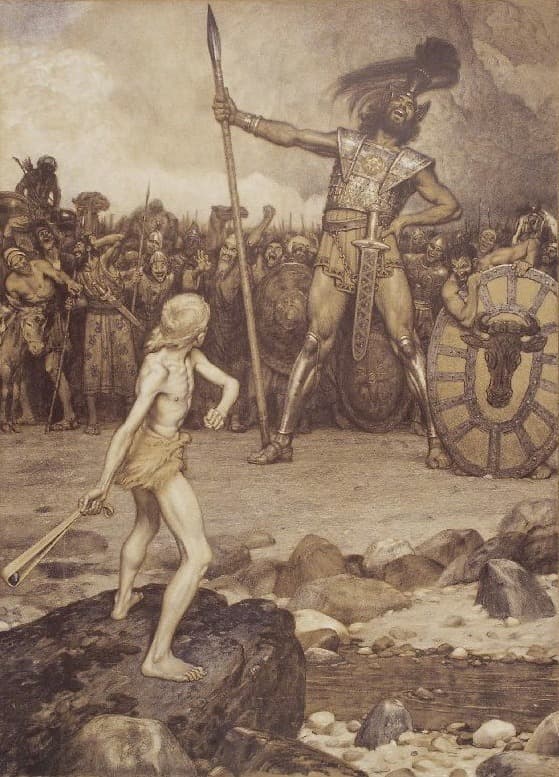
Osmar Schindler, David und Goliath, 1888, colour lithograph. Public domain (the artist died in 1927). Wikimedia Commons, File:Osmar_Schindler_David_und_Goliath.jpg.
Schindler drew the boy and the giant from Gath face to face before the jeering Philistine army.
And there was still another battle at Gath, where there was a man of great stature with six fingers on each hand and six toes on each foot—twenty-four in all. He too was descended from Rapha, and when he taunted Israel, Jonathan the son of David’s brother Shimei killed him. So these four descendants of Rapha in Gath fell at the hands of David and his servants.David's men end the line where Joshua left it.
The thread runs back past Joshua. Numbers ties the Anakim to the Nephilim, and Genesis sets the Nephilim on both sides of the flood. The first promise in Scripture sets two seeds against each other and says how their war ends.
And I will put enmity between you and the woman, and between your seed and her seed. He will crush your head, and you will strike his heel.”Eden declares the war, and its end.
MannaFest's tradition, Wesleyan-Pentecostal, reads the conquest as judgment on the Canaanites' own conduct. It also holds that the serpent's line was in operation from the incursion of Genesis 6 through the Anakim to Gath, in the war Genesis 3:15 declares.
Goliath's height and its Hebrew and Greek readings are argued in David and Goliath; the war of the seeds is traced in The Seed.
Clarke and Barnes on GathAdam Clarke, 1832; Albert Barnes, 1832 to 1869
“In Gaza, in Gath, and in Ashdod - The whole race of the Anakims was extirpated in this war, except those who had taken refuge in the above cities, which belonged to the Philistines; and in which some of the descendants of Anak were found even in the days of David.”
Adam Clarke · Commentary on the Bible · on Joshua 11:22Evangelical
“Four - Not necessarily meaning that they were brothers, but that they were all of the race of the Giant, all Rephaim. The word ‘four’ is omitted in the parallel passage, only the three last being mentioned in that chapter.”
Albert Barnes · Notes, Explanatory and Practical, on the Old and New Testaments (1832-1869) · on 2 Samuel 21:22Evangelical
2 Samuel 21:20 to 22, Genesis 3:15
The Question Readers Bring
The moral objection, with the positions and their holders
Most readers come to Joshua with a question already formed, and the word they have heard for it is genocide. The question deserves a straight answer.
The text settles the ground of the judgment: conduct, named in the law, denied to Israel as a reward, and turned on Israel by the same rule. It leaves open how literally the formulas of destruction are meant, and scholars who read the same chapters divide on that.
1990 · K. Lawson Younger Jr.
The formulas are ancient war rhetoric, and displacement is the reality
The reading1 paragraph
K. Lawson Younger Jr., Ancient Conquest Accounts (Sheffield, 1990), set Joshua's formulas beside Egyptian, Hittite, Assyrian and Moabite royal inscriptions. He found phrases such as "all the land" and "no survivors" to be conventions of the genre, used to claim total victory.
1996 · Richard Hess
The reading1 paragraph
Richard Hess, Joshua (IVP, 1996), argues from Rahab and Gibeon that Canaanite towns could come to terms. Christopher J. H. Wright, The God I Don't Understand (Zondervan, 2008), grants that judgment on a culture given to child sacrifice makes a moral difference, and that the events stay violent. Each work is in copyright and is cited by title.
2009 · Randal Rauser
The moderating readings leave the difficulty standing
The reading1 paragraph
Randal Rauser, "Let Nothing that Breathes Remain Alive", Philosophia Christi 11.1 (2009), argues that every moderation granted, clearing a people under threat of death is still ethnic cleansing. He pressed the point in a long public exchange with Copan and Flannagan.
2009 · Eric Seibert
The reading1 paragraph
Eric Seibert, Disturbing Divine Behavior (Fortress, 2009) and The Violence of Scripture (Fortress, 2012), holds that the portrayals of God commanding these killings misrepresent God's character. He leans partly on the dispute over Jericho's date. Reviewers in a 2011 symposium on his work in the journal Direction answered that a prior commitment to pacifism shapes his reading.
2011 · Paul Copan
The reading1 paragraph
Paul Copan, Is God a Moral Monster? (Baker, 2011), and Copan with Matthew Flannagan, Did God Really Command Genocide? (Baker Academic, 2014), build on him. The targets were mostly forts and seats of rule, and driving out describes what happened.
Randal Rauser, Eric Seibert, Paul Copan
What the Ground Shows
Two excavations, with their disputes named
Two sites carry most of the argument, and they pull in different directions.
Jericho: a destruction layer, and a dispute over its dateGarstang 1930 to 1936; Kenyon, Digging Up Jericho (1957); Wood, Biblical Archaeology Review (1990)
The excavators agree that Jericho was violently destroyed and burned with full grain jars still in store, which points to a short siege. The dispute is over the date.
John Garstang, digging in the 1930s, dated the destruction to about 1400 BC, the early date for the conquest. Kathleen Kenyon dug again in the 1950s and moved it back to about 1550 BC, which would leave the site empty when Joshua came. Her date stood for decades.
Bryant Wood re-examined her pottery in Biblical Archaeology Review in 1990. He argued that she leaned on the absence of imported ware in a small, poor area, and that the local pottery points to about 1400 BC. Piotr Bienkowski answered him in the same magazine later in 1990 and held to Kenyon's date, and later radiocarbon work on the destruction layer has generally supported her earlier date rather than Wood's.
Hazor: the one city of the north Joshua burnedJoshua 11:13; Yigael Yadin, Hazor (1975)
Yet Israel did not burn any of the cities built on their mounds, except Hazor, which Joshua burned.A narrator inventing a total conquest would have no reason to volunteer this limit.
Joshua 11:10 calls Hazor the head of all these kingdoms. The excavators agree that its last Canaanite city ended in fire, and in its palace they found burnt cedar beams, a collapsed ceiling, bricks fused by heat and jars of scorched wheat.
Who set the fire is argued. Yigael Yadin ascribed it to the tribes of Joshua, and Amnon Ben-Tor judged the Israel named on the stele of the pharaoh Merneptah the likeliest destroyer. Sharon Zuckerman holds that the destruction dates too early for the Israelites. The one city the text singles out for fire has an unmistakable burn layer.
The limits, stated plainlyWhat the excavations cannot do
A burn layer records that a city burned, never who lit it or why. Where a layer lines up with a text it is corroboration, short of proof, in both directions.
Books to Read Next
Commentary on the Whole Bible
Matthew Henry · 1710
Henry reads Genesis 15:16 and the Joshua campaigns together, the patience first and the judgment after.
Read it free at CCELCommentary on the Bible
Adam Clarke · 1832
Clarke writes the fullest older notes on the ban, the Gibeonites and the Anakim of Gath.
Read it free at CCELAncient Conquest Accounts
K. Lawson Younger Jr. · 1990
Younger compares the conquest reports of Israel's neighbours, and the reading of the formulas as war rhetoric rests on his study.
In print: find it wherever books are sold.
Hazor: The Rediscovery of a Great Citadel of the Bible
Yigael Yadin · 1975
The excavator tells how he found the burned city of Joshua 11.
In print: find it wherever books are sold.
Judgment on Conduct, and a Door Left Open
Not one of all the LORD’s good promises to the house of Israel had failed; everything was fulfilled.The book counts every promise kept.
Sources
Scripture is the Berean Standard Bible.
- Matthew Henry, Commentary on the Whole Bible (1710), on Genesis 15:16.
- Adam Clarke, Commentary on the Bible (1832), on Leviticus 18:25, Numbers 13:33, Deuteronomy 7:2, 9:5 and 20:17, and Joshua 9:26 and 11:22.
- Albert Barnes, Notes, Explanatory and Practical, on the Old and New Testaments (1832 to 1869), on Joshua 2:11 and 2 Samuel 21:22.
- John Gill, Exposition of the Old Testament (1748 to 1763), on Deuteronomy 20:16.
- John Wesley, Explanatory Notes upon the Old Testament (1765), on Joshua 6:25.
- Jamieson, Fausset and Brown, Commentary Critical and Explanatory on the Whole Bible (1871), on Deuteronomy 7:2.
- K. Lawson Younger Jr., Ancient Conquest Accounts (Sheffield Academic Press, 1990)
- Paul Copan, Is God a Moral Monster? (Baker, 2011); Paul Copan and Matthew Flannagan, Did God Really Command Genocide? (Baker Academic, 2014)
- Christopher J. H. Wright, The God I Don't Understand (Zondervan, 2008)
- Richard S. Hess, Joshua: An Introduction and Commentary (IVP, 1996)
- Randal Rauser, "Let Nothing that Breathes Remain Alive", Philosophia Christi 11.1 (2009)
- Eric A. Seibert, Disturbing Divine Behavior (Fortress, 2009) and The Violence of Scripture (Fortress, 2012)
- William Ford, "What About the Gibeonites?", Tyndale Bulletin 66.2 (2015)
- Stephanie Budin, The Myth of Sacred Prostitution in Antiquity (Cambridge University Press, 2008)
- Paul Mosca, Child Sacrifice in Canaanite and Israelite Religion (Harvard dissertation, 1975)
- The Carthage tophet studies: the 2010 skeletal study in PLoS ONE, the 2014 study reported in Archaeology, and the 2024 review in the Bryn Mawr Classical Review.
- John Garstang's excavations at Jericho (1930 to 1936); Kathleen Kenyon, Digging Up Jericho (1957); Bryant Wood, "Did the Israelites Conquer Jericho?", Biblical Archaeology Review 16.2 (1990)
- Yigael Yadin, Hazor: The Rediscovery of a Great Citadel of the Bible (Random House, 1975)
- Yigael Yadin and Shimon Gibson, the article Hazor, Encyclopaedia Judaica, second edition (Gale, 2008), as the Jewish Virtual Library prints it.
- Biblical Archaeology Society, Scorched Wheat May Provide Answers on the Destruction of Canaanite Tel Hazor, Bible History Daily (2013), citing Ben-Tor and Rubiato, BAR May/June 1999, Zuckerman, BAR March/April 2006, and Ben-Tor, BAR July/August 2013.
- OpenBible.info, Bible-Geocoding-Data, the file ancient.jsonl, with its identification scores.
- George Adam Smith, Atlas of the Historical Geography of the Holy Land (1915), plate: Palestine, Period of Israel's Settlement and of the Judges, public domain.
Keep Studying
Read it5
Studies10
People and groups9
Symbols1
Doctrines15