
Ruth 4 and 1 Samuel 8 · Subject · Featured Study
Money, Law and Power
Who owned the fields, how silver changed hands and who judged, from the days of Ruth to Samuel's warning about a king.
The silver is Mine, and the gold is Mine, declares the LORD of Hosts.
- Books
- Ruth, Leviticus, Genesis, Jeremiah, Deuteronomy, 1 Samuel, 1 Kings, Mark
- Hold in memory
- Leviticus 25:23, Deuteronomy 16:19
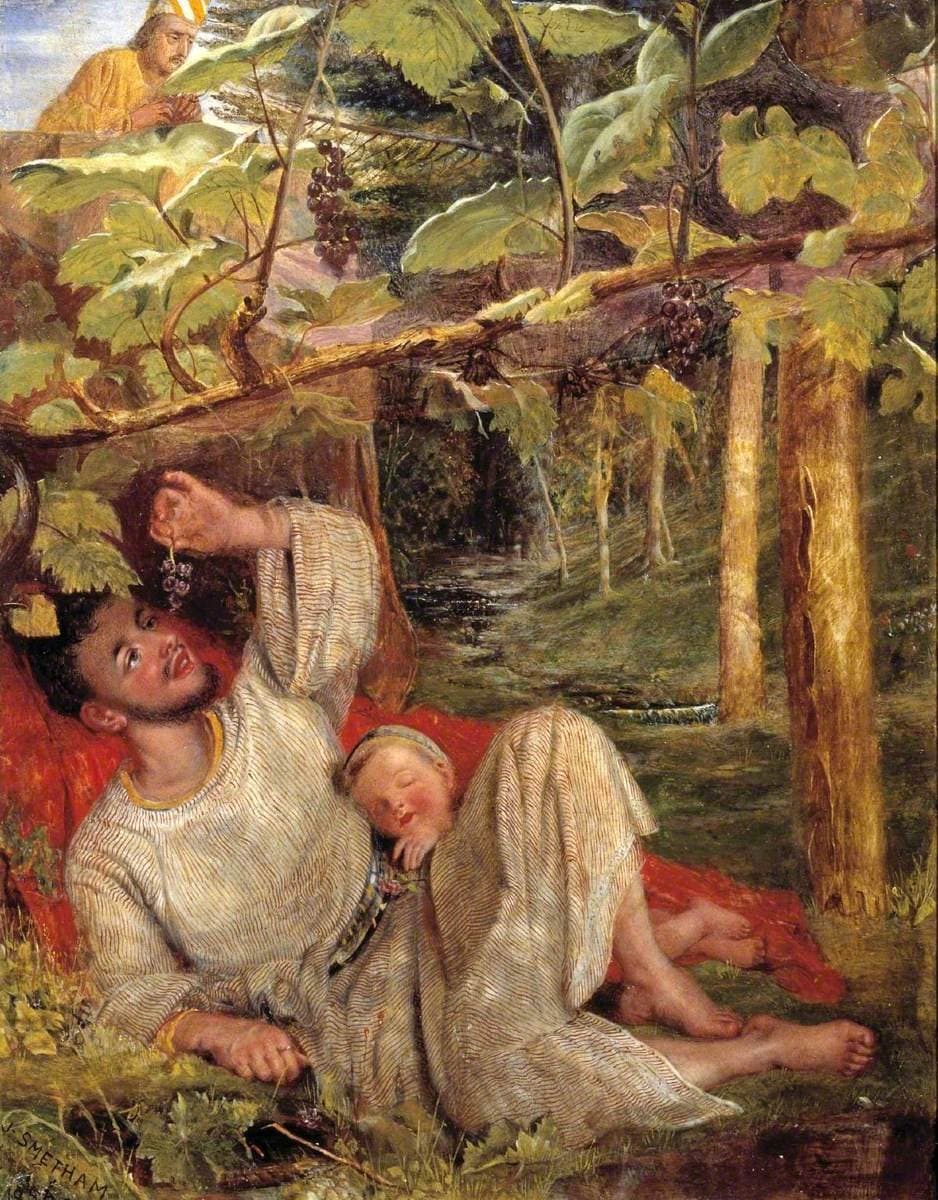
James Smetham, Naboth in his Vineyard, 1856, collection number N03203. Public domain (painted in 1856), via Wikimedia Commons, File:James_Smetham_(1821-1889)_-_Naboth_in_his_Vineyard_-_N03203_-_National_Gallery.jpg.
THE ARTWORKSmetham painted Naboth at rest under his own vine with a child asleep beside him, while a crowned man looks over the wall at the vineyard. In 1 Kings 21 King Ahab wants the vineyard, and Naboth will not give him the inheritance of his fathers.
Summary
Israel before the kings lived under laws that kept land in families, honest weights in the market and bribes out of the courts.
- A family could sell its land only until the nearest kinsman or the Jubilee brought it back, because the LORD called the land His own.
- Silver was weighed out on scales, and the text records prices from a quarter shekel to a thousand shekels.
- The law forbade a judge to take a bribe, and Samuel's sons took bribes in the years before Israel asked for a king.
- Samuel warned that a king would take sons, daughters, fields and a tenth of the harvest and the flocks.
Land Held from the LORD
Ruth 4 turns on a field that a widow could sell and a kinsman could buy back.
The land must not be sold permanently, because it is Mine, and you are but foreigners and residents with Me.The LORD names Himself the owner of the land, so every sale in Israel was a sale of its use for a time.
In Ruth 4:3 Naomi is selling the land that belonged to Elimelech, and Leviticus 25:25 gives the nearest of kin the right to buy back what a poor brother has sold. The hearing where that right passed from one kinsman to another is the subject of the page on the city gate as the court.
Prices in Silver
Twelve prices the Old Testament names in shekels of silver, for land and goods and for people and their service.
A vineyard of a thousand vines was valued at a thousand shekels of silver, and Jeremiah's field at Anathoth cost seventeen.
The six counts as a table
| What was bought | Shekels of silver | Verse |
|---|---|---|
| The field and cave at Machpelah | 400 | Genesis 23:16 |
| Araunah's threshing floor and oxen | 50 | 2 Samuel 24:24 |
| A chariot brought from Egypt | 600 | 1 Kings 10:29 |
| A horse brought from Egypt | 150 | 1 Kings 10:29 |
| A vineyard of a thousand vines | 1,000 | Isaiah 7:23 |
| The field at Anathoth | 17 | Jeremiah 32:9 |
Bars from zero for what land, animals and a chariot cost, with the verse for each.
A man valued for a vow was set at fifty shekels of silver, and a gift for the seer at a quarter shekel.
The six counts as a table
| Who or what service | Shekels of silver | Verse |
|---|---|---|
| Joseph, sold to the Ishmaelites | 20 | Genesis 37:28 |
| A servant gored by an ox | 30 | Exodus 21:32 |
| A man of twenty to sixty, valued for a vow | 50 | Leviticus 27:3 |
| A Levite's wage for a year | 10 | Judges 17:10 |
| A gift for the seer | 0.25 | 1 Samuel 9:8 |
| Hosea's price for his wife, with barley | 15 | Hosea 3:2 |
Six prices set on a person or on a person's work, in canon order.
Silver Weighed before Witnesses
Two purchases of land, one in Abraham's day and one during the siege of Jerusalem, were paid in weighed silver.
Abraham agreed to Ephron’s terms and weighed out for him the price he had named in the hearing of the Hittites: four hundred shekels of silver, according to the standard of the merchants.The weighing is done in public, so the town is witness to the price as well as to the sale.
I signed and sealed the deed, called in witnesses, and weighed out the silver on the scales.Jeremiah buys his cousin's field while Babylon besieges the city, and he puts the sale in writing as well as on the scales.
Jeremiah 32:11 adds two copies of the deed, one sealed and one left open. The page on weights and measures gives the shekel's parts and the larger weights.
Judges Who Took No Bribe
The law barred a judge from gifts, and the last judge before the kings put his own hands to the test.
Do not deny justice or show partiality. Do not accept a bribe, for a bribe blinds the eyes of the wise and twists the words of the righteous.Moses joins the ban to its reason, so the judge knows what a bribe does to him.
But his sons did not walk in his ways; they turned aside toward dishonest gain, accepting bribes and perverting justice.Samuel's sons break this law, and the elders point to the sons when they ask for a king.
Here I am. Bear witness against me before the LORD and before His anointed: Whose ox or donkey have I taken? Whom have I cheated or oppressed? From whose hand have I accepted a bribe and closed my eyes? Tell me, and I will restore it to you.”Samuel asks the whole people to name one bribe he took, and in the next verse they answer that he took nothing.
A gift before the case is heardMatthew Henry on Exodus 23:8
Matthew Henry reads Exodus 23:8 as a rule against taking any gift at all, even one that seems to leave the verdict free.
“They must not only not be swayed by a gift to give an unjust judgment, to condemn the innocent, or acquit the guilty, or adjudge a man's right from him, but they must not so much as take a gift, lest it should have a bad influence upon them, and overrule them, contrary to their intentions; for it has a strange tendency to blind those that otherwise would do well.”
Matthew Henry · Commentary on the Whole Bible · on Exodus 23:8Puritan
The Manner of the King
Samuel's warning in 1 Samuel 8 lists what a king would take from Israel.
Now listen to them, but you must solemnly warn them and show them the manner of the king who will reign over them.”The LORD tells Samuel to grant the request and to warn the people, so the list that follows is the LORD's warning.
In 1 Samuel 8:7 the LORD says the people have rejected Him as their king. The law of the king in Deuteronomy 17:14 to 20 is the subject of the page on the rise of the monarchy.
| What the king takes | What it serves |
|---|---|
| Your sons | His chariots and horses, his commanders, his ploughing, his harvest and his weapons |
| Your daughters | His perfumers, cooks and bakers |
| The best of your fields, vineyards and olive groves | His servants |
| A tenth of your grain and grape harvest | His officials and servants |
| Your servants and your best cattle and donkeys | His own use |
| A tenth of your flocks | The king, and you become his slaves |
The Words of Money and Law
Four Hebrew words of the market and the court.
KEÇEPH
Silver, named for its pale colour, the metal Israel paid in.
SHEQEL
A weight, the unit in which the prices of the Old Testament are given.
MÂKAR
To sell, the verb of Naomi's sale of Elimelech's land.
SHACHAD
A gift given to sway a judge, which the law forbids and Samuel's sons accepted.
What the Texts Leave Unsaid
Ruth 4 and 1 Samuel 8 leave three matters open.
Ruth 4 names no price for Elimelech's land, and it does not say whether the years to the Jubilee set the price, as Leviticus 25:15 to 16 requires. Matthew Henry, on Ruth 4:1, thinks it probable that the land had been mortgaged for bread in the famine, which the text leaves as a guess.
1 Samuel 8 does not say which king would be the first to take what Samuel listed.
Whose Land and Whose Silver
1 Kings 21 tests the law of the inheritance against a king who wanted a garden.
But Naboth replied, “The LORD forbid that I should give you the inheritance of my fathers.”Naboth refuses in the LORD's name, so his answer rests on the law and on no price.
Ahab had offered a better vineyard or its value in silver, in 1 Kings 21:2, and Naboth refused under the same law that let Boaz buy back Elimelech's field. Jezebel then wrote to the elders and nobles of Naboth's city, and two scoundrels testified against him before the people. The page on Naboth's vineyard tells the whole account.
Voices on Money and Power
Matthew Henry on the land and on false weights, and Irenaeus on Samuel's clean hands.
Tenants of the LORDMatthew Henry on 1 Kings 21:3
Henry explains Naboth's refusal from the terms on which Israel held its land.
“Canaan was in a peculiar manner God's land; the Israelites were his tenants; and this was one of the conditions of their leases, that they should not alienate (no, not to one another) any part of that which fell to their lot, unless in case of extreme necessity, and then only till the year of jubilee, Lev. xxv.”
Matthew Henry · Commentary on the Whole Bible · on 1 Kings 21:3Puritan
False weights as false judgmentMatthew Henry on Leviticus 19:36
Henry joins the honest scale of the market to the honest verdict of the court.
“In weighing and measuring, we pretend a design to give all those their own whom we deal with; but, if the weights and measures be false, it is like a corruption in judgment, it cheats under colour of justice; and thus to deceive a man to his damage is worse than picking his pocket or robbing him on the highway.”
Matthew Henry · Commentary on the Whole Bible · on Leviticus 19:36Puritan
The judge who took nothingIrenaeus, Against Heresies 4.26.4
Irenaeus holds up Samuel's last speech as an example for the presbyters of the church.
“In this way, too, Samuel, who judged the people so many years, and bore rule over Israel without any pride, in the end cleared himself, saying, ‘I have walked before you from my childhood even unto this day: answer me in the sight of God, and before His anointed; whose ox or whose ass of yours have I taken, or over whom have I tyrannized, or whom have I oppressed? or if I have received from the hand of any a bribe or [so much as] a shoe, speak out against me, and I will restore it to you.’”
Irenaeus · Against Heresies 4.26.4 · on 1 Samuel 12:3 to 5Patristic
What Samuel's Warning Grants the King
Readers have taken 1 Samuel 8:11 to 17 in three ways, and each reading meets an objection.
The rights a king may useShmuel and Rabbi Yosei, Babylonian Talmud, Sanhedrin 20b
In the Babylonian Talmud, Sanhedrin 20b, Shmuel holds that a king is permitted every act the passage names, and the Talmud gives Rabbi Yosei the same view. The objection is that Deuteronomy 17:16 to 17 limits what a king may gather for himself.
Words to make the people fear the kingRav and Rabbi Yehuda, Babylonian Talmud, Sanhedrin 20b
Rav and Rabbi Yehuda hold that the passage was said only so that the people would hold the king in awe, and that he may not do these things. The objection is that Samuel calls the list the manner of the king who will reign over them, in 1 Samuel 8:11.
A warning meant to turn them backRabbi Nehorai; John Chrysostom; John Gill
Rabbi Nehorai, in the same passage of the Talmud, says Samuel meant to frighten the people into withdrawing their request. John Chrysostom, in his twenty-fourth homily on 2 Corinthians, says the prophet gathered these hardships to turn them from their design. John Gill, in his Exposition of the Old Testament on 1 Samuel 8:11, reads the list as what kings will do and not as what they ought to do. The objection is that in 1 Samuel 8:22 the request was granted after the warning.
Books on Money, Law and Power
Four works on the land, the courts and the king, three of them free to read.
Babylonian Talmud, Sanhedrin
The William Davidson Edition · 2017
Folio 20b sets out the rabbis' dispute over what 1 Samuel 8 permits a king.
Read on SefariaAgainst Heresies
Irenaeus of Lyons · about 180
Book 4, chapter 26 sets Samuel's farewell speech beside the conduct asked of presbyters.
Read on New AdventHomilies on Second Corinthians
John Chrysostom · about 390
Homily 24 reads Samuel's list of the king's demands as a warning from the kindness of God.
Read on New AdventCommentary on the Whole Bible
Matthew Henry · 1710
Henry writes on the bribe of Exodus 23:8 and on the false weights of Leviticus 19:36.
The Son of Man Came to Serve
Mark 10:45 and 1 Peter 1:18 to 19 speak of the ransom Christ paid for His people.
In Mark 10:42 to 44 Jesus tells His disciples that the rulers of the Gentiles lord it over them, and that whoever wants to become great among them must be their servant. The text asks the reader who holds land, silver or power to use it in that service.
For even the Son of Man did not come to be served, but to serve, and to give His life as a ransom for many.”Jesus names Himself as the pattern of the service He has just asked of His disciples.
For you know that it was not with perishable things such as silver or gold that you were redeemed from the empty way of life you inherited from your forefathers, but with the precious blood of Christ, a lamb without blemish or spot.Peter sets the blood of Christ against silver and gold, the metals of every price the Old Testament names.
Keep studying
Studies5