

Genesis 1 · Symbol · Featured Study
The Sun
The fourth day's lamp, the worship the Law forbade, and the readings of Malachi 4:2.
When Israel's prophets speak of the day the LORD comes, they often speak of the sun.
- The word
- שֶׁמֶשׁ (shemesh), H8121
- First appears
- Genesis 15:12 “As the sun was setting,…”
J. M. W. Turner, The Angel Standing in the Sun, 1846. Public domain.
Summary
The sun in Scripture is a created light with a task: God sets it in the sky to rule the day, to mark signs, seasons, days and years, and to give light on the earth. The psalmists use it for God's care and glory, and the New Testament for the face of the risen Christ.
- Psalm 84:11 says the LORD God is a sun and a shield.
- Revelation 12:1 shows a woman clothed in the sun, with the moon under her feet.
- Ecclesiastes 1:5 notes that the sun rises and sets and hurries back to where it rises.
The Greater Light
Genesis 1:16 and the six times Genesis names the sun.
The fourth day of creation sets lamps in the sky and gives them work to do. The account names the task, ruling the daytime, and never uses the ordinary Hebrew word for the sun. Genesis describes it as a lamp God made and set to a task.
When the word shemesh does appear in Genesis, it tells the hour at which something happens. It sets on covenants and dreams and rises on rescues and wounded men. Most of those hours belong to someone meeting God or fleeing judgment.
God made two great lights: the greater light to rule the day and the lesser light to rule the night. And He made the stars as well.The verse sets the order of creation's lamps.
SUNSET, GENESIS 15:12
Abram falls into a deep sleep before the covenant is cut.
AFTER SUNSET, GENESIS 15:17
A smoking firepot and a flaming torch pass between the pieces.
SUNRISE, GENESIS 19:23
Lot reaches Zoar just before fire falls on Sodom.
SUNSET, GENESIS 28:11
Jacob lies down at Bethel and sees the stairway.
SUNRISE, GENESIS 32:31
Jacob limps away from Penuel after wrestling until daybreak.
IN A DREAM, GENESIS 37:9
The last use in Genesis comes in Joseph's second dream.
Sunrise, Genesis 19:23, Sunset, Genesis 28:11, Sunrise, Genesis 32:31, In a dream, Genesis 37:9
The Angel Standing in the Sun
Revelation 19:17 as J. M. W. Turner painted it.
Turner filled the whole canvas with the sun the angel stands in.
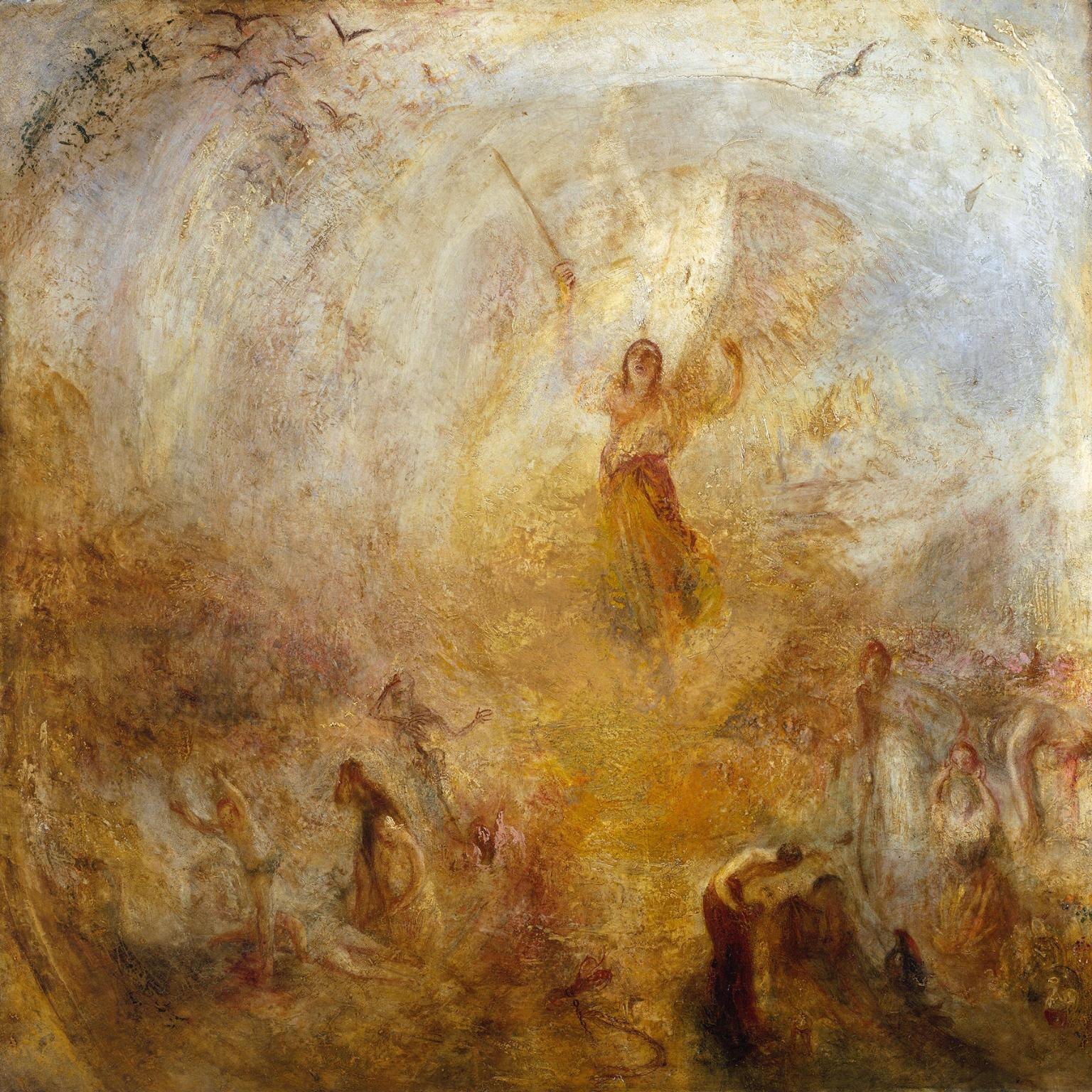
- The angelA winged figure stands at the centre of the light.Revelation 19:17
- The blazeRings of white and gold light fill the sky around him.Revelation 19:17
- The birdsFlocks of dark birds wheel in the upper corner.Revelation 19:17
- The figures belowFigures crouch and fall in the haze at the foot of the canvas.Revelation 19:18
J. M. W. Turner, The Angel Standing in the Sun, 1846. Public domain.
Four parts of the canvas, each numbered where it stands, with the verse it answers to.
When the Sun Leaves Its Course
From the book of Joshua to the last chapters of Revelation.
The sun stands still, goes back, darkens and finally gives way to the glory of God.
- GibeonIt stood still in the middle of the sky about a full day.Joshua 10:12 to 13
- The stairway of AhazIts shadow went back ten steps as a sign to Hezekiah.Isaiah 38:8
- Amos's warningGod will make it go down at noon.Amos 8:9
- The crossIts light failed while Jesus hung there.Luke 23:44 to 45
- The sixth sealIt turned black like sackcloth.Revelation 6:12
- The last cityIt is no longer needed, because the glory of God gives the light.Revelation 21:23
Each stop opens its verse in the reader.
What Scripture Says and What Readers Have Heard
Four verses say what the sun pictures, and one reading comes from a medieval rabbi.
KINDNESS TO ALL
Jesus points to sunshine on the evil and the good as the pattern for loving enemies.
A DAILY RACE
The psalm pictures the sun as a bridegroom and a champion running its course.
THOSE WHO LOVE GOD
Deborah's song ends with a prayer that they shine like the sun at its brightest.
PROTECTION
The pilgrim psalm promises that the sun will not strike by day.
Those who love God, Protection
The sun in Joseph's dreamRadak on Genesis 37:9; Genesis 37:10
Radak, in his commentary on Genesis 37:9, says the second dream needs no interpreter. The two lights stand for Joseph's parents and the stars for his brothers, and Jacob reads it the same way when he answers his son.
He told his father and brothers, but his father rebuked him and said, “What is this dream that you have had? Will your mother and brothers and I actually come and bow down to the ground before you?”Jacob's question shows the family understood the dream at once.
The Sun Worshipped
The Law forbids it, a king tears it out of the temple, and a prophet sees it come back.
Israel was warned that looking up at the sky could lead to bowing down to it, and the history of the kings shows the warning was needed.
When you look to the heavens and see the sun and moon and stars—all the host of heaven—do not be enticed to bow down and worship what the LORD your God has apportioned to all the nations under heaven.Moses names the sun first among the host of heaven Israel must not serve.
The horses of the sun and the men facing east2 Kings 23:11 and Ezekiel 8:16
Josiah removed horses that earlier kings of Judah had dedicated to the sun from the entrance of the temple and burned the chariots of the sun. A generation later Ezekiel saw sun worship inside the temple court itself.
So He brought me to the inner court of the house of the LORD, and there at the entrance to the temple of the LORD, between the portico and the altar, were about twenty-five men with their backs to the temple of the LORD and their faces toward the east; and they were bowing to the east in worship of the sun.The vision gives the place, the number of the men and the direction they faced.
Shemesh, Chammah, Maor and Helios
Two Hebrew names for the sun, the Hebrew word for a light-bearer, and the Greek word for the sun.
שֶׁמֶשׁ shemesh
134 uses in the canon
The ordinary Hebrew word for the sun, first used at Abram's covenant.
חַמָּה chammah
6 uses in the canon
Heat, and by extension the sun, a poetic name used in Isaiah 30:26.
מָאוֹר maor
19 uses in the canon
A light-bearer, the word Genesis 1 uses for the sun and moon.
ἥλιος helios
32 uses in the canon
The Greek word for the sun across the New Testament.
What the Text Does Not Say
Four questions about the sun that Scripture leaves open.
The sun passages leave the mechanics of the signs and the source of day one's light unstated.
| What is not said | What the verse does say |
|---|---|
| What gave light before the fourth day? | Day and night are named from the first day on. |
| How did the sun stand still at Gibeon? | The book points to the Book of Jashar for the account. |
| Is the sun itself God's dwelling? | The psalm says God pitched a tent for it in the heavens. |
| How can Joseph's mother bow down when Rachel has already died? | Jacob's rebuke names the mother and says no more. |
The Sun of Righteousness
Malachi promises a rising sun, and Revelation likens the face of Christ to the sun.
Malachi's sunrise has been read as a name for Christ since the early centuries.
“But for you who fear My name, the sun of righteousness will rise with healing in its wings, and you will go out and leap like calves from the stall.The calves let out of the stall show the joy the sunrise brings.
He held in His right hand seven stars, and a sharp double-edged sword came from His mouth. His face was like the sun shining at its brightest.John sees the face of the risen Christ before any message to the churches.
Voices on the Sun
Four teachers from the fourth century to the nineteenth, each with the work named.
died 379 · Basil of Caesarea
“‘Let them serve,’ he says, ‘for the fixing of days,’ not for making days but for ordering the days. For day and night are earlier than the generation of the luminaries.”
Basil of Caesarea · HEXAEMERON 6.8 · on Genesis 1:14 to 15Patristic
died 397 · Ambrose of Milan
“Look first on the firmament of heaven, which was made before the sun. Look first on the earth, which began to be visible and was already formed before the sun put in its appearance. Look at the plants of the earth, which preceded in time the light of the sun. The bramble preceded the sun. The blade of grass is older than the moon. Therefore, do not believe that object to be a god to which the gifts of God are seen to be preferred. Three days have passed.”
Ambrose of Milan · The Six Days of Creation · on Genesis 1:14 to 15Patristic
1662 to 1714 · Matthew Henry
“It is absurd to worship them, for they are man's servants, were made and ordained to give light on earth; and shall we serve those that were made to serve us? The sun, in Hebrew is called shemesh, which signifies a servant, for it is the minister-general of this visible world, and holds the candle to all mankind; let it not then be worshipped as a lord.”
Matthew Henry · Commentary on the Whole Bible · on Deuteronomy 4:19Puritan
1802 to 1910 · Jamieson, Fausset & Brown
“Paul (Ro 10:8), quoting from the Septuagint, uses ‘sound,’ which gives the same sense. The sun, as the most glorious heavenly body, is specially used to illustrate the sentiment; and his vigorous, cheerful, daily, and extensive course, and his reviving heat (including light), well display the wondrous wisdom of his Maker.”
Jamieson, Fausset & Brown · Commentary Critical and Explanatory on the Whole Bible · on Psalm 19:4Reformed
Matthew Henry, Jamieson, Fausset & Brown
Where Careful Readers Differ
Who or what the sun of righteousness of Malachi 4:2 is.
Both comings of ChristTheodoret of Cyrus; John Wesley
Theodoret of Cyrus, in his Commentary on Malachi, applies the verse to both comings of the Saviour, who rose like a sun on those sitting in darkness. John Wesley, in his Explanatory Notes upon the Old Testament, names the sun of righteousness as Christ, the fountain of light and warmth to His church. The objection: Malachi does not name the Messiah in the verse, and the New Testament never quotes it.
The return of Christ above allAlbert Barnes, Notes, Explanatory and Practical
Albert Barnes reads the sun of righteousness as Christ and says that Malachi speaks first of His second coming. The objection: Zechariah's song in Luke 1:78 already greets the Dawn from on high at the first coming.
The sun itself, on the day of judgmentRashi on Malachi 3:19
Rashi comments on the verse that Hebrew Bibles number Malachi 3:19, and he cites the Sages. In the age to come God will take the sun out of its case, and by it the wicked will be punished and the righteous healed. The objection: Malachi calls it the sun of righteousness, a name that fits a person who brings justice better than a star.
Books to Read Next
Three works a student reads next, each free to read.
The Hexaemeron
Basil of Caesarea · fourth century
His sixth homily treats the lights of the fourth day.
Read at New AdventCommentary on the Whole Bible
Matthew Henry · 1708 to 1710
The notes run verse by verse through Deuteronomy.
Read his Deuteronomy notesExplanatory Notes upon the Old Testament
John Wesley · 1765
It has short comments on every book of the Old Testament, Malachi among them.
Read his Malachi notesThe Light of His Face
Genesis set the sun to a task, and the Law forbade Israel to worship it. On the mountain the disciples saw His face shine like the sun, and the Father commanded them to heed the Son. The text asks the reader to heed Him too.
While Peter was still speaking, a bright cloud enveloped them, and a voice from the cloud said, “This is My beloved Son, in whom I am well pleased. Listen to Him!”Sources
Scripture is the Berean Standard Bible.
- James Strong, Exhaustive Concordance of the Bible, 1890, entries H8121, H2535, H3974 and G2246, with their occurrence counts and their uses by Strong's number.
- Basil of Caesarea, Hexaemeron 6.8, on Genesis 1:14.
- Ambrose of Milan, The Six Days of Creation, on Genesis 1:14.
- Matthew Henry, Commentary on the Whole Bible, 1710, on Deuteronomy 4:19.
- Jamieson, Fausset and Brown, Commentary Critical and Explanatory, 1871, on Psalm 19:4.
- Radak on Genesis 37:9, translated by Eliyahu Munk, HaChut Hameshulash.
- Theodoret of Cyrus, Commentary on Malachi, on Malachi 4:2.
- John Wesley, Explanatory Notes upon the Old Testament, 1765, on Malachi 4:2.
- Albert Barnes, Notes, Explanatory and Practical, on Malachi 4:2.
- Rashi on Malachi 3:19, in The Judaica Press Complete Tanach with Rashi, translated by A. J. Rosenberg.