
Deuteronomy 21 · Subject · Featured Study
The stubborn and rebellious son
Deuteronomy 21:18 to 21 gives a household in Israel its procedure for a son beyond correction.
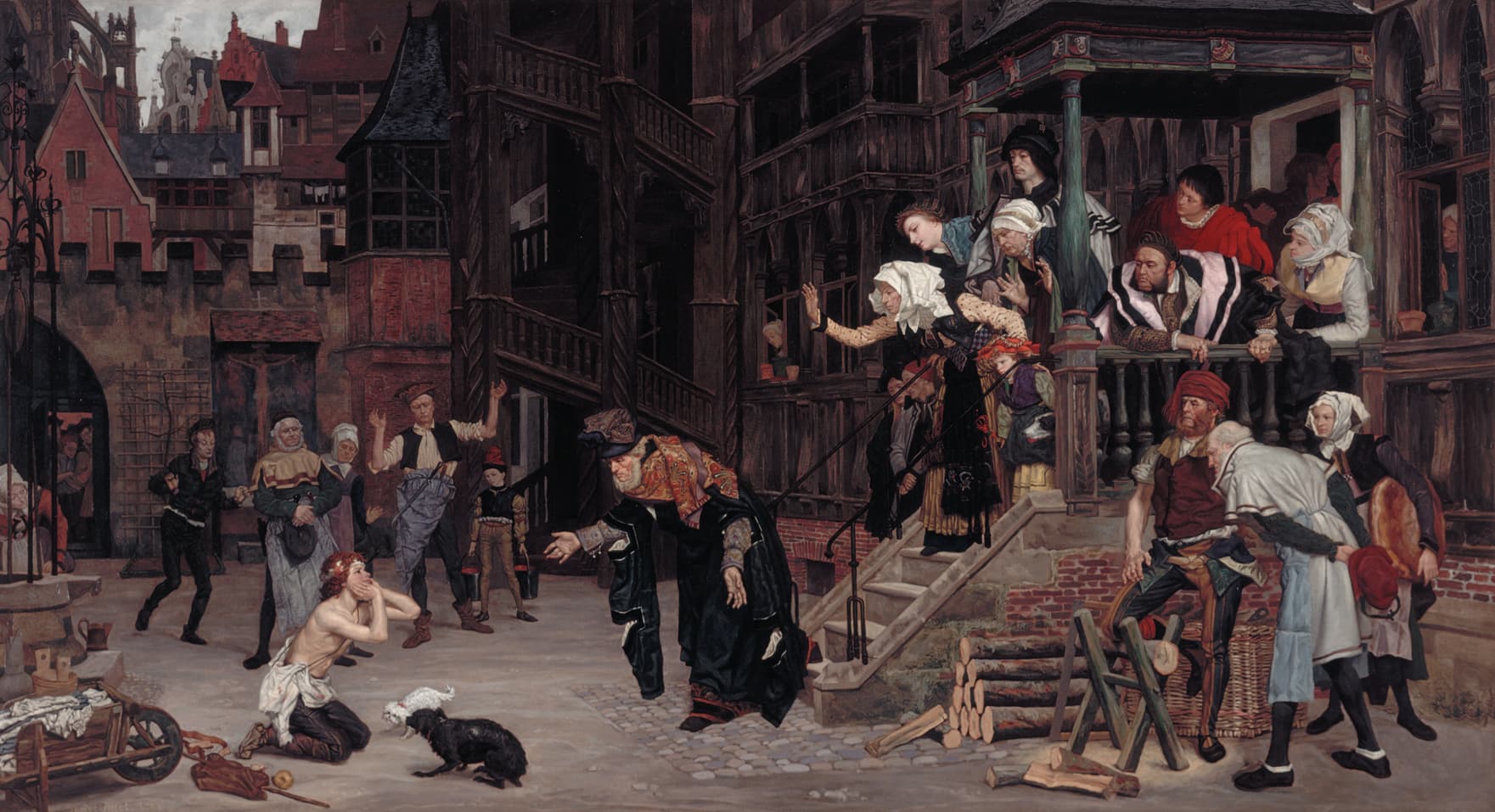
James Tissot, The Return of the Prodigal Son, 1862, oil on canvas. Public domain (made before 1930), via Wikimedia Commons, file The_Return_of_the_Prodigal_Son_James_Tissot.jpeg.
THE ARTWORKJames Tissot painted the father of the parable in a dark robe, bending with open hands toward his kneeling, half-clothed son. The scene is a Flemish town street, and the household watches from a balcony and a stair. It shows the welcome that Luke 15:20 to 24 records.
The charge the parents spoke at the gate, a glutton and a drunkard, was later spoken against Jesus.
Summary
Moses set out a procedure for a son who refused his parents' discipline, in which father and mother brought him together to the elders of his city and the city carried out the sentence.
- Exodus 21:15 and 17 already set death for striking or cursing a father or mother.
- The next law in the chapter, on a body hung on a tree, is the one Paul applies to the cross in Galatians 3:13.
- In Luke 15 Jesus told of a younger son who came home and of the welcome his father gave him.
The Law in Deuteronomy 21
Four verses among the household laws Moses gave in the land of Moab
The law comes straight after the right of the firstborn, which a father must honour even when the firstborn is the son of the wife he does not love (Deuteronomy 21:15 to 17).
Moses gave both laws on the east side of the Jordan, when he began to explain the law to Israel before the crossing (Deuteronomy 1:5).
If a man has a stubborn and rebellious son who does not obey his father and mother and does not listen to them when disciplined, his father and mother are to lay hold of him and bring him to the elders of his city, to the gate of his hometown, and say to the elders, “This son of ours is stubborn and rebellious; he does not obey us. He is a glutton and a drunkard.” Then all the men of his city will stone him to death. So you must purge the evil from among you, and all Israel will hear and be afraid.The Law Step by Step
Six steps from the son's refusal to the purpose the law names
- What the text says
- He does not obey his father and mother and does not listen when they discipline him.
- Verse
- Deuteronomy 21:18
- What the text says
- His father and mother lay hold of him.
- Verse
- Deuteronomy 21:19
- What the text says
- They bring him to the elders of his city, to the gate of his hometown.
- Verse
- Deuteronomy 21:19
- What the text says
- They name his conduct before the elders in two pairs of words.
- Verse
- Deuteronomy 21:20
- What the text says
- All the men of his city stone him to death.
- Verse
- Deuteronomy 21:21
- What the text says
- All Israel will hear and be afraid.
- Verse
- Deuteronomy 21:21
Six stations joined by arrows give the steps in order, each with what the text says and its verse.
The Law in the New Testament
Matthew and Luke, in canon order
When Pharisees and scribes from Jerusalem set the tradition of the elders against His disciples, Jesus answered from the fifth commandment and from the law of Exodus 21:17.
For God said, ‘Honor your father and mother’ and ‘Anyone who curses his father or mother must be put to death.’He also reported what His critics said of Him.
The Son of Man came eating and drinking, and they say, ‘Look at this glutton and drunkard, a friend of tax collectors and sinners!’ But wisdom is vindicated by her actions.”In His parable of a father and two sons, Jesus told what the father did when the younger son came home.
So he got up and went to his father. But while he was still in the distance, his father saw him and was filled with compassion. He ran to his son, embraced him, and kissed him.What the Text Says
Two clauses the law shares with other laws of Deuteronomy, and Rashi's notes on the parent laws
THE CLOSING CLAUSE
The command to purge the evil closes other laws of the book as well, among them Deuteronomy 13:5, 17:7, 19:19, 22:21, 22:24 and 24:7.
THE STATED PURPOSE
The same purpose, that the people learn fear by hearing of the sentence, closes the laws of Deuteronomy 13:11, 17:13 and 19:20 as well.
Rashi on sorer and on verse 21Rashi on Deuteronomy 21:18 and 21:21
Rashi, Rabbi Shlomo Yitzchaki of Troyes (1040 to 1105), is the standard medieval Jewish commentator on the Torah. He reads sorer, stubborn, the first word said of the son in verse 18, from the root meaning to deviate, so that the son has left the proper path of life.
From the words “all Israel will hear” in verse 21 he draws a rule of the court. The court announced the man's name and the charge at his execution, and Rashi cites the Talmud, tractate Sanhedrin 89a, for it.
A blow that woundsRashi on Exodus 21:15
Rashi notes that the law makes a man who wounds his neighbour pay damages, and he says Exodus 21:15 had to state the death penalty for one who wounds a father or mother. He holds that the penalty falls only for a blow that leaves a wound, citing Sanhedrin 85b.
Who falls under the law on cursingRashi on Exodus 21:17 and Leviticus 20:9
Rashi reads the general wording of Exodus 21:17, anyone who curses, to include a daughter as well as a son, and the wording of Leviticus 20:9 to leave out a child under age.
On Leviticus 20:9 he also reads the repeated words of the verse to include one who curses a parent after the parent's death, again citing Sanhedrin 85b.
The Elders at the Gate
Where a town in Israel heard its cases, from the Law to the days of David
A DAUGHTER'S GOOD NAME
The parents of a young woman accused by her husband answer the charge before the elders, with the proof of her virginity.
A WIDOW'S CLAIM
A widow whose brother-in-law refuses his duty goes to the elders at the city gate and states her case.
BOAZ AND THE ELDERS
Boaz sits down at the gate and asks ten of the elders of the city to sit with him while he settles the matter of the land.
ABSALOM BY THE GATE ROAD
Absalom stood beside the road to the city gate and told each man with a grievance that the king had no deputy to hear him.
The Texts on Father and Mother
Eight texts of the Law and Proverbs, each with the act it names and its sentence or promise
| Text | The act | The sentence or the promise | Verse |
|---|---|---|---|
| The Ten Commandments | Honouring father and mother | Long days in the land the LORD gives | Exodus 20:12 |
| The ordinances of Exodus 21 | Striking a father or mother | Death | Exodus 21:15 |
| The ordinances of Exodus 21 | Cursing a father or mother | Death | Exodus 21:17 |
| The penalties of Leviticus 20 | Cursing a father or mother | Death, with his blood upon him | Leviticus 20:9 |
| The Ten Commandments repeated | Honouring father and mother | Long days, and that it may go well | Deuteronomy 5:16 |
| The stubborn and rebellious son | A son's refusal of his parents' voice | Death by stoning | Deuteronomy 21:18 to 21 |
| The curses at Mount Ebal | Dishonouring father or mother | A curse, to which all the people say Amen | Deuteronomy 27:16 |
| The words of Agur | Mocking a father and scorning obedience to a mother | The ravens of the valley pluck out the eye | Proverbs 30:17 |
John Gill, in his Exposition of the Old Testament, reads Deuteronomy 27:16 as a curse on contempt kept secret. A son who cursed a parent openly, he says, came before the magistrate under Leviticus 20:9.
The Hebrew of the Charge
Four Hebrew words in two pairs, with the lexicon's count of each
SORER
A form of sarar, which Strong's defines as to turn away, and morally to be refractory.
MOREH
A form of marah, which Strong's defines as to be bitter and the STEP Bible gloss gives as to rebel.
ZOLEL
The word the Berean renders glutton, which Proverbs 28:7 uses of the companion of gluttons who disgraces his father.
SOVE
A form of sava, which Strong's defines as to quaff to satiety, and which the Berean renders drunkard.
Glutton and drunkard are rarer words in the Hebrew Bible than stubborn and rebellious.
- Said in verses 18 and 20
- Added in verse 20
The four counts as a table
| Word | Counts | Pair | Verse |
|---|---|---|---|
| sarar, stubborn | 17 | Said in verses 18 and 20 | Deuteronomy 21:18 |
| marah, rebellious | 45 | Said in verses 18 and 20 | Deuteronomy 21:18 |
| zalal, glutton | 8 | Added in verse 20 | Deuteronomy 21:20 |
| sava, drunkard | 5 | Added in verse 20 | Deuteronomy 21:20 |
Four bars from zero give the uses the lexicon records for each word, coloured by pair.
The first pair used of IsraelPsalm 78:8 and Jeremiah 5:23
The first pair stands together in only two other verses, and in both it describes Israel.
Then they will not be like their fathers, a stubborn and rebellious generation, whose heart was not loyal, whose spirit was not faithful to God.But these people have stubborn and rebellious hearts. They have turned aside and gone away.The second pair in ProverbsProverbs 23:19 to 21
Zolel and sove stand together again only in Proverbs 23:20 to 21, in a father's counsel that opens with the words listen, my son (Proverbs 23:19).
Do not join those who drink too much wine or gorge themselves on meat. For the drunkard and the glutton will come to poverty, and drowsiness will clothe them in rags.Discipline in Deuteronomy 21:18 and Ephesians 6:4yasar and paideia
The parents' discipline in Deuteronomy 21:18 is yasar, which Strong's defines as to chastise, with blows or with words. The word for the discipline of the Lord in Ephesians 6:4 is paideia, which Strong's defines as tutorage, or education and training.
Paul set the fifth commandment and its promise before children, and he gave fathers a charge of their own.
Children, obey your parents in the Lord, for this is right. “Honor your father and mother” (which is the first commandment with a promise), “that it may go well with you and that you may have a long life on the earth.” Fathers, do not provoke your children to wrath; instead, bring them up in the discipline and instruction of the Lord.The Greek of Matthew 11:19phagos and oinopotes
The Greek words for glutton and drunkard in Matthew 11:19 are phagos and oinopotes. Each stands in the New Testament only there and in Luke 7:34, so the likeness to Deuteronomy 21:20 lies in what the two words mean.
What the Law Leaves Unsaid
Three questions the four verses leave open
The law gives no age for the son, and its word for him, ben, is the common Hebrew word for a son, which Strong's takes in the widest sense.
It records the parents' words to the elders and the sentence, and it records no question the elders ask. Albert Barnes reads the parents' formal charge as received without inquiry, as its own proof.
It does not say what follows when only one parent will bring the charge.
The Law That Follows, and the Cross
Deuteronomy 21:22 to 23 as Paul, Peter, Athanasius, Albert Barnes and Rashi read it
Moses goes on at once from the son's law to the body of an executed man.
If a man has committed a sin worthy of death, and he is executed, and you hang his body on a tree, you must not leave the body on the tree overnight, but you must be sure to bury him that day, because anyone who is hung on a tree is under God’s curse. You must not defile the land that the LORD your God is giving you as an inheritance.Paul quotes the end of verse 23 when he explains what Christ did on the cross.
Christ redeemed us from the curse of the law by becoming a curse for us. For it is written: “Cursed is everyone who is hung on a tree.”Athanasius of Alexandria, in On the Incarnation, asks why the Lord died on a cross and answers from the curse of this law.
“If any of our own people also inquire, not from love of debate but from love of learning, why he suffered death in no other way except on the cross, let him also be told that no other way than this was good for us and that it was well that the Lord suffered this for our sakes. For if he himself came to bear the curse laid upon us, how else could he have ‘become a curse’ unless he received the death set for a curse? And that is the cross.”
Athanasius of Alexandria · On the Incarnation of the Word 25 · on Deuteronomy 21:23Patristic
Peter before the SanhedrinActs 5:30
Hanging after death
“There were four methods of execution in use among the ancient Jews; stoning (Exo 17:4; Deu 13:10, etc.), burning Lev 20:14; Lev 21:9, the sword Exo 32:27, and strangulation. The latter, though not named in Scripture, is regarded by the rabbis as the most common, and the proper one to be adopted when no other is expressly enjoined by the Law. Suspension, whether from cross, stake, or gallows, was not used as a mode of taking life, but was sometimes added after death as an enhancement of punishment.”
Albert Barnes · Notes, Explanatory and Practical, on the Old and New Testaments (1832-1869) · on Deuteronomy 21:22Evangelical
A dishonour to the KingRashi on Deuteronomy 21:23
Rashi reads the words under God's curse as a degradation of the Divine King, since man is made in His image and the Israelites are His children. He gives the Talmud's parable of twin brothers, one made king and one hanged for robbery, so that all who saw the hanged man thought the king was hanged (Sanhedrin 46b).
Voices on the Law and the Gospels
Matthew Henry, Cyril of Alexandria, Origen and Ambrose on Matthew 15, Luke 7 and Luke 15
Henry explains why Jesus cited the penalty and passed over the promise.
“The sanction of this law in the fifth commandment, is, a promise, that thy days may be long; but our Saviour waives that, lest any should thence infer it to be only a thing commendable and profitable, and insists upon the penalty annexed to the breach of this commandment in another scripture, which denotes the duty to be highly and indispensably necessary;”
Matthew Henry · Commentary on the Whole Bible · on Matthew 15:4Puritan
Cyril of Alexandria answers the charge that Jesus was a glutton.
“But where could they point out the Lord as gluttonous? For Christ is found every where repressing excess, and leading men to temperance. But He associated with publicans and sinners. Hence they said against Him, He is a friend of Publicans and sinners, though He could in no wise fall into sin, but on the contrary was to them the cause of salvation. For the sun is not polluted though sending its rays over all the earth, and frequently falling upon unclean bodies. Neither will the Sun of righteousness be hurt by associating with the bad.”
Cyril of Alexandria · Catena Aurea by Aquinas · on Luke 7:34 to 35Patristic
Origen on the words of Matthew 15:4
“But when we wish to examine the very letter of the words as given by Matthew, ‘He that speaks evil of father or mother, let him die the death,’ consider whether it was taken from the place where it was written, ‘Whoso strikes his father or mother, let him die the death; and he that speaks evil of father or mother, let him die the death.’ For such are the exact words taken from the law with regard to the two commandments; but Matthew has quoted them in part and in an abridged form, and not in the very words.”
Origen of Alexandria · Commentary on the Gospel of Matthew 11.9 · on Leviticus 20:9Patristic
Ambrose on the running father
“Christ chooses those who stand. Rise and run to the church. Here is the Father, the Son and the Holy Spirit. He who hears you pondering in the secret places of the mind runs to you. When you are still far away, he sees you and runs to you. He sees in your heart. He runs, perhaps someone may hinder, and he embraces you. His foreknowledge is in the running, his mercy in the embrace and the disposition of fatherly love.”
Ambrose of Milan · Exposition of the Gospel of Luke · on Luke 15:20Patristic
Henry on the son's confession
“When he had received the kiss which sealed his pardon, yet he said, Father, I have sinned. Note, Even those that have received the pardon of their sins, and the comfortable sense of their pardon, must have in their hearts a sincere contrition for it, and with their mouths must make a penitent confession of it, even of those sins which they have reason to hope are pardoned.”
Matthew Henry · Commentary on the Whole Bible · on Luke 15:21Puritan
Where Readers Differ
Four readings of what the law shows, each with its holders and the strongest objection
The parents' authority upheldJohn Wesley; Adam Clarke; Matthew Henry
John Wesley, in his Explanatory Notes upon the Old Testament of 1765, finds the justice of the law in the joint charge of both parents.
“And it cannot reasonably be supposed that both would agree without the son's abominable and incorrigible wickedness, in which case it seems a righteous law, because the crime of rebellion against his own parents did so fully signify what a pernicious member he would be in the commonwealth of Israel, who had dissolved all his natural obligations.”
John Wesley · Explanatory Notes upon the Old Testament · on Deuteronomy 21:19Evangelical
Adam Clarke, on Exodus 20:12, writes that parents stand for a time in the place of God to their children. On Deuteronomy 21:18 he judges that the law must have acted as a powerful preventive of crime.
Matthew Henry, on verse 21, says the law upheld the authority of parents and showed God jealous for it.
Against this reading stands the purpose the law gives, which speaks of all Israel and names no parent (Deuteronomy 21:21).
The father's power limitedAlbert Barnes
Albert Barnes, in his Notes on Deuteronomy 21:18, holds that the law withholds from the Israelite father the power of life and death that Rome and other pagan nations gave a father.
Against this reading stands the sentence itself, which is death by stoning (Deuteronomy 21:21).
A son judged for what he would becomeRashi, after Midrash Tanchuma
Rashi, on Deuteronomy 21:22, reads the placing of the next law as a warning. A son whom his father and mother spare, he says, will in the end commit sins for which a court would sentence him to death. He takes the reading from Midrash Tanchuma, Ki Teitzei 1.
Against this reading stands the parents' charge, which names his present conduct, his refusal to obey and his gluttony and drunkenness (Deuteronomy 21:20).
A law never brought to trialBabylonian Talmud, Sanhedrin 71a
The Babylonian Talmud was compiled in Babylonia between about 450 and 550. A teaching it records in tractate Sanhedrin 71a holds that there never was a stubborn and rebellious son and never will be. Rabbi Shimon bar Yochai taught in the land of Israel in the generation of about 135 to 170. He asks whether a father and mother would bring out their son to be stoned for a measure of meat and wine. The teaching says the law was written to be studied, and that the one who studies it is rewarded.
Against this reading stands Rabbi Yonatan on the same page, who says he saw such a son condemned and sat on his grave. He is Rabbi Yonatan ben Yosef, a teacher of the same generation.
Books to Read Next
Four works in the public domain that read the law verse by verse
Commentary on the Whole Bible
Matthew Henry · 1710
Henry looks ahead, on Deuteronomy 21:19 to 20, to the day of God's righteous judgment.
Explanatory Notes upon the Old Testament
John Wesley · 1765
Wesley reads the cursing the law punishes as bitter reproaches or imprecations.
Notes, Explanatory and Practical, on the Old and New Testaments
Albert Barnes · 1832 to 1869
Barnes lists, on Exodus 21:15, the offences the law punished with death.
Pentateuch with Rashi's Commentary
Rashi, translated by M. Rosenbaum and A. M. Silbermann · 1929 to 1934
Rashi gives the rabbinic reading of the son's law and the parent laws, and Sefaria serves this translation as public domain.
Read Rashi on Deuteronomy 21 at SefariaThe Son Received
The law asks a son to hear the voice of the parents who correct him.
It also shows what a son who would not listen deserved. The gospel answers it in Christ, through whom the one who comes home to the Father is received.
Keep studying
Studies7
Symbols1