
Exodus 10 · Symbol · Featured Study
Locusts in Scripture
The eighth plague of Exodus 10 and the locust after it in the law, the Psalms, Joel, Amos and Revelation 9.
God sent the locust on Egypt with an east wind, and through Joel He promised to repay the years eaten by locusts.
- The word
- אַרְבֶּה (arbeh), H697
- First appears
- Exodus 10:4
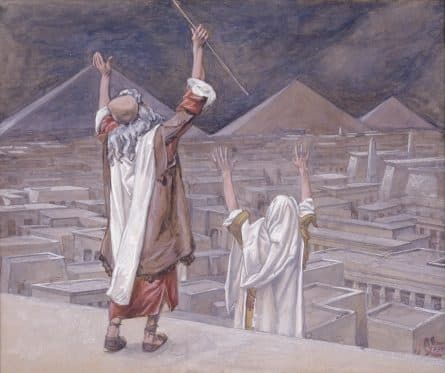
James Tissot, The Plague of Locusts, about 1896 to 1902, The Jewish Museum, New York. Public domain by date, via Wikimedia Commons.
THE ARTWORKTissot set Moses and Aaron on a rooftop above the flat roofs of the city, with Moses lifting his staff toward a dark sky over the pyramids.
Summary
The locust is the eighth plague on Egypt, and Scripture returns to it as the curse on a harvest, the army of the Day of the LORD and the woe of the fifth trumpet.
- The locusts of Exodus 10 leave nothing green in Egypt and are blown into the Red Sea.
- Deuteronomy 28 names locusts among the curses on Israel's own fields.
- Joel calls the swarm the LORD's army and calls the people to return to Him.
- Revelation 9 sees locusts rise from the Abyss to torment those without the seal of God.
- The law lets Israel eat the locust, and John the Baptist's food was locusts and wild honey.
The Eighth Plague
Exodus 10:1 to 20 tells the warning, the bargain, the swarm and its removal.
God sends the signs so that Israel will tell its children of them, and the locusts come for whatever the hail left standing.
THE WARNING
Moses warns that locusts will cover the land and fill the houses of every Egyptian.
THE OFFICIALS
Pharaoh's officials ask how long Moses will be a snare to them and tell the king that Egypt is in ruins.
THE BARGAIN
Pharaoh will let only the men go to worship, and he has Moses and Aaron driven out.
THE EAST WIND
Moses stretches out his staff, and the LORD sends an east wind all day and all night that brings the locusts by morning.
THE CONFESSION
Pharaoh says he has sinned and asks Moses to pray that this death be taken from him.
THE WEST WIND
The LORD turns the wind, a very strong west wind carries the locusts into the Red Sea, and the LORD hardens Pharaoh's heart again.
The locusts swarmed across the land and settled over the entire territory of Egypt. Never before had there been so many locusts, and never again will there be. They covered the face of all the land until it was black, and they consumed all the plants on the ground and all the fruit on the trees that the hail had left behind. Nothing green was left on any tree or plant in all the land of Egypt.Joel 2:2 gives its army the same measure, one never seen before and never to be seen again.
The Locust Across the Canon
Thirteen passages from Exodus to Revelation where the locust returns.
- Exodus 10:14a swarm never matched before or after
- Leviticus 11:22the locust among the clean foods
- Deuteronomy 28:38the locust that eats the seed Israel sows
- Judges 6:5Midian's camps as many as a swarm
- 1 Kings 8:37locusts in Solomon's prayer
- Psalms 105:34the plague of Egypt sung
- Proverbs 30:27no king, yet they advance in formation
- Joel 1:4four names for one ruin
- Joel 2:25the eaten years repaid
- Amos 7:1a swarm turned back at a prophet's prayer
- Nahum 3:15Nineveh's guards fly off like locusts
- Mark 1:6John's food in the wilderness
- Revelation 9:3locusts out of the smoke of the Abyss
Each card opens its passage in the reader.
From Egypt to the Abyss
Deuteronomy 28 names the locust twice among the curses, at verses 38 and 42.
In the law the plague changes sides, since Moses warns that the locust that struck Egypt will eat Israel's harvest if Israel does not obey the LORD.
You will sow much seed in the field but harvest little, because the locusts will consume it.And out of the smoke, locusts descended on the earth, and they were given power like that of the scorpions of the earth. They were told not to harm the grass of the earth or any plant or tree, but only those who did not have the seal of God on their foreheads.This is the last locust of Scripture, sent out of the Abyss at the fifth trumpet.
Joel's Locusts
Readers of Joel 1 and 2 part over whether the swarm is insects, men or both.
A swarm of insectsAdam Clarke, Matthew Henry
Adam Clarke, in his Commentary on the Bible, says there can be little doubt that real locusts are meant in Joel 1:6. Matthew Henry, in his Commentary on the Whole Bible, reads Joel 2:20 as locusts removed in mercy from a penitent people, where the locusts of Egypt were removed in wrath from an impenitent king.
The objection to this reading is that Joel 2:20 calls the swarm the northern army, a name that suits soldiers.
The northern army I will drive away from you, banishing it to a barren and desolate land, its front ranks into the Eastern Sea, and its rear guard into the Western Sea. And its stench will rise; its foul odor will ascend. For He has done great things.The swarm is driven into the eastern and western seas, as the locusts of Egypt were driven into the Red Sea.
An invading armyJohn Wesley
John Wesley, in his Explanatory Notes upon the Old Testament, reads the fire of Joel 2:3 as the Chaldeans, and on Joel 1:6 he allows the powerful nation to be the Assyrians or the Babylonians.
For a nation has invaded My land, powerful and without number; its teeth are the teeth of a lion, and its fangs are the fangs of a lioness. It has laid waste My grapevine and splintered My fig tree. It has stripped off the bark and thrown it away; the branches have turned white.Joel's first picture of the swarm calls it a nation, the word this reading rests on.
The objection to this reading is that Joel 2:4 to 9 compares the swarm to horses and to soldiers, and a comparison keeps the two apart.
They charge like mighty men; they scale the walls like men of war. Each one marches in formation, not swerving from the course. They do not jostle one another; each proceeds in his path. They burst through the defenses, never breaking ranks. They storm the city; they run along the wall; they climb into houses, entering through windows like thieves.A swarm that foreshadows an armyJamieson, Fausset and Brown, Adam Clarke
Jamieson, Fausset and Brown, in their Commentary Critical and Explanatory, read the LORD's command in Joel 2:11 as given both to the locusts and to the human enemies of Judea whom the locusts foreshadow. Adam Clarke, in his Commentary on the Bible, allows that Joel 1 may be a double prophecy, with the four names of Joel 1:4 standing for four attacks of the Chaldeans.
The objection to this reading is that Joel 1 and 2 never name the later invader, so the second sense depends on history outside the text.
The LORD raises His voice in the presence of His army. Indeed, His camp is very large, for mighty are those who obey His command. For the Day of the LORD is great and very dreadful. Who can endure it?The double reading turns on whom this verse calls the LORD's army.
Locusts in the Ancient World
What travellers and ancient writers record of the swarms, and how the law treats the locust as food.
What travellers and Pliny sawAdam Clarke, Albert Barnes, John Gill
Adam Clarke quotes Dr. Shaw, who saw locusts in Barbary in 1724 and 1725. In June, Shaw wrote, the swarms gather into compact bodies a furlong or more square and march on, eating everything green or juicy.
Albert Barnes gathers travellers' reports that a field the locusts have grazed looks scorched as if by fire, which is the picture of Joel 2:3. John Gill notes that Pliny called locusts the plague of the gods.
The east wind and the west windAlbert Barnes, John Wesley
Albert Barnes, in his note on Exodus 10:13, says Moses takes care to record the east wind as the natural cause of the plague. He adds that its size and its timing at Moses' word still make it a portent.
“An east-wind brought the locusts and now a west-wind carried them off. Whatever point of the compass the wind is in, it is fulfilling God's word, and turns about by his counsel; the wind blows where it listeth for us, but not where it listeth for him; he directeth it under the whole heaven.”
John Wesley · Explanatory Notes upon the Old Testament · on Exodus 10:19Evangelical
Of these you may eat any kind of locust, katydid, cricket, or grasshopper.The law forbids most flying insects and names four kinds of locust that Israel may eat.
John wore a garment of camel’s hair, with a leather belt around his waist. His food was locusts and wild honey.John the Baptist ate what Leviticus allows, in the wilderness where he preached.
The Names of the Locust
Seven Hebrew words and one Greek word for the locust, from the verses where they stand.
The words of Joel 1:44 Hebrew words
Adam Clarke derives arbeh from rabah, to multiply, because the swarms are so large. The promise to repay in Joel 2 names these four in another order, and Albert Barnes takes the change to mean that the weight falls on one swarm coming after another.
| Word | Sense | Where it stands |
|---|---|---|
| ʼarbeh, H697 | a locust, from its rapid increase | the swarming locust, Exodus 10:4 and Joel 1:4 |
| gâzâm, H1501 | a kind of locust | the devouring locust, Joel 1:4 |
| yeleq, H3218 | a devourer, the young locust | the young locust, Joel 1:4 |
| châçîyl, H2625 | the ravager, a locust | the destroying locust, Joel 1:4 |
- Word
- ʼarbeh, H697
- Sense
- a locust, from its rapid increase
- Where it stands
- the swarming locust, Exodus 10:4 and Joel 1:4
- Word
- gâzâm, H1501
- Sense
- a kind of locust
- Where it stands
- the devouring locust, Joel 1:4
- Word
- yeleq, H3218
- Sense
- a devourer, the young locust
- Where it stands
- the young locust, Joel 1:4
- Word
- châçîyl, H2625
- Sense
- the ravager, a locust
- Where it stands
- the destroying locust, Joel 1:4
Leviticus 11:22 and the Greek word3 Hebrew words, 1 Greek word
| Word | Sense | Where it stands |
|---|---|---|
| çolʻâm, H5556 | a kind of locust, from its destructiveness | the katydid, Leviticus 11:22 |
| chârᵉgôl, H2728 | the leaping insect, a locust | the cricket, Leviticus 11:22 |
| châgâb, H2284 | a locust | the grasshopper, Leviticus 11:22 |
| akrís, G200 | a locust | Matthew 3:4, Mark 1:6 and Revelation 9:3 |
- Word
- çolʻâm, H5556
- Sense
- a kind of locust, from its destructiveness
- Where it stands
- the katydid, Leviticus 11:22
- Word
- chârᵉgôl, H2728
- Sense
- the leaping insect, a locust
- Where it stands
- the cricket, Leviticus 11:22
- Word
- châgâb, H2284
- Sense
- a locust
- Where it stands
- the grasshopper, Leviticus 11:22
- Word
- akrís, G200
- Sense
- a locust
- Where it stands
- Matthew 3:4, Mark 1:6 and Revelation 9:3
What the Text Leaves Unsaid
The questions Exodus 10, Joel and Revelation 9 leave open.
Exodus 10 gives no count of the locusts and no length of their stay; it measures the plague by the land they covered and the plants they ate.
Joel 1:1 names no king, so the book carries no date of its own.
Revelation 9 gives the locusts a king and a span of five months, and it does not explain what the five months measure.
The Years Eaten by Locusts
Joel 2:12 to 32 answers the swarm with a call to return, a promise to repay, and the Spirit poured out.
“Yet even now,” declares the LORD, “return to Me with all your heart, with fasting, weeping, and mourning.” So rend your hearts and not your garments, and return to the LORD your God. For He is gracious and compassionate, slow to anger, abounding in loving devotion. And He relents from sending disaster.I will repay you for the years eaten by locusts—the swarming locust, the young locust, the destroying locust, and the devouring locust—My great army that I sent against you.God calls the swarm My great army in this verse, so the One who sent the loss promises to repay it.
No, this is what was spoken by the prophet Joel: ‘In the last days, God says, I will pour out My Spirit on all people. Your sons and daughters will prophesy, your young men will see visions, your old men will dream dreams.Peter quoted this promise at Pentecost to explain what the crowd was seeing.
Voices on the Locusts
Ambrose in the fourth century, and Matthew Henry and John Wesley in the eighteenth, on the locusts sent, removed and repaid.
“Even the locust, by divine grace, penetrates everywhere, and when it has filled the width of each region with its dense swarm, it first strikes without harm, and feeds on the barren land only after receiving the divine signal of permission. Indeed, just as we read in Exodus, it also acts as the celestial executor of righteous vengeance.”
Ambrose of Milan · The Six Days of Creation 5.23.82 · on Exodus 10:12Patristic
“He never desired the woeful day, though he threatened it. His commission indeed ran against Egypt, but his intercession was for it, which was a good reason why they should love him, though they feared him. It was also as strong an argument for their repentance as the judgment itself; for by this it appeared that God is ready to forgive, and swift to show mercy.”
Matthew Henry · Commentary on the Whole Bible · on Exodus 10:18 to 19Puritan
“Though, in justice, he distrained upon them, and did them no wrong, yet, in compassion, he makes restitution; as the father of the prodigal, upon his return, made up all he had lost by his sin and folly, and took him into his family, as in his former estate.”
Matthew Henry · Commentary on the Whole Bible · on Joel 2:25Puritan
“Pharaoh desires their prayers that this death only might be taken away, not this sin: he deprecates the plague of locusts, not the plague of a hard heart.”
John Wesley · Explanatory Notes upon the Old Testament · on Exodus 10:17Evangelical
The Locusts of the Abyss
Three readings of Revelation 9:1 to 11, each with its holders and the objection it meets.
Spiritual powers of evilTiconius, Andreas of Caesarea
Ticonius, in his Commentary on the Apocalypse, reads the locusts as spiritual and adversarial powers that fly in the air to harm humankind. Andreas of Caesarea, in his Commentary on the Apocalypse, calls them spiritual locusts whose sting is the death of the soul, laid on those who have not signed their foreheads with the divine seal.
The objection to this reading is that John gives the locusts a fixed task and a fixed season, which reads as one judgment within history.
The locusts were not given power to kill them, but only to torment them for five months, and their torment was like the stinging of a scorpion. In those days men will seek death and will not find it; they will long to die, but death will escape them.These verses set the limits of the torment the locusts bring.
Armies of the later centuriesJohn Wesley, John Gill, Albert Barnes
John Wesley, in his Explanatory Notes upon the New Testament, takes the locusts to be the Persians. John Gill, in his Exposition of the New Testament, reads their iron breastplates as the armour of the Saracens. Albert Barnes, in his Notes, Explanatory and Practical, on the Old and New Testaments, reads the fallen star as a military chieftain who summons the pit's legions.
The objection to this reading is that its holders part over which army is meant, because the text names none.
Then the fifth angel sounded his trumpet, and I saw a star that had fallen from heaven to earth, and it was given the key to the pit of the Abyss. The star opened the pit of the Abyss, and smoke rose out of it like the smoke of a great furnace, and the sun and the air were darkened by the smoke from the pit.Powers from the Abyss at the end of the ageJamieson, Fausset and Brown
Jamieson, Fausset and Brown, in their Commentary Critical and Explanatory, say these are no natural locusts, since they come up from hell and are held back from the grass to mark the judgment as divine. They place the fifth trumpet after the sealing of the servants of God in Revelation 7.
The objection to this reading is that John describes the locusts in likenesses, and the other two readings take those likenesses as figures.
And the locusts looked like horses prepared for battle, with something like crowns of gold on their heads, and faces like the faces of men. They had hair like that of women, and teeth like those of lions. They also had thoraxes like breastplates of iron, and the sound of their wings was like the roar of many horses and chariots rushing into battle. They had tails with stingers like scorpions, which had the power to injure people for five months. They were ruled by a king, the angel of the Abyss. His name in Hebrew is Abaddon, and in Greek it is Apollyon.The likenesses and the king of the Abyss are the words every reading has to explain.
Books on the Locusts
The commentaries on Joel and Revelation 9 a student reads next.
Exposition of the Old Testament
John Gill · 1748 to 1763
Its notes on Joel 2 read the swarm with the Jewish commentators Jarchi and Kimchi beside it.
READ HIS JOEL NOTES →Notes, Explanatory and Practical, on the Old and New Testaments
Albert Barnes · 1832 to 1869
Barnes takes the call to return in Joel 2:12 as the one way of escape from the swarm.
READ HIS JOEL NOTES →Commentary Critical and Explanatory on the Whole Bible
Jamieson, Fausset and Brown · 1871
Its notes on Revelation 9 read the fifth trumpet with the Greek text beside the English.
READ THEIR REVELATION NOTES →The Lord of the Swarm
Paul gives Joel's promise to all who confess that Jesus is Lord, with no difference between Jew and Greek. The text asks the reader to return to Him with the whole heart while the day is still coming.
And everyone who calls on the name of the LORD will be saved; for on Mount Zion and in Jerusalem there will be deliverance, as the LORD has promised, among the remnant called by the LORD.Joel's prophecy of the locust army ends in a promise of rescue for everyone who calls on the LORD.
Keep studying
Read it4
Studies6
Doctrines10
Peoples and groups1