
Numbers 15 · Symbol · Featured Study
The Tassels and the Blue Cord
The tassels Israel wore on the corners of the cloak, from the Law of Numbers 15 to the cloak of Jesus in Matthew 9.
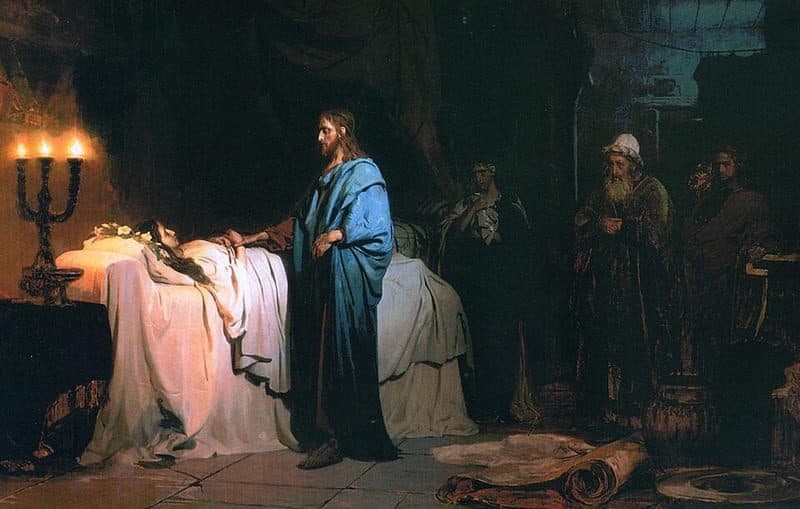
Ilya Repin, Raising of Jairus' Daughter, 1871. Russian Museum. Public domain by date, via Wikimedia Commons (Ilja Jefimowitsch Repin 013.jpg).
THE ARTWORKIlya Repin painted Jesus at the bedside of Jairus' daughter, in the house He was walking to when the woman of Matthew 9 reached for His cloak.
One cord on every Israelite's tassel was blue, the colour that ran through the tabernacle's curtains and the high priest's robe.
Summary
Numbers 15 tells the Israelites to make tassels for the corners of their garments throughout the generations to come.
- The tassels were for Israel to look at, so that they would remember all the commandments of the LORD and obey them instead of following their own heart and their own eyes.
- Deuteronomy 22:12 sets the tassels on the four corners of the cloak, directly after the law against wool and linen woven together.
- A woman who had suffered from bleeding for twelve years touched the fringe of Jesus' cloak and was healed. Matthew's word for that fringe is his word for the Pharisees' tassels.
- Commentators from Jerome to Barnes disagree over the sense of the colour and over the edge of Jesus' cloak.
The Command in Numbers 15
Numbers 15:37 to 41 gives Israel tassels with a blue cord on each, and the reason for them.
The command closes a chapter of laws given in the wilderness, directly after a man found gathering wood on the Sabbath was stoned outside the camp in Numbers 15:32 to 36.
“Speak to the Israelites and tell them that throughout the generations to come they are to make for themselves tassels for the corners of their garments, with a blue cord on each tassel.This verse names the three parts of the sign: the tassel, the corner of the garment and the blue cord on each tassel.
These will serve as tassels for you to look at, so that you may remember all the commandments of the LORD, that you may obey them and not prostitute yourselves by following your own heart and your own eyes.This verse gives the reason for the tassels and names the danger they guard against.
Then you will remember and obey all My commandments, and you will be holy to your God.Remembering leads to obeying, and obeying makes Israel holy to God.
I am the LORD your God who brought you out of the land of Egypt to be your God. I am the LORD your God.”The command rests on the God who brought Israel out of Egypt to be their God.
The tassels in Deuteronomy 22Deuteronomy 22:11 to 12
Do not wear clothes of wool and linen woven together.Rashi, in his commentary on Deuteronomy 22:12, reads this ban, set directly before the tassels, as leave to make the tassels of wool and linen together.
You are to make tassels on the four corners of the cloak you wear.Deuteronomy fixes the number of tassels at four, one for each corner of the cloak a man wears.
The Corner of the Cloak
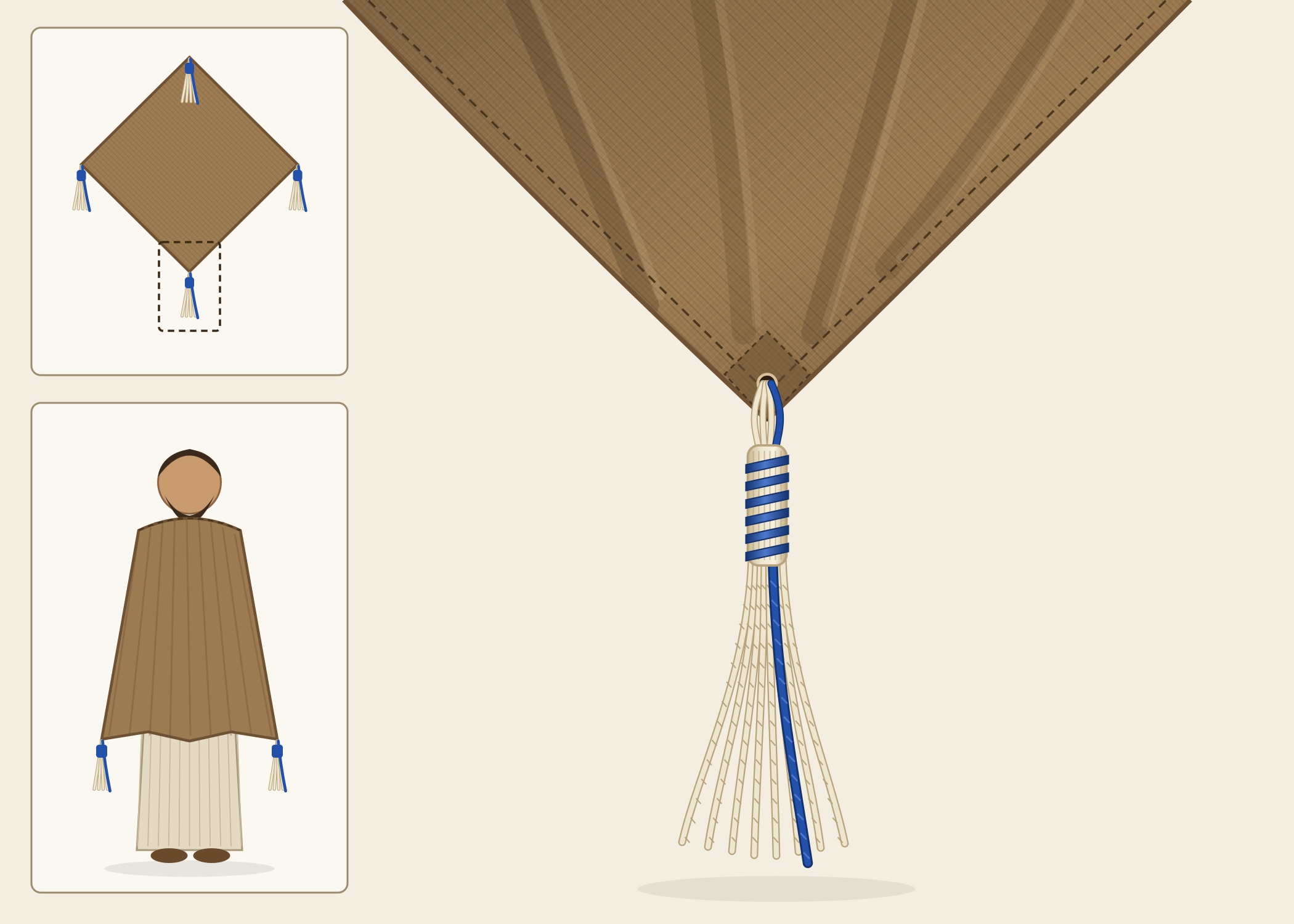
One corner of the cloak is drawn large, with the whole cloak and the cloak as worn beside it.
Each corner of the cloak carried a tassel, and each tassel carried a cord of blue.
- Tsitsit, the tasselA tassel to look at
- Petil tekhelet, the cord of blueOne cord of blue on each tassel
- Gedilim, the twisted threadsDeuteronomy's word for the tassels
- Kanaph, the cornerWhere the tassel hangs
- Beged, the garmentThe garment that carries the tassel
- Arba kanphot, the four cornersA tassel on each of the four corners
- Kesut, the covering you wearThe cloak worn over the tunic
A drawing after Numbers 15 and Deuteronomy 22.
Seven parts are numbered, each with its Hebrew word from Numbers 15 or Deuteronomy 22. The cord of blue is drawn in blue, and the other threads, whose colour the text does not give, in undyed cream.
- Numbers 15:38Moses gives the command in the wilderness
- Deuteronomy 22:12the law repeated before Israel enters the land
- Ruth 3:9Ruth asks Boaz to spread the corner of his garment over her
- 1 Samuel 15:27Saul grabs the hem of Samuel's robe, and it tears
- 1 Samuel 24:4David cuts off a corner of Saul's robe
- Zechariah 8:23ten men from the nations grasp the robe of a Jew
- Matthew 9:20a sick woman comes up behind Him
- Matthew 14:36a whole region brings its sick to Him
- Matthew 23:5the Pharisees lengthen their tassels
A strip of nine passages, from Numbers to Matthew, where the corner or the fringe of a garment stands.
In the first six passages the Hebrew word is kanaph, and in the last three the Greek word is kraspedon.
The Fringe of His Cloak
Matthew tells of a woman and a crowd who reached for the fringe of Jesus' cloak, and of Pharisees who lengthened their tassels.
Suddenly a woman who had suffered from bleeding for twelve years came up behind Him and touched the fringe of His cloak.Matthew names the very part of the cloak she touched, with the word he gives the Pharisees' tassels later in his Gospel.
She said to herself, “If only I touch His cloak, I will be healed.” Jesus turned and saw her. “Take courage, daughter,” He said, “your faith has healed you.” And the woman was cured from that very hour.These verses tell what the touch of the fringe meant, since Jesus says to her that her faith has healed her.
All their deeds are done for men to see. They broaden their phylacteries and lengthen their tassels.Jesus charges the Pharisees with doing their deeds to be seen, and the lengthened tassel is one of His examples.
The same reach at Gennesaret, in Mark and in LukeMatthew 14:35 to 36; Mark 6:56; Luke 8:44
And when the men of that place recognized Jesus, they sent word to all the surrounding region. People brought all the sick to Him and begged Him just to let them touch the fringe of His cloak. And all who touched Him were healed.The crowd brought every sick person to Him, and one touch was enough for each.
And wherever He went—villages and towns and countrysides—they laid the sick in the marketplaces and begged Him just to let them touch the fringe of His cloak. And all who touched Him were healed.Mark shows the same reach for His cloak wherever He went.
She came up behind Jesus and touched the fringe of His cloak, and immediately her bleeding stopped.Luke records that her bleeding stopped at once when she touched the fringe.
Why the woman was afraidLeviticus 15:25
When a woman has a discharge of her blood for many days at a time other than her menstrual period, or if it continues beyond her period, she will be unclean all the days of her unclean discharge, just as she is during the days of her menstruation.This law made a woman with a long discharge of blood unclean for as long as it lasted.
John Wesley, in his Explanatory Notes upon the New Testament, gives her uncleanness under this law as a reason for her fear when Jesus turned and saw her.
Cloaks in Israel's World
Barnes and Wesley describe the garment that carried the tassels, and Exodus 22:25 to 27 shows what a cloak meant to the poor.
Albert Barnes, in his Notes on Numbers 15, describes the ordinary outer garment as a square piece of cloth with a tassel attached to each corner. John Wesley, in his Explanatory Notes upon the Old Testament, places the tassels on the upper garments.
The cloak as a pledgeExodus 22:25 to 27
If you lend money to one of My people among you who is poor, you must not act as a creditor to him; you are not to charge him interest. If you take your neighbor’s cloak as collateral, return it to him by sunset, because his cloak is the only covering he has for his body. What else will he sleep in? And if he cries out to Me, I will hear, for I am compassionate.The cloak that carried the tassels was the only covering a poor man had for his body, so the Law would not let a lender keep it overnight.
Tsitsit, Kanaph and Tekhelet
Numbers 15 names the tassel, the corner and the cord of blue, and Matthew calls the edge of the cloak kraspedon.
| Word | Berean text | Sense in the lexicon | Times in Scripture |
|---|---|---|---|
| צִיצִת tsitsit | tassels | a floral or wing-like projection, a forelock of hair, a tassel | 4 |
| כָּנָף kanaph | corners | an edge or extremity; of a bird a wing, of a garment a flap | 109 |
| פָּתִיל petil | cord | twine | 11 |
| תְּכֵלֶת tekhelet | blue | the cerulean mussel, and the violet colour obtained from it | 49 |
| גְּדִל gedil | tassels | thread, a tassel or festoon | 2 |
| κράσπεδον kraspedon | fringe; tassels | a margin, and especially a fringe or tassel | 5 |
Tsitsit as a lock of hairEzekiel 8:3
The word tsitsit stands once more in Ezekiel 8:3, where the Berean text renders it the hair of my head and Rashi, in his commentary on that verse, gives it as a lock of hair.
The blue dyetekhelet
Rashi, in his commentary on Exodus 25:4, describes the blue as wool dyed with the blood of a kind of shellfish, its colour a greenish blue, and he cites the Talmud at Menachot 44a.
What the Text Leaves Unsaid
Numbers names the tassel, its place and its cord, and leaves their making and the meaning of the blue unsaid.
Numbers 15 gives no count of threads, no knots, no length for the tassel and no way of making the blue. The Gospels give no colour or form for what the sick woman touched.
Rashi on the number of tasselsDeuteronomy 4:2
Rashi, in his commentary on Deuteronomy 4:2, counts a fifth tassel on a garment as adding to the commandments, a rule of later Jewish practice built on the four corners of Deuteronomy 22:12.
The Blue Cord and Holiness
Exodus 28 shows a cord of blue on the high priest's turban, holding the words HOLY TO THE LORD.
You are to make a plate of pure gold and engrave on it as on a seal: HOLY TO THE LORD. Fasten to it a blue cord to mount it on the turban; it shall be on the front of the turban.The Hebrew of Exodus 28:37 has petil tekhelet, the two words of the command in Numbers 15 for the cord on each tassel.
John Wesley, in his notes on Deuteronomy 22, adds that the tassels were a public profession of Israel's nation and religion. In his reading they set Israel apart from strangers and called them to live as the people of God.
Matthew Henry on the Tassels
Matthew Henry reads the command beside the pardon for unintentional sin given earlier in Numbers 15.
His note on Numbers 15:38Commentary on the Whole Bible
“Provision had been just now made by the law for the pardon of sins of ignorance and infirmity; now here is an expedient provided for the preventing of such sins. They are ordered to make fringes upon the borders of their garments, which were to be memorandums to them of their duty, that they might not sin through forgetfulness.”
Matthew Henry · Commentary on the Whole Bible · on Numbers 15:38Puritan
Three Contested Questions
Commentators and the lexicon take up the colour, the fringe in the Gospels and the garment of Deuteronomy 22.
What the tassel and its blue meantWesley, Barnes, Clarke
John Wesley, in his Explanatory Notes upon the Old Testament, holds that the blue cord made the tassel easy to see, since without it the fringe was of the garment's own piece and colour.
Albert Barnes, in his Notes on Numbers 15:38, takes the deep blue as a symbol of the heavenly origin of the commandments the tassel recalled.
Adam Clarke, in his Commentary on the Bible, holds that a fringe stands for a precept only because God appointed it to, since no likeness between the two can be shown.
Numbers 15:39 gives the tassel as a whole its purpose, and the colour receives none of its own, which each reading of the blue has to answer.
The fringe of Jesus' cloakthe lexicon, Gill, Jerome, Henry
One reading takes the fringe for a tassel of the Law. The lexicon gives kraspedon two senses, an edge or border in ordinary Greek and a tassel or corner in the Greek Old Testament and the New. It lists Matthew 9:20 and Matthew 14:36 under the second.
John Gill, in his Exposition of the Old Testament on Deuteronomy 22:12, notes that the Targum of Onkelos renders both Hebrew words by one word taken from the Greek of Matthew 23. Jerome, in his Commentary on Matthew, reads the fringe the sick touched at Gennesaret as the least commandment of Matthew 5:19.
Matthew Henry, in his Commentary on the Whole Bible, holds the other reading, that the fringe of Matthew 9:20 was the very hem of the garment, its extremity. The King James Version renders the word hem and border.
The objection to the reading of a tassel is that Matthew never calls the fringe blue. The objection to the reading of a hem is that Matthew 23:5 uses the same word for the tassels.
The garment of Deuteronomy 22:12Jamieson, Fausset and Brown; Gill
Jamieson, Fausset and Brown, in their Commentary Critical and Explanatory, hold that the precept of Deuteronomy 22:12 differs from that of Numbers 15:38. They give the reading of tassels on the coverlet of a bed. John Gill holds that the same tassels as in Numbers 15:38 are meant under a different word.
The objection to the reading of a coverlet is the verse's own words, the cloak you wear.
Books on the Tassels
Three public domain commentaries read Numbers 15 and Deuteronomy 22 verse by verse.
Explanatory Notes upon the Old Testament
John Wesley · 1765
He treats the blue cord in his notes on Numbers and the four corners in his notes on Deuteronomy.
READ HIS NOTES →Commentary on the Whole Bible
Matthew Henry · 1706
His notes run through Numbers 15 and Matthew 9.
READ HIS COMMENTARY →Exposition of the Old Testament
John Gill · 1748
His notes on Numbers 15 and Deuteronomy 22 draw on the Targums and the rabbis.
The Law He Came to Fulfill
Do not think that I have come to abolish the Law or the Prophets. I have not come to abolish them, but to fulfill them.Jesus says He came to fulfill the Law that gave Israel the tassels.
The holiness the tassels called Israel to in Numbers 15:40 is given in Hebrews 10:10, where believers have been sanctified through the sacrifice of the body of Jesus Christ once for all.
Keep studying
Read it1
Studies6
Places1
Doctrines8
Peoples and groups1