

Popular Bible Encyclopedia of Archimandrite Nicephorus, Rabbah of the Ammonites, 1892. Public domain.
Genesis 19:38 · Place · Featured Study
Ammon
The kingdom on the upper Jabbok fought Israel from the days of the judges to Nehemiah's wall.
Nahash threatened to put out the right eye of every man in Jabesh, and Hanun shaved off half the beard of each of David's envoys.
But when you get close to the Ammonites, do not harass them or provoke them, for I will not give you any of the land of the Ammonites. I have given it to the descendants of Lot as their possession.”
- Today
- Amman, Jordan
- Region
- East of the Jordan
- Site
- 31.950, 35.924
- First named
- Genesis 19:38 “…is the father of the Ammonites of today.”
- Last named
- Zephaniah 2:9 “…be like Sodom and the Ammonites like Gomorrah—a…”
Nahash threatened to put out the right eye of every man in Jabesh, and Hanun shaved off half the beard of each of David's envoys.
Summary
Ammon is the people descended from Lot's younger son, and their country east of the Jordan, with Rabbah as its capital.
- Genesis names Ben-ammi, son of Lot's younger daughter, as the father of the Ammonites.
- The LORD gave the land to Lot's line and forbade Israel to take any of it.
- Israel took Sihon's land between the Arnon and the Jabbok, and an Ammonite king later claimed that land as his own.
- David's army took Rabbah, and Amos, Jeremiah and Ezekiel each named the city for judgment.
Lot's Younger Son
Genesis names the father of the Ammonites, and Deuteronomy gives his people their land.
But when you get close to the Ammonites, do not harass them or provoke them, for I will not give you any of the land of the Ammonites. I have given it to the descendants of Lot as their possession.”The LORD speaks of Ammon's land as His gift, as He had given Seir to Esau.
The Hebrew name Ammon stands for Lot's son, for his people and for their country, the three senses that James Strong's Hebrew dictionary of 1890 gives the one word. Deuteronomy 2:20 adds that the land had first belonged to the Rephaim, whom the Ammonites called Zamzummites. Adam Clarke and John Gill both record the view that they were the Zuzites of Genesis 14:5.
The Hebrew name Ammon stands for Lot's son, for his people and for their country, the three senses that James Strong's Hebrew dictionary of 1890 gives the one word. Deuteronomy 2:20 adds that the land had first belonged to the Rephaim, whom the Ammonites called Zamzummites. Adam Clarke and John Gill both record the view that they were the Zuzites of Genesis 14:5.
Ammon on Smith's Plate
George Adam Smith's plate shows the lands David ruled on both sides of the Jordan.
Ammon's land stretched east of Gilead, between the Jabbok and the desert.
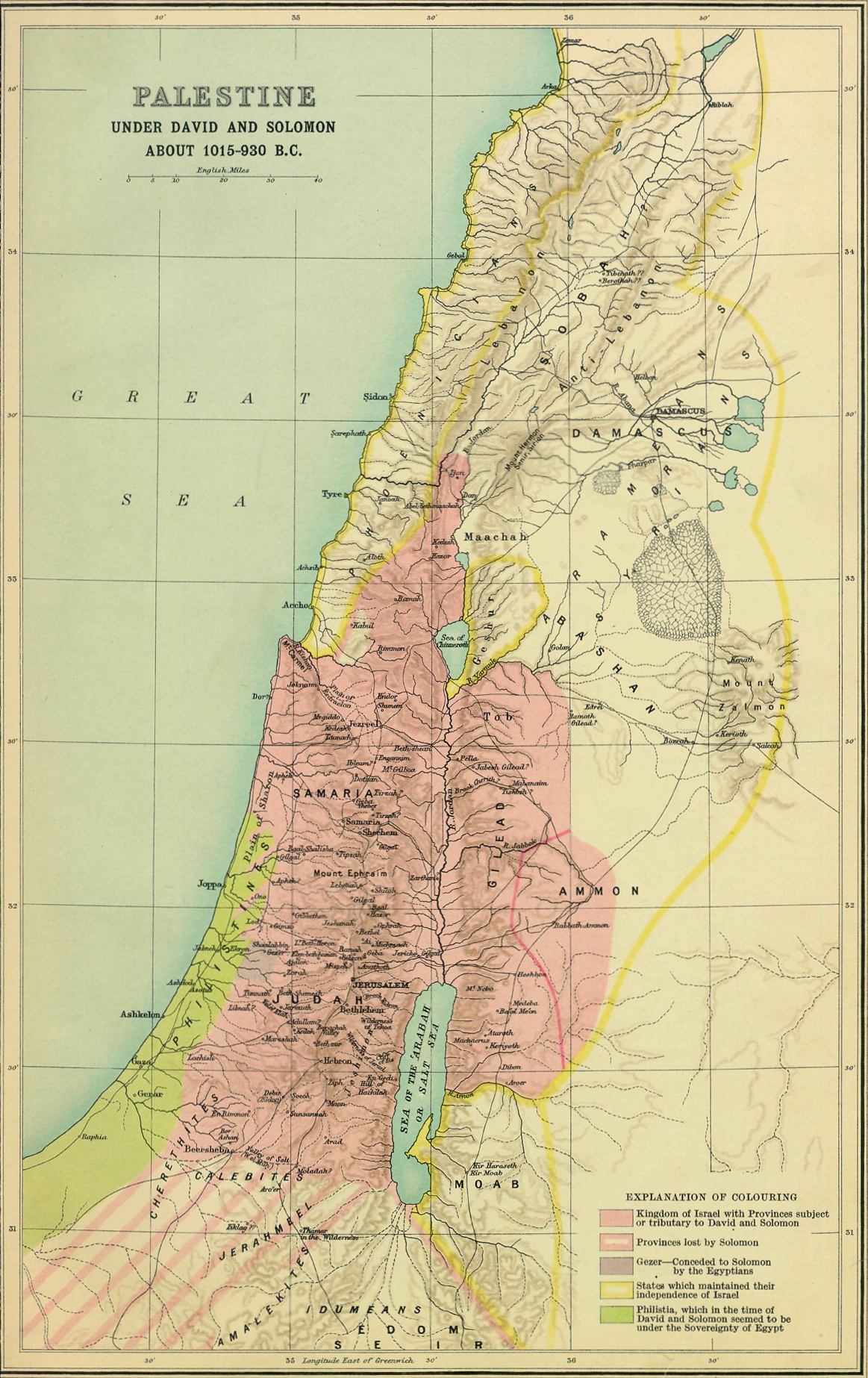
- AmmonSmith colours Ammon among the provinces subject to David.2 Samuel 12:31
- RabbahRabbath Ammon stands on a stream of the upper Jabbok, where Joab took the water supply.2 Samuel 12:27
- The JabbokMoses named the river as the border of the Ammonites.Deuteronomy 3:16
- GileadAmmon pressed on Gilead in the days of Jephthah and of Amos.Amos 1:13
- Jabesh-gileadNahash the Ammonite besieged the town, and Saul relieved it.
- TobJephthah lived here before Gilead called him, and Ammon later hired its men.Judges 11:3
- HeshbonHeshbon was Sihon's city, and Jephthah said Israel had held it for three hundred years.Judges 11:26
- The ArnonThe Arnon marked the southern end of the land the Ammonite king claimed.Judges 11:13
George Adam Smith, Palestine under David and Solomon, Atlas of the Historical Geography of the Holy Land, 1915. Public domain; Wikimedia Commons, File:Palestine_under_David_and_Solomon_(Smith,_1915).jpg.
Eight places are numbered where the plate prints them, from Tob in the north to the Arnon in the south.
Ammon and Israel, in Order
Twelve meetings between the two peoples, from Lot's cave to Nehemiah's wall.
The record of Ammon and Israel runs from Lot's son to Tobiah, through the wars of the judges, Saul, David and Judah's last kings.
- After SodomLot's daughters bear Moab and Ben-ammiGenesis 19:37 to 38
- The march to the JordanIsrael takes Sihon's land only up to Ammon's fortified borderNumbers 21:24
- In the plains of MoabIsrael keeps away from the land of the Ammonites, as the LORD had forbiddenDeuteronomy 2:37
- Eglon's warMoab enlists Ammon and Amalek and takes the City of PalmsJudges 3:13
- Jephthah's warAmmon is subdued from Aroer to MinnithJudges 11:33
- Saul's first battleSaul relieves Jabesh-gilead from Nahash1 Samuel 11:11
- Hanun's insultDavid's envoys are sent home with half their beards2 Samuel 10:4
- The siegeDavid takes Rabbah2 Samuel 12:29
- Absalom's revoltShobi son of Nahash supplies David at Mahanaim2 Samuel 17:27
- Solomon's old ageSolomon follows Milcom1 Kings 11:5
- Judah's last kingsAmmonite raiders come against Jehoiakim2 Kings 24:2
- The rebuilt wallTobiah the Ammonite mocks the buildersNehemiah 4:3
Each row gives the meeting and the verse that tells it.
Hanun's insult, The siege, Absalom's revolt, Solomon's old age, Judah's last kings, The rebuilt wall
The Land Between the Arnon and the Jabbok
An Ammonite king claimed the land Israel had taken from Sihon, and Jephthah answered him from its history.
The king of the Ammonites answered Jephthah’s messengers, “When Israel came up out of Egypt, they seized my land, from the Arnon to the Jabbok and all the way to the Jordan. Now, therefore, restore it peaceably.”The king's claim covers the very land Moses had taken from Sihon king of the Amorites.
And Israel put him to the sword and took possession of his land, from the Arnon to the Jabbok—but only up to the border of the Ammonites, because it was fortified.Israel's own record says the march stopped at the border of the Ammonites.
Now since the LORD, the God of Israel, has driven out the Amorites from before His people Israel, should you now possess it?Jephthah's answer rests on the war with Sihon that Numbers 21 tells.
Adam Clarke, on Judges 11:23, holds that Israel's title was good, because it came by a war the Amorite king had begun.
Half the land of the AmmonitesJoshua 13:25; Albert Barnes
The territory of Jazer, all the cities of Gilead, and half the land of the Ammonites as far as Aroer, near Rabbah;The verse records that part of the old Ammonite country fell to Gad.
Albert Barnes, on Judges 11:13, describes the strip bounded by the two rivers and the Jordan as the old kingdom of Sihon, which had passed to Reuben and Gad.
Rabbah and Its Water Supply
Joab captured the water supply of Rabbah and sent for David to take the city.
In the spring, at the time when kings march out to war, David sent out Joab and his servants with the whole army of Israel. They destroyed the Ammonites and besieged Rabbah, but David remained in Jerusalem.The siege of Rabbah is the war during which David stayed in Jerusalem.
Then Joab sent messengers to David to say, “I have fought against Rabbah and have captured the water supply of the city.Joab reports the fall of the water supply, which left the city unable to hold out.
Albert Barnes, on 2 Samuel 12:27, takes the captured water supply to be the lower town of Rabbah, the modern Amman, built on a stream, with the citadel on a hill to the north. Rabbah means the great city. Jamieson, Fausset and Brown, on Ezekiel 25:5, record that it was rebuilt under the Ptolemies and named Philadelphia, and Deuteronomy 3:11 says that the iron bed of Og king of Bashan was kept there.
What Scripture Leaves Unsaid
Scripture leaves three things about Ammon untold.
Scripture gives Ammon a border on the west at the Jabbok and draws none on the east. Deuteronomy 2:21 says that the LORD destroyed the Rephaim before the Ammonites and does not say when.
The New Testament never names the Ammonites.
Rabbah in the Prophets
Amos, Jeremiah and Ezekiel each name Rabbah, and Jeremiah ends with a promise.
So I will kindle a fire in the walls of Rabbah to consume its citadels amid war cries on the day of battle and a violent wind on the day of tempest.Amos 1:13 gives the cause, the cruelty in Gilead, and this verse the sentence on the capital.
Therefore, behold, the days are coming, declares the LORD, when I will sound the battle cry against Rabbah of the Ammonites. It will become a heap of ruins, and its villages will be burned. Then Israel will drive out their dispossessors, says the LORD.Jeremiah answers the seizure of Gad's cities in Jeremiah 49:1 with the fall of Rabbah.
I will make Rabbah a pasture for camels, and Ammon a resting place for sheep. Then you will know that I am the LORD.’Ezekiel's sentence on Rabbah answers Ammon's gloating over the sanctuary in Ezekiel 25:3.
Yet afterward I will restore the Ammonites from captivity,” declares the LORD.The oracle against Ammon closes with restoration, as the oracle against Moab does in Jeremiah 48:47.
The two roads of Ezekiel 21Ezekiel 21:20
Mark out one road for the sword to come against Rabbah of the Ammonites, and another against Judah into fortified Jerusalem.The king of Babylon stands at a fork with Rabbah down one road and Jerusalem down the other.
In Ezekiel 21:21 the king shakes the arrows, consults the idols and examines the liver, and Ezekiel 21:22 puts the portent for Jerusalem in his right hand. Ezekiel 21:28 then turns the sword back to the Ammonites.
Ezekiel 25:5, Jeremiah 49:6
The Voices on Ammon
Origen, Matthew Henry, John Wesley, and Jamieson, Fausset and Brown wrote on Ammon's sons, its claim and its wars.
died 253 · Origen of Alexandria
Origen doubts that a reader who knows the record of the Ammonites could take Lot and his daughters as a figure of the Lord and the two Testaments.
“But I know that some, so far as the story pertains to a spiritual interpretation, have referred Lot to the person of the Lord and his daughters to the two Testaments. But I do not know if anyone freely accepts these views who knows what the Scripture says about the Ammonites and Moabites who descend from Lot's race.”
Origen of Alexandria · Homilies on Genesis 5.5 · on Genesis 19:37Patristic
1662 to 1714 · Matthew Henry
Matthew Henry sees in Jephthah's three hundred years a claim barred by the passing of time.
“So that, supposing their title had not been clear at the first (which yet he had proved it was), yet, no claim having been made for so many generations, the entry of the children of Ammon, without doubt, was barred for ever.”
Matthew Henry · Commentary on the Whole Bible · on Judges 11:26Puritan
1703 to 1791 · John Wesley
John Wesley dates the eighteen years of Ammon's oppression within the judgeship of Jair.
“And these eighteen years are not to be reckoned from Jair's death, because that would enlarge the time of the Judges beyond the just bounds; but from the fourth year of Jair's reign: so that the greatest part of Jair's reign was contemporary with this affliction.”
John Wesley · Explanatory Notes upon the Old Testament · on Judges 10:8Evangelical
1802 to 1910 · Jamieson, Fausset & Brown
Jamieson, Fausset and Brown see Jephthah trying every means of peace before he would fight.
“The bravest officers have always been averse to war; so Jephthah, whose courage was indisputable, resolved not only to make it clearly appear that hostilities were forced upon him, but to try measures for avoiding, if possible, an appeal to arms: and in pursuing such a course he was acting as became a leader in Israel (De 20:10-18).”
Jamieson, Fausset & Brown · Commentary Critical and Explanatory on the Whole Bible · on Judges 11:12 to 28Reformed
John Wesley, Jamieson, Fausset & Brown
Whose Crown Did David Take?
The Hebrew word behind their king in 2 Samuel 12:30 is also the name of the Ammonite god Milcom.
Then he took the crown from the head of their king. It weighed a talent of gold and was set with precious stones, and it was placed on David’s head. And David took a great amount of plunder from the city.The crown's weight, a talent of gold, is what divides the readers of this verse.
The lexicon lists Malkam as the name of the national idol of the Ammonites.
The crown of the god MilcomAlbert Barnes; Jamieson, Fausset and Brown
Albert Barnes, on 2 Samuel 12:30, reads the word as the idol's name and holds that a crown weighing a hundred pounds or more was too heavy for any man to wear. Jamieson, Fausset and Brown add that crowns of such weight were hung over the head or fixed above the throne, and that the jewel was probably set in David's own crown.
The objection: John Wesley notes that Hebrew uses one word for weight and for price, so the talent may give the crown's worth.
The crown of the Ammonite kingJohn Wesley; Adam Clarke
John Wesley, on 2 Samuel 12:30, points to the precious stones, which are never valued by weight. Adam Clarke reckons that a crown worth a talent of gold, rather than weighing one, could be worn by a king.
The objection: Jeremiah 49:3 sends the same name into exile with priests, which fits a god better than a king.
The Land God Gave
Ammon's history with Israel is a quarrel over land that God had already assigned to each of them. Christ, the Son of David, gives an inheritance no border can take away. The text asks the reader to receive what God gives and to leave alone what He has given to another.
and into an inheritance that is imperishable, undefiled, and unfading, reserved in heaven for you,Peter writes to exiles of the Dispersion, who held no land of their own.
Sources
Scripture is the Berean Standard Bible.
- James Strong, Exhaustive Concordance of the Bible (1890), Hebrew dictionary, entries 5983, 7237 and 4445.
- Adam Clarke, Commentary on the Bible (1832), on Judges 11:23.
- Adam Clarke, Commentary on the Bible (1832), on Deuteronomy 2:20.
- John Gill, Exposition of the Old Testament, on Deuteronomy 2:20.
- Albert Barnes, Notes, Explanatory and Practical, on the Old and New Testaments, on Judges 11:13.
- Albert Barnes, Notes, Explanatory and Practical, on the Old and New Testaments, on 2 Samuel 12:27 and 12:30.
- Jamieson, Fausset and Brown, Commentary Critical and Explanatory on the Whole Bible (1871), on Ezekiel 25:5.
- Jamieson, Fausset and Brown, Commentary Critical and Explanatory on the Whole Bible (1871), on 2 Samuel 12:30.
- John Wesley, Explanatory Notes upon the Old Testament (1765), on Judges 10:8.
- John Wesley, Explanatory Notes upon the Old Testament (1765), on 2 Samuel 12:30.
- Jamieson, Fausset and Brown, Commentary Critical and Explanatory on the Whole Bible (1871), on Judges 11:12 to 28.
- Adam Clarke, Commentary on the Bible (1832), on 2 Samuel 12:30.
- Matthew Henry, Commentary on the Whole Bible (1710), on Judges 11:26.
- Origen, Homilies on Genesis 5.5, on Genesis 19:37.
- OpenBible.info Bible Geocoding: Ammon, the gazetteer's point.
Keep Studying
Read it4
People and groups4