
Ruth 2 to 4 · Subject · Featured Study
A Day in the Life
The hours, the meal, the measure and the household of a harvest town, as the book of Ruth records them.
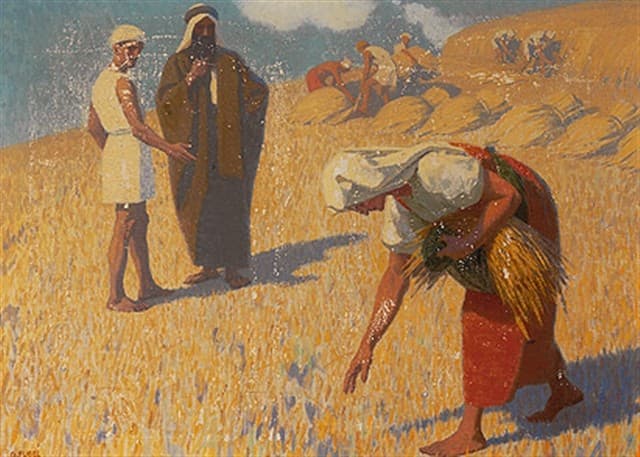
Gebhard Fugel, Wheat Harvest with Ruth (Weizenernte mit Ruth), about 1900. Public domain, via Wikimedia Commons, File:Gebhard Fugel Weizenernte mit Ruth.jpg.
THE ARTWORKFugel painted Ruth bent low in the stubble, a white cloth over her head and an armful of stalks against her red skirt, reaching for the next ear. Boaz stands behind her in a dark cloak beside a young man in a short tunic who points her out, and on the bright slope beyond them the reapers cut and bind the sheaves.
Ruth gleaned in Boaz's field from morning until evening and carried home about an ephah of barley.
Summary
In the time of the judges a working day in an Israelite town ran by the sun, and Ruth 2 to 4 follow such days through a field, a threshing floor and a town gate.
- Harvesters ate in the field at mealtime, and a guest at their meal was given bread, vinegar sauce and roasted grain.
- Barley was winnowed at night on the threshing floor, and business was settled at the town gate in the morning.
- Readers from the Targum to Rashi weighed the barley Boaz gave Ruth at the threshing floor differently, from six seahs to six barleycorns.
The Working Day in the Law
Four verses of the psalms, the proverbs and the law that set the bounds and the wage of a day's work.
Man goes forth to his work and to his labor until evening.The psalm sends a person out to work once the sun has risen and the young lions have gone back to their dens.
She rises while it is still night to provide food for her household and portions for her maidservants.This verse puts the first work of the day in the house, done by its mistress before the field work of the psalm begins.
Do not muzzle an ox while it is treading out the grain.It carries the law's care for a day's work past the people who do it, to the animal that works beside them.
You are to pay his wages each day before sunset, because he is poor and depends on them. Otherwise he may cry out to the LORD against you, and you will be guilty of sin.This law fixed an end to the employer's day as well as the worker's, because the debt fell due when the sun went down.
Ruth's Days, From the Field to the Gate
Ruth's first day of gleaning ends at the seventh stop, and the night of winnowing and the day after it hold the rest.
- MorningRuth goes out to glean behind the harvesters and comes to the part of the field that belongs to Boaz.Ruth 2:3
- Boaz arrivesBoaz comes out from Bethlehem and greets the harvesters in the name of the LORD.Ruth 2:4
- From morning until nowThe foreman tells Boaz she has worked since morning, with a short rest in the shelter.Ruth 2:7
- The water jarsBoaz tells her to drink from the jars the young men have filled.Ruth 2:9
- MealtimeRuth eats at the harvesters' meal.Ruth 2:14
- Until eveningShe gathers until evening and beats out what she has gleaned.Ruth 2:17
- Into the townShe carries the grain home and gives Naomi the food saved from her meal.Ruth 2:18
- NightBoaz winnows barley on the threshing floor.Ruth 3:2
- After the evening mealBoaz finishes eating and drinking and lies down at the end of the heap of grain.Ruth 3:7
- MidnightBoaz wakes with a start and finds a woman lying at his feet.Ruth 3:8
- Before anyone could be recognizedRuth rises and goes home with barley in her shawl.Ruth 3:14 to 15
- The gateBoaz goes up to the gate and sits down, to settle the matter that same day.Ruth 4:1
A timeline of twelve stops over two days of Ruth, each with its verse.
Between the seventh stop and the eighth, both grain harvests of the year ran to their end.
The Meal at the Field
What Ruth was given at mealtime, and the law that allowed it.
At mealtime Boaz said to her, “Come over here; have some bread and dip it into the vinegar sauce.” So she sat down beside the harvesters, and he offered her roasted grain, and she ate and was satisfied and had some left over.It is the only verse in Ruth that tells what harvesters ate in the field, so every claim about their meal rests on it.
You must not eat any bread or roasted or new grain until the very day you have brought this offering to your God. This is to be a permanent statute for the generations to come, wherever you live.Roasted grain from the new harvest could be eaten only after the first sheaf had been brought to the priest.
Jamieson, Fausset and Brown describe the roasted grain as new grain roasted on the spot in the field. Albert Barnes notes that grain was the common food of the country.
Matthew Henry adds the lesson the meal held for the afternoon's work.
“She did not, under pretence either of her want or of her labour, eat more than was convenient for her, nor so much as to unfit her for work in the afternoon. Temperance is a friend to industry; and we must eat and drink to strengthen us for business, not to indispose us to it.”
Matthew Henry · Commentary on the Whole Bible · on Ruth 2:14 to 15Puritan
The vinegar sauceRashi on Ruth 2:14; Jamieson, Fausset and Brown on Ruth 2:9; Adam Clarke on Ruth 2:14
Rashi, the eleventh-century commentator of Troyes in France, took the verse to teach that vinegar is good against the heat. The note of the Metsudah edition calls it a refreshing drink for those who work in hot climates.
Jamieson, Fausset and Brown describe it as a poor, weak wine, sometimes mixed with a little olive oil and very cooling at harvest. Adam Clarke took it for a refreshing acid sauce that the reapers used for dipping their bread.
Where the reapers ateRuth 2:7; Albert Barnes; John Gill
The Hebrew of Ruth 2:7 calls the place where Ruth rested the house, and the Berean text renders it the shelter. Albert Barnes took it for the shed or booth where the reapers ate their meals out of the sun, and John Gill placed the meal of Ruth 2:14 in the same booth.
An Ephah of Barley
The measure of Ruth's first day, set beside the omer of the manna and the ephahs others carried.
The site's page on weights and measures sets the ephah, the dry measure of Ruth 2:17, at about 22 litres by most reckonings and as much as 45 by others.
Henry sets the ephah in the English measure of his day and draws a lesson from the sum.
“Ruth had gathered it ear by ear, but, when she had put it all together, it was an ephah of barley, about four pecks. Many a little makes a great deal. It is an encouragement to industry that in all labour, even that of gleaning, there is profit, but the talk of the lips tendeth only to penury.”
Matthew Henry · Commentary on the Whole Bible · on Ruth 2:17Puritan
By Exodus 16:36 an ephah held ten omers, ten days of manna for one person.
- A daily ration of the law
- An ephah carried by hand
The seven counts as a table
| Measure | Omers | Kind | Verse |
|---|---|---|---|
| One person's manna for a day | 1 | A daily ration of the law | Exodus 16:16 |
| Flour with the daily lamb | 1 | A daily ration of the law | Numbers 28:5 |
| Manna on the sixth day | 2 | A daily ration of the law | Exodus 16:22 |
| Gideon's flour for his guest | 10 | An ephah carried by hand | Judges 6:19 |
| Ruth's barley at evening | 10 | An ephah carried by hand | Ruth 2:17 |
| Hannah's flour for Shiloh | 10 | An ephah carried by hand | 1 Samuel 1:24 |
| Jesse's roasted grain for the camp | 10 | An ephah carried by hand | 1 Samuel 17:17 |
A bar chart of seven measures of grain in Scripture, counted in omers, each with its verse.
The Words of the Day
Five Hebrew words for the hours, the meal and the measure of Ruth's day.
BOQER (HEBREW, H1242)
Morning, properly the break of day; the foreman uses it of the time Ruth began her work.
EREB (HEBREW, H6153)
Evening or dusk, the word that ends the working day in Psalm 104:23 and Ruth's gleaning in Ruth 2:17.
CHOMETS (HEBREW, H2558)
Vinegar, the word Numbers 6:3 uses for vinegar made from wine, into which the harvesters dipped their bread.
QALI (HEBREW, H7039)
Roasted ears of grain, a word the lexicon counts six times in the Hebrew Bible.
EPHAH (HEBREW, H374)
A measure for grain, used forty times in the Hebrew Bible.
What the Text Leaves Unsaid
Three questions about Ruth's days that the text leaves open.
Ruth names no hour of the day. The Gospel of John counts twelve hours of daylight, and the owner of the vineyard in Matthew 20 hires workers from the third hour to the eleventh.
The book names no wage for the harvesters and no payment for a gleaner.
It gives no distance from Boaz's field to the town and no count of the weeks between Ruth's first day and the night at the threshing floor.
What the Day Shows
What one day in Boaz's field shows of the law at work among neighbours.
The law left the edges of the field and the gleanings to the poor and the foreigner, as the page on gleaning and the corner of the field sets out. Ruth's first day shows a landowner who kept that law and a household that lived on it.
When Ruth got up to glean, Boaz ordered his young men, “Even if she gathers among the sheaves, do not insult her. Rather, pull out for her some stalks from the bundles and leave them for her to gather. Do not rebuke her.”Boaz gives his young men orders that leave more for Ruth than the gleanings the law reserved.
Then her mother-in-law asked her, “Where did you glean today, and where did you work? Blessed be the man who noticed you.” So she told her mother-in-law where she had worked. “The name of the man I worked with today is Boaz,” she said.Naomi judged from the size of the grain that someone had shown Ruth favour, and she blessed him before she knew his name.
Does the ephah carry a meaning?Abraham ibn Ezra on Ruth 2:17
Abraham ibn Ezra, who wrote on Ruth in the twelfth century, tells of a man who asked him what an ephah of barley signified. Ibn Ezra answered that the text simply reports what happened, and the man later came back to tell him there were many reasons.
Voices on the Harvest Day
Three teachers on Ruth's work and the household it fed, earliest first.
Ambrose of Milan gives the harvest day from the side of the household it fed.
“Does the widow Naomi seem to you of small account, who supported her widowhood on the gleanings from another's harvest, and who, when heavy with age, was supported by her daughter-in-law? It is a great benefit both for the support and for the advantage of widows that they so train their daughters-in-law as to have in them a support in full old age, and, as it were, payment for their teaching and reward for their training.”
Ambrose of Milan · Concerning Widows 6.33 · on Ruth 2:2Patristic
Theodoret of Cyrus gives the same day from the side of the landowner and the manner of his giving.
“The story of Boaz also teaches us about virtue. For he not only liberally shares his grain with Ruth but also consoles her with words. Not only does he share food with her but also was himself the minister of his kindness; so that whoever …”
Theodoret of Cyrus · Questions on Ruth · on Ruth 2:12Patristic
Henry follows Ruth past the field to the end of the harvest and her nights at home.
“But she constantly came to her mother at night in due time, as became a virtuous woman, that was for working days, and not for merry nights. And when the harvest was ended (as bishop Patrick expounds it) she did not gad abroad, but kept her aged mother company at home.”
Matthew Henry · Commentary on the Whole Bible · on Ruth 2:23Puritan
How Much Barley Was in the Shawl?
Three readings of the six measures of Ruth 3:15, each with its holders.
The Hebrew of Ruth 3:15 gives the number six and the grain, and names no unit for the measure Boaz gave her.
Six seahs, twice her first dayThe Targum; Albert Barnes
Adam Clarke reports that the Targum renders the words six seahs and adds that Ruth received strength from the LORD to carry them.
Albert Barnes reads six seahs as two ephahs, twice what she gleaned on her first day, and holds that Boaz laid the load on her, probably on her head, because it was heavy.
Six barleycornsRashi
Rashi judged six seahs impossible, because a woman does not carry so large a load. He read the words as six barleycorns, a sign that a son blessed with six blessings would come from her.
A smaller measureAdam Clarke; Malbim
Adam Clarke allows that the omer may be meant, which makes a load of about four gallons and a half.
The Metsudah edition of Rashi, citing Malbim, the nineteenth-century commentator, gives the reading of a kav, a sixth of a seah, half of it for Ruth and half for Naomi.
Reading Further
Five older works on Ruth's harvest, each free to read.
Concerning Widows
Ambrose of Milan, tr. H. de Romestin · 1896
In its fifth and sixth chapters Ambrose sets the widow of the two mites in the Gospel beside Naomi.
Read at New AdventRashi on Ruth
Rashi, in the Metsudah Five Megillot · 2001
Rashi's notes on Ruth are short comments, verse by verse, on the meal, the shawl and the gate.
Read at SefariaIbn Ezra on Ruth
Abraham ibn Ezra, Sefaria Community Translation · 12th century
Ibn Ezra's notes on Ruth are short readings of its words and grammar.
Read at SefariaCommentary on the Whole Bible, Volume II (Joshua to Esther)
Matthew Henry · 1710
Henry's chapters on Ruth are full of lessons for daily work, taken from each scene of the harvest.
Read at CCELCommentary Critical and Explanatory on the Whole Bible
Robert Jamieson, A. R. Fausset and David Brown · 1871
Its notes on Ruth describe the harvest field, the water vessels and the threshing floor.
Read at CCELThe End of the Day
The law of Israel reached into each part of Ruth's days. It left her the gleanings in the field and settled the family's matter before the elders at the gate.
That first evening Naomi told Ruth that Boaz was one of their kinsman-redeemers, and that word led her to the threshing floor and Boaz to the gate.
Keep studying
Doctrines11