
Genesis 31:19 to 35 · Subject · Featured Study
The teraphim
The household figures called teraphim, which Laban, Micah, Michal and the king of Babylon kept or consulted.
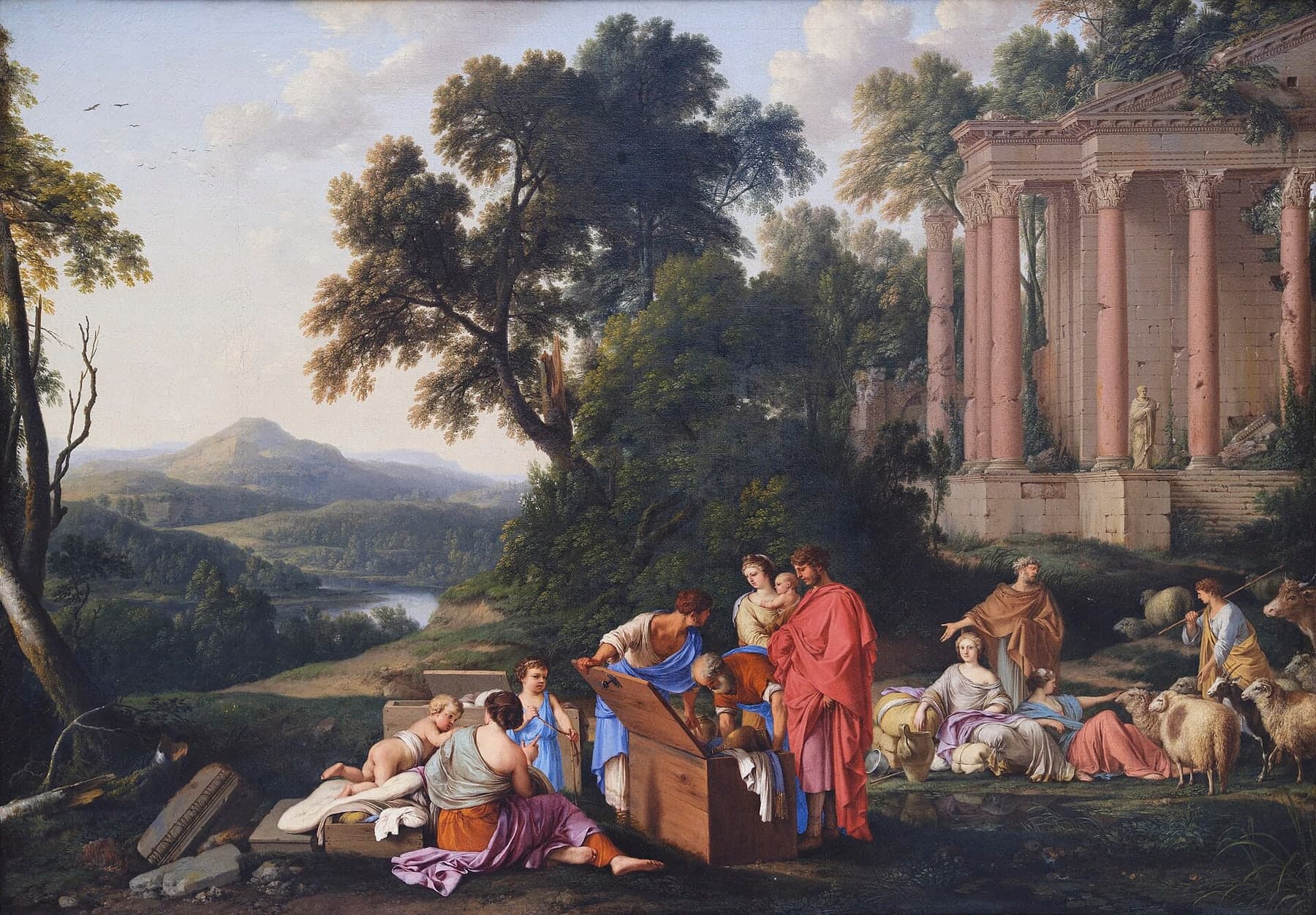
Laurent de La Hyre, Laban Searching Jacob's Baggage for the Stolen Idols, 1647, Musée du Louvre. Public domain, via Wikimedia Commons, File:Laban_cherchant_ses_idoles_dans_les_bagages_de_Jacob_-_Laurent_de_La_Hyre_-_Musée_du_Louvre_Peintures_INV_5354_%3B_MR_1848.jpg
THE ARTWORKLa Hyre painted Laban's search of Jacob's baggage for the gods Rachel had hidden, Genesis 31:33 to 35, and set it among trees, hills and a ruined temple.
Rachel stole her father's household idols, and the prophets later named such figures among the things that deceive.
Summary
Teraphim were figures used in worship and in seeking omens, and the law of Moses forbids both idols and omens.
- The Hebrew word teraphim stands in fifteen verses, from Genesis 31:19 to Zechariah 10:2.
- Micah of Ephraim made them for his shrine, and the Danites carried them north with his priest.
- Samuel set them beside divination when he rebuked Saul, and Josiah removed them from Judah under the law.
- Genesis gives no reason for Rachel's theft, and Gordon's reading of the Nuzi tablets offers one.
From Rachel's Tent to Michal's Ruse
Genesis 31, Judges 17 and 18 and 1 Samuel 19 show the figures in use.
Jacob left Paddan-aram with his wives, his children and his flocks.
Now while Laban was out shearing his sheep, Rachel stole her father’s household idols.The teraphim enter Scripture here, and Laban's pursuit in the rest of the chapter turns on this theft.
Laban pursued Jacob for seven days and overtook him in the hill country of Gilead.
Now you have gone off because you long for your father’s house. But why have you stolen my gods?” “I was afraid,” Jacob answered, “for I thought you would take your daughters from me by force. If you find your gods with anyone here, he shall not live! In the presence of our relatives, see for yourself if anything is yours, and take it back.” For Jacob did not know that Rachel had stolen the idols.Jacob stakes the life of the thief without knowing who it was.
Now Rachel had taken Laban’s household idols, put them in the saddlebag of her camel, and was sitting on them. And Laban searched everything in the tent but found nothing. Rachel said to her father, “Sir, do not be angry that I cannot stand up before you; for I am having my period.” So Laban searched, but could not find the household idols.These verses end the search and hold the last use of the word in Genesis.
In the days of the judges Micah of Ephraim kept a shrine for his household.
Now this man Micah had a shrine, and he made an ephod and some household idols, and ordained one of his sons as his priest. In those days there was no king in Israel; everyone did what was right in his own eyes.Judges ties the shrine to the years before Israel had a king.
Five Danite spies found the shrine on their way to Laish and came back with six hundred armed men to take it.
He replied, “You took the gods I had made, and my priest, and went away. What else do I have? How can you say to me, ‘What is the matter with you?’”Micah's complaint shows that losing the figures left him with nothing he valued.
In Saul's reign Michal, David's wife, used one of the figures to cover her husband's escape.
Then Michal took a household idol and laid it in the bed, placed some goat hair on its head, and covered it with a garment.The figure won time for David after Michal lowered him from the window.
Where the Word Stands
The word appears in the Law, the histories and the prophets, from Genesis to Zechariah.
| Verse | Berean rendering | Who holds them | What is done with them |
|---|---|---|---|
| Genesis 31:19 | household idols | Laban, then Rachel | Rachel steals them |
| Genesis 31:34 | household idols | Rachel | She sits on them in her camel's saddlebag |
| Genesis 31:35 | household idols | Rachel | Laban searches and cannot find them |
| Judges 17:5 | household idols | Micah of Ephraim | He makes them with an ephod |
| Judges 18:14 | household gods | Micah | Danite spies report them |
| Judges 18:17 | household idols | Micah | The five spies take them |
| Judges 18:18 | household idols | Micah | The priest questions the spies |
| Judges 18:20 | household idols | Micah's priest | The priest takes them and goes with the Danites |
| 1 Samuel 15:23 | idolatry | No holder named | Samuel likens Saul's arrogance to their wickedness |
| 1 Samuel 19:13 | household idol | Michal, David's wife | She lays one in the bed in David's place |
| 1 Samuel 19:16 | idol | Michal | Saul's messengers find it in the bed |
| 2 Kings 23:24 | household gods | The people of Judah | Josiah removes them from the land |
| Ezekiel 21:21 | idols | The king of Babylon | He consults them for an omen |
| Hosea 3:4 | idol | The Israelites | Israel is to live many days without them |
| Zechariah 10:2 | idols | Those who consult them | They speak deceit and the people wander |
- Verse
- Genesis 31:19
- Berean rendering
- household idols
- Who holds them
- Laban, then Rachel
- What is done with them
- Rachel steals them
- Verse
- Genesis 31:34
- Berean rendering
- household idols
- Who holds them
- Rachel
- What is done with them
- She sits on them in her camel's saddlebag
- Verse
- Genesis 31:35
- Berean rendering
- household idols
- Who holds them
- Rachel
- What is done with them
- Laban searches and cannot find them
- Verse
- Judges 17:5
- Berean rendering
- household idols
- Who holds them
- Micah of Ephraim
- What is done with them
- He makes them with an ephod
- Verse
- Judges 18:14
- Berean rendering
- household gods
- Who holds them
- Micah
- What is done with them
- Danite spies report them
- Verse
- Judges 18:17
- Berean rendering
- household idols
- Who holds them
- Micah
- What is done with them
- The five spies take them
- Verse
- Judges 18:18
- Berean rendering
- household idols
- Who holds them
- Micah
- What is done with them
- The priest questions the spies
- Verse
- Judges 18:20
- Berean rendering
- household idols
- Who holds them
- Micah's priest
- What is done with them
- The priest takes them and goes with the Danites
- Verse
- 1 Samuel 15:23
- Berean rendering
- idolatry
- Who holds them
- No holder named
- What is done with them
- Samuel likens Saul's arrogance to their wickedness
- Verse
- 1 Samuel 19:13
- Berean rendering
- household idol
- Who holds them
- Michal, David's wife
- What is done with them
- She lays one in the bed in David's place
- Verse
- 1 Samuel 19:16
- Berean rendering
- idol
- Who holds them
- Michal
- What is done with them
- Saul's messengers find it in the bed
- Verse
- 2 Kings 23:24
- Berean rendering
- household gods
- Who holds them
- The people of Judah
- What is done with them
- Josiah removes them from the land
- Verse
- Ezekiel 21:21
- Berean rendering
- idols
- Who holds them
- The king of Babylon
- What is done with them
- He consults them for an omen
- Verse
- Hosea 3:4
- Berean rendering
- idol
- Who holds them
- The Israelites
- What is done with them
- Israel is to live many days without them
- Verse
- Zechariah 10:2
- Berean rendering
- idols
- Who holds them
- Those who consult them
- What is done with them
- They speak deceit and the people wander
Whom Micah's Shrine Served
Judges 17 joins the LORD's name to a graven image, and its readers have taken the shrine in two ways.
And when he had returned the eleven hundred shekels of silver to his mother, she said, “I wholly dedicate the silver to the LORD for my son’s benefit, to make a graven image and a molten idol. Therefore I will now return it to you.”Micah's mother gives the silver to the LORD and in the same sentence orders an image made from it.
A chapel for the worship of the true GodAdam Clarke; John Wesley
Adam Clarke, on Judges 17:5, takes the house of God as a private chapel where mother and son meant to worship the true God.
John Wesley, on Judges 18:24, holds that Micah took the images for lower gods through whom he offered his worship to the true God.
A temple of idol worshipRashi
Rashi, on Judges 17:5, reads the shrine as a temple of idol worship.
Size, Shape and Use
Micah's shrine, the king of Babylon's omen and the commentators show the figures' size and use.
In Micah's house the teraphim stood with an ephod, a graven image and a molten idol.
For the king of Babylon stands at the fork in the road, at the junction of the two roads, to seek an omen: He shakes the arrows, he consults the idols, he examines the liver.The king of Babylon's use shows the teraphim known as a tool of divination beyond Israel.
The commentators on their size and useJamieson, Fausset & Brown; Albert Barnes; Adam Clarke; Rashi
Jamieson, Fausset & Brown describe Rachel's seat as the common pack saddle, which was often used as a cushion to sit or lean on.
Albert Barnes, on 1 Samuel 19:13, judged Michal's figure a bust in human form as large as life.
Adam Clarke, on Ezekiel 21:21, counts three kinds of divination there: by arrows, by images or talismans, and by the entrails of a sacrifice.
Rashi, in his commentary on 2 Kings 23:24, calls the teraphim images that speak through sorcery.
The Word Teraphim
The Hebrew noun, Strong's H8655, is found only in the plural.
In 1 Samuel 19:13 and 19:16 that plural names the single figure Michal laid in the bed.
The Berean text has no single English word for it and renders it household idols, household gods, idols, idol or idolatry.
Laban and Micah both call the figures elohim, gods, in Genesis 31:30 and Judges 18:24.
Jerome, in his Hebrew Questions on Genesis, reports that Aquila translated the word into Greek as figures or images.
What the Text Leaves Unsaid
Genesis 31 and 1 Samuel 19 raise two questions that their verses do not answer.
Genesis does not say what became of Rachel's figures after Laban's search.
So they gave Jacob all their foreign gods and all their earrings, and Jacob buried them under the oak near Shechem.The word teraphim does not stand here, so the text never ties this burial to Rachel's theft.
Rashi, on Genesis 35:2, reads those gods as plunder from the sack of the city in Genesis 34.
1 Samuel does not say whose the figure in David's house was, or why it was there.
John Gill, on 1 Samuel 19:13, judged that Michal kept it privately, since David would not have allowed it in his house had he known.
How Scripture Judges Them
Samuel, the law and the prophets condemn the figures, and Hosea counts them among the things Israel would lose.
After Saul spared Agag and the best of the Amalekites' flocks, Samuel rebuked him in words that use the term.
For rebellion is like the sin of divination, and arrogance is like the wickedness of idolatry. Because you have rejected the word of the LORD, He has rejected you as king.”The word behind idolatry in this verse is teraphim, so Samuel weighs Saul's arrogance against the figures themselves.
Let no one be found among you who sacrifices his son or daughter in the fire, practices divination or conjury, interprets omens, practices sorcery, casts spells, consults a medium or spiritist, or inquires of the dead.The teraphim of Ezekiel 21:21 and Zechariah 10:2 served the very practices this law forbids.
Furthermore, Josiah removed the mediums and spiritists, the household gods and idols, and all the abominations that were seen in the land of Judah and in Jerusalem. He did this to carry out the words of the law written in the book that Hilkiah the priest had found in the house of the LORD.This is the one verse that records the removal of the figures from the land.
For idols speak deceit and diviners see illusions; they tell false dreams and offer empty comfort. Therefore the people wander like sheep, oppressed for lack of a shepherd.Zechariah, prophesying after the exile, still names the figures as a cause of Israel's wandering.
For the Israelites must live many days without king or prince, without sacrifice or sacred pillar, and without ephod or idol.Hosea's list joins the figures to the ephod, as Micah's shrine had joined them.
Henry ends his note on the verse with a warning about the loss of public worship.
“They shall have no sacrifice or altar (so the LXX.), and therefore no sacrifice because no altar. They shall have no ephod, nor teraphim, no legal priesthood, no means of knowing God's mind, no oracle to consult in doubtful cases, but shall be all in the dark. Note, The case of those is very melancholy that are deprived of all opportunities to worship God in public.”
Matthew Henry · Commentary on the Whole Bible · on Hosea 3:4Puritan
Two Voices on the Teraphim
Ambrose of Milan and Jamieson, Fausset & Brown each comment on Genesis 31.
Ambrose of Milan read the scene in Laban's tent as an allegory of the church.
“Moreover, holy Rachel—that is, the church, or prudence—hid the idols, because the church does not know representations and figures of idols that are totally devoid of reality, but it knows the real existence of the Trinity. Indeed, it has destroyed darkness and revealed the splendor of glory.”
Ambrose of Milan · Flight from the World 5.27 · on Genesis 31:34Patristic
Jamieson, Fausset & Brown weigh Laban's two charges against Jacob and find the second the graver.
“Considering the past conduct of Laban, his complaint on this ground was hypocritical cant. But his second charge was a grave one--the carrying off his gods--Hebrew, ‘teraphim,’ small images of human figures, used not as idols or objects of worship, but as talismans, for superstitious purposes.”
Jamieson, Fausset & Brown · Commentary Critical and Explanatory on the Whole Bible · on Genesis 31:26 to 30Reformed
What the Teraphim Were
The teraphim are read as household gods, as ancestor figures or as tokens of family leadership, and only the third reading gives a reason for Rachel's theft.
Household gods kept for omensJohn Gill; Jamieson, Fausset & Brown
Jamieson, Fausset & Brown, in their Commentary Critical and Explanatory on Ezekiel 21:21, call the teraphim household gods worshipped as family talismans, to learn the future.
John Gill, in his Exposition of the Old Testament on 1 Samuel 19:13, likens them to the penates, the household gods of the heathen.
He also reports Aben Ezra's view that they were figures made under a constellation and consulted to foretell things to come.
The objection: Genesis 31 shows no one consulting the figures.
Figures of the family's forefathersKarel van der Toorn
Karel van der Toorn, in The Nature of the Biblical Teraphim in the Light of the Cuneiform Evidence (1990), reads the teraphim as figures of the family's dead forefathers.
2 Kings 23:24 lists the teraphim with the mediums and spiritists, and Deuteronomy 18:11 sets mediums and spiritists beside inquiry of the dead.
The objection: no verse that names the teraphim names a forefather, and the verses that show their use show them consulted for an omen.
Leadership of the family, read from the Nuzi tabletsCyrus H. Gordon; E. A. Speiser
Cyrus H. Gordon and E. A. Speiser read the tablets from Nuzi, near Kirkuk, as parallels to the customs of Laban's household.
Gordon set out the reading in 1940, in Biblical Customs and the Nuzu Tablets, from a tablet in which only a begotten son takes his father's gods.
He held that possession of the gods may have implied leadership of the family, a right that passed to Laban's own sons once they were born.
And Rachel and Leah replied, “Do we have any portion or inheritance left in our father’s house? Are we not regarded by him as outsiders? Not only has he sold us, but he has certainly squandered what was paid for us. Surely all the wealth that God has taken away from our father belongs to us and to our children. So do whatever God has told you.”The sisters' complaint shows that inheritance was in dispute in Laban's house when Rachel took the figures.
The objection: Moshe Greenberg questioned the reading in Another Look at Rachel's Theft of the Teraphim (1962).
Thomas L. Thompson, in The Historicity of the Patriarchal Narratives (1974), and John Van Seters, in Abraham in History and Tradition (1975), argued that the Nuzi parallels had been overstated and in places misread.
Works on the Teraphim
A commentary on Genesis and two journal articles that argue what the teraphim were.
Genesis (Anchor Bible)
E. A. Speiser · 1964
Speiser's commentary carried the Nuzi reading of Genesis 29 to 31 to a wide readership.
In print: find it wherever books are sold.
Another Look at Rachel's Theft of the Teraphim
Moshe Greenberg · 1962
The article stands in volume 81 of the Journal of Biblical Literature, from page 239.
In print: find it wherever books are sold.
The Nature of the Biblical Teraphim in the Light of the Cuneiform Evidence
Karel van der Toorn · 1990
The article stands on pages 203 to 222 of volume 52 of the Catholic Biblical Quarterly.
In print: find it wherever books are sold.
Seeking the LORD Their God
Afterward, the people of Israel will return and seek the LORD their God and David their king. They will come trembling to the LORD and to His goodness in the last days.This promise follows directly on the loss of the teraphim in Hosea 3:4.
John Wesley, on Hosea 3:5, reads David their king as the Messiah, the son of David.
And we know that the Son of God has come and has given us understanding, so that we may know Him who is true; and we are in Him who is true—in His Son Jesus Christ. He is the true God and eternal life. Little children, keep yourselves from idols.These are the last words of John's first letter, which ends on the same choice Hosea 3:4 to 5 sets out.
Keep studying
Read it1
Studies8
People8
Places3
Doctrines1