
Exodus 22 · Exodus 23 · Deuteronomy 15 · Subject · Featured Study
Lending, Pledges and the Year of Release
The laws of the loan, the pledge and the seventh year, from the Book of the Covenant to Nehemiah and the synagogue at Nazareth.
A lender in Israel could take a poor man's cloak as security for a loan, and he had to hand it back before the sun went down.
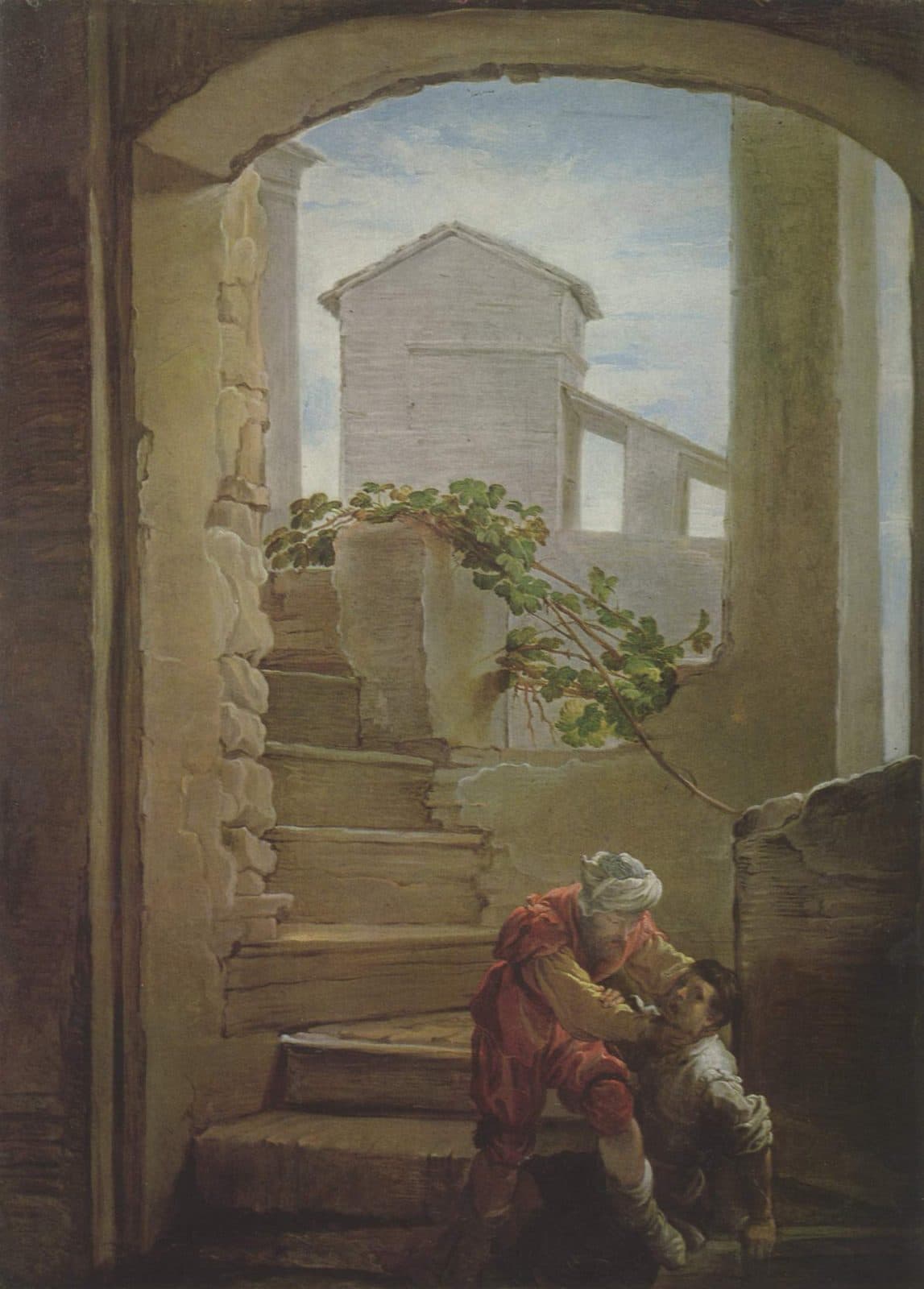
Domenico Fetti, The Parable of the Unforgiving Servant, about 1619 to 1621, Gemäldegalerie Alte Meister, Dresden. Public domain by date (painted before 1930), via Wikimedia Commons.
THE ARTWORKFetti set the parable of Matthew 18:23 to 35 at the foot of a Roman stair, the creditor in red gripping his debtor by the throat. The parable turns on the release of a debt, the subject of Deuteronomy 15.
Summary
The law of Moses governs a loan to the poor in three ways: no interest, a pledge that leaves him what he needs to live, and a release of debts in the seventh year.
- Exodus 22 forbids interest on a loan to a poor Israelite and limits what a lender may hold as a pledge.
- Exodus 23 lets the land lie fallow in the seventh year so that the poor may eat from it.
- Deuteronomy 15 gives the release the verb Exodus 23 uses for the fallow field, and every creditor must cancel what he has loaned to his neighbor.
- Nehemiah made the nobles of Jerusalem restore what they had taken, and Jesus read the year of the Lord's favor as fulfilled at Nazareth.
Six Verses on the Loan
The interest, the cloak, the field, the release, the open hand and the pledge at the door
The first three verses come from the Book of the Covenant in Exodus, and the last three from the laws Moses gave again in Deuteronomy.
If you lend money to one of My people among you who is poor, you must not act as a creditor to him; you are not to charge him interest.This verse sets the rule every later law on lending builds on.
If you take your neighbor’s cloak as collateral, return it to him by sunset, because his cloak is the only covering he has for his body. What else will he sleep in? And if he cries out to Me, I will hear, for I am compassionate.The LORD gives His own reason for the law, and it is His compassion.
For six years you are to sow your land and gather its produce, but in the seventh year you must let it rest and lie fallow, so that the poor among your people may eat from the field and the wild animals may consume what they leave. Do the same with your vineyard and olive grove.This is the earliest command of the sabbatical year in Scripture.
At the end of every seven years you must cancel debts. This is the manner of remission: Every creditor shall cancel what he has loaned to his neighbor. He is not to collect anything from his neighbor or brother, because the LORD’s time of release has been proclaimed.The cancellation is proclaimed as the LORD's own, which makes the creditor's loss a command of God.
Be careful not to harbor this wicked thought in your heart: “The seventh year, the year of release, is near,” so that you look upon your poor brother begrudgingly and give him nothing. He will cry out to the LORD against you, and you will be guilty of sin.The law foresees the lender who will refuse a loan as the year draws near.
When you lend anything to your neighbor, do not enter his house to collect security. You are to stand outside while the man to whom you are lending brings the security out to you.The borrower keeps his house closed to the lender who comes for security.
Nine Further Laws on Lending
From Leviticus, Deuteronomy and Ezekiel, each with its verse
| The law | What it asks of the lender | Verse |
|---|---|---|
| The Sabbath of the land | Do not sow the field or prune the vineyard in the seventh year | Leviticus 25:4 |
| No profit from a destitute countryman | Lend him silver without interest and sell him food without profit | Leviticus 25:37 |
| No interest from a brother | Charge a brother no interest on money, food or any other loan | Deuteronomy 23:19 |
| Interest from a foreigner | A foreigner may be charged interest, and a brother may not | Deuteronomy 23:20 |
| The millstones | Take no pair of millstones and no upper millstone as security | Deuteronomy 24:6 |
| No pledge kept overnight | Give it back the same day when the borrower is poor | Deuteronomy 24:12 |
| The widow's cloak | Take no widow's cloak as security | Deuteronomy 24:17 |
| The righteous man of Ezekiel | He restores the pledge to the debtor | Ezekiel 18:7 |
| The lender at interest in Ezekiel | He who engages in usury will surely die | Ezekiel 18:13 |
- The law
- The Sabbath of the land
- What it asks of the lender
- Do not sow the field or prune the vineyard in the seventh year
- Verse
- Leviticus 25:4
- What it asks of the lender
- Lend him silver without interest and sell him food without profit
- Verse
- Leviticus 25:37
- The law
- No interest from a brother
- What it asks of the lender
- Charge a brother no interest on money, food or any other loan
- Verse
- Deuteronomy 23:19
- The law
- Interest from a foreigner
- What it asks of the lender
- A foreigner may be charged interest, and a brother may not
- Verse
- Deuteronomy 23:20
- The law
- The millstones
- What it asks of the lender
- Take no pair of millstones and no upper millstone as security
- Verse
- Deuteronomy 24:6
- The law
- No pledge kept overnight
- What it asks of the lender
- Give it back the same day when the borrower is poor
- Verse
- Deuteronomy 24:12
- The law
- The widow's cloak
- What it asks of the lender
- Take no widow's cloak as security
- Verse
- Deuteronomy 24:17
- The law
- The righteous man of Ezekiel
- What it asks of the lender
- He restores the pledge to the debtor
- Verse
- Ezekiel 18:7
- What it asks of the lender
- He who engages in usury will surely die
- Verse
- Ezekiel 18:13
From the Field to the Debt
What Exodus, Leviticus and Deuteronomy each add to the seventh year
Exodus gives the seventh year to the land and the poor, Leviticus calls it a Sabbath to the LORD, and Deuteronomy names it the year of release and applies it to loans.
Exodus: the fallow fieldExodus 23:10 to 11
Barnes notes that Exodus speaks of the seventh year and the weekly Sabbath only as they touch the poor.
“This is the first mention of the Sabbatical year; the law for it is given at length in Lev 25:2. Both the Sabbatical year and the weekly Sabbath are here spoken of exclusively in their relation to the poor, as bearing testimony to the equality of the people in their covenant with Yahweh.”
Albert Barnes · Notes, Explanatory and Practical, on the Old and New Testaments (1832-1869) · on Exodus 23:10Evangelical
Leviticus: a Sabbath to the LORDLeviticus 25:4 and 20 to 22
But in the seventh year there shall be a Sabbath of complete rest for the land—a Sabbath to the LORD. You are not to sow your field or prune your vineyard.Here the rest of the seventh year becomes an act of worship.
Now you may wonder, ‘What will we eat in the seventh year if we do not sow or gather our produce?’ But I will send My blessing upon you in the sixth year, so that the land will yield a crop sufficient for three years. While you are sowing in the eighth year, you will be eating from the previous harvest, until the ninth year’s harvest comes in.The LORD answers the farmer's fear with a promise of a crop for three years.
Clement of Alexandria reads the fallow year as the law teaching sharing and humanity.
“So do we now understand how the law educates us in piety, sharing, justice and humanity? Well? Does it not enjoin that the land lie fallow through the seventh year and invites the poor not to be afraid to use any crops that grow by God's grace, nature acting as farmer for any who will?”
Clement of Alexandria · The Stromata Book 2 · on Leviticus 25:4Patristic
Deuteronomy: the year of releaseDeuteronomy 15:3 to 4 and 31:10 to 11
You may collect something from a foreigner, but you must forgive whatever your brother owes you. There will be no poor among you, however, because the LORD will surely bless you in the land that the LORD your God is giving you to possess as an inheritance,The release covers a brother's debt and the promise looks to a land with no poor.
Then Moses commanded them, “At the end of every seven years, at the appointed time in the year of remission of debt, during the Feast of Tabernacles, when all Israel comes before the LORD your God at the place He will choose, you are to read this law in the hearing of all Israel.Every Israelite heard the commands read aloud in that same season.
What the Text Says of the Loan
Three questions of the laws, each with the verse that answers it
WHETHER THE CLOAK RETURNED NIGHTLY
Adam Clarke reads the law in his Commentary on the Bible. In his reading the cloak went back each night and returned to the creditor each morning until the debt was paid.
WHETHER THE LAW FORBADE LENDING
Deuteronomy commands the loan itself and asks the lender to open his hand and lend whatever the poor man needs.
WHEN THE SEVENTH YEAR FELL
Rashi, in his commentary on Deuteronomy, reasons from Deuteronomy 15:9 that the seven years run to a fixed year for the whole land, since a lender could otherwise not fear the year as near.
The Law in the Life of Israel
Jeremiah 34, Nehemiah 5 and 2 Chronicles 36
Scripture reports both the neglect of these laws and one return to them after the exile.
The slaves freed and taken backJeremiah 34:8 to 17
Under Zedekiah the people of Jerusalem freed their Hebrew slaves by covenant and then forced them back into service.
Every seventh year, each of you must free his Hebrew brother who has sold himself to you. He may serve you six years, but then you must let him go free. But your fathers did not listen or incline their ear.The LORD charges the fathers with the same neglect of the seventh year.
The nobles of JerusalemNehemiah 5:1 to 13
In a famine the poor of Judah mortgaged their fields and sold their children to pay for grain and the king's tax. Nehemiah rebuked the nobles and officials for exacting usury from their own brothers.
Please restore to them immediately their fields, vineyards, olive groves, and houses, along with the percentage of the money, grain, new wine, and oil that you have been assessing them.” “We will restore it,” they replied, “and will require nothing more from them. We will do as you say.” So I summoned the priests and required of the nobles and officials an oath that they would do what they had promised.The appeal succeeds where the law had been ignored.
In his Notes on the Old Testament, Albert Barnes takes the percentage of Nehemiah 5:11 to be one in the hundred each month, twelve in the hundred a year.
Henry sets the nobles who kept their oath beside the ancestors of Jeremiah 34 who broke theirs.
“This cheerfulness in promising was well, but that which follows was better: They did according to this promise, and adhered to what they had done, not as their ancestors in a like case, who re-enslaved those whom a little before they had released, Jer. xxxiv. Good promises are good things, but good performances are all in all.”
Matthew Henry · Commentary on the Whole Bible · on Nehemiah 5:13Puritan
The land's Sabbaths2 Chronicles 36:21
So the land enjoyed its Sabbath rest all the days of the desolation, until seventy years were completed, in fulfillment of the word of the LORD through Jeremiah.The Chronicler counts the seventy years of exile as the land's unkept rest.
The Words of the Loan
Six Hebrew words from the lexicon, each in the verse where it stands
NESHEK, INTEREST (HEBREW, H5392)
The lexicon gives interest on a debt, a word it counts 12 times.
NASHAK, TO BITE (HEBREW, H5391)
The lexicon gives to strike with a sting, as a serpent does, and also to oppress with interest on a loan.
CHABAL, TO TAKE A PLEDGE (HEBREW, H2254)
The lexicon gives to bind, and specifically by a pledge, the verb Exodus doubles for the cloak.
ABOT, THE PLEDGE (HEBREW, H5667)
The lexicon gives a pawn, and Deuteronomy uses it for the security the borrower carries out of his house.
SHAMAT, TO LET REST OR REMIT (HEBREW, H8058)
The lexicon gives to let alone or remit, and the word stands for the field left fallow and the debt remitted.
SHEMITTAH, THE RELEASE (HEBREW, H8059)
The lexicon gives remission of debt or suspension of labor, the noun of Deuteronomy 15 and 31.
What the Text Leaves Unsaid
Three questions the laws leave open
The returned exiles pledged to keep the seventh year, and no later verse reports a year in which the release was kept.
When the people of the land bring merchandise or any kind of grain to sell on the Sabbath day, we will not buy from them on a Sabbath or holy day. Every seventh year we will let the fields lie fallow, and will cancel every debt.The pledge stands inside a sworn oath to keep the whole law of Moses.
The law forbids interest from a poor brother and names no rate of interest anywhere.
Deuteronomy does not say whether a debt released in the seventh year could be claimed again in the eighth.
The Year of the Lord's Favor
Jesus at Nazareth, and the prayer for debts forgiven
“The Spirit of the Lord is on Me, because He has anointed Me to preach good news to the poor. He has sent Me to proclaim liberty to the captives and recovery of sight to the blind, to release the oppressed, to proclaim the year of the Lord’s favor.”Jesus reads these words at Nazareth and tells the synagogue they are fulfilled in their hearing.
And forgive us our debts, as we also have forgiven our debtors.Jesus puts the language of the debt and its release into the prayer He taught.
Four Teachers on the Loan
Clement of Alexandria, John Wesley, Matthew Henry and Jamieson, Fausset and Brown, each with the work named
Writing about 200, Clement reads the brother of the law as any who share the faith.
“There is a great deal about sharing and exchanging, but it is enough to say that the law forbids lending at interest to a brother. By brother it means not merely one born of the same parents but a member of the same tribe or one of the same faith, who shares in the same Logos. The law does not deem it right to collect interest on the capital. It seeks to enable free giving to those in need, with hands and minds wide open. God is the creator of this free gift.”
Clement of Alexandria · The Stromata Book 2 · on Exodus 22:25Patristic
Wesley explains why Israel borrowed only from need.
“And such provision the law made for the preserving estates to their families by the year of Jubilee, that a people who had little concern in trade could not be supposed to borrow money but for necessity; therefore it was generally forbidden among themselves; but to a stranger they were allowed to lend upon usury.”
John Wesley · Explanatory Notes upon the Old Testament · on Exodus 22:25Evangelical
Henry reads the pledge at the door as the law's guard on a poor man's house.
“The borrower (says Solomon) is servant to the lender; therefore lest the lender should abuse the advantage he has against him, and improve it for his own interest, it is provided that he shall take not what he pleases, but what the borrower can best spare. A man's house is his castle, even the poor man's house is so, and is here taken under the protection of the law.”
Matthew Henry · Commentary on the Whole Bible · on Deuteronomy 24:10 to 11Puritan
Jamieson, Fausset and Brown argue from the sixth-year promise to the law's divine source.
“None but a legislator who was conscious of acting under divine authority would have staked his character on so singular an enactment as that of the sabbatic year; and none but a people who had witnessed the fulfilment of the divine promise would have been induced to suspend their agricultural preparations on a recurrence of a periodical Jubilee.”
Jamieson, Fausset & Brown · Commentary Critical and Explanatory on the Whole Bible · on Leviticus 25:21Reformed
What the Release Did
Three readings of Deuteronomy 15, each with its case and the strongest objection
A pause in collection for the yearAlbert Barnes, Notes on the Old Testament, on Deuteronomy 15:1
This reading takes the release as a year in which the creditor could not press for payment, and limits it to loans made from poverty.
“The year of release is no doubt identical with the sabbatical year of the earlier legislation (Exo 23:10 ff, and Lev 25:2 ff), the command of the older legislation being here amplified. The release was probably for the year, not total and final, and had reference only to loans lent because of poverty (compare Deu 15:4, Deu 15:7).”
Albert Barnes · Notes, Explanatory and Practical, on the Old and New Testaments (1832-1869) · on Deuteronomy 15:1Evangelical
The objection: the Berean text of Deuteronomy 15:3 tells the creditor to forgive whatever his brother owes.
A cancellation of the debtMatthew Henry, Commentary on the Whole Bible, on Deuteronomy 15:2
This reading takes the verbs cancel and forgive at their full weight, and Henry reads the release as a figure of the pardon of sins.
“This year of release typified the grace of the gospel, in which is proclaimed the acceptable year of the Lord, and by which we obtain the release of our debts, that is, the pardon of our sins, and we are taught to forgive injuries, as we are and hope to be forgiven of God.”
Matthew Henry · Commentary on the Whole Bible · on Deuteronomy 15:2Puritan
The objection: in Exodus 23:11 shamat describes land rested for a single year and then sown again.
A pattern at work in the nationsJonathan Cahn, interview on the Shemitah, Christ in Prophecy
This reading holds that the seventh year still marks the economies of nations in its season.
“On that day something really extraordinary happened — all debts are wiped out! All credits are wiped out. The financial realm is wiped clean every seven years.”
Jonathan Cahn · Christ in Prophecy interview: Jonathan Cahn on the Shemitah (Lamb & Lion Ministries) · on Deuteronomy 15:1 to 2Messianic Jewish
The objection: the law binds a creditor and his brother in the land, and Deuteronomy 15:3 leaves a foreigner's debt to be collected.
Books on the Loan
Three commentaries to read whole, earliest first
Commentary on the Whole Bible
Matthew Henry · 1710
Henry writes on every law of the loan from Exodus 22 to Nehemiah 5.
Explanatory Notes upon the Old Testament
John Wesley · 1765
Wesley gives short notes on the interest law and the year of release.
Commentary Critical and Explanatory
Robert Jamieson, A. R. Fausset and David Brown · 1871
Jamieson, Fausset and Brown wrote notes on the seventh year in Exodus 23, Leviticus 25 and Deuteronomy 15.
The Servant Who Would Not Release
Every one of these laws treats the borrower as the LORD treats him. Jesus told of a servant forgiven a great debt who seized a fellow servant over a small one, and the parable asks the reader to forgive as he has been forgiven.
Then the master summoned him and declared, ‘You wicked servant! I forgave all your debt because you begged me. Shouldn’t you have had mercy on your fellow servant, just as I had on you?’The master's question to the unforgiving servant is the question the law puts to every lender.
Keep studying
Read it4