
Genesis to Esther · Group · Featured Study
Amalek and the Standing War
The people of the Negev who bore Amalek's name, from Abram's day in Genesis 14 to Haman the Agagite in Esther.
After the battle at Rephidim, Moses said that the LORD will war against Amalek from generation to generation.
- Began
- With Amalek, born to Eliphaz and Timna (Genesis 36:12)
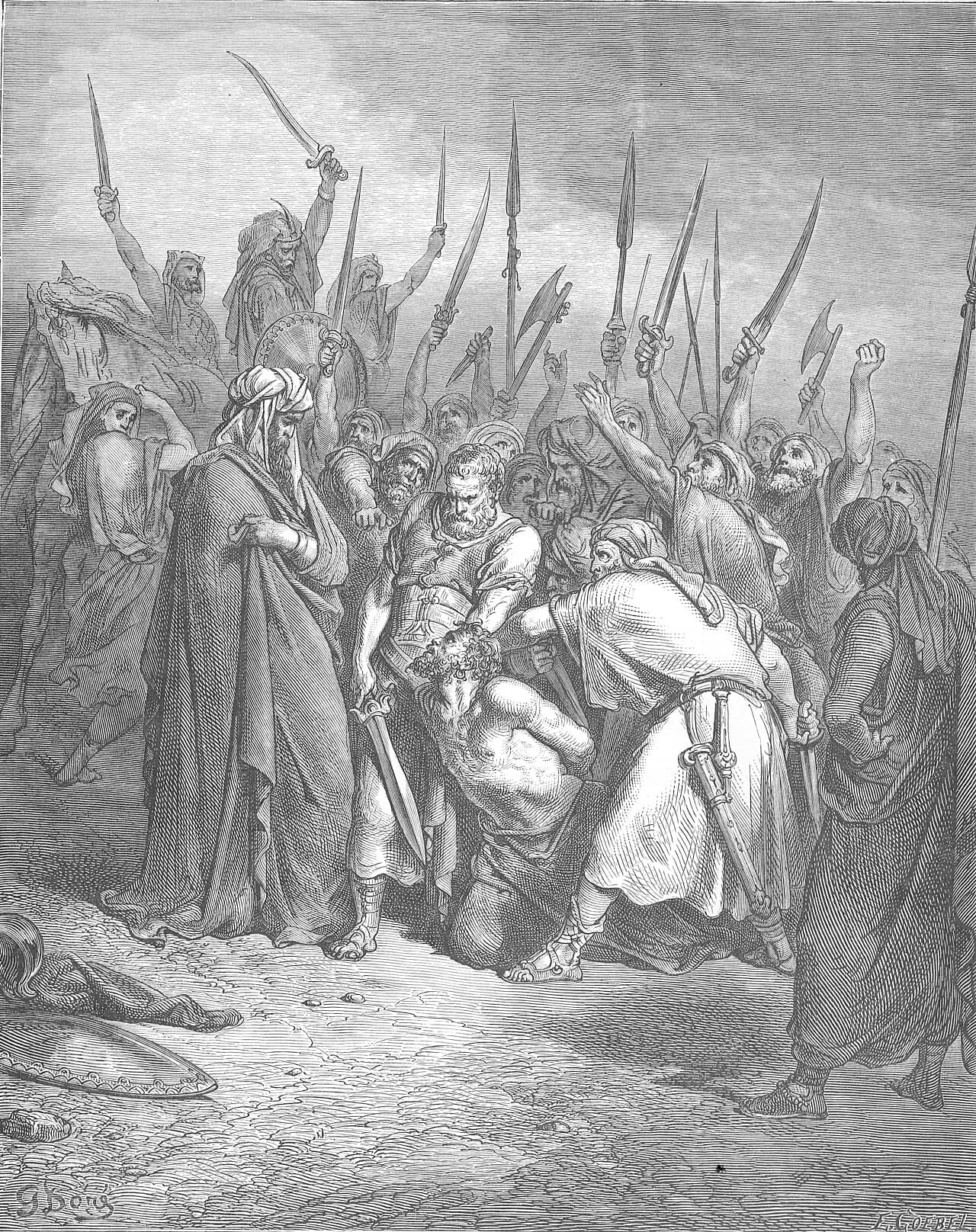
Gustave Doré, The Death of Agag, 1866, from Doré's English Bible. Public domain.
THE ARTWORKDoré engraved the scene of 1 Samuel 15:32 to 33, where Agag king of the Amalekites is brought to Samuel at Gilgal. The captive king kneels among the soldiers while the old prophet stands over him.
Summary
The Amalekites were the first people to make war on Israel after the Exodus, and Scripture follows the conflict from Moses to the days of Hezekiah.
- Amalek was a grandson of Esau and a chief of Edom.
- Israel prevailed at Rephidim while Moses held up his hands.
- Saul spared Agag and the best of the flocks, and the LORD rejected him as king.
- The book of Esther calls Haman son of Hammedatha the Agagite.
The Grandson of Esau
Genesis 36 gives Amalek's parents and his rank, and Numbers gives his people's land.
Additionally, Timna, a concubine of Esau’s son Eliphaz, gave birth to Amalek. These are the grandsons of Esau’s wife Adah.Amalek's birth places the people named for him inside the family of Esau, the brother of Jacob.
Korah, Gatam, and Amalek. They are the chiefs of Eliphaz in the land of Edom, and they are the grandsons of Adah.Amalek's clan began as one of the ruling clans of Edom.
Timna was the sister of Lotan the Horite. Adam Clarke notes that Esau's family and the Horites were joined by such marriages.
Where the Amalekites livedNumbers 13:29; 1 Samuel 27:8
The Amalekites live in the land of the Negev; the Hittites, Jebusites, and Amorites live in the hill country; and the Canaanites live by the sea and along the Jordan.”The spies' report places the Amalekites in the Negev, south of the hill country of Canaan.
Now David and his men went up and raided the Geshurites, the Girzites, and the Amalekites. (From ancient times these people had inhabited the land extending to Shur and Egypt.)The narrator says the Amalekites had lived from ancient times in the land that runs toward Shur and Egypt.
Amalek from Genesis to Esther
From Amalek's birth in Genesis to Haman the Agagite in Esther
- Genesis 36:12Amalek is born to Eliphaz and Timna, Genesis 36:12
- Exodus 17:8 to 13The Amalekites attack Israel at Rephidim, Exodus 17:8 to 13
- Exodus 17:14 to 16The LORD has the sentence on Amalek written on a scroll, Exodus 17:14 to 16
- Numbers 14:43 to 45Israel goes up against Moses' word and is beaten, Numbers 14:43 to 45
- Numbers 24:20Balaam lifts up an oracle on Amalek, Numbers 24:20
- Deuteronomy 25:17 to 19Moses commands Israel to remember Amalek, Deuteronomy 25:17 to 19
- Judges 6:3The Amalekites join the raids of Midian, Judges 6:3
- 1 Samuel 15:8 to 9Saul captures Agag and spares him, 1 Samuel 15:8 to 9
- 1 Samuel 30:1The Amalekites burn Ziklag, 1 Samuel 30:1
- 1 Chronicles 4:41 to 43The Simeonites strike the last Amalekites, 1 Chronicles 4:41 to 43
- Esther 3:1King Xerxes raises Haman the Agagite, Esther 3:1
The timeline sets out eleven texts in the order of the canon.
The Battle at Rephidim
Exodus 17:8 to 16 tells the first battle and the oath that followed it.
After this, the Amalekites came and attacked the Israelites at Rephidim.The attack comes at Rephidim, the place where the people had just tested the LORD at Massah and Meribah.
As long as Moses held up his hands, Israel prevailed; but when he lowered them, Amalek prevailed.This verse shows that the battle on the plain turned on the hands of Moses on the hill.
When Moses’ hands grew heavy, they took a stone and put it under him, and he sat on it. Then Aaron and Hur held his hands up, one on each side, so that his hands remained steady until the sun went down.Moses could not keep his hands up alone, and the victory needed Aaron and Hur beside him.
Then the LORD said to Moses, “Write this on a scroll as a reminder and recite it to Joshua, because I will utterly blot out the memory of Amalek from under heaven.”This is the first command in Scripture to write a thing down, and the record is a sentence on Amalek.
And Moses built an altar and named it The LORD Is My Banner. “Indeed,” he said, “a hand was lifted up toward the throne of the LORD. The LORD will war against Amalek from generation to generation.”The altar's name gives the victory to the LORD, and the oath makes the war outlast the generation that fought it.
Rashi, Barnes and Clarke on the battleExodus 17:11 to 16
Rashi, Rabbi Shlomo Yitzchaki of France (1040 to 1105), refers verse 11 to the Talmud, Rosh Hashanah 29a, in his commentary on Exodus. On verse 12 he says Moses was remiss in appointing another to wage a war that was his own duty.
Albert Barnes reads the name The LORD Is My Banner as the motto under which victory is certain, like the inscription a royal standard carried. Adam Clarke reads verse 16 as a charge that the hand of Amalek was raised against the throne of God.
Remember What Amalek Did
Seven passages record the deed Israel was to remember and the war that followed it.
Remember what the Amalekites did to you along your way from Egypt, how they met you on your journey when you were tired and weary, and they attacked all your stragglers; they had no fear of God. When the LORD your God gives you rest from the enemies around you in the land that He is giving you to possess as an inheritance, you are to blot out the memory of Amalek from under heaven. Do not forget!This command is the ground Samuel gives for Saul's war in 1 Samuel 15:2.
The war from Numbers to Chronicles6 passages
For there the Amalekites and Canaanites will face you, and you will fall by the sword. Because you have turned away from the LORD, He will not be with you.” But they dared to go up to the ridge of the hill country, though neither Moses nor the ark of the covenant of the LORD moved from the camp. Then the Amalekites and Canaanites who lived in that part of the hill country came down, attacked them, and routed them all the way to Hormah.Israel's first defeat by Amalek came when the people went up without the LORD.
Then Balaam saw Amalek and lifted up an oracle, saying: “Amalek was first among the nations, but his end is destruction.”Balaam's oracle sets Amalek's rank among the nations beside the ruin to come.
Whenever the Israelites would plant their crops, the Midianites, Amalekites, and other people of the east would come up and invade them,In Gideon's day the Amalekites raided Israel's harvests in company with Midian.
Then all the Midianites, Amalekites, and other people of the east gathered together, crossed over the Jordan, and camped in the Valley of Jezreel.The same raiders crossed the Jordan as one army before Gideon's battle.
So David recovered everything the Amalekites had taken, including his two wives. Nothing was missing, young or old, son or daughter, or any of the plunder the Amalekites had taken. David brought everything back.David's pursuit from Ziklag ended with nothing of the captives or the plunder missing.
These who were noted by name came in the days of Hezekiah king of Judah. They attacked the Hamites and Meunites there in their dwellings, devoting them to destruction even to this day. Then they settled in their place, because there was pasture for their flocks. And five hundred of these Simeonites led by Pelatiah, Neariah, Rephaiah, and Uzziel, the sons of Ishi, went to Mount Seir and struck down the remnant of the Amalekites who had escaped. And they have lived there to this day.The Chronicler dates the end of the Amalekite remnant to the reign of Hezekiah.
Saul and the Ban
1 Samuel 15 tells how Saul was sent to devote Amalek to destruction and lost the kingdom.
The command of 1 Samuel 15:3 is to devote Amalek to destruction. Albert Barnes explains that when a people was made cherem, everything living was destroyed and no part of the spoil fell to the conquerors.
Saul and his troops spared Agag, along with the best of the sheep and cattle, the fat calves and lambs, and the best of everything else. They were unwilling to destroy them, but they devoted to destruction all that was despised and worthless.Saul and his troops kept the king and the best of the flocks, so the ban was kept only on what they despised.
But Samuel declared: “Does the LORD delight in burnt offerings and sacrifices as much as in obedience to His voice? Behold, obedience is better than sacrifice, and attentiveness is better than the fat of rams.Samuel's answer sets obedience to the LORD's voice above every offering.
The command and the end of Agag1 Samuel 15:2 to 3; 15:32 to 33
This is what the LORD of Hosts says: ‘I witnessed what the Amalekites did to the Israelites when they ambushed them on their way up from Egypt. Now go and attack the Amalekites and devote to destruction all that belongs to them. Do not spare them, but put to death men and women, children and infants, oxen and sheep, camels and donkeys.’”The LORD grounds the command in a deed He witnessed in Moses' day.
Then Samuel said, “Bring me Agag king of the Amalekites.” Agag came to him cheerfully, for he thought, “Surely the bitterness of death is past.” But Samuel declared: “As your sword has made women childless, so your mother will be childless among women.” And Samuel hacked Agag to pieces before the LORD at Gilgal.Samuel carries out on Agag the sentence that Saul had left undone.
Saul's three answers to Samuel1 Samuel 15:13 to 28; 28:18
Saul first told Samuel that he had carried out the LORD's instructions. He then said the troops had spared the animals to sacrifice to the LORD. At last he confessed that he had feared the people and obeyed their voice.
So Samuel said to him, “The LORD has torn the kingdom of Israel from you today and has given it to your neighbor who is better than you.Samuel names a successor before any is anointed, a neighbor who is better than Saul.
Because you did not obey the LORD or carry out His burning anger against Amalek, the LORD has done this to you today.At Endor Samuel gives the unfinished war on Amalek as the reason for what the LORD did to Saul that day.
Haman the AgagiteEsther 3:1; 9:24
After these events, King Xerxes honored Haman son of Hammedatha, the Agagite, elevating him to a position above all the princes who were with him.The title the Agagite, given here and again in Esther 9:24, is the ground of every reading that links Haman to Agag.
John Gill reads Agag as the common name of the Amalekite kings, as Pharaoh was of the kings of Egypt. John Wesley reads the Agagite as an Amalekite of the royal seed of that nation.
Albert Barnes reports that the Jews generally understand the word as a descendant of Agag. He adds that the names of Haman, his father and his sons look Persian.
Adam Clarke supposes that the command of Deuteronomy 25 found its final accomplishment in the death of Haman and his ten sons.
What the Text Leaves Unsaid
Three questions Scripture leaves open
Then they turned back to invade En-mishpat (that is, Kadesh), and they conquered the whole territory of the Amalekites, as well as the Amorites who lived in Hazazon-tamar.The territory of the Amalekites is named here in Abram's day, generations before Amalek's birth in Genesis 36.
Scripture does not say how the people of that territory relate to Esau's grandson. John Gill holds that the Amalekites of Exodus 17 were not Amalek's descendants.
Exodus does not say why the battle turned as Moses raised and lowered his hands.
The book of Esther gives Haman no line of descent beyond his father Hammedatha.
Three Voices on Amalek and Saul
Matthew Henry, Gregory the Dialogist and Athanasius of Alexandria
Matthew Henry reads the attack at Rephidim as Esau's old hatred of Jacob carried on in his descendants.
“The Amalekites were the posterity of Esau, who hated Jacob because of the birthright and blessing, and this was an effort of the hereditary enmity, a malice that ran in the blood, and perhaps was now exasperated by the working of the promise towards an accomplishment.”
Matthew Henry · Commentary on the Whole Bible · on Exodus 17:8Puritan
Gregory the Dialogist traces Saul's fall to the pride that grew in him with his power.
“Thus Saul, after merit of humility, became swollen with pride, when in the height of power: for his humility he was preferred, for his pride rejected; as the Lord attests, Who says, ‘When thou wast little in thine own sight, did I not make thee the head of the tribes of Israel?’ He had before seen himself little in his own eyes, but, when propped up by temporal power, he no longer saw himself little. For, preferring himself in comparison with others because he had more power than all, he esteemed himself great above all.”
Gregory the Dialogist · The Book of Pastoral Rule, Part 2, Chapter 6 · on 1 Samuel 15:17Patristic
Athanasius of Alexandria reads Samuel's rebuke as the rule that keeping God's word pleases Him more than a gift.
“Samuel, that great man, no less clearly reproved Saul, saying, ‘Is not the word better than a gift?’ For hereby one fulfills the law and pleases God, as he says, ‘The sacrifice of praise shall glorify me.’ Let one ‘learn what this means, I will have mercy, and not sacrifice,’ and I will not condemn the adversaries.”
Athanasius of Alexandria · Letter 19.5 · on 1 Samuel 15:22Patristic
The Command of 1 Samuel 15:3
Three readings of the command to devote Amalek to destruction, each with its holders
Readers divide over a command that names children, infants and cattle among those to be put to death.
A judgment on a nation for its deedsMatthew Henry; John Wesley
On this reading God judged the Amalekites for their attack on Israel and their long hostility, the reason 1 Samuel 15:2 gives. John Wesley, in his Explanatory Notes, holds that the command was just because God is the supreme Lord of life.
“They were idolaters, and were guilty of many other sins, for which they deserved to fall under the wrath of God; yet, when God would reckon with them, he fastened upon the sin of their ancestors in abusing his Israel as the ground of his quarrel. Lord, How unsearchable are thy judgments, yet how incontestable is thy righteousness!”
Matthew Henry · Commentary on the Whole Bible · on 1 Samuel 15:8Puritan
The objection: the command reached infants and cattle, who had no part in an attack that Matthew Henry dates nearly four hundred years before Saul.
The idiom of ancient war reportsPaul Copan, Is God a Moral Monster? (2011)
On this reading the language of total destruction was the conventional idiom of ancient victory reports. Paul Copan gives the reading its fullest popular statement in his book Is God a Moral Monster?, published in 2011.
Amalekites appear again in Scripture after Saul's war, in 1 Samuel 30:1.
The objection: Samuel holds Saul to the letter of the command, and Matthew Henry says Saul was rejected because he did not carry out the sentence effectually.
A figure of the enemyAmbrose of Milan; Rashi
On this reading Amalek also stands for the enemy who attacks God's people. Rashi, in his commentary on Exodus, reads the attack as the answer to the people's doubt at Massah whether the LORD was among them. On Deuteronomy 25:17 he ties it to false weights and measures.
“In the book also, which is titled On Numbers, Scripture says: 'The beginning of the nations is Amalek, and his seed shall perish' (Num. XXIV, 20). And indeed, Amalek is not the first of all nations; but because by interpretation Amalek is taken to mean the king of the wicked, and the wicked are the nations: beware lest we should take the prince of this world, who commands the nations doing his will, whose seed shall perish.”
Ambrose of Milan · The Six Days of Creation · on Numbers 24:20Patristic
The objection: the text names a people with a king, a city and a land from Havilah to Shur.
Books to Read Next
Four works on Amalek and the command against him
Commentary on the Torah
Rashi · eleventh century
Rashi reads Exodus 17 and Deuteronomy 25 verse by verse with the rabbinic sources behind each reading.
Commentary on the Whole Bible
Matthew Henry · 1706
Henry follows Amalek from Rephidim to Agag and draws a lesson from each battle.
Notes, Explanatory and Practical, on the Old Testament
Albert Barnes · 1832 to 1869
Barnes explains the banner, the ban and the Agagite with the custom behind each word.
Is God a Moral Monster?
Paul Copan · 2011
Copan gathers the answers to the moral charge against the conquest texts in a book for general readers.
In print: find it wherever books are sold.
Keep studying
Studies5