
Leviticus 19:9 to 10 · Subject · Featured Study
Gleaning and the corner of the field
What the Law of Moses kept back from the reaper for the needy, and what it let a passer-by eat by hand. The Mishnah's tractate Peah sets out the rules for the gifts left at harvest.
Ruth the Moabitess gathered barley behind the harvesters of Boaz under a law that kept part of every harvest for the poor and the foreigner.
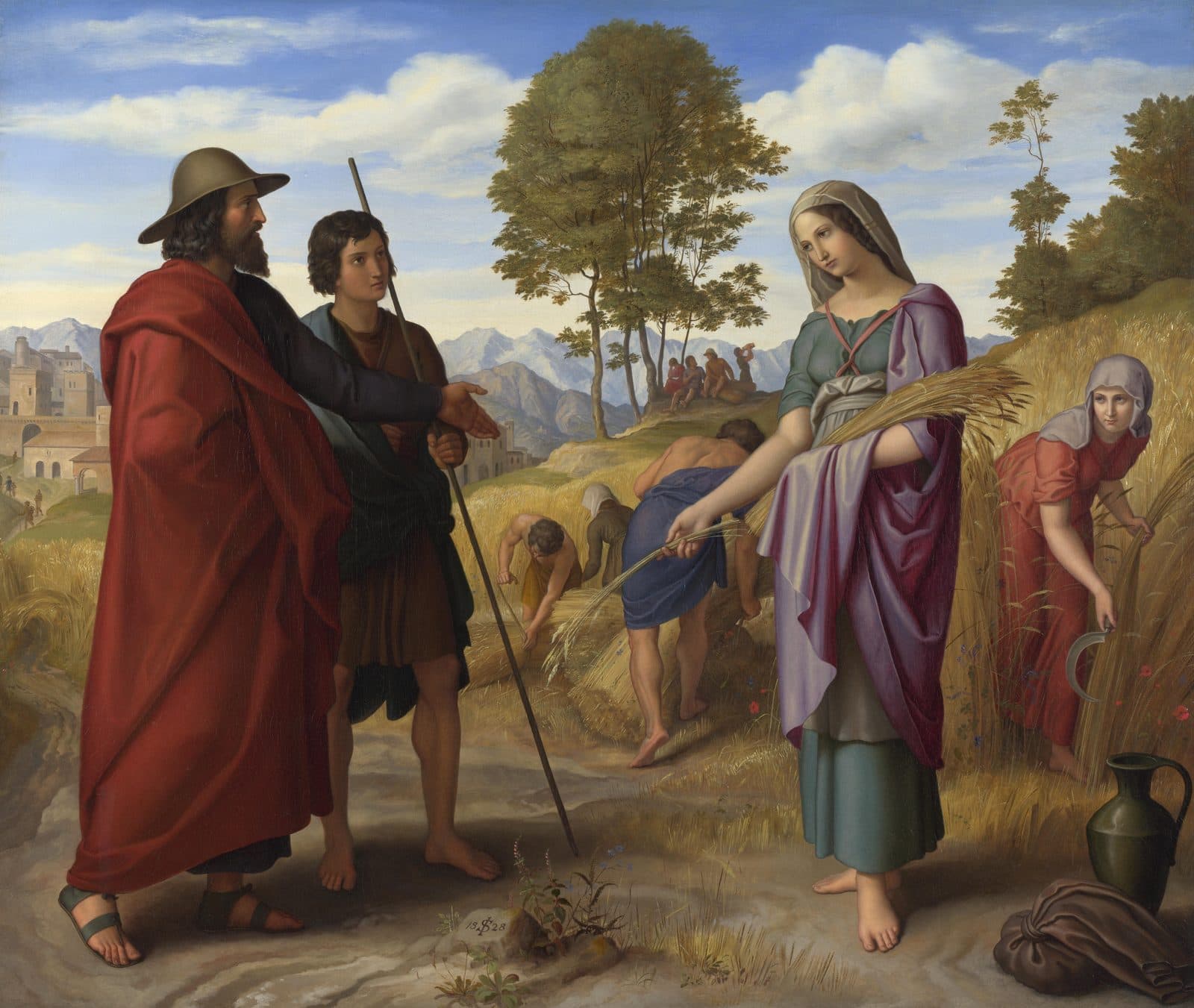
Julius Schnorr von Carolsfeld, Ruth in Boaz's Field, 1828, National Gallery, London. Public domain (published before 1930), via Wikimedia Commons.
THE ARTWORKSchnorr von Carolsfeld painted Ruth in a blue dress and a violet mantle with cut stalks gathered in her arm. Boaz turns to her with an open hand, reapers stoop over the wheat behind her, and a woman with a sickle cuts the grain at the right.
Summary
The Law of Moses told each Israelite farmer what to leave in his field and vineyard when he gathered his crop.
- The owner left the edges of his field unreaped and did not gather the grain that fell as he reaped.
- In the vineyard he left the fallen grapes and did not strip the vines bare. Deuteronomy adds the forgotten sheaf and the olives left on the branches.
- Ruth gleaned under this law in the field of Boaz, who let her gather among the sheaves and had stalks pulled out for her.
- The Mishnah set the corner at no less than one sixtieth of the field.
The Law of the Field
Leviticus gives the harvest law in chapter 19 and again in chapter 23
The law speaks to the owner at the moment of harvest. It names what he must leave and the people he leaves it for, and it closes with the name of the LORD.
Albert Barnes, in his Notes on Leviticus 19:10, took the foreigner of this verse to be a man who could own no land in Israel.
When you reap the harvest of your land, you are not to reap to the very edges of your field or gather the gleanings of your harvest. You must not strip your vineyard bare or gather its fallen grapes. Leave them for the poor and the foreigner. I am the LORD your God.These two verses forbid the owner four acts at harvest, two in the field and two in the vineyard.
When you reap the harvest of your land, do not reap all the way to the edges of your field or gather the gleanings of your harvest. Leave them for the poor and the foreign resident. I am the LORD your God.’”The law is given again inside the calendar of feasts, between the offering of new grain and the day of trumpet blasts.
What the Harvest Laws Leave
Seven gifts the owner may not gather and one right to eat by hand
| What is left | The text | Who it is for |
|---|---|---|
| The edges of the field, left unreaped (pe'ah) | Leviticus 19:9 and 23:22 | The poor and the foreigner |
| The gleanings of the grain harvest (leqet) | Leviticus 19:9 and 23:22 | The poor and the foreigner |
| The grapes left on a vine that is not stripped bare | Leviticus 19:10 | The poor and the foreigner |
| The fallen grapes (peret) | Leviticus 19:10 | The poor and the foreigner |
| The sheaf forgotten in the field | Deuteronomy 24:19 | The foreigner, the fatherless and the widow |
| The olives left after the branches are beaten once | Deuteronomy 24:20 | The foreigner, the fatherless and the widow |
| The grapes left after the vines are gone over once | Deuteronomy 24:21 | The foreigner, the fatherless and the widow |
| Grapes or heads of grain eaten by hand in a neighbor's field | Deuteronomy 23:24 to 25 | Anyone who enters, to eat there and carry nothing away |
Ruth in the Field of Boaz
Ruth 2 shows the law kept at the barley harvest in Bethlehem
Naomi and Ruth reached Bethlehem at the beginning of the barley harvest, and Ruth asked Naomi's leave to glean after someone in whose sight she might find favor.
She asked the foreman for more than the law gave, to gather among the sheaves after the harvesters.
So Ruth departed and went out into the field and gleaned after the harvesters. And she happened to come to the part of the field belonging to Boaz, who was from the clan of Elimelech.It stands here because Ruth's gleaning is the law of Leviticus 19:9 kept in a field with a named owner.
When Ruth got up to glean, Boaz ordered his young men, “Even if she gathers among the sheaves, do not insult her. Rather, pull out for her some stalks from the bundles and leave them for her to gather. Do not rebuke her.”Boaz goes past the law here, since the law left only what fell and he had stalks pulled from the bundles for her.
Leave among the sheavesRuth 2:5, 2:15 and 2:16; Clarke, Gill and Rashi
Adam Clarke, in his Commentary on Ruth 2:15, wrote that no one gleaned until the sheaves were bound, so the leave to glean among them was a privilege. John Gill, in his Exposition on Ruth 2:16, took the handfuls to be scattered where they were reaped, so that Ruth could gather them.
Rashi, the Jewish commentator who wrote in France about 1075 to 1105, read the Hebrew of Ruth 2:16 as an order to pretend to forget. In his note on Ruth 2:5 he says Boaz first noticed Ruth for the modest and wise way she gleaned.
An ephah of barleyRuth 2:17 and 2:23; Barnes
So Ruth gathered grain in the field until evening. And when she beat out what she had gleaned, it was about an ephah of barley.The verse measures one day's gleaning, so the reader can weigh what the law gave a poor woman.
Albert Barnes, in his Notes on Ruth 2:17, reckoned the ephah enough to feed Ruth and Naomi for five days, by the measure of manna in Exodus 16:16.
So Ruth stayed close to the servant girls of Boaz to glean grain until the barley and wheat harvests were finished. And she lived with her mother-in-law.It stands here because the law fed Naomi's household for a whole season of reaping.
The Grain the Disciples Picked
Deuteronomy 23:24 to 25 and the charge the Pharisees brought in Matthew 12:2
Deuteronomy 23:24 lets a man who enters his neighbor's vineyard eat his fill of grapes, but he may put none in his basket.
Matthew, Mark and Luke each tell how the disciples picked heads of grain as they walked through the grainfields. Adam Clarke, in his Commentary on Deuteronomy 23:25, wrote that they plucked the ears under the permission of this law.
When you enter your neighbor’s grainfield, you may pluck the heads of grain with your hand, but you must not put a sickle to your neighbor’s grain.When the Pharisees saw this, they said to Him, “Look, Your disciples are doing what is unlawful on the Sabbath.”The charge names the Sabbath alone, and Jesus answers it in Matthew 12:3 to 8.
Matthew Henry, in his Commentary on Deuteronomy 23:24 to 25, reports the Jewish reading of this law as made chiefly for the laborers who gathered the harvest and the vintage. Jamieson, Fausset & Brown explain the leave from the low price of grapes where vines grow.
“In vine-growing countries grapes are amazingly cheap; and we need not wonder, therefore, that all within reach of a person's arm, was free; the quantity plucked was a loss never felt by the proprietor, and it was a kindly privilege afforded to the poor and wayfaring man.”
Jamieson, Fausset & Brown · Commentary Critical and Explanatory on the Whole Bible · on Deuteronomy 23:24Reformed
The Corner in Jewish Law
The Mishnah's tractate Peah and Rashi's note on Leviticus 19:9
The Mishnah, the code of Jewish law set down in the land of Israel about AD 190 to 230, gives a whole tractate to these gifts and names it Peah, the corner. It counts the corner among the things that have no fixed measure. It then rules that no one should leave less than one sixtieth of the field, and more where the field is large, the poor are many or the yield is great.
Rashi, in his commentary on Leviticus 19:9, reads the verse as leaving the corner at the far end of the field, and he cites that ruling of the Mishnah.
The Mishnah defines gleanings as what falls at the time of harvesting. In the ruling of the school of Hillel, two ears that fall together belong to the poor and three belong to the owner.
The corner left standingMishnah Peah 4:1
The corner was left in the standing grain for the poor to reap themselves. If ninety-nine poor men asked the owner to share it out and one asked to take it from the field, the one was heard.
Who could take the giftsMishnah Peah 8:8
A man who owned two hundred zuz could not take the gleanings, the forgotten sheaf, the corner or the poor man's tithe. A man who owned less was not made to sell his house or his tools before he took them.
Hebrew Words for the Corner and the Gleanings
Four words of Leviticus 19:9 to 10, each on a card
PE'AH
The Hebrew noun for corner or side names the edge of the field here and the hair at the sides of the head in Leviticus 19:27.
LEQET
The Hebrew noun for gleaning means what may be gleaned, and Jastrow's dictionary of the Talmud calls it the poor man's share in the crop.
PERET
The Hebrew noun for fallen grapes means berries dropped in the picking, and Klein's dictionary finds it in the Bible only in this verse.
TE'OLEL
Rashi derives this verb for stripping the vineyard bare from a word for young and tender, and reads it as forbidding the owner to take the small clusters.
What the Text Leaves Unsaid
Three matters the harvest laws and Ruth 2 leave open
Leviticus gives no size for the corner of the field. The law names no court and no penalty for an owner who reaps to the edge.
Ruth 2 does not say whether Boaz left the corner of his own field.
Why the Law Stands Among the Feasts
Leviticus, Deuteronomy and the rabbis each give the harvest law a reason
Rashi, in his commentary on Leviticus 23:22, gives the reason the Sifra finds for its place between the festival offerings. One who leaves the gleanings, the forgotten sheaf and the corner for the poor is counted as though he had built the Temple and offered his sacrifices in it.
Remember that you were slaves in the land of Egypt. Therefore I am commanding you to do this.The verse gives Israel's own slavery in Egypt as the reason for the three gifts before it.
The land must not be sold permanently, because it is Mine, and you are but foreigners and residents with Me.The owner who leaves the edge of his field holds that field from the LORD, who calls the land His own.
Voices on Ruth the Gleaner
Ambrose of Milan, Theodoret of Cyrus and Matthew Henry on Ruth 2
Ambrose wrote to the widows of the church and drew a lesson for them from Naomi and Ruth.
“Does the widow Naomi seem to you of small account, who supported her widowhood on the gleanings from another's harvest, and who, when heavy with age, was supported by her daughter-in-law? It is a great benefit both for the support and for the advantage of widows that they so train their daughters-in-law as to have in them a support in full old age, and, as it were, payment for their teaching and reward for their training.”
Ambrose of Milan · Concerning Widows 6.33 · on Ruth 2:2Patristic
Theodoret reads the blessing Boaz spoke over Ruth in Ruth 2:12 as fulfilled in her descendants.
“The blessing followed as Boaz said it would. For Ruth received the full reward from God, so that she was the progenitor of the blessing of the nations.”
Theodoret of Cyrus · Questions on Ruth · on Ruth 2:12Patristic
Matthew Henry reads the word happened in Ruth 2:3 as the work of Providence.
“She knew not whose field it was, nor had she any reason for going to that more than any other, and therefore it is said to be her hap; but Providence directed her steps to this field. Note, God wisely orders small events; and those that seem altogether contingent serve his own glory and the good of his people.”
Matthew Henry · Commentary on the Whole Bible · on Ruth 2:3Puritan
Charity or Right
Two readings of who held the gleanings, and a third that divides the gleaning from the place it was done
A right of the poorThe Mishnah; Adam Clarke
The Mishnah calls an owner who keeps the poor out of his field, or lets one glean and not another, a robber of the poor. Adam Clarke, in his Commentary on Deuteronomy 24:19, called the corners, the gleanings and the forgotten sheaf the property of the poor.
Do not move an ancient boundary stone which your fathers have placed.It stands here because the Mishnah treats the gifts as a landmark that no landowner may shift.
The objection: in Ruth 2:2 a widow seeks an owner's favor before she gleans, as though he could send her away.
A gift that trains the ownerClement of Alexandria; John Wesley
Clement of Alexandria, in The Stromata, set the harvest laws beside the laws on usury and wages as the law's training in kindness. He wrote that the part left unreaped trained those who possess to sharing and to large-heartedness. John Wesley, on Leviticus 23:22, joined the law to the worship of God around it.
“And it is observable, that though the present business is only concerning the worship of God, yet he makes a kind of excursion to repeat a former law of providing for the poor, to shew that our devotion to God is little esteemed by him if it be not accompanied with acts of charity to men.”
John Wesley · Explanatory Notes upon the Old Testament · on Leviticus 23:22Evangelical
The objection: every verb of the law is a prohibition to the owner, and none leaves him the choice of how much to leave or of whom to leave it for.
A right to the gleanings and a favor among the sheavesJamieson, Fausset & Brown
Jamieson, Fausset & Brown, in their Commentary on Ruth 2:2, held that the law gave the widow, the poor and the stranger a right to glean. Leave to glean behind the reapers was a favor the owner could grant or refuse.
The objection: Mishnah Peah 5:6 gives the owner no choice among the poor once they come to glean.
From the Field of Boaz to Christ
Matthew 1 on Ruth in the line of Jesus and 2 Corinthians 8 on the grace of giving
No Israelite was to reap the whole of his own crop.
The text asks the reader to leave the edge of his own harvest for those who have none, and to give as Christ gave.
Salmon was the father of Boaz by Rahab, Boaz the father of Obed by Ruth, Obed the father of Jesse,The gleaner of Ruth 2 stands in the genealogy of Jesus as the wife of Boaz and the mother of Obed.
For you know the grace of our Lord Jesus Christ, that though He was rich, yet for your sakes He became poor, so that you through His poverty might become rich.Paul grounds the giving of the Corinthians in the grace of Christ, who became poor for their sakes.