
Joshua 12 · Joshua 10 to 11 · Joshua 15:63 · Subject · Featured Study
The Register of the Thirty-One Kings
The chapter that closes the wars of Joshua and comes before the division of the land among the tribes.
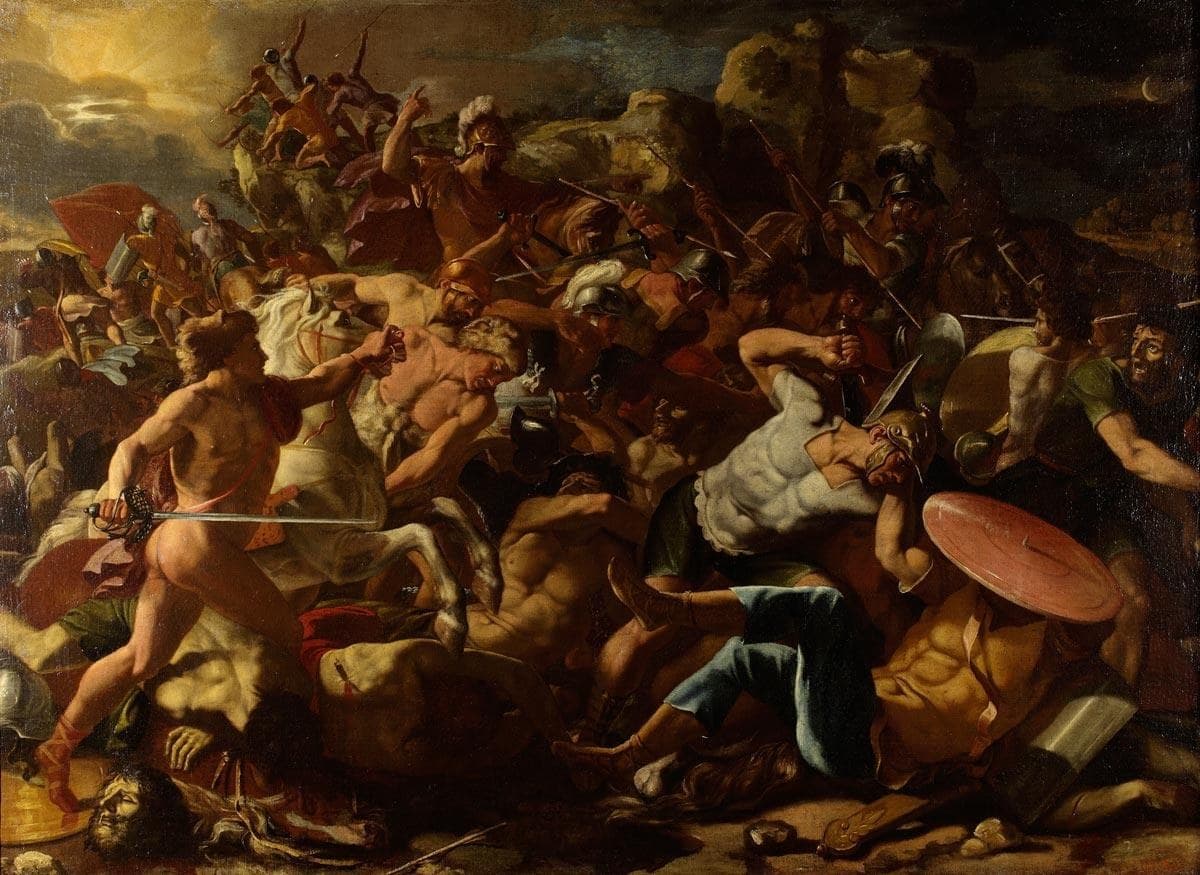
Nicolas Poussin, The Victory of Joshua over the Amorites, 1624 to 1625, Pushkin Museum, Moscow. Public domain, via Wikimedia Commons.
THE ARTWORKPoussin painted the battle of Joshua 10 with the sun breaking through cloud at the upper left and a crescent moon at the upper right, while the armies fight hand to hand below. The kings of that battle are named third to seventh in the register.
Joshua 12 counts each king with the word one, and the count ends at thirty-one.
Summary
The register names two kings Moses defeated east of the Jordan and thirty-one kings Joshua defeated west of the river.
- Joshua 10 and 11 tell of two leagues of kings, the south led by the king of Jerusalem and the north led by the king of Hazor.
- The king of Jerusalem died in Joshua 10, and yet the Jebusites still lived in the city in Joshua 15:63, because the death of a king did not give Israel his city.
- Twenty-nine of the thirty-one cities have a proposed site, and two of the names stand for regions.
Five Verses of the Register
The two panels, the sum and the verse that follows the register, in the order of the chapter
Its first six verses look back to the wars of Moses, and verses 9 to 24 count the kings of Joshua's own campaigns.
Now these are the kings of the land whom the Israelites struck down and whose lands they took beyond the Jordan to the east, from the Arnon Valley to Mount Hermon, including all the Arabah eastward:The register opens on the far side of the river, with the conquests of an earlier generation.
And these are the kings of the land that Joshua and the Israelites conquered beyond the Jordan to the west, from Baal-gad in the Valley of Lebanon to Mount Halak, which rises toward Seir (according to the allotments to the tribes of Israel, Joshua gave them as an inheritanceThe thirty-one names of the western panel follow this heading.
and the king of Tirzah, one. So there were thirty-one kings in all.The list closes with Tirzah and gives its sum.
The tribes east of the JordanJoshua 12:6
Moses, the servant of the LORD, and the Israelites had struck them down and given their land as an inheritance to the Reubenites, the Gadites, and the half-tribe of Manasseh.Moses had given the eastern land to two and a half tribes before Israel crossed the river.
The land that remainedJoshua 13:1
Now Joshua was old and well along in years, and the LORD said to him, “You are old and well along in years, but very much of the land remains to be possessed.The chapter after the register opens with land still to be possessed, so the list cannot mean that every city was held.
Where the Thirty-One Kings Ruled
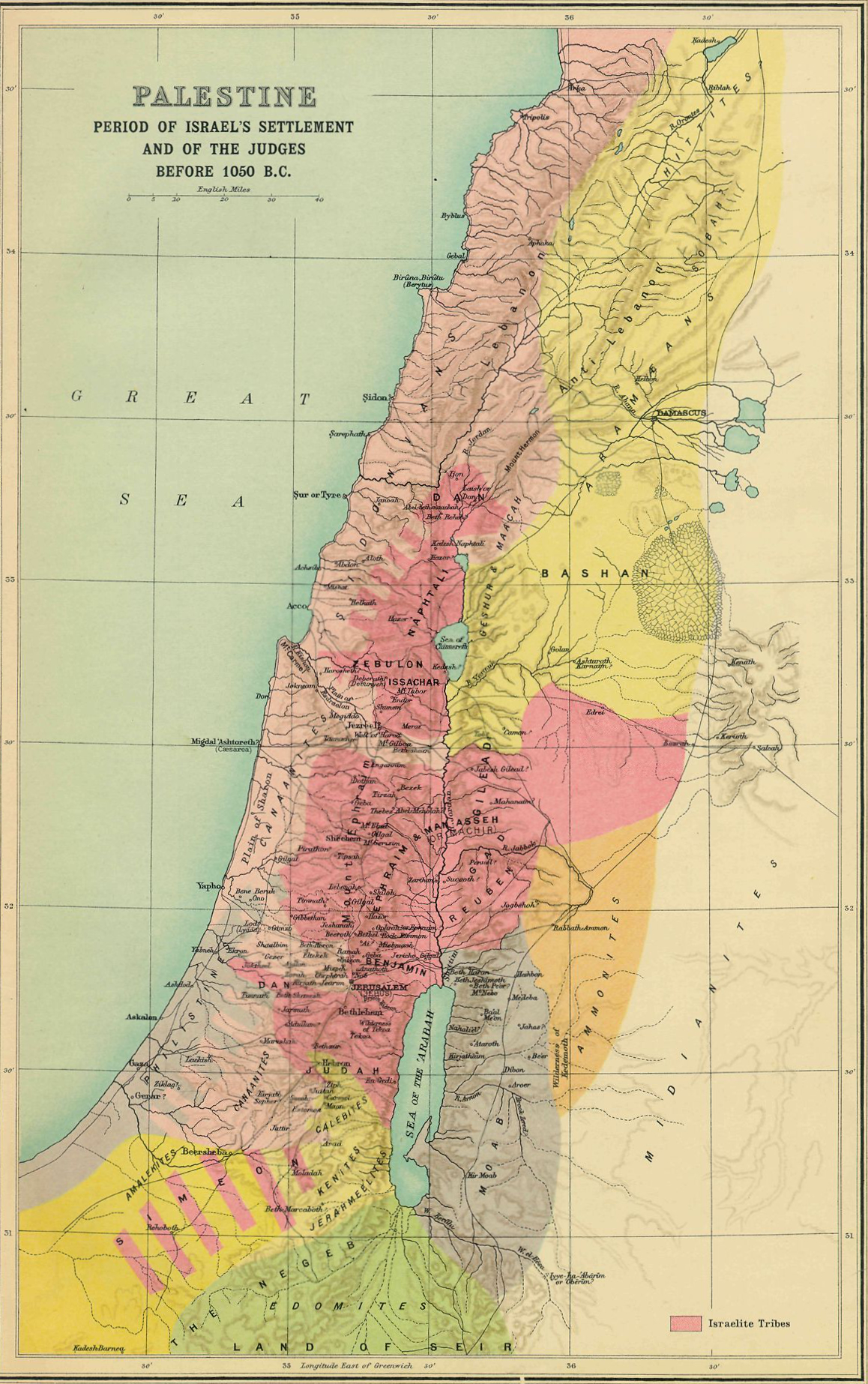
The cities on George Adam Smith's plate of 1915, placed by the identifications of OpenBible
Twenty-nine of the thirty-one cities west of the Jordan are marked, with the cities of Sihon and Og east of the river.
- Jericho
- Ai
- Jerusalem
- Hebron
- Jarmuth
- Lachish
- Eglon
- Gezer
- Debir
- Geder
- Hormah
- Arad
- Libnah
- Adullam
- Makkedah
- Bethel
- Tappuah
- Hepher
- Aphek
- Madon
- Hazor
- Shimron-meron
- Achshaph
- Taanach
- Megiddo
- Kedesh
- Jokneam
- Dor
- Tirzah
- Sihon at HeshbonTell Hesban, east of the Jordan
- Og at AshtarothTell Ashtara, with Edrei at Daraa
George Adam Smith, Atlas of the Historical Geography of the Holy Land (1915), plate of Palestine in the period of Israel's settlement and of the Judges. Public domain, via Wikimedia Commons.
Thirty-one numbered marks on the plate, the western kings in the order of Joshua 12 and then Sihon and Og, with Lasharon and Goiim left unmarked because each names a region.
The Register and the Wars of Joshua
The kings of the register set beside the chapters of Joshua that tell their defeat
Albert Barnes, in his Notes on Joshua 12:7, held that the names stand in the order in which Joshua met the kings.
Fifteen of the thirty-one kings appear in Joshua only in the register.
The 4 groups, by kings counted as a table
| Where the defeat is told | Groups, by kings counted | Who they are | Verse |
|---|---|---|---|
| Jericho and Ai, Joshua 6 to 8 | 2 | Jericho and Ai | Joshua 8:29 |
| The south, Joshua 10 | 9 | Jerusalem, Hebron, Jarmuth, Lachish, Eglon, Makkedah, Libnah, Gezer and Debir | Joshua 10:42 |
| The north, Joshua 11 | 5 | Hazor, Madon, Shimron-meron, Achshaph and Dor | Joshua 11:12 |
| No account in Joshua | 15 | Geder, Hormah, Arad, Adullam, Bethel, Tappuah, Hepher, Aphek, Lasharon, Taanach, Megiddo, Kedesh, Jokneam, Goiim and Tirzah | Joshua 12:13 |
The thirty-one kings of Joshua 12:9 to 24 counted by the chapter that tells their defeat.
Jericho and AiJoshua 6:2 and Joshua 8:29
And the LORD said to Joshua, “Behold, I have delivered Jericho into your hand, along with its king and its mighty men of valor.The LORD names the king of Jericho in the promise, so the first king of the list is promised before the walls fall.
He hung the king of Ai on a tree until evening, and at sunset Joshua commanded that they take down the body from the tree and throw it down at the entrance of the city gate. And over it they raised a large pile of rocks, which remains to this day.The king of Ai is the second name of the register, and this verse tells his death.
The campaign of the southJoshua 10
Joshua 10 takes the army from Gibeon through the cities of the foothills and the hill country and back to the camp at Gilgal.
- Located: the site is known
- The route, in the order the text gives
- 1Gibeon, The five kings of the Amorites camped before the city and made war against it. Joshua 10:5
- 2Makkedah, Joshua captured the city and put its king to the sword. Joshua 10:28
- 3Libnah, The LORD delivered the city and its king into the hand of Israel. Joshua 10:30
- 4Lachish, Joshua captured the city on the second day, and Horam king of Gezer fell coming to its help. Joshua 10:32 to 33
- 5Eglon, Israel captured the city on the day of the siege. Joshua 10:35
- 6Hebron, Israel went up from Eglon, captured the city and put its king to the sword. Joshua 10:37
- 7Debir, Israel captured Debir, its king and all its villages. Joshua 10:39
- 8Gilgal, Joshua returned with all Israel to the camp. Joshua 10:43
Not placed: Gibeon (1), Makkedah (2), Libnah (3), Eglon (5), Debir (7).
Base map: Israel's settlement and the period of the Judges, George Adam Smith, Atlas of the Historical Geography of the Holy Land (1915), public domain. Each place stands at its place page's coordinates, set on the plate by Jerusalem and Damascus, as the plate prints them.
The stations of Joshua 10 in the order of the chapter, with Lachish, Hebron and Gilgal drawn on the plate and the other five in the key.
And because the LORD, the God of Israel, fought for Israel, Joshua captured all these kings and their land in one campaign.This verse gives the cause of the whole southern campaign in one clause.
The campaign of the northJoshua 11:1 to 12
Now when Jabin king of Hazor heard about these things, he sent word to Jobab king of Madon; to the kings of Shimron and Achshaph; to the kings of the north in the mountains, in the Arabah south of Chinnereth, in the foothills, and in Naphoth-dor to the west;Jabin's summons names four cities of the register and the region of Naphoth-dor, the Dor of Joshua 12:23.
At that time Joshua turned back and captured Hazor and put its king to the sword, because Hazor was formerly the head of all these kingdoms.The chapter tells the death of the king of Hazor on its own, apart from the other kings of the north.
A King Struck and a City Held
Jerusalem, Gezer, Taanach, Megiddo and Dor kept their Canaanite people after the defeat of their kings
Joshua 12:10 and Joshua 15:63 answer two questions. The first verse says who ruled Jerusalem and was defeated, and the second says who went on living there.
Adam Clarke, in his Commentary on Judges 1:8, reads the verse as Judah taking the city of Jerusalem, while the Jebusites kept the stronghold on Mount Zion until David took it.
| City | The king | The city | Verse |
|---|---|---|---|
| Jerusalem | Adoni-zedek is killed at Makkedah, Joshua 10:26 | The Jebusites live there among Judah, until David takes the fortress of Zion in 2 Samuel 5:7 | Joshua 15:63 |
| Gezer | Horam is struck down coming to help Lachish, Joshua 10:33 | The Canaanites dwell among Ephraim as forced laborers, until Pharaoh captures the city in 1 Kings 9:16 | Joshua 16:10 |
| Taanach | Listed in Joshua 12:21 | Manasseh is unable to occupy the city | Joshua 17:12 |
| Megiddo | Next after Taanach in Joshua 12:21 | Manasseh fails to drive out its people in Judges 1:27 | Judges 1:27 |
| Dor | Named in Joshua 12:23 | Named among the cities of Joshua 17:11 that Manasseh could not occupy | Joshua 17:11 |
The king of Jerusalem in the registerJoshua 12:10
the king of Jerusalem, one; the king of Hebron, one;The register counts the king of Jerusalem among the defeated.
The Jebusites in JudgesJudges 1:21
The Benjamites, however, failed to drive out the Jebusites living in Jerusalem. So to this day the Jebusites live there among the Benjamites.Judges repeats the words of Joshua 15:63 with Benjamin in place of Judah.
The Kings Moses Struck
Numbers 21 tells the defeat of Sihon and Og, the first panel of the register
Rashi, in his commentary on Joshua 12:1, reads the opening of the chapter as the kings Israel struck in the lifetime of Moses. Sihon ruled from Heshbon between the Arnon and the Jabbok, and Og ruled Bashan from Ashtaroth and Edrei.
The defeat of SihonNumbers 21:24
And Israel put him to the sword and took possession of his land, from the Arnon to the Jabbok—but only up to the border of the Ammonites, because it was fortified.The borders this verse gives are the borders of Joshua 12:2.
The defeat of Og and his sixty citiesNumbers 21:35 and Deuteronomy 3:4
So they struck down Og, along with his sons and his whole army, until no remnant was left. And they took possession of his land.Og is the second king of the eastern panel.
At that time we captured all sixty of his cities. There was not a single city we failed to take—the entire region of Argob, the kingdom of Og in Bashan.Moses counts the cities of Og's kingdom, so the eastern panel stands for a whole kingdom taken.
The Thirty-One Kings in Order
Each king with the chapter that tells his defeat, the proposed site of his city and how sure that site is
The sites are those of OpenBible, and the certainty follows its score. A site is known at a score of 900 and above, and so are Jerusalem and Hebron, which keep their names. It is probable from 500 and proposed below 500.
| King of | His defeat told | Proposed site | Certainty | Verse |
|---|---|---|---|---|
| Jericho | Joshua 6 | Tell es Sultan | Probable | Joshua 12:9 |
| Ai | Joshua 8 | Et Tell | Probable | Joshua 12:9 |
| Jerusalem | Joshua 10 | Jerusalem | Known | Joshua 12:10 |
| Hebron | Joshua 10 | Tel Rumeida in Hebron | Known | Joshua 12:10 |
| Jarmuth | Joshua 10 | Tel Yarmuth | Probable | Joshua 12:11 |
| Lachish | Joshua 10 | Tell ed Duweir | Probable | Joshua 12:11 |
| Eglon | Joshua 10 | Tell Eton | Proposed | Joshua 12:12 |
| Gezer | Joshua 10 | Tel Gezer | Known | Joshua 12:12 |
| Debir | Joshua 10 | Khirbet Rabud | Probable | Joshua 12:13 |
| Geder | No account in Joshua | Khirbet Jedur | Proposed | Joshua 12:13 |
| Hormah | No account in Joshua; the place is named in Numbers 21:3 | Tel Masos | Proposed | Joshua 12:14 |
| Arad | No account in Joshua; a king of Arad fights Israel in Numbers 21:1 | Tel Arad | Proposed | Joshua 12:14 |
| Libnah | Joshua 10 | Tell Bornat | Proposed | Joshua 12:15 |
| Adullam | No account in Joshua | Khirbet esh Sheikh Madhkur | Probable | Joshua 12:15 |
| Makkedah | Joshua 10 | Khirbet el Qom | Proposed | Joshua 12:16 |
| Bethel | No account in Joshua; the house of Joseph takes the city in Judges 1:25 | Beitin | Known | Joshua 12:16 |
| Tappuah | No account in Joshua | Tell Abu Zarad | Probable | Joshua 12:17 |
| Hepher | No account in Joshua | Tell el Muhaffar | Proposed | Joshua 12:17 |
| Aphek | No account in Joshua | Tel Afek | Probable | Joshua 12:18 |
| Lasharon | No account in Joshua | No site; OpenBible reads the plain of Sharon | No site | Joshua 12:18 |
| Madon | Joshua 11 | Placed at Merom | Proposed | Joshua 12:19 |
| Hazor | Joshua 11 | Tel Hazor | Known | Joshua 12:19 |
| Shimron-meron | Joshua 11 | Placed at Shimron | Proposed | Joshua 12:20 |
| Achshaph | Joshua 11 | Tel Regev | Proposed | Joshua 12:20 |
| Taanach | No account in Joshua | Tell Ta’anakh | Probable | Joshua 12:21 |
| Megiddo | No account in Joshua | Tel Megiddo | Probable | Joshua 12:21 |
| Kedesh | No account in Joshua | Tel Kedesh | Probable | Joshua 12:22 |
| Jokneam in Carmel | No account in Joshua | Tel Yokneam | Probable | Joshua 12:22 |
| Dor in Naphath-dor | Joshua 11, among the kings of Naphoth-dor | Tel Dor | Probable | Joshua 12:23 |
| Goiim in Gilgal | No account in Joshua | No site; OpenBible reads Galilee | No site | Joshua 12:23 |
| Tirzah | No account in Joshua | Tell el Farah | Probable | Joshua 12:24 |
Lasharon, Aphek and the second GilgalJoshua 12:18 and Joshua 12:23
Adam Clarke, in his Commentary on Joshua 12:18, knew no city named Lasharon and noted that the Vulgate reads the name as the king of Sharon. He counted several cities named Aphek and could not say which one the register means. John Wesley, in his Explanatory Notes on Joshua 12:23, read the Gilgal of that verse as a city of the same name in Galilee, apart from the camp where Joshua first lodged after the crossing.
What Joshua Leaves Unsaid
The book leaves untold the date of the list and whether Hebron had a second king, and other books tell of three of its cities
Numbers 21 tells of Arad and Hormah, and Judges 1 of Bethel, three cities of the register whose taking Joshua does not narrate.
The register carries no date of its own.
Joshua waged war against all these kings for a long period of time.The chapter before the register measures the war in these words, with no count of years.
Joshua 10:26 tells of the king of Hebron hung with the four other kings on five trees, and Joshua 10:37 tells of a king of Hebron put to the sword when the city fell. The text does not say whether the second king succeeded the first.
Hormah in the days of MosesNumbers 21:3
And the LORD heard Israel’s plea and delivered up the Canaanites. Israel devoted them and their cities to destruction; so they named the place Hormah.Hormah has its name from this vow and this victory in the days of Moses.
The second king of HebronJoshua 10:37
They captured it and put to the sword its king, all its villages, and all the people. Joshua left no survivors, just as he had done at Eglon; he devoted to destruction Hebron and everyone in it.This verse names a king of Hebron after the five kings have died.
Every Promise Fulfilled
Joshua 21 reads the wars as the word of the LORD kept, while Joshua 13 sends Israel on to finish them
The register is a count of what the LORD had done, and Joshua 21 ends the division of the land with the same verdict. Albert Barnes, in his Notes on Joshua 13:1, reads the verse as a command to divide the whole land in faith that God would finish the expulsion Joshua could not carry further.
Thus the LORD gave Israel all the land He had sworn to give their fathers, and they took possession of it and settled in it. And the LORD gave them rest on every side, just as He had sworn to their fathers. None of their enemies could stand against them, for the LORD delivered all their enemies into their hand. Not one of all the LORD’s good promises to the house of Israel had failed; everything was fulfilled.These verses set the rest of Israel and the promises kept beside the register's count of kings.
Three Teachers on the Register
Jamieson, Fausset and Brown on the league of the south, Albert Barnes on the death of Horam and Matthew Henry on the kings of Moses
The commentary of 1871 explains why the king of Jerusalem, the third name of the register, led the league of the south.
“This confederacy among the mountaineers of Southern Palestine was formed and headed by the king of Jerusalem, because his territory was most exposed to danger, Gibeon being only six miles distant, and because he evidently possessed some degree of pre-eminence over his royal neighbors.”
Jamieson, Fausset & Brown · Commentary Critical and Explanatory on the Whole Bible · on Joshua 10:2Reformed
Barnes reads the death of Horam as an attack turned back near Lachish, with Gezer itself left untaken.
“Gezer lies on the southern border of the tribe of Ephraim Jos 16:3. It was considerably to the northward of Joshua’s present line of operations, and does not appear to have been captured at this time. He contented himself for the present with repulsing the attack made upon him, killed Horam (compare Jos 12:12), inflicting a severe defeat upon his people, and then continued to pursue his conquests over the confederated kings and their allies in south Canaan.”
Albert Barnes · Notes, Explanatory and Practical, on the Old and New Testaments (1832-1869) · on Joshua 10:33Evangelical
Henry gives the reason the register begins with the kings of Moses.
“Joshua's services and achievements are confessedly great, but let not those under Moses be overlooked and forgotten, since God was the same who wrought both, and both put together proclaim him the Alpha and Omega of Israel's great salvation.”
Matthew Henry · Commentary on the Whole Bible · on Joshua 12:6Puritan
How Joshua Took the Whole Land
Three readings of Joshua 11:23 beside Joshua 13:1, each with its holder and the strongest objection
Open resistance broken and the land held in stagesAlbert Barnes, Notes on the Old Testament, on Joshua 11:23
This reading takes the entire land of Joshua 11:23 as the end of the armies that fought Israel, with many cities left to be occupied.
“These words import that Joshua had overcome all overt resistance. There were, however, many districts by no means thoroughly and finally subdued Jos 13:1-6.”
Albert Barnes · Notes, Explanatory and Practical, on the Old and New Testaments (1832-1869) · on Joshua 11:23Evangelical
The objection is that Joshua 11:23 states the taking as complete.
So Joshua took the entire land, in keeping with all that the LORD had spoken to Moses. And Joshua gave it as an inheritance to Israel according to the allotments to their tribes. Then the land had rest from war.The reading has to explain the plain words of this verse.
The promise asked for Israel's effortJohn Wesley, Explanatory Notes upon the Old Testament, on Joshua 13:6
This reading takes the cities left standing as the fault of tribes that did not go up against them.
“I will do it by my word; so the Chaldee here, as in many other places: by the eternal word, the captain of my host. But the promise of driving them out from before the children of Israel, supposes that the Israelites must use their own endeavours, must go up against them. If Israel, thro' sloth or cowardice let them alone, they are not likely to be driven out.”
John Wesley · Explanatory Notes upon the Old Testament · on Joshua 13:6Evangelical
The objection is that Joshua 17 names a different cause.
But the descendants of Manasseh were unable to occupy these cities, because the Canaanites were determined to stay in this land.The verse lays the failure on the resolve of the Canaanites, which the reading has to weigh against its charge of sloth.
The whole land taken by ChristOrigen, Homilies on Joshua 15.7
This reading takes the whole land of Joshua 11:23 as larger than Judea and taken in truth by Jesus.
“I do not see that Jesus [Joshua] the son of Nun took possession of all the earth. For how much of the earth does one take who seizes only Judea? But our Lord Jesus truly took possession of all the earth, because a multitude of believers from all over the earth and out of all the nations flock to him. After these things, after ‘Jesus [Joshua] took possession of all the earth,’ it is also added, ‘And the earth rested from wars.’”
Origen of Alexandria · Homilies on Joshua 15.7 · on Joshua 11:23Patristic
The objection is that Joshua 12 names a land with borders, from Baal-gad to Mount Halak.
the hill country, the foothills, the Arabah, the slopes, the wilderness, and the Negev—the lands of the Hittites, Amorites, Canaanites, Perizzites, Hivites, and Jebusites):The verse lists the regions and peoples of the land the register covers.
Books on the Register
Three works to read whole, earliest first
Commentary on the Whole Bible
Matthew Henry · 1710
Henry divides the kingdoms of the register among the tribes that received them.
Exposition of the Old Testament
John Gill · 1748 to 1763
Gill gives each king of Joshua 12 with his name from Joshua 10 and Joshua 11 where the text names him.
Atlas of the Historical Geography of the Holy Land
George Adam Smith · 1915
Its plate of the settlement and the Judges is the ground of the map of the thirty-one cities.
A Rest Still to Come
The register counts every king the LORD gave into Israel's hand, and the chapters after it count the cities still to be taken. Hebrews reads that gap as a rest Joshua did not give, kept for the people of God in Christ. The reader is asked to trust the One who finishes what He begins.
For if Joshua had given them rest, God would not have spoken later about another day. There remains, then, a Sabbath rest for the people of God.Hebrews names Joshua and points past his rest to the Sabbath rest that remains.
Keep studying
Studies6
Places9
Doctrines5
Peoples and groups1