
Exodus 19:1 to 25 · Place · Featured Study
Sinai, the Mountain of God
Sinai, also called Horeb, is the mountain where God spoke to Moses from the bush, gave Israel the law and met Elijah.
At the burning bush God told Moses that the people he led out of Egypt would worship God on this mountain.
- Today
- Jebel Musa in the tradition of the monastery of Saint Catherine; the site is disputed
- Region
- The Sinai peninsula, or Midian in Arabia on another reading
- Site
- 28.540, 33.973 (proposed)
- First named
- Exodus 3:1
- Last named
- Galatians 4:25
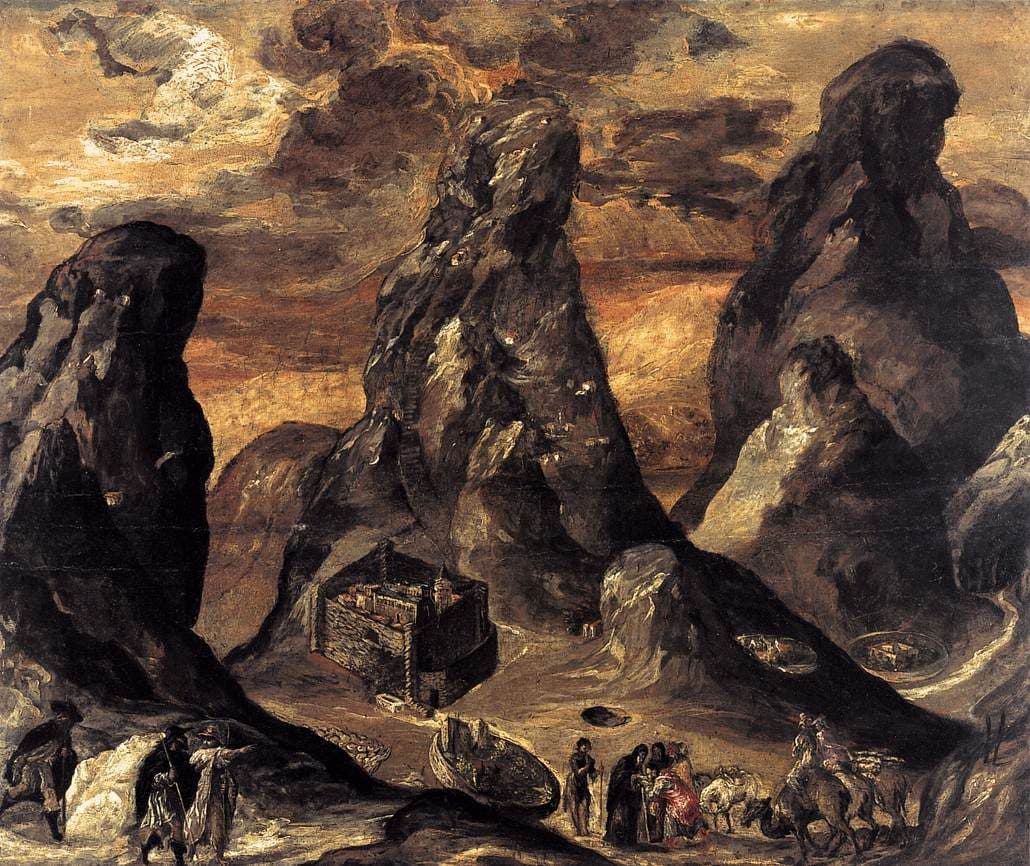
El Greco, Mount Sinai, 1570 to 1572, Historical Museum of Crete, Heraklion. Public domain, via Wikimedia Commons.
THE ARTWORKEl Greco painted Mount Sinai as three peaks with a walled monastery at their foot and pilgrims arriving below.
Summary
God made His covenant with Israel at Sinai after the exodus, and Deuteronomy calls the same mountain Horeb.
- Israel camped in front of the mountain from the third month after leaving Egypt until the second month of the second year.
- Moses stayed on the mountain forty days and forty nights two times, and came down the second time with his face radiant.
- Elijah fled to Horeb when Jezebel sought his life, and the LORD spoke with him there.
- Paul and the letter to the Hebrews set Sinai beside the Jerusalem above and Mount Zion.
Horeb, the Mountain of God
Moses first came to the mountain as a shepherd, before he went back to Egypt.
Meanwhile, Moses was shepherding the flock of his father-in-law Jethro, the priest of Midian. He led the flock to the far side of the wilderness and came to Horeb, the mountain of God. There the angel of the LORD appeared to him in a blazing fire from within a bush. Moses saw the bush ablaze with fire, but it was not consumed.Exodus names the mountain of God before Israel ever reaches it, and sets the bush there.
“I will surely be with you,” God said, “and this will be the sign to you that I have sent you: When you have brought the people out of Egypt, all of you will worship God on this mountain.”Exodus 19 records the fulfilment, when Israel camped in front of this mountain.
Two names for one mountainExodus 3:1 and Deuteronomy 5:2
Strong's lexicon counts the name Sinai 35 times in the Old Testament and Horeb 17 times, and it defines Horeb as a general name for the Sinai mountains.
The LORD our God made a covenant with us at Horeb.Moses names Horeb as the place of the covenant that Exodus sets at Mount Sinai.
John Wesley, in his Explanatory Notes upon the Old Testament, explains the two names as two tops of the same mountain.
After forty years had passed, an angel appeared to Moses in the flames of a burning bush in the desert near Mount Sinai.Stephen dates the bush forty years after Moses fled Egypt and uses the name Sinai for the mountain of Exodus 3.
Why the ground was holyExodus 3:5
“Do not come any closer,” God said. “Take off your sandals, for the place where you are standing is holy ground.”The command to Moses comes before the boundary God later set for all Israel at the same mountain.
Albert Barnes argues that the place was not a sanctuary before that day. Moses had spent some forty years in the region and knew nothing of its holiness, and the ground became holy by the presence of God.
Five Peaks Proposed as Sinai
Travelers and scholars have placed the mountain in the southern peninsula, in Arabia and in the Negev.
| Peak | Where it stands | Certainty | Held by |
|---|---|---|---|
| Jebel Musa | The southern Sinai peninsula | Proposed | Ritter, as Smith's Dictionary reports him |
| Ras Sufsafeh | The northwest face of the same ridge, over the plain er Rahah | Proposed | Robinson, as Smith's Dictionary reports him |
| Jebel Serbal | About 30 miles west of Jebel Musa, above Wadi Feiran | Proposed | Lepsius and Burckhardt, as Smith's Dictionary reports them |
| Jebel Baghir | Arabia, near the head of the Gulf of Aqaba | Proposed | Beke (1878) |
| Har Karkom | The Negev | Proposed | Emmanuel Anati (1986) |
- Peak
- Jebel Musa
- Where it stands
- The southern Sinai peninsula
- Certainty
- Proposed
- Held by
- Ritter, as Smith's Dictionary reports him
- Peak
- Ras Sufsafeh
- Where it stands
- The northwest face of the same ridge, over the plain er Rahah
- Certainty
- Proposed
- Held by
- Robinson, as Smith's Dictionary reports him
- Peak
- Jebel Serbal
- Where it stands
- About 30 miles west of Jebel Musa, above Wadi Feiran
- Certainty
- Proposed
- Held by
- Lepsius and Burckhardt, as Smith's Dictionary reports them
- Peak
- Jebel Baghir
- Where it stands
- Arabia, near the head of the Gulf of Aqaba
- Certainty
- Proposed
- Held by
- Beke (1878)
- Peak
- Har Karkom
- Where it stands
- The Negev
- Certainty
- Proposed
- Held by
- Emmanuel Anati (1986)
Israel at the Mountain
Israel stayed at Sinai for about eleven months, and the text dates five of its events by the month.
- The third monthIsrael enters the Wilderness of Sinai and camps in front of the mountain, Exodus 19:1 to 2
- The third dayThe LORD descends on the mountain in fire, smoke and thunder, Exodus 19:16 to 18
- The same dayGod speaks the Ten Commandments to the people, Exodus 20:1 to 17
- After the lawMoses builds an altar with twelve pillars, and the elders eat before God, Exodus 24:4 to 11
- Forty days and nightsMoses stays on the mountain inside the cloud, Exodus 24:18
- At his descentMoses sees the calf and breaks the tablets, Exodus 32:19
- A second forty daysThe words of the covenant are written on new tablets, Exodus 34:28
- The first day of the first month, second yearThe tabernacle is set up, Exodus 40:17
- The fourteenth day of that monthIsrael keeps the Passover in the Wilderness of Sinai, Numbers 9:1 to 5
- The first day of the second monthThe LORD orders the census in the Tent of Meeting, Numbers 1:1
- The twentieth day of the second monthThe cloud lifts and Israel sets out for Paran, Numbers 10:11 to 12
Eleven events in order, from the arrival in the third month to the departure in the second month of the second year, each with its verse.
The third day and the people's fearExodus 19:18 and Exodus 20:19
Mount Sinai was completely enveloped in smoke, because the LORD had descended on it in fire. And the smoke rose like the smoke of a furnace, and the whole mountain quaked violently.This is the descent that Exodus 19:11 had announced for the third day.
“Speak to us yourself and we will listen,” they said to Moses. “But do not let God speak to us, or we will die.”The people's fear made Moses the one who would carry God's words to them.
The meal of the eldersExodus 24:9 to 11
But God did not lay His hand on the nobles of Israel; they saw Him, and they ate and drank.The fear of Exodus 20:19 is answered here, since the leaders saw God and lived.
Matthew Henry carries the meal forward to the Lord's table.
“They feasted upon the sacrifice, before God, in token of their cheerful consent to the covenant now made, their grateful acceptance of the benefits of it, and their communion with God, in pursuance of that covenant. Thus believers eat and drink with Christ at his table, Luke xxii.”
Matthew Henry · Commentary on the Whole Bible · on Exodus 24:11Puritan
The tablets broken at the foot of the mountainExodus 32:19 and Exodus 34:1
As Moses approached the camp and saw the calf and the dancing, he burned with anger and threw the tablets out of his hands, shattering them at the base of the mountain.The tablets were broken at the foot of the same mountain where they were given.
Then the LORD said to Moses, “Chisel out two stone tablets like the originals, and I will write on them the words that were on the first tablets, which you broke.God renewed the covenant on the same mountain and wrote the same words again.
The name proclaimedExodus 33:18 to 34:9
and when My glory passes by, I will put you in a cleft of the rock and cover you with My hand until I have passed by.God kept Moses safe on the mountain while He showed him as much as he could bear.
Then the LORD passed in front of Moses and called out: “The LORD, the LORD God, is compassionate and gracious, slow to anger, abounding in loving devotion and faithfulness, maintaining loving devotion to a thousand generations, forgiving iniquity, transgression, and sin. Yet He will by no means leave the guilty unpunished; He will visit the iniquity of the fathers on their children and grandchildren to the third and fourth generations.”The LORD answered Moses' request to see His glory by declaring His own character.
Jamieson, Fausset and Brown tie the timing of the proclamation to the pardon of Israel.
“Being about to republish His law--the sin of the Israelites being forgiven and the deed of pardon about to be signed and sealed by renewing the terms of the former covenant--it was the most fitting time to proclaim the extent of the divine mercy which was to be displayed, not in the case of Israel only, but of all who offend.”
Jamieson, Fausset & Brown · Commentary Critical and Explanatory on the Whole Bible · on Exodus 34:6Reformed
The radiant faceExodus 34:29 to 35
And when Moses came down from Mount Sinai with the two tablets of the Testimony in his hands, he was unaware that his face had become radiant from speaking with the LORD.Moses' face carried back to the camp the glory he had met on the mountain.
Three Things the Text Says Plainly
The text fixes a boundary at the mountain, a voice without a form and a companion for Moses.
THE PEOPLE WERE KEPT FROM THE MOUNTAIN
God set a boundary around the mountain, and anyone who touched it was to be put to death. Adam Clarke says the text does not show whether the boundary was a line on the ground or a fence.
THE PEOPLE HEARD A VOICE AND SAW NO FORM
Moses reminded Israel that they heard the sound of words out of the fire and saw no form, and on that ground he warned them not to make an idol of any form.
JOSHUA WENT UP WITH MOSES
Joshua, Moses' attendant, set out with him up the mountain of God. In Exodus 32:17 he is with Moses again on the way down, when they hear the shouting in the camp.
The Wilderness of Sinai
The camp lay in the Wilderness of Sinai, which took its name from the mountain.
After they had set out from Rephidim, they entered the Wilderness of Sinai, and Israel camped there in front of the mountain.Rephidim is the last station Exodus names before the mountain.
John Gill, in his Exposition of the Old Testament, says the mountain itself was named for the bushes that grew on it.
It is an eleven-day journey from Horeb to Kadesh-barnea by way of Mount Seir.Moses opens Deuteronomy by measuring the road from Horeb to Kadesh-barnea, the camp from which the spies went into Canaan.
The Mountain in the Written Record
A pilgrim's account, a dictionary of 1863 and Rashi's commentary each add to the record of the mountain.
Egeria climbs the mount of GodThe Pilgrimage of Etheria, pages 1 to 8
Egeria, a pilgrim from the far west of the Roman world, reached the mountain toward the end of the fourth century, by the date her English editors accept. Her guides showed her a group of peaks they called the mount of God, and she climbed the central peak, on which they said the glory of God had come down.
She came down to a church and a garden at the head of the valley, where the monks showed her the bush, still alive. They also showed her where the camp had stood and where the calf was made.
Her editors of 1919 report Sir Charles Wilson's judgment that her mount of God was Jebel Musa. They add that the convent of Saint Catherine now stands at the place of the bush.
Paran and the monastery of JustinianSmith's Dictionary of the Bible, 1863
William Smith's Dictionary of the Bible records that a church and a bishop's city stood at Paran in Wadi Feiran before Justinian founded the convent of Saint Catherine.
Rashi on the order of Exodus 24Rashi on Exodus 24:1
Rashi, the Jewish commentator of eleventh-century France, says the call to come up in Exodus 24:1 was spoken before the Ten Commandments were given, on the fourth of the month Sivan. He cites the Talmud, tractate Shabbat 88a.
What the Text Leaves Unsaid
Readers ask where the peak stands and where Hebrews found a saying of Moses, and the text answers neither.
Exodus describes the mountain by its fire, smoke and cloud, and gives no landmark beside them.
The sight was so terrifying that even Moses said, “I am trembling with fear.”The writer to the Hebrews sets this saying among the terrors of the mountain.
Albert Barnes notes that readers have asked on what authority the writer gives it.
Where Scripture Returns to the Mountain
Elijah went back to Horeb, and Stephen, Paul and Hebrews read the mountain in the light of Christ.
So he got up and ate and drank. And strengthened by that food, he walked forty days and forty nights until he reached Horeb, the mountain of God.Elijah's forty days match the forty days Moses spent on the same mountain.
Instead, you have come to Mount Zion, to the city of the living God, the heavenly Jerusalem. You have come to myriads of angelsThis is the mountain Hebrews sets in place of Sinai for those who believe in Christ.
Elijah at Horeb1 Kings 19:9 to 13
Then the LORD said, “Go out and stand on the mountain before the LORD. Behold, the LORD is about to pass by.” And a great and mighty wind tore into the mountains and shattered the rocks before the LORD, but the LORD was not in the wind. After the wind there was an earthquake, but the LORD was not in the earthquake. After the earthquake there was a fire, but the LORD was not in the fire. And after the fire came a still, small voice.The LORD passed by Elijah on the mountain where He had once come down in fire, and He was not in the fire.
Matthew Henry connects Elijah's cave with the account of Moses in Exodus 33.
“Elijah housed in a cave at Mount Horeb, which is called the mount of God, because on it God had formerly manifested his glory. And perhaps this was the same cave, or cleft of a rock, in which Moses was hidden when the Lord passed by before him and proclaimed his name, Exod. xxxiii.”
Matthew Henry · Commentary on the Whole Bible · on 1 Kings 19:7Puritan
Albert Barnes thinks a well-known cave must be meant, and judges the small cave of Elijah shown below the summit of Jebel Musa too small to be the real one. He counts Horeb less than 200 miles from the wilderness beyond Beersheba where the angel fed Elijah, six or seven days of travel.
Stephen and PaulActs 7:38 and Galatians 4:24 to 26
He was in the assembly in the wilderness with the angel who spoke to him on Mount Sinai, and with our fathers. And he received living words to pass on to us.Stephen gives the law of Sinai its full honour while he is on trial for speaking against it.
These things serve as illustrations, for the women represent two covenants. One covenant is from Mount Sinai and bears children into slavery: This is Hagar. Now Hagar stands for Mount Sinai in Arabia and corresponds to the present-day Jerusalem, because she is in slavery with her children. But the Jerusalem above is free, and she is our mother.Paul turns the mountain into a figure in his letter to the Galatian churches.
Matthew Henry explains how a covenant of grace could stand for bondage.
“The former, Agar, represented that which was given from mount Sinai, and which gendereth to bondage, which, though it was a dispensation of grace, yet, in comparison of the gospel state, was a dispensation of bondage, and became more so to the Jews, through their mistake of the design of it, and expecting to be justified by the works of it.”
Matthew Henry · Commentary on the Whole Bible · on Galatians 4:24 to 27Puritan
The two mountains of HebrewsHebrews 12:18 to 24
For you have not come to a mountain that can be touched and that is burning with fire; to darkness, gloom, and storm;Hebrews describes Sinai by the fire and darkness of Exodus 19.
Matthew Henry contrasts the darkness at Sinai with the clearer light of the gospel.
“The state of the gospel church on mount Zion is more spiritual, rational, and easy. It was a dark dispensation. Upon that mount there were blackness and darkness, and that church-state was covered with dark shadows and types: the gospel state is much more clear and bright.”
Matthew Henry · Commentary on the Whole Bible · on Hebrews 12:18Puritan
Three Voices on the Mountain
Three teachers, two of the fourth century and one of the eighteenth, read what happened at the mountain.
Eusebius of Caesarea asks who spoke to Moses from the pillar of cloud.
“The people then beheld the pillar of cloud, and it spoke to Moses. But who was the speaker? Obviously the pillar of cloud, which before appeared to the fathers in a corporeal form. And I have already shown that this was not directly and visibly the almighty God as such but the One whom we name as the Word of God, the Christ who was seen for the sake of the multitude of Moses and the people in a pillar of cloud, because it was not possible for them to see him like their fathers in human shape.”
Eusebius of Caesarea · Proof of the Gospel 5.14.241 · on Exodus 19:9Patristic
Gregory of Nazianzus applies the boundary at the mountain to those who would come near to God.
“For it is not everyone who may draw near to God but only one who, like Moses, can bear the glory of God. Moreover, before this, when the law was first given, the trumpet blasts, and lightnings, and thunders, and darkness, and the smoke of the whole mountain, and the terrible threats that if even a beast touched the mountain it should be stoned, and other like alarms kept back the rest of the people, for whom it was a great privilege, after careful purification, merely to hear the voice of God.”
Gregory of Nazianzus · ORATION 2.92 · on Exodus 24:2Patristic
Matthew Henry asks what came of God speaking to the people without a mediator.
“Once God tried the expedient of speaking to the children of men immediately, but it was found that they could not bear it; it rather drove men from God than brought them to him, and, as it proved in the issue, though it terrified them, it did not deter them from idolatry, for soon after this they worshipped the golden calf.”
Matthew Henry · Commentary on the Whole Bible · on Exodus 20:19Puritan
Three Tests of the Site
Readers test each peak against the room the camp needed, the oldest tradition and the texts that tie the mountain to Midian and Arabia.
Room for the campExodus 19:17 and Exodus 20:18
Exodus has the people stand at a distance from the mountain while it burns. Albert Barnes reads Exodus 19:17 as a camp spread far over the plain in front of the mountain, and takes er Rahah as that plain if the law was given from Ras Sufsafeh.
The objection: Smith's Dictionary finds no plain near Serbal large enough for the camp. It finds none below the highest summit of Jebel Musa either, and no stream coming down from the mountain there, which Deuteronomy 9:21 names.
The oldest traditionEusebius, Jerome and Cosmas
Smith's Dictionary reports Stanley's finding that Eusebius, Jerome and Cosmas named Serbal as Sinai, and it calls Serbal the most magnificent mountain of the peninsula.
The objection: the same article judges a Sinai within a mile of Rephidim unsuitable, since Exodus 19:2 makes the move from Rephidim a full stage of the march.
The ties to Midian and ArabiaExodus 3:1, Exodus 18:5 and Galatians 4:25
Moses was a shepherd in Midian when he came to Horeb, and Paul writes of Mount Sinai in Arabia. On these texts Beke regarded Jebel Baghir as the true Mount Sinai.
Moses’ father-in-law Jethro, along with Moses’ wife and sons, came to him in the desert, where he was encamped at the mountain of God.Jethro, the priest of Midian, met Moses at the mountain of God.
The objection: Paul's phrase may name a language and not a region.
“Translate, ‘For this word, Hagar, is (imports) Mount Sinai in Arabia (that is, among the Arabians--in the Arabian tongue).’ So CHRYSOSTOM explains. Haraut, the traveller, says that to this day the Arabians call Sinai, ‘Hadschar,’ that is, Hagar, meaning a rock or stone.”
Jamieson, Fausset & Brown · Commentary Critical and Explanatory on the Whole Bible · on Galatians 4:25Reformed
Books on the Mountain
Three of these four works can be read free online.
The Pilgrimage of Etheria
Egeria, translated by M. L. McClure and C. L. Feltoe · 1919
It records in her own words a pilgrim's ascent of the mountain the monks called Sinai.
Read at archive.orgA Dictionary of the Bible, volume 3, the article Sinai
William Smith, editor · 1863
The article sets out the cases for three peaks of the southern peninsula with the objections to each.
Read at archive.orgDiscoveries of Sinai in Arabia and of Midian
Charles Beke · 1878
Beke's account of his travels to the head of the Gulf of Aqaba is an early case for a Sinai in Midian.
Read at archive.orgThe Mountain of God: Har Karkom
Emmanuel Anati · 1986
Anati presents his excavations in the Negev as the setting of the mountain.
In print: find it wherever books are sold.
The Mediator of a New Covenant
The letter to the Hebrews ends its comparison of the two mountains with Jesus.
to Jesus the mediator of a new covenant, and to the sprinkled blood that speaks a better word than the blood of Abel.The mediator of the new covenant brings the believer near, where Sinai kept the people back.
See to it that you do not refuse Him who speaks. For if the people did not escape when they refused Him who warned them on earth, how much less will we escape if we reject Him who warns us from heaven?The warning asks every reader to listen to the One who speaks from heaven.
Keep studying
Studies4
Doctrines11