
Numbers 5 · Exodus 34 · Hosea 2 · Subject · Featured Study
The Ordeal of the Suspected Wife
The law of jealousy in Numbers 5 read beside the law of witnesses and the prophets, with the readings of Jewish and Christian commentators.
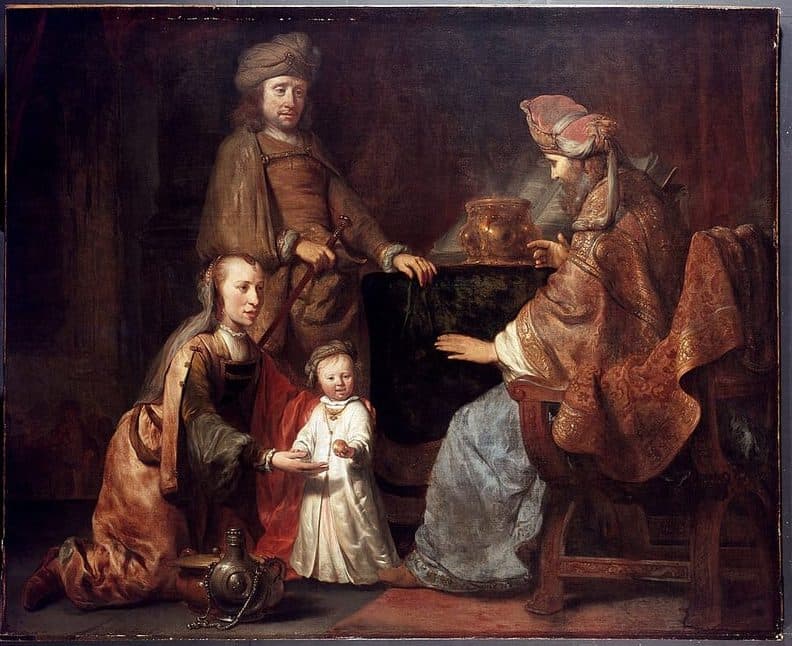
Gerbrand van den Eeckhout, The Infant Samuel brought by Hannah to Eli, between 1660 and 1663, Ashmolean Museum. Public domain by date, via Wikimedia Commons.
THE ARTWORKEeckhout painted Hannah bringing her son Samuel to Eli the priest at the house of the LORD in Shiloh, the scene of 1 Samuel 1:24 to 28. It stands here because it shows a woman before the priest at the sanctuary, the setting of Numbers 5:16, and Eli had once misjudged her as she prayed there (1 Samuel 1:13 to 14).
When a husband suspected his wife and no witness could settle it, the law took the case out of his hands and brought it before the LORD.
Summary
Numbers 5:11 to 31 calls itself the law of jealousy, and the priest carried it out at the tabernacle.
- The husband brought his wife and an offering of barley flour to the priest.
- She answered the oath with Amen, Amen, and drank holy water that held dust from the tabernacle floor and the washed-off words of the curse.
- If she was guilty she suffered and became a curse among her people; if she was clean she was unaffected and able to conceive.
- The prophets later call Israel's worship of other gods the unfaithfulness of a wife to the LORD her husband.
The Law of Jealousy
Numbers 5:11 to 31, among the laws for the purity of the camp
The law of jealousy follows the sending away of the unclean from the camp in Numbers 5:1 to 4 and the law of restitution in Numbers 5:5 to 10.
by sleeping with another man, and it is concealed from her husband and her impurity is undetected (since there is no witness against her and she was not caught in the act),This verse is the case the whole rite answers, an act kept hidden from the husband.
and if a feeling of jealousy comes over her husband and he suspects his wife who has defiled herself—or if a feeling of jealousy comes over him and he suspects her even though she has not defiled herself—This verse lets the husband's jealousy alone bring the case, whether his wife is guilty or innocent.
The Rite and What the Priest Prepared
The rite of Numbers 5:15 to 28 in order, and the jar, the water and the offering drawn
The rite ran in ten steps, from the husband's offering to the outcome left to the LORD.
- The husband brings his wife and a tenth of an ephah of barley flour to the priestNumbers 5:15
- The priest has her stand before the LORDNumbers 5:16
- He puts dust from the tabernacle floor into holy water in a clay jarNumbers 5:17
- He lets down her hair and places the grain offering in her handsNumbers 5:18
- He puts her under oath and names first the case of her innocenceNumbers 5:19 to 20
- He speaks the curse, and she answers Amen, AmenNumbers 5:21 to 22
- He writes the curses on a scroll and washes them into the waterNumbers 5:23
- He waves the offering before the LORD and brings it to the altarNumbers 5:25
- He burns a handful on the altar and has her drink the waterNumbers 5:26
- The outcome follows, suffering for a guilty wife and no harm for a clean oneNumbers 5:27 to 28
Ten numbered steps, each with its verse.
The priest prepared holy water, dust and a written curse in a clay jar, and the barley offering stood in the woman's hands.
Numbers 5 gives no measure of the jar or the scroll.
- The clay jar
- The holy water
- The dust of the tabernacle floor
- The curses written on a scrollNumbers 5:23
- The words washed into the water
- The barley offering in her handsBarley flour with no oil or frankincenseNumbers 5:18
Numbers 5 gives no measure of the jar or the scroll.
The parts are drawn in proportion for reading. The deep tone marks what came from the sanctuary, the holy water and the dust of its floor; the middle tone marks the barley flour the husband brought; the clay jar and the scroll are left unfilled.
Six labelled parts, from the clay jar to the barley offering.
From the Offering to the Outcome
Numbers 5:15 to 28 in five scenes, with what the commentators add to each
The offering of jealousyNumbers 5:15
then he is to bring his wife to the priest. He must also bring for her an offering of a tenth of an ephah of barley flour. He is not to pour oil over it or put frankincense on it, because it is a grain offering for jealousy, an offering of memorial as a reminder of iniquity.This verse is the husband's last act in the rite.
“When anyone brings a grain offering to the LORD, his offering must consist of fine flour. He is to pour olive oil on it, put frankincense on it,The usual grain offering carried oil and frankincense, so their absence marks the offering of jealousy out.
Jamieson, Fausset and Brown give two reasons the oil and the frankincense were left off. In their reading the rite was a solemn appeal to God in distress. It was also a sin offering for a wife who came before God as a real or suspected offender.
Rashi notes that the word for flour here, qemach, means flour that was not finely sifted.
The water, the dust and the loosened hairNumbers 5:16 to 18
Then he is to take some holy water in a clay jar and put some of the dust from the tabernacle floor into the water.This verse is the ground of the readings below, Rashi's on the water and Clarke's on the dust.
After the priest has the woman stand before the LORD, he is to let down her hair and place in her hands the grain offering of memorial, which is the grain offering for jealousy. The priest is to hold the bitter water that brings a curse.This verse is the first to call the water bitter, the name it keeps through the rest of the rite.
Rashi holds that the basin that held the holy water was made from the mirrors of Exodus 38:8, so that a wife suspected of unfaithfulness was tried by water from it.
Clarke reads the dust as a sign of how base the crime was, and the uncovering of a woman's head as a great disgrace in the East.
The oath and the amenNumbers 5:19 to 22
And he is to put the woman under oath and say to her, ‘If no other man has slept with you and you have not gone astray and become defiled while under your husband’s authority, may you be immune to this bitter water that brings a curse.The priest speaks of the woman's innocence first, before any word of the curse.
May this water that brings a curse enter your stomach and cause your belly to swell and your thigh to shrivel.’ Then the woman is to say, ‘Amen, Amen.’This verse holds the only words the woman speaks in the rite.
Rashi draws a rule from this order, that a trial for a person's life begins with what bears on the innocence of the accused. He cites the Talmud for it, in Sotah 17a and Sanhedrin 33a.
The written curse and the drinkNumbers 5:23 to 24
And the priest shall write these curses on a scroll and wash them off into the bitter water.This verse is the only act of writing in the rite, the act the Mishnah later fills out.
Rashi notes that Numbers 5:24 speaks of the drink before the offering, and that in practice the offering came first, as Numbers 5:26 has it. Clarke writes that the curses were washed off the parchment, so that she drank the very words of the curse.
The outcomeNumbers 5:27
When he has made her drink the water, if she has defiled herself and been unfaithful to her husband, then the water that brings a curse will enter her and cause bitter suffering; her belly will swell, her thigh will shrivel, and she will become accursed among her people.This verse is the end that the curse of Numbers 5:21 called down.
Rashi reads the words that the water will enter her as meaning her whole body, with the thigh and the belly named first.
What the Text Says of the Water
Two readings later teachers gave of the water, each set beside its verse
A BITTER SUBSTANCE WAS PUT INTO THE WATER
Clarke reports that the rabbis held this, and he answers that Moses says nothing of it and takes bitter as a word for affliction.
THE HOLY WATER CAME FROM THE BASIN
Gill reports that the Targums of Onkelos and Jonathan, with Rashi and Ibn Ezra, take it from the basin, and the verse itself does not name its source.
Witnesses and Ordeals
Why the law needed a rite for this case, and the trials of other nations
A lone witness is not sufficient to establish any wrongdoing or sin against a man, regardless of what offense he may have committed. A matter must be established by the testimony of two or three witnesses.Deuteronomy 17:6 applies this rule to a sentence of death, the penalty the next verse gives for adultery.
If a man commits adultery with another man’s wife—with the wife of his neighbor—both the adulterer and the adulteress must surely be put to death.This penalty belonged to adultery that witnesses proved, and Numbers 5 names no execution for a wife the water convicts.
Clarke calls the rite the most ancient case of trial by ordeal. He writes that almost all nations, civilized or barbarian, used like trials when complete evidence was wanting.
The Words of the Rite
Ten Hebrew words of Numbers 5:12 to 30, with the sense the lexicon gives each
Clarke reads the spirit of jealousy in Numbers 5:14, ruach qin'ah, in two ways, as a supernatural influence from the devil that stirs the husband to jealousy or as the passion of jealousy itself.
| Word | Sense | Where it stands in Numbers 5 |
|---|---|---|
| sâṭâh, H7847 | to turn aside; to deviate from duty | goes astray, verses 12, 19, 20 and 29 |
| rûwach, H7307 | wind; spirit | a feeling of jealousy, verses 14 and 30 |
| qinʼâh, H7068 | jealousy or envy | jealousy, verses 14, 15, 18, 25, 29 and 30 |
| qemach, H7058 | flour | barley flour, verse 15 |
| cheres, H2789 | earthenware | a clay jar, verse 17 |
| ʻâphâr, H6083 | dust | dust, verse 17 |
| mar, H4751 | bitter | the bitter water, verses 18, 19, 23, 24 and 27 |
| ʼârar, H779 | to curse | that brings a curse, verses 18, 19, 22, 24 and 27 |
| yârêk, H3409 | the thigh | your thigh shrivel, verses 21, 22 and 27 |
| ʼâmên, H543 | sure; amen | Amen, Amen, verse 22 |
Clarke writes that the meaning of the swelling and the shrivelling in Numbers 5:21 to 22 cannot easily be found, and that the Hebrew lanpel yarech means literally that the thigh falls. Rashi reads both verbs as causing the act, so that the water causes the belly to swell and causes the thigh to fall.
What the Text Leaves Unsaid
Two questions Numbers 5 leaves open, and what later practice added to the rite
Numbers 5 gives the law and tells of no woman brought to it.
The rite is for the wife alone, and Numbers 5 does not bring the man she was suspected with into it.
The rabbis filled out the rite beyond what Numbers says. Gill reports from the Mishnah that the jar held half a log of water, about a quarter of a pint, and that the curses were written out in full without her amen. Clarke reports that some rabbis held the ink was made to wash off, and Rashi reports from the Talmud that the woman was led from place to place to tire her into confessing.
The LORD Who Is Jealous
How the Law and the prophets speak of the LORD's jealousy for his people
The Law also calls the LORD jealous, with the Hebrew word qanna.
For you must not worship any other god, for the LORD, whose name is Jealous, is a jealous God.This verse ties the LORD's jealousy to the command against other gods, the sin the prophets call adultery.
The prophets describe the people's turning from the LORD as a wife's unfaithfulness, with the LORD as the husband.
Rebuke your mother, rebuke her, for she is not My wife, and I am not her husband. Let her remove the adultery from her face and the unfaithfulness from between her breasts.This verse turns the law's picture of an unfaithful wife on the whole land, which Hosea 1:2 says has departed from the LORD.
You adulterous wife! You receive strangers instead of your own husband!This verse brings the same charge against Jerusalem, to whom Ezekiel 16:2 to 3 addresses the chapter.
Both chapters then turn to the LORD restoring the wife who wronged Him.
So I will betroth you to Me forever; I will betroth you in righteousness and justice, in loving devotion and compassion. And I will betroth you in faithfulness, and you will know the LORD.”These verses answer the charge of Hosea 2:2.
But I will remember the covenant I made with you in the days of your youth, and I will establish an everlasting covenant with you.This verse answers the charge of Ezekiel 16:32, since the LORD keeps the covenant that Jerusalem broke in Ezekiel 16:59.
Two Teachers on the Rite
Albert Barnes and Matthew Henry
Barnes sets the rite beside the customs of Egypt in the age of Moses.
“The trial of jealousy. Since the crime of adultery is especially defiling and destructive of the very foundations of social order, the whole subject is dealt with at a length proportionate to its importance. The process prescribed has lately been strikingly illustrated from an Egyptian ‘romance,’ which refers to the time of Rameses the Great, and may therefore well serve to illustrate the manners and customs of the Mosaic times. This mode of trial, like several other ordinances, was adopted by Moses from existing and probably very ancient and widely spread institutions.”
Albert Barnes · Notes, Explanatory and Practical, on the Old and New Testaments (1832-1869) · on Numbers 5:11Evangelical
Henry gathers what earlier writers said of how soon the effect of the water was seen.
“Bishop Patrick says, from some of the Jewish writers, that the effect of these waters appeared immediately, she grew pale, and her eyes ready to start out of her head. Dr. Lightfoot says that sometimes it appeared not for two or three years, but she bore no children, was sickly, languished, and rotted at last; it is probable that some indications appeared immediately.”
Matthew Henry · Commentary on the Whole Bible · on Numbers 5:27Puritan
What the Rite Was For
Two readings of the purpose of Numbers 5:11 to 31 and the objection to each
A guard for the suspected wifeJohn Wesley, Explanatory Notes upon the Old Testament, 1765, on Numbers 5:12
Wesley holds that the law was given partly to keep wives from adultery and partly to secure them against hard-hearted husbands, who might otherwise destroy them or put them away on mere suspicion. On this reading the rite gave a falsely suspected wife a public way to be cleared.
The objection: the closing words of the law in Numbers 5:31 speak of her guilt and clear the man who brought the charge.
A way to convict the guilty wifeJamieson, Fausset and Brown, Commentary Critical and Explanatory, 1871, on Numbers 5:29
Jamieson, Fausset and Brown read the law as a provision for cases that were strongly suspected and could not be proved, so that the guilty could be convicted.
The objection: on Wesley's reading the outcome for a clean wife in Numbers 5:28 shows that the rite was made to clear the innocent as well.
Books on the Rite
Two works to read whole
Rashi on Numbers
Rashi, in the English of M. Rosenbaum and A. M. Silbermann · 1929 to 1934
Rashi explains the Hebrew of the rite and names the passages of the Talmud he draws each reading from, chiefly the tractate Sotah.
Read Rashi on Numbers 5 at SefariaCommentary on the Bible
Adam Clarke · 1832
Clarke sets the verses of the law beside other Scripture and the customs of the East.
Read Clarke's Commentary at CCELPromised to One Husband
Numbers 5 placed a wife's faithfulness under the LORD's judgment, and the prophets used the same picture of a husband and a wife for the LORD and His people.
I am jealous for you with a godly jealousy. For I promised you to one husband, to present you as a pure virgin to Christ.Paul takes the jealousy the prophets give the LORD as the pattern for his own care of the church.
Keep studying
Studies5