
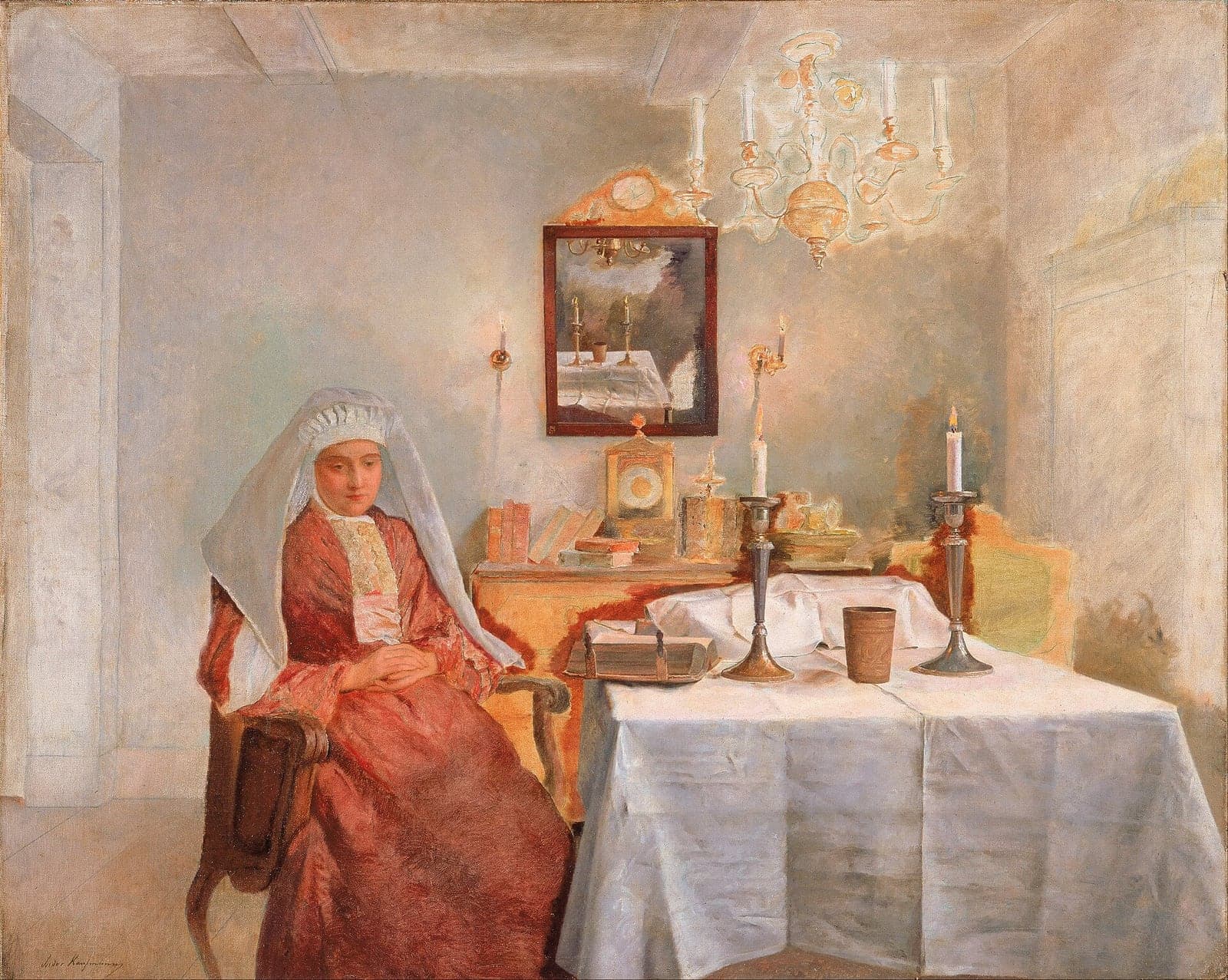
Isidor Kaufmann, Friday Evening, about 1920. Public domain.
Leviticus 23 · Doctrine · Featured Study
The Hebrew Feasts
Leviticus 23 sets the Sabbath and seven appointed feasts on fixed days of Israel's year, four in the spring and three in the seventh month.
No holy day falls between the loaves of new wheat and the autumn, so Israel's summer passed without one.
“Speak to the Israelites and say to them, ‘These are My appointed feasts, the feasts of the LORD that you are to proclaim as sacred assemblies.
- First taught
- Exodus 23:14 “Three times a year you are to celebrate…”
- Fullest statement
- Leviticus 23:1 to 44 “Then the LORD said to Moses, “Speak to…”
No holy day falls between the loaves of new wheat and the autumn, so Israel's summer passed without one.
Summary
Israel's year of feasts runs from the Passover of the first month to the Feast of Tabernacles in the seventh, with the weekly Sabbath kept through all of it.
- The chapter calls them the LORD's appointed feasts, sacred assemblies that Israel was to proclaim at their appointed times.
- Three of the seven were pilgrim feasts, at which every man of Israel appeared before the LORD.
- The sheaf of barley and the loaves of new wheat mark the spring, and the ingathering of the harvest closes the autumn.
- Paul names Christ the Passover lamb and the firstfruits of the dead, and Luke sets the coming of the Spirit on the day of Pentecost.
- MannaFest's own tradition reads the three autumn feasts as awaiting Christ's return, and other readers hold that Christ has met all seven.
The Appointed Times
Leviticus 23 opens with the Sabbath and then names the feasts of the LORD in the order of the year.
“Speak to the Israelites and say to them, ‘These are My appointed feasts, the feasts of the LORD that you are to proclaim as sacred assemblies.The feasts belong to the LORD, and the word for them is mo'adim, times He has set.
For six days work may be done, but the seventh day is a Sabbath of complete rest, a day of sacred assembly. You must not do any work; wherever you live, it is a Sabbath to the LORD.The weekly Sabbath stands first in the chapter, before any feast of the year.
These are the LORD’s appointed feasts, the sacred assemblies you are to proclaim at their appointed times.This verse begins the feasts of the year, each proclaimed on its own day.
The LORD speaks to Moses five times in the chapter, at verses 1, 9, 23, 26 and 33, and each time opens a new set of days.
Three times a year all your men are to appear before the LORD your God in the place He will choose: at the Feast of Unleavened Bread, the Feast of Weeks, and the Feast of Tabernacles. No one should appear before the LORD empty-handed.Three of the feasts drew every man of Israel to the place the LORD would choose.
John Wesley, in his Explanatory Notes upon the Old Testament, observes that the Day of Atonement was a fast, so he would rather call the list the solemnities.
“These are the feasts of the Lord - Or rather, the solemnities: (for the day of atonement was a fast:) and so the word is used, Isaiah xxxiii, 20, where Zion is called the city of our solemnities.”
John Wesley · Explanatory Notes upon the Old Testament · on Leviticus 23:4Evangelical
For six days work may be done, but the seventh day is a Sabbath of complete rest, a day of sacred assembly. You must not do any work; wherever you live, it is a Sabbath to the LORD.The weekly Sabbath stands first in the chapter, before any feast of the year.
These are the LORD’s appointed feasts, the sacred assemblies you are to proclaim at their appointed times.This verse begins the feasts of the year, each proclaimed on its own day.
The LORD speaks to Moses five times in the chapter, at verses 1, 9, 23, 26 and 33, and each time opens a new set of days.
Three times a year all your men are to appear before the LORD your God in the place He will choose: at the Feast of Unleavened Bread, the Feast of Weeks, and the Feast of Tabernacles. No one should appear before the LORD empty-handed.Three of the feasts drew every man of Israel to the place the LORD would choose.
John Wesley, in his Explanatory Notes upon the Old Testament, observes that the Day of Atonement was a fast, so he would rather call the list the solemnities.
“These are the feasts of the Lord - Or rather, the solemnities: (for the day of atonement was a fast:) and so the word is used, Isaiah xxxiii, 20, where Zion is called the city of our solemnities.”
John Wesley · Explanatory Notes upon the Old Testament · on Leviticus 23:4Evangelical
Deuteronomy 16:16, John Wesley, Leviticus 23:2
The Year of Leviticus 23
The feasts of the year fall in its first, third and seventh months.
Each line gives a date, what Leviticus 23 sets on it, and the harvest or pilgrimage it belongs to.
- Every seventh dayThe Sabbath, a day of complete rest, every week
- Month 1, day 14, at twilightPassover, sacrificed at the place the LORD chooses, by Deuteronomy 16:5 to 6
- Month 1, days 15 to 21Unleavened Bread, pilgrim feast
- The day after the Sabbath: day 16 by Josephus, or the first day of the week by the BoethusiansFirstfruits, the sheaf waved, the first barley
- Fifty days from the sheaf: month 3, day 6 counted from day 16, or a first day of the week by the BoethusiansWeeks, the new wheat, pilgrim feast
- The rest of month 3 to the end of month 6No appointed time, no sacred assembly
- Month 7, day 1A day of trumpet blasts, a sacred assembly
- Month 7, day 10The Day of Atonement, a fast and a Sabbath of complete rest
- Month 7, days 15 to 21, and day 22Tabernacles and the eighth day, the ingathering, pilgrim feast
From the Sheaf to the Ingathering
The year moves from the lamb of the first month through two spring harvests to the booths of the seventh month.
C. H. Mackintosh, in his Notes on the Book of Leviticus (1860), sorts the chapter by those five words to Moses. He sets the Sabbath, the Passover and the feast that follows it under the first, and the sheaf and the loaves under the second. A long unnoticed interval follows them, in his words, before the trumpets of the seventh month.
1. The Passover and the week without leaven1 passage
The Passover to the LORD begins at twilight on the fourteenth day of the first month. On the fifteenth day of the same month begins the Feast of Unleavened Bread to the LORD. For seven days you must eat unleavened bread.The two feasts stand on consecutive days, so Israel kept them as one week of remembrance.
Exodus 12 gives the night these days remember, and the page on the Passover teaches it in full.
2. The sheaf of the first barley1 passage, 1 quotation
“Speak to the Israelites and say, ‘When you enter the land that I am giving you and you reap its harvest, you are to bring to the priest a sheaf of the firstfruits of your harvest. And he shall wave the sheaf before the LORD so that it may be accepted on your behalf; the priest is to wave it on the day after the Sabbath.No grain of the new harvest was eaten until the first sheaf had been waved before the LORD.
The commentary of Jamieson, Fausset and Brown reads the waving of the sheaf as a picture of the resurrection.
“The offering of the wave-sheaf sanctified the whole harvest (Ro 11:16). At the same time, this feast had a typical character, and pre-intimated the resurrection of Christ (1Co 15:20), who rose from the dead on the very day the first-fruits were offered.”
Jamieson, Fausset & Brown · Commentary Critical and Explanatory on the Whole Bible · on Leviticus 23:10Reformed
3. Fifty days to Weeks1 passage, 1 quotation
You shall count off fifty days until the day after the seventh Sabbath, and then present an offering of new grain to the LORD. Bring two loaves of bread from your dwellings as a wave offering, each made from two-tenths of an ephah of fine flour, baked with leaven, as the firstfruits to the LORD.The fiftieth day gives the feast its Greek name, Pentecost, which Acts 2:1 uses.
Adam Clarke counts the seven weeks from the sixteenth day of the first month to the sixth day of the third. Bede, in his Homilies on the Gospels, reads the two loaves as the church gathered from Jews and Gentiles.
“Two loaves of bread made from the first fruits of the new harvest were rightly ordered to be offered, for the church gathers those it can consecrate to its Redeemer as a new family from both peoples, the Jews and the Gentiles.”
Bede · Homilies on the Gospels 2.17 · on Leviticus 23:17Patristic
4. The seventh month1 passage
On the fifteenth day of the seventh month, after you have gathered the produce of the land, you are to celebrate a feast to the LORD for seven days. There shall be complete rest on the first day and also on the eighth day.Tabernacles falls after the produce of the land has been gathered, so the year ends at the ingathering.
The page on the fall feasts teaches the seventh month day by day.
The Day After the Sabbath
Two dates in the spring were read in more than one way in the days of the second temple.
Leviticus 23:11 sets the sheaf on the day after the Sabbath. Josephus, in his Antiquities 3.10.5, puts it on the second day of unleavened bread, the sixteenth of Nisan.
The Mishnah, at Menachot 10:3, records that the Boethusians held the sheaf could be cut only at the close of a weekly Sabbath. On their reading, Firstfruits and Weeks always fall on the first day of the week.
The day of the cross is the second question. Mark 14:12 has the disciples prepare the Passover on the day the lamb was to be sacrificed, and John 19:14 sets the trial on the day of preparation for the Passover. The page on the Passover sets out both readings.
What the Chapter Leaves Unsaid
Leviticus 23 leaves two things about the year unnamed.
The chapter sets Weeks by counting from the sheaf and gives it no date of its own.
It numbers the months and names none of them, and Exodus 13:4 calls the first month Abib.
Shadow and Substance
The apostles name three of the spring feasts in Christ and in the coming of the Spirit.
Get rid of the old leaven, that you may be a new unleavened batch, as you really are. For Christ, our Passover lamb, has been sacrificed.The first feast of Israel's year is the one Paul names in Christ.
But Christ has indeed been raised from the dead, the firstfruits of those who have fallen asleep.The risen Christ is the firstfruits, the sheaf that promises the harvest after it.
But each in his own turn: Christ the firstfruits; then at His coming, those who belong to Him.Paul gives the harvest an order, Christ first and then those who belong to Him at His coming.
When the day of Pentecost came, they were all together in one place.Luke dates the outpouring of the Spirit by the Feast of Weeks.
Therefore let no one judge you by what you eat or drink, or with regard to a feast, a New Moon, or a Sabbath. These are a shadow of the things to come, but the body that casts it belongs to Christ.Paul warns the church at Colossae against being judged over the keeping of holy days.
1 Corinthians 15:23, Acts 2:1, Colossians 2:16 to 17
Three Readings of the Calendar
C. H. Mackintosh, Matthew Henry and the date-setters of 1988 stand for three ways of reading the autumn feasts.
The spring feasts met, the autumn feasts awaitedC. H. Mackintosh and Chuck Missler; MannaFest's own tradition
Mackintosh reads the trumpets of the first day as the time when the remnant of Israel shall blow the trumpet and seek the Lord. He reads the Day of Atonement as their affliction of soul still to come.
Then all the survivors from the nations that came against Jerusalem will go up year after year to worship the King, the LORD of Hosts, and to celebrate the Feast of Tabernacles.Mackintosh holds that the feast of tabernacles in this verse means the feast of tabernacles, kept in a kingdom still to come.
Chuck Missler, in his article The Fall Feasts of Israel (2013), holds that each feast has a prophetic role beside its remembrance, and he reads the three feasts of the seventh month in that light.
“While each of these feasts has a historical commemorative role, each also has a prophetic role.”
Chuck Missler · The Fall Feasts of Israel (article) · on Leviticus 23:2Evangelical
The objection rests on Hebrews 9:12, which reads Christ's entry into the Most Holy Place, the rite of the tenth day, as done once for all at the first coming.
Christ has met the feasts as a wholeMatthew Henry and Augustine of Hippo; amillennial readers
Henry reads the Feast of Tabernacles as fulfilled in the worship of the church under the gospel.
“And the worship of God under the New Testament is prophesied of under the notion of keeping the feast of tabernacles, Zech. xiv. For, [1.] The gospel of Christ teaches us to dwell in tabernacles, to sit loose to this world, as those that have here no continuing city, but by faith, and hope and holy contempt of present things, to go out to Christ without the camp, Heb. xiii.”
Matthew Henry · Commentary on the Whole Bible · on Leviticus 23:39Puritan
Augustine, in The City of God 20.9, holds that the Church even now is the kingdom of Christ, and the amillennial reading of the autumn feasts rests on that ground. It must then take Zechariah 14:16, the nations keeping the feast year after year, as already met in the church, and the apostles' care for the order of the spring feasts goes unexplained.
Dates set from the feastsEdgar Whisenant, 1988; answered by Thomas Ice, 1992
Edgar Whisenant set the rapture at Rosh Hashanah in September 1988, and when the day passed he moved it to October 3, as Dean C. Halverson recorded in the Christian Research Journal.
Thomas Ice of the Pre-Trib Research Center, in Israel's Fall Feasts and Date-Setting of the Rapture (1992), answers from inside the premillennial camp. He holds that the rapture is a signless, any-moment event and that the Feast of Trumpets does not relate to it.
No one knows about that day or hour, not even the angels in heaven, nor the Son, but only the Father.Jesus says that no one knows the day or hour, so no feast can fix the date of His coming.
MannaFest's own tradition, premillennial and dispensational, holds the first reading and keeps Matthew 24:36 beside it. Which autumn feast answers which event is argued among its readers, and the page on the appointed times read as a calendar of prophecy sets out the case.
Offered Once and Coming Again
The year that began with a lamb looks to the One who was offered once and will appear a second time.
Israel's year began with a lamb and ended with an ingathering, and the believer reads both ends of it in Christ.
so also Christ was offered once to bear the sins of many; and He will appear a second time, not to bear sin, but to bring salvation to those who eagerly await Him.The writer to the Hebrews sets the cross and the return side by side in one sentence.
Sources
Scripture is the Berean Standard Bible.
- John Wesley, Explanatory Notes upon the Old Testament (1765)
- Jamieson, Fausset and Brown, Commentary Critical and Explanatory on the Whole Bible (1871)
- Adam Clarke, Commentary on the Bible (1832)
- Bede, Homilies on the Gospels 2.17.
- Matthew Henry, Commentary on the Whole Bible (1710)
- Chuck Missler, The Fall Feasts of Israel (article, 2013)
- C. H. Mackintosh, Notes on the Book of Leviticus (preface dated London, May 1860), chapter 23, public domain.
- Flavius Josephus, Antiquities of the Jews 3.10.5, translated by William Whiston.
- Mishnah Menachot 10:3, William Davidson Edition, via Sefaria.
- Augustine of Hippo, The City of God, book 20, chapter 9, translated by Marcus Dods, via New Advent.
- Thomas Ice, Israel's Fall Feasts and Date-Setting of the Rapture (Pre-Trib Research Center, July 1992)
- Dean C. Halverson, 88 Reasons: What Went Wrong?, Christian Research Journal 11:2 (Fall 1988)
Keep Studying
Studies6
Doctrines26
Show the next 6 titles
Go further1