
Genesis to Matthew · Group · Featured Study
Moab and Ammon
Lot's two sons fathered the nations east of the Jordan, and Ruth of Moab stands in the line of David.
In Isaiah's oracle against Moab the prophet grieves over the nation he condemns: “My heart cries out over Moab.”
- Began
- With Moab and Ben-ammi, born to Lot's daughters (Genesis 19)
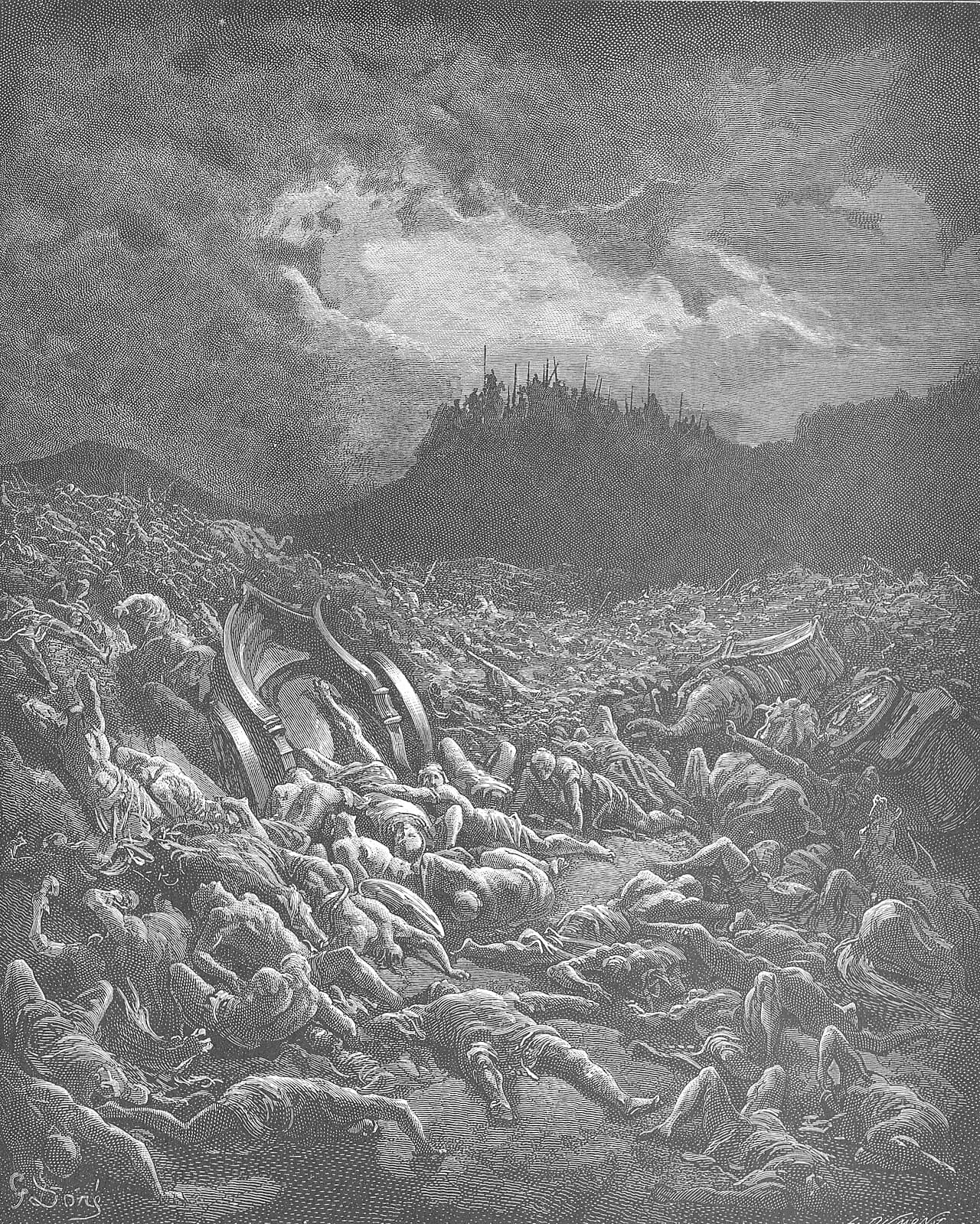
Gustave Doré, The Ammonite and Moabite Armies Are Destroyed, 1866, from Doré's English Bible. Public domain.
THE ARTWORKDoré engraved the field of 2 Chronicles 20:24, where the men of Judah looked for the vast army of Ammon, Moab and Mount Seir and found only corpses. He drew the valley full of fallen men and broken chariots, with a host of raised spears small on the far ridge under a break in the clouds.
Summary
Moab and Ammon were the two peoples descended from Lot, and Scripture follows them from their birth in Genesis 19 to the oracles of the prophets.
- Lot's older daughter named her son Moab, and the younger named hers Ben-ammi.
- Moab and Ammon hired Balaam to curse Israel, and the LORD turned the curse into a blessing.
- The law kept the Ammonite and the Moabite out of the assembly of the LORD to the tenth generation.
- Ruth the Moabitess bore Obed, the grandfather of David.
The Two Sons of Lot
Genesis 19:30 to 38 tells the birth of Moab and Ben-ammi, the fathers of two peoples.
Lot and his two daughters left Zoar and settled in the mountains—for he was afraid to stay in Zoar—where they lived in a cave.Lot's fear of Zoar is the reason his family lived alone in a cave in the mountains.
One day the older daughter said to the younger, “Our father is old, and there is no man in the land to sleep with us, as is the custom over all the earth. Come, let us get our father drunk with wine so we can sleep with him and preserve his line.”The older daughter gives her reason as the want of a man in the land and the wish to preserve her father's line.
The older daughter gave birth to a son and named him Moab. He is the father of the Moabites of today. The younger daughter also gave birth to a son, and she named him Ben-ammi. He is the father of the Ammonites of today.The words of today tie two peoples the first readers of Genesis knew to these two sons.
Rashi (France, 1040 to 1105) reads the name Moab as born of the father in his commentary on Deuteronomy. He holds that the older daughter made her father's part public in that name, and that Israel was forbidden any provocation of Ammon as a reward for the younger daughter's modesty.
Gill and Clarke on the two namesGenesis 19:37 to 38
John Gill gives the same reading of Moab after Ibn Ezra and Josephus. Adam Clarke reads Ben-ammi as the son of my people.
The land the LORD gave to Lot's sonsDeuteronomy 2:9 to 19
Then the LORD said to me, “Do not harass the Moabites or provoke them to war, for I will not give you any of their land, because I have given Ar to the descendants of Lot as their possession.”This verse shows that the LORD Himself gave Moab its land, so Israel passed it by on the way to Canaan.
(The Emites used to live there, a people great and many, as tall as the Anakites. Like the Anakites, they were also regarded as Rephaim, though the Moabites called them Emites.Moab's land had first belonged to the Emites, a people counted among the Rephaim.
But when you get close to the Ammonites, do not harass them or provoke them, for I will not give you any of the land of the Ammonites. I have given it to the descendants of Lot as their possession.”The same gift protected the Ammonites when Israel came near their border.
Albert Barnes calls the Moabites and the Ammonites kinsmen of the Israelites, as the Edomites were.
Moab and Ammon from Genesis to Nehemiah
Scripture follows the two peoples from Genesis 19 to Nehemiah 13.
- Genesis 19:36 to 38Lot's daughters bear Moab and Ben-ammi, Genesis 19:36 to 38
- Numbers 22:4 to 6Balak king of Moab sends for Balaam to curse Israel, Numbers 22:4 to 6
- Numbers 25:1 to 3Israel bows to the gods of Moab at Shittim, Numbers 25:1 to 3
- Deuteronomy 2:9 to 19The LORD forbids Israel to take the land of Moab and Ammon, Deuteronomy 2:9 to 19
- Judges 3:14 to 30Ehud ends eighteen years of service to Eglon king of Moab, Judges 3:14 to 30
- Judges 11:12 to 33Jephthah answers the king of the Ammonites and defeats him, Judges 11:12 to 33
- Ruth 1:4Naomi's sons marry Orpah and Ruth, women of Moab, Ruth 1:4
- Ruth 4:13 to 17Ruth bears Obed, the grandfather of David, Ruth 4:13 to 17
- 1 Samuel 11:1 to 11Saul rescues Jabesh-gilead from Nahash the Ammonite, 1 Samuel 11:1 to 11
- 2 Samuel 8:1 to 2David subdues the Philistines and then Moab, which pays him tribute, 2 Samuel 8:1 to 2
- 2 Samuel 10:1 to 4Hanun king of the Ammonites shames David's envoys, 2 Samuel 10:1 to 4
- 1 Kings 11:7Solomon builds high places for Chemosh and Molech, 1 Kings 11:7
- 2 Kings 3:4 to 27Mesha king of Moab rebels against Israel, 2 Kings 3:4 to 27
- 2 Chronicles 20:1 to 25Moab and Ammon march on Jehoshaphat and destroy one another, 2 Chronicles 20:1 to 25
- Nehemiah 13:23 to 27Jews of Nehemiah's day take wives from Ashdod, Ammon and Moab, Nehemiah 13:23 to 27
The timeline sets out fifteen texts in the order of the canon.
From Balak to Jehoshaphat
Moab and Ammon met Israel in war and drew it to their gods from the wilderness to the divided kingdom.
So please come now and put a curse on this people, because they are too mighty for me. Perhaps I may be able to defeat them and drive them out of the land; for I know that those you bless are blessed, and those you curse are cursed.”Balak's fear of Israel's strength led Moab to seek a curse before it sought a battle.
Peor and the days of the judges3 passages
While Israel was staying in Shittim, the men began to indulge in sexual immorality with the daughters of Moab, who also invited them to the sacrifices for their gods. And the people ate and bowed down to these gods. So Israel joined in worshiping Baal of Peor, and the anger of the LORD burned against them.The sin at Peor brought on the camp the anger of the LORD that Balak's hired curse never brought.
Once again the Israelites did evil in the sight of the LORD. So He gave Eglon king of Moab power over Israel, because they had done evil in the sight of the LORD.The oppression that follows is the discipline of Israel's own God, given through a foreign king.
I have not sinned against you, but you have done me wrong by waging war against me. May the LORD, the Judge, decide today between the Israelites and the Ammonites.”Jephthah rests his case against Ammon on the LORD as the Judge between the two peoples.
Saul, David and Solomon4 passages
But Nahash the Ammonite replied, “I will make a treaty with you on one condition, that I may put out everyone’s right eye and bring reproach upon all Israel.”Nahash set terms meant to bring reproach on all Israel, and Saul answered them by raising the tribes.
David also defeated the Moabites, made them lie down on the ground, and measured them off with a cord. He measured off with two lengths those to be put to death, and with one length those to be spared. So the Moabites became subject to David and brought him tribute.This verse marks the turn from Moab's rule over Israel in Judges to Moab's tribute under David.
So Hanun took David’s servants, shaved off half of each man’s beard, cut off their garments at the hips, and sent them away.Hanun's insult to the men David sent began the war with the Ammonites that runs to 2 Samuel 12.
King Solomon, however, loved many foreign women along with the daughter of Pharaoh—women of Moab, Ammon, Edom, and Sidon, as well as Hittite women.Solomon's wives from Moab and Ammon are the reason the high places of verse 7 were built for their gods.
Mesha king of Moab2 Kings 3:4 to 27
Now Mesha king of Moab was a sheep breeder, and he would render to the king of Israel a hundred thousand lambs and the wool of a hundred thousand rams. But after the death of Ahab, the king of Moab rebelled against the king of Israel.The war of this chapter began with Moab's refusal of the tribute it had paid to Israel.
So he took his firstborn son, who was to succeed him, and offered him as a burnt offering on the city wall. And there was great fury against the Israelites, so they withdrew and returned to their own land.This verse gives the reason the allied kings went home without taking the city.
Albert Barnes reads the Moabite Stone as Mesha's own record of this revolt. He adds that the Moabites drove the Reubenites back and recovered most of the land Moses had taken from the Amorites.
Jehoshaphat and the three armies2 Chronicles 20:1 to 25
After this, the Moabites and Ammonites, together with some of the Meunites, came to make war against Jehoshaphat.The alliance named here is the army that destroyed itself in verse 23.
Jehoshaphat was alarmed and set his face to seek the LORD. And he proclaimed a fast throughout Judah.The king's first act was to seek the LORD, and he called the whole kingdom to do the same.
The moment they began their shouts and praises, the LORD set ambushes against the men of Ammon, Moab, and Mount Seir who had come against Judah, and they were defeated. The Ammonites and Moabites rose up against the inhabitants of Mount Seir, devoting them to destruction. And when they had made an end to the inhabitants of Seir, they helped to destroy one another.The battle turned while Judah was still singing, and the allied armies fell on one another.
Matthew Henry finds the purpose of the invasion in what it did for Judah.
“Now it appeared what was God's end in bringing this great army against Judah; it was to humble them and prove them, that he might do them good in their latter end. It seemed at first a disturbance to their reformation, but it proved a recompence of it. Never was victory celebrated with more solemn and enlarged thanksgivings.”
Matthew Henry · Commentary on the Whole Bible · on 2 Chronicles 20:25Puritan
The Law of the Assembly
Deuteronomy 23:3 to 6 gives the law, and Nehemiah 13 shows it read aloud and kept.
No Ammonite or Moabite or any of their descendants may enter the assembly of the LORD, even to the tenth generation. For they did not meet you with food and water on your way out of Egypt, and they hired Balaam son of Beor from Pethor in Aram-naharaim to curse you.Both grounds of the bar are deeds the two peoples did to Israel on the road out of Egypt.
At that time the Book of Moses was read aloud in the hearing of the people, and in it they found the passage stating that no Ammonite or Moabite should ever enter the assembly of God, because they had not met the Israelites with food and water, but had hired Balaam to call down a curse against them (although our God had turned the curse into a blessing). As soon as the people heard this law, they excluded from Israel all of foreign descent.Nehemiah's text reads the tenth generation of Deuteronomy as for ever.
Nehemiah and the wives from Ammon and MoabNehemiah 13:23 to 27
In those days I also saw Jews who had married women from Ashdod, Ammon, and Moab.The bar of verse 1 had not kept these peoples out of the homes of Judah.
Did not King Solomon of Israel sin in matters like this? There was not a king like him among many nations, and he was loved by his God, who made him king over all Israel—yet foreign women drew him into sin. Must we now hear that you too are doing all this terrible evil and acting unfaithfully against our God by marrying foreign women?”Nehemiah gives Solomon as the warning of where such marriages lead.
The Prophets Against Moab and Ammon
Five prophets bring seven oracles against the two peoples, and four of the oracles carry a promise.
The oracles from Isaiah to Zephaniah7 oracles
| Prophet | Reference | Charge | Promise |
|---|---|---|---|
| Isaiah | Isaiah 15:1 to 16:14 | Moab's pride, conceit and arrogance (Isaiah 16:6) | A throne in the tent of David (Isaiah 16:5) |
| Jeremiah | Jeremiah 48:1 to 47 | Moab's trust in its works and treasures, and its pride (Jeremiah 48:7 and 48:29) | The LORD will restore Moab in the latter days (Jeremiah 48:47) |
| Jeremiah | Jeremiah 49:1 to 6 | Milcom has taken possession of Gad (Jeremiah 49:1) | The LORD will restore the Ammonites afterward (Jeremiah 49:6) |
| Ezekiel | Ezekiel 25:1 to 11 | Ammon's cry of Aha over the sanctuary, and Moab's word that Judah is like all the nations (Ezekiel 25:3 and 25:8) | None; the Ammonites will no longer be remembered among the nations (Ezekiel 25:10) |
| Amos | Amos 1:13 to 15 | Ammon ripped open the pregnant women of Gilead to enlarge its territory | None |
| Amos | Amos 2:1 to 3 | Moab burned to lime the bones of Edom's king | None |
| Zephaniah | Zephaniah 2:8 to 11 | The reproach and the insults of Moab and Ammon against the LORD's people | The nations of every shore will bow in worship to the LORD (Zephaniah 2:11) |
- Prophet
- Isaiah
- Reference
- Isaiah 15:1 to 16:14
- Charge
- Moab's pride, conceit and arrogance (Isaiah 16:6)
- Promise
- A throne in the tent of David (Isaiah 16:5)
- Prophet
- Jeremiah
- Reference
- Jeremiah 48:1 to 47
- Charge
- Moab's trust in its works and treasures, and its pride (Jeremiah 48:7 and 48:29)
- Promise
- The LORD will restore Moab in the latter days (Jeremiah 48:47)
- Prophet
- Jeremiah
- Reference
- Jeremiah 49:1 to 6
- Charge
- Milcom has taken possession of Gad (Jeremiah 49:1)
- Promise
- The LORD will restore the Ammonites afterward (Jeremiah 49:6)
- Prophet
- Ezekiel
- Reference
- Ezekiel 25:1 to 11
- Charge
- Ammon's cry of Aha over the sanctuary, and Moab's word that Judah is like all the nations (Ezekiel 25:3 and 25:8)
- Promise
- None; the Ammonites will no longer be remembered among the nations (Ezekiel 25:10)
- Prophet
- Amos
- Reference
- Amos 1:13 to 15
- Charge
- Ammon ripped open the pregnant women of Gilead to enlarge its territory
- Promise
- None
- Prophet
- Amos
- Reference
- Amos 2:1 to 3
- Charge
- Moab burned to lime the bones of Edom's king
- Promise
- None
- Prophet
- Zephaniah
- Reference
- Zephaniah 2:8 to 11
- Charge
- The reproach and the insults of Moab and Ammon against the LORD's people
- Promise
- The nations of every shore will bow in worship to the LORD (Zephaniah 2:11)
John Gill reads the ruin of Jeremiah 48:42 as a ruin for a time, since verse 47 promises that Moab's captivity will be returned.
Yet in the latter days I will restore Moab from captivity,” declares the LORD. Here ends the judgment on Moab.This promise is the last word of Jeremiah 48, after forty-six verses of judgment.
Henry on the promise to MoabJeremiah 48:47
Matthew Henry carries the promise to Moab forward to the days of the Messiah.
“Yet it looks further, to gospel times; the Jews themselves refer it to the days of the Messiah; then the captivity of the Gentiles, under the yoke of sin and Satan, shall be brought back by divine grace, which shall make them free, free indeed. This prophecy concerning Moab is long, but here it ends; it ends comfortably: Thus far is the judgment of Moab.”
Matthew Henry · Commentary on the Whole Bible · on Jeremiah 48:47Puritan
What the Text Leaves Unsaid
Scripture leaves three questions about the two peoples open.
Ruth the Moabitess in the Line of David
A woman of Moab took Naomi's God as her own and became the great-grandmother of David.
But Ruth replied: “Do not urge me to leave you or to turn from following you. For wherever you go, I will go, and wherever you live, I will live; your people will be my people, and your God will be my God.Ruth's words to Naomi bind her to Israel's people and Israel's God before she has seen Bethlehem.
The neighbor women said, “A son has been born to Naomi,” and they named him Obed. He became the father of Jesse, the father of David.The neighbor women count Ruth's son as Naomi's, so the child of a Moabite mother is received into an Israelite house.
Salmon was the father of Boaz by Rahab, Boaz the father of Obed by Ruth, Obed the father of Jesse,Matthew keeps the Moabite woman in the record of the Messiah's descent.
Ambrose on Ruth and the GentilesRuth 1:16
Ambrose of Milan sees in Ruth the pattern of the Gentiles' entrance into the Church.
“Ruth, who surpassed the definition of the Law, and entered into the Church, and became an Israelite, and deserved to be counted among the greater ones of the Lord's family, because of the choice of her mind and not her body, is a great example for us, because in her the figure of our entrance into the Church of the Lord, who are gathered from the nations, preceded.”
Ambrose of Milan · Commentary on Luke · on Ruth 1:16Patristic
Three Voices on Moab and Ammon
Jerome, Origen of Alexandria and Aphrahat the Persian Sage
Jerome reads David's measuring of Moab as a figure of Naomi's two daughters-in-law.
“In the second book of Kings [Samuel], where David defeated the Moabites, Scripture records the measuring out of two separate lines for life and two for death. The significance of setting aside some Moabites for life and others for death is made clear by the story of Orpah and Ruth. Orpah, who turned back to idolatry and her ancient country, was destined for death; Ruth, following her mother-in-law, whose name means ‘pleasant,’ says, ‘Your people shall be my people, and your God my God.’”
Jerome · Homilies on the Psalms, Alternate Series 61 (Ps 15) · on 2 Samuel 8:2Patristic
Origen of Alexandria tests a spiritual reading of Lot against what Scripture says of his descendants.
“But I know that some, so far as the story pertains to a spiritual interpretation, have referred Lot to the person of the Lord and his daughters to the two Testaments. But I do not know if anyone freely accepts these views who knows what the Scripture says about the Ammonites and Moabites who descend from Lot's race.”
Origen of Alexandria · Homilies on Genesis 5.5 · on Genesis 19:37Patristic
Aphrahat the Persian Sage counts Ammon and Moab among the nations whose captivity the LORD will turn back after they drink the cup of wrath.
“It is written that when Jeremiah caused the nations and kingdoms to drink the cup of wrath, he said concerning each one of the cities, that after they shall drink the cup, I will turn back the captivity of Elam, of Tyre, of Sidon, of the children of Ammon, and of Moab and of Edom.”
Aphrahat the Persian Sage · DEMONSTRATIONS 21:6 · on Jeremiah 48:47Patristic
How the Birth and the Bar Are Read
Two readings of the birth of the two sons and three readings of the law of the assembly beside Ruth, each with its holders
Readers divide over what the account of the daughters' act is meant to teach.
The plain history of two nationsMatthew Henry; Origen of Alexandria
On this reading Genesis gives the true origin of two neighbouring peoples and names the act as sin.
“The great sin that Lot and his daughters were guilty of, when they were in this desolate place. His daughters laid a very wicked plot to bring him to sin; and theirs was, doubtless, the greater guilt.”
Matthew Henry · Commentary on the Whole Bible · on Genesis 19:31Puritan
Origen of Alexandria sets the daughters' guilt above their father's.
“After these things now that well-known story is related in which it is written that Lot's daughters cunningly lay with their father by stealth. In this matter I do not know if anyone can so excuse Lot as to free him from sin. Nor again do I think he should be so accused that he ought to become party to such serious incest. For I do not find him to have plotted against or to have violently snatched away the chastity of his daughters but rather to have been the victim of a plot and cunningly ensnared.”
Origen of Alexandria · Homilies on Genesis 5.3 · on Genesis 19:33 to 35Patristic
The objection: Genesis passes no sentence on the act, and this reading draws its judgment from the rest of Scripture.
A tale told against Israel's neighboursDillmann, Stade and Holzinger, as Hermann Gunkel reports them
On this reading the account was told in Israel to shame Moab and Ammon by their birth. Hermann Gunkel, in his commentary Genesis (1901), names Dillmann, Stade and Holzinger among its holders and grants that later Israel read the account so. He judges, however, that the tale began among Moab and Ammon, where it was told in honour of the two mothers.
Readers also divide over how the bar on the Moabite stands beside Ruth in David's line.
The bar falls on the manThe Mishnah, Yevamot 8:3; Rashi
On this reading the law bars the Ammonite and the Moabite man and permits the woman. The Mishnah states it at Yevamot 8:3. Rashi, in his commentary on Deuteronomy, reads the bar as forbidding the man to marry an Israelite woman, citing the Talmud at Yevamot 77b.
The objection: Nehemiah 13:23 to 27 counts the wives from Ammon and Moab among the people's sins.
The bar falls on the nationAlbert Barnes, Notes, Explanatory and Practical, on the Old Testament (1832 to 1869)
On this reading the law forbids the naturalization of the two nations and leaves room for the person who takes Israel's God. Albert Barnes holds it in his Notes, Explanatory and Practical, on the Old Testament, on Deuteronomy 23:3. He adds that the law was never understood to forbid marriage with a Moabitess, and that Ruth was a proselyte.
The objection: the verse names any of their descendants to the tenth generation, which reads as a bar on persons.
The bar stands for everMatthew Henry, Commentary on the Whole Bible (1706)
On this reading the tenth generation means for ever, as Matthew Henry takes it in his Commentary on the Whole Bible, on Deuteronomy 23:3. Henry links the bar to Lot's parting from Abraham in Genesis 13, and he finds no later return of Lot's line to the children of the covenant.
The objection: the reading leaves Ruth's place in David's line to be explained from elsewhere in Scripture.
Books to Read Next
Four works on Moab, Ammon and Ruth
Commentary on the Torah
Rashi · eleventh century
Rashi reads Deuteronomy 2 and 23 with the rabbinic sources behind each reading.
Homilies on Genesis
Origen of Alexandria · about 240
The fifth homily on Genesis reads the story of Lot's daughters part by part, from their plot to the peoples descended from their sons.
Commentary on the Whole Bible
Matthew Henry · 1706
Henry follows the two peoples from Lot's cave to Jeremiah's promise and draws a lesson from each text.
Notes, Explanatory and Practical, on the Old Testament
Albert Barnes · 1832 to 1869
Barnes explains the law of the assembly, the Moabite Stone and the cities of the oracles.
The Nations Brought In
The history of Moab and Ammon asks the reader to choose the LORD as Ruth did, when Orpah went back to her people and her gods.
Paul tells the Gentile believers of Ephesians 2:19 that they are “no longer strangers and foreigners, but fellow citizens with the saints and members of God’s household.”
Keep studying
Studies9
People7