
Leviticus 27 · Subject · Featured Study
Vows in Israel
What Leviticus 27, Numbers 30 and Deuteronomy 23 teach about vows made to God, and the vows told in Scripture from Genesis to Acts.
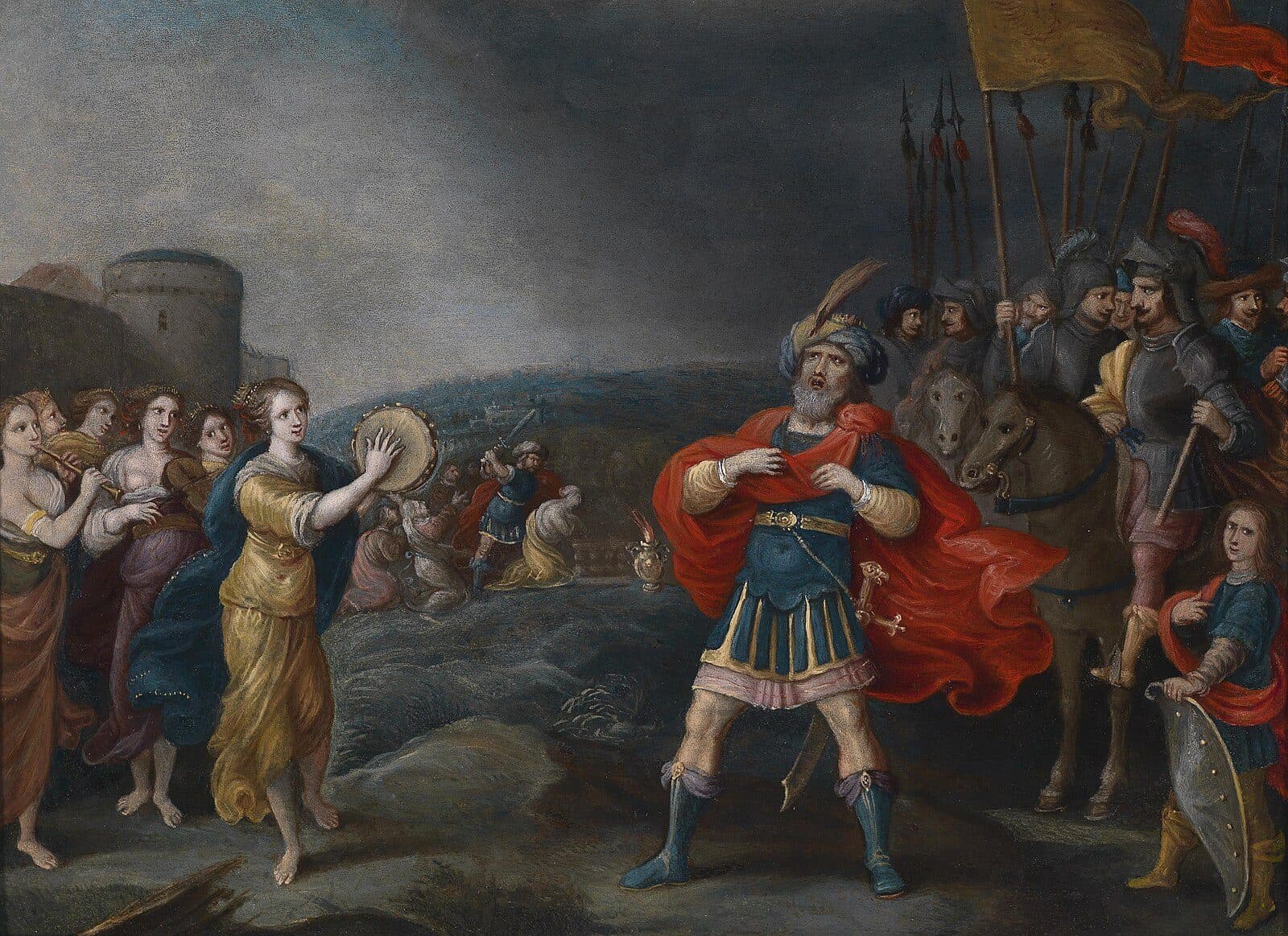
Hieronymus Francken III, Jephthah Meets His Daughter, by 1661, oil on copper. Public domain (published before 1930), via Wikimedia Commons.
THE ARTWORKFrancken painted Jephthah tearing at his cloak as his daughter steps toward him at the head of her companions, the moment his vow fell due. In the distance he painted a man raising a sword over a kneeling figure beside an altar fire, so the picture follows the reading in which the vow ended in a sacrifice.
Jephthah told his daughter that he had given his word to the LORD and could not take it back.
Summary
A vow in Israel was a promise made to the LORD in words, and it bound the one who spoke it.
- Leviticus 27 set a price in silver for a person vowed to the LORD, by age and by sex, from three shekels to fifty.
- Animals, houses and fields could be vowed, and an owner who bought one back added a fifth to its value.
- A firstborn could not be vowed, and nothing devoted to the LORD could be sold or bought back.
- A father or a husband could cancel a woman's vow on the day he heard of it.
- No one was required to vow, and a vow once made was to be paid without delay.
The Law of the Vow
Leviticus, Numbers, Deuteronomy and Ecclesiastes each give a rule for the vow.
The Hebrew word for a vow is neder. A vow was spoken to the LORD and promised Him a gift, and Psalm 66 speaks of vows that the lips promised in distress.
“Speak to the Israelites and say to them, ‘When someone makes a special vow to the LORD involving the value of persons,The Law's rules for paying a vow in silver begin with this verse, and the rates that follow apply to the special vow it names.
If a man makes a vow to the LORD or swears an oath to obligate himself by a pledge, he must not break his word; he must do everything he has promised.A man's vow binds him to do all he has promised, and the rest of the chapter turns to the vows of women.
If you make a vow to the LORD your God, do not be slow to keep it, because He will surely require it of you, and you will be guilty of sin. But if you refrain from making a vow, you will not be guilty of sin.Moses counts delay in paying a vow as sin and leaves the choice to vow free.
When you make a vow to God, do not delay in fulfilling it, because He takes no pleasure in fools. Fulfill your vow. It is better not to vow than to make a vow and not fulfill it.The Preacher gives the rule of Deuteronomy to a reader standing in the house of God, and he adds counsel for one who has not yet vowed.
The Valuations of Leviticus 27
Leviticus 27 sets eight rates in four bands of age, and verse 8 lowers the rate for the poor.
| Age | A male | A female | Verse |
|---|---|---|---|
| One month to five years | 5 shekels | 3 shekels | Leviticus 27:6 |
| Five to twenty years | 20 shekels | 10 shekels | Leviticus 27:5 |
| Twenty to sixty years | 50 shekels | 30 shekels | Leviticus 27:3 to 4 |
| Sixty years and older | 15 shekels | 10 shekels | Leviticus 27:7 |
| A vower too poor to pay | What the priest sets | What the priest sets | Leviticus 27:8 |
Animals, Houses and Fields
Leviticus 27:9 to 33 gives the rule for each kind of gift and the cost of buying it back.
If he vows an animal that may be brought as an offering to the LORD, any such animal given to the LORD shall be holy. He must not replace it or exchange it, either good for bad or bad for good. But if he does substitute one animal for another, both that animal and its substitute will be holy.Leviticus 22:21 required an animal brought to pay a vow to be without blemish, and these verses bring that same animal under the law of vows.
If, however, the owner decides to redeem the animal, he must add a fifth to its value.Adam Clarke, in his Commentary on Leviticus 27:13, held that the added fifth was probably meant to prevent rash vows and covetous redemptions.
The cost of buying back each giftTen gifts in Leviticus 27:9 to 33
| Gift | To buy it back | Verse |
|---|---|---|
| A clean animal | No price; no other animal could take its place | Leviticus 27:9 to 10 |
| An unclean animal | The value the priest set, with a fifth added | Leviticus 27:11 to 13 |
| A house | Its assessed value and one fifth more | Leviticus 27:14 to 15 |
| A field of the family's inheritance | Fifty shekels a homer of barley seed, less for the years past the Jubilee, and a fifth | Leviticus 27:16 to 19 |
| A field bought from another man | Its value up to the Jubilee, when it went back to the first owner | Leviticus 27:22 to 24 |
| A firstborn of the livestock | It could not be vowed | Leviticus 27:26 |
| A firstborn of an unclean animal | Its value and a fifth, or it was sold | Leviticus 27:27 |
| A thing devoted to the LORD | It could not be sold or bought back | Leviticus 27:28 |
| The tithe of the land | Its value and a fifth | Leviticus 27:30 to 31 |
| The tenth animal of the herd or flock | No price, and a substitute made both holy | Leviticus 27:32 to 33 |
Every valuation was weighed by the sanctuary shekel of twenty gerahs. Clarke worked the sum on the same verse: a thing the priest valued at forty shekels cost its former owner forty-eight.
Why the firstborn could not be vowedLeviticus 27:26 and Exodus 13:2
But no one may consecrate a firstborn of the livestock, because a firstborn belongs to the LORD. Whether it is an ox or a sheep, it is the LORD’s.The rule rests on an older claim, made when Israel came out of Egypt.
“Consecrate to Me every firstborn male. The firstborn from every womb among the Israelites belongs to Me, both of man and beast.”Exodus 13:15 gives the ground of the claim: the LORD killed every firstborn in Egypt when Pharaoh refused to let Israel go.
A Woman's Vow
Numbers 30:3 to 15 gives the rule for a woman's vow in her father's house and in her husband's.
Numbers 30 assumes that a woman made vows of her own. A widow or a divorced woman was bound by her vow as a man was.
Jamieson, Fausset & Brown explain why the Law gave a father and a husband a say over these vows.
“But as it would frequently happen that parties would vow to do things which were neither good in themselves nor in their power to perform, the law ordained that their natural superiors should have the right of judging as to the propriety of those vows, with discretionary power to sanction or interdict their fulfilment.”
Jamieson, Fausset & Brown · Commentary Critical and Explanatory on the Whole Bible · on Numbers 30:2Reformed
And if a woman in her father’s house during her youth makes a vow to the LORD or obligates herself by a pledge, and her father hears about her vow or pledge but says nothing to her, then all the vows or pledges by which she has bound herself shall stand. But if her father prohibits her on the day he hears about it, then none of the vows or pledges by which she has bound herself shall stand. The LORD will absolve her because her father has prohibited her.The daughter in her father's house is the chapter's first case, and the wife's case in verses 6 to 8 follows its pattern.
But if he nullifies them after he hears of them, then he will bear her iniquity.”The guilt of a vow cancelled late falls on the husband, so the wife is not held to account for it.
Vows in the Story of Israel
Seven vows told from Genesis to Acts, each with the verse that records it.
JACOB AT BETHEL
Jacob vowed that if God would be with him and watch over him on his way, the LORD would be his God, and he would give God a tenth of all He gave him.
JEPHTHAH BEFORE THE BATTLE
Jephthah vowed that whatever came out of his door to greet him would belong to the LORD, and his only child came out first.
HANNAH AT SHILOH
Hannah vowed that if the LORD gave her a son, she would dedicate him to the LORD all the days of his life, and no razor would come over his head.
ABSALOM AT HEBRON
Absalom asked leave to pay a vow at Hebron, and while he offered the sacrifices his conspiracy grew.
THE SAILORS WITH JONAH
The men who threw Jonah into the sea feared the LORD, offered Him a sacrifice and made vows to Him.
PAUL AT CENCHREA
Paul had his head shaved at Cenchrea to keep a vow he had made, and then sailed for Syria.
FOUR MEN IN THE TEMPLE
At the counsel of the elders in Jerusalem, Paul purified himself with four men under a vow and paid their expenses.
Hannah's son was never bought back1 Samuel 1:28 and Leviticus 27:6
I now dedicate the boy to the LORD. For as long as he lives, he is dedicated to the LORD.” So they worshiped the LORD there.Hannah keeps the vow of verse 11 to the letter, since the boy is given for as long as he lives.
Matthew Henry gives the reason no silver was paid for Samuel under Leviticus 27:6.
“Samuel, who was thus vowed to God, was not redeemed, because he was a Levite, and a particular favourite, and therefore was employed in his childhood in the service of the tabernacle.”
Matthew Henry · Commentary on the Whole Bible · on Leviticus 27:6Puritan
The Nazirite vowNumbers 6:2 to 21
“Speak to the Israelites and tell them that if a man or woman makes a special vow, the vow of a Nazirite, to separate himself to the LORD,The Nazirite vow is called a special vow, the phrase Leviticus 27:2 uses for the vow of persons.
For the days of his vow the Nazirite kept from wine and from everything the vine yields, let no razor touch his head and went near no dead body. At the end he shaved his head at the entrance to the Tent of Meeting and put the hair on the fire under the peace offering.
Paul in the templeActs 21:20 to 26
The elders asked Paul to join the four men because thousands of Jewish believers had heard that he taught Jews to forsake Moses. Matthew Henry sets Paul's part in the vow beside his circumcising of Timothy.
“He had circumcised Timothy, to please the Jews; though he would not constantly observe the ceremonial law, yet, to gain an opportunity of doing good, and to show how far he could comply, he would occasionally go to the temple and join in the sacrifices there. Those that are weak in the faith are to be borne with, when those that undermine the faith must be opposed.”
Matthew Henry · Commentary on the Whole Bible · on Acts 21:26Puritan
The vow in the MishnahNedarim and Arakhin
The Mishnah, compiled in the land of Israel in about AD 190 to 230, gives a tractate to each part of this law. Nedarim treats vows that forbid a thing to oneself or to others as though it were an offering, and Arakhin treats the valuations of Leviticus 27.
Rashi wrote his commentary in France in about 1075 to 1105. On Numbers 30:3 he defines a vow as taking on an obligation as sacred as an offering, such as a promise not to eat a certain thing.
The Words of the Subject
Three Hebrew words carry the law of Leviticus 27.
NEDER
The Hebrew noun for a vow also names the votive offering, and Brown, Driver and Briggs list under it the vows of Jacob, Hannah, Absalom and Jephthah.
EREK
The noun means order, row or estimate, and in Leviticus 27 it is the valuation the Law sets for a person or a thing.
HEREM
The noun means a thing devoted to the LORD, which Leviticus 27:28 calls most holy and forbids to be sold or bought back.
The devoted thing and the devoted personLeviticus 27:28 to 29 and Numbers 21:2
No person set apart for destruction may be ransomed; he must surely be put to death.The verse turns from things a man devotes to persons set apart for destruction, and it allows no ransom for them.
The lexicon of Brown, Driver and Briggs reads the verse of every human being who came under the herem, the ban that set a person apart for destruction. Rashi reads it of a man already condemned to death, who has neither a market value nor a valuation, so that a vow to pay his value has no effect. John Wesley sets a limit on what a man could devote.
“But this is not to be generally understood, as some have taken it, as if a Jew might by virtue of this Text, devote his child or his servant to the Lord, and thereby oblige himself to put them to death. For this is expressly limited to all that a man hath, or which is his, that is, which he hath a power over.”
John Wesley · Explanatory Notes upon the Old Testament · on Leviticus 27:29Evangelical
So Israel made a vow to the LORD: “If You will deliver this people into our hands, we will devote their cities to destruction.”Israel's vow before the battle at Hormah promises the ban itself, so the same word names a vow's gift and the destruction of a city.
Two more wordsnadar and Corban
The verb nadar, to vow, is a form parallel to nazar, the root from which the Nazirite takes his name. Corban is the Hebrew qorban, which Brown, Driver and Briggs define as an offering or oblation, the general word for every kind of offering in Leviticus and Numbers from Leviticus 1:2 on.
What the Text Leaves Unsaid
The text is silent on four matters.
Leviticus 27 gives no reason for its rates. Judges 11:39 says that Jephthah did to his daughter as he had vowed, and it does not say what he did.
Acts 18:18 does not say what Paul vowed or why he vowed it. Numbers 30 rules on the vows of a man, a daughter, a wife and a widow, and it says nothing of a son still in his father's house.
What the Vow Taught
Psalm 116 places the paying of a vow before the people, and Jesus sets two limits on the vow.
I will fulfill my vows to the LORD in the presence of all His people.Verse 19 sets the place of payment in the courts of the LORD's house in Jerusalem.
Again, you have heard that it was said to the ancients, ‘Do not break your oath, but fulfill your vows to the Lord.’ But I tell you not to swear at all: either by heaven, for it is God’s throne;Jesus takes up the Law's words on vows and carries His hearers past every oath to the plain yes and no of verse 37.
But you say that if a man says to his father or mother, ‘Whatever you would have received from me is Corban’ (that is, a gift devoted to God), he is no longer permitted to do anything for his father or mother.Here a vow to God was used to set aside the command to honor father and mother, the misuse Jesus names in Mark 7:9.
Voices on the Vow
Ambrose of Milan, Bonaventure and Matthew Henry on paying a vow and on breaking one.
Ambrose of Milan defines the vow before he names its fault.
“A wish is a request for blessings from God with a promise to fulfill a duty. And so, when you obtain what you have asked for, it is ungrateful to delay the promise.”
Ambrose of Milan · On Cain and Abel · on Deuteronomy 23:21Patristic
Matthew Henry carries the law of Numbers 30 to a Christian's sacramental vows.
“A promise to man is a bond upon the estate, but a promise to God is a bond upon the soul. Our sacramental vows, by which we are bound to no more than what was before our duty, and which neither father nor husband can disannul, are bonds upon the soul, and by them we must feel ourselves bound out from all sin and bound up to the whole will of God.”
Matthew Henry · Commentary on the Whole Bible · on Numbers 30:13Puritan
A vow repented ofDeuteronomy 23:23
“The second mode of breaking a vow occurs through a contrary will, as when someone promises something to God and afterward repents of it. Against such persons it is said in Deuteronomy: ‘If anything has proceeded from your lips, you shall not make it void.’”
Bonaventure · Collationes de Decem Praeceptis, Collation 3 · on Deuteronomy 23:23Patristic
A vow that must be brokenEcclesiastes 5:6
“We must take heed that we never vow anything that is sinful, or that may be an occasion of sin, for such a vow is ill-made and must be broken. Suffer not thy mouth, by such a vow, to cause thy flesh to sin, as Herod's rash promise caused him to cut off the head of John the Baptist.”
Matthew Henry · Commentary on the Whole Bible · on Ecclesiastes 5:6Puritan
The Rates and Jephthah's Vow
Two readings of the rates of Leviticus 27, and two readings of what Jephthah did to his daughter
The rates follow a person's workAdam Clarke; Matthew Henry
Adam Clarke, in his Commentary on Leviticus 27:4, held that a woman was valued lower because she could not be of so much use in the service of the sanctuary. On verse 7 he held that an old man and an old woman were valued nearly alike because both were nearly past labour.
“The females were then less esteemed, but not so in Christ; for in Christ Jesus there is neither male nor female, Gal. iii. Note, Those that are in the prime of their time must look upon themselves as obliged to do more in the service of God and their generation than can be expected either from minors, that have not yet arrived to their usefulness, or from the aged, that have survived it.”
Matthew Henry · Commentary on the Whole Bible · on Leviticus 27:3 to 4Puritan
The objection rests on Leviticus 27:8, which lets the priest lower the price for poverty alone and never for weakness.
The rates are a fixed priceRashi; the Mishnah
Rashi, on Leviticus 27:3, held that the valuation is a sum fixed by age, whether the person is of high value or of low. A market price, he wrote, changes with the person and the market, and the valuation does not. The Mishnah keeps the two apart in Arakhin 1:1. A vow of a person's valuation pays the sum the Torah fixes, and a vow of his assessment pays what he would fetch if sold as a slave.
The objection rests on the highest rate, which falls in the years of working strength. It also rests on John Gill's Exposition on Leviticus 27:4, which sets the thirty shekels for a woman beside the price of a servant in Exodus 21:32.
After two months, she returned to her father, and he did to her as he had vowed. And she had never had relations with a man. So it has become a custom in Israel that each year the young women of Israel go out for four days to lament the daughter of Jephthah the Gileadite.One reading takes the yearly custom of verse 40 as mourning for her death, and the other as mourning for her virginity.
She was offered as a burnt offeringAlbert Barnes; Ambrose of Milan; Matthew Henry; Rashi
Albert Barnes, in his Notes on Judges 11:31, held that the vow could only mean a human sacrifice. Only one of the household could be expected to come out of the door to meet him. Ambrose of Milan, in On the Duties of the Clergy, set Jephthah beside Herod as men who kept a word that it was wrong to keep.
Matthew Henry, on Judges 11:37, held that a daughter bound only to a single life would not have needed two months to mourn it, since she had her whole life before her. Rashi gives the rabbis' teaching that the high priest Phinehas could have released the vow, and that both men bore the blame for her ruin.
The objection rests on Adam Clarke's Commentary on Leviticus 27:29, which holds that it can never be conceded that human sacrifices were offered to God under the Law of Moses. It also rests on Deuteronomy 12:31, which names the burning of sons and daughters as a practice the LORD hates. Leviticus 27 let a person vowed to the LORD be bought back in silver.
She was given to the LORD for lifeDavid Kimhi; Adam Clarke; John Gill; John Wesley
David Kimhi, called Radak, wrote his commentary in Provence in about 1185 to 1235. On Judges 11:31 he read the vow as two cases joined by or: what was fit for the altar would be a burnt offering, and what was not would belong to the LORD. He noted that she went to mourn her virginity, where a girl facing death would mourn her life, and he read verse 39 as a vow kept by her separation.
Adam Clarke, on Judges 11:40, read the verb lethannoth to mean that the young women went each year to comfort her, and John Gill gives that sense of the word from Kimchi and Ben Melech. John Wesley, on the same verse, asked which law of the Old Testament made the killing of an only child a part of religion.
The objection rests on Matthew Henry's words as Wesley quotes them, that no law of the Old Testament makes a single life a part of religion. It also rests on Jephthah's own words in Judges 11:31, which name a burnt offering.
Every Promise Is Yes in Christ
2 Corinthians 1 on the promises of God and 1 Corinthians 6 on the price paid for His people
Israel paid its vows to a God who had first bound Himself by His own promises, and Hebrews 6:13 says that He swore by Himself to Abraham.
So the law of vows in Leviticus 27, Deuteronomy 23 and Ecclesiastes 5 asks the reader to speak to God with care and to keep what he has promised Him.
For all the promises of God are “Yes” in Christ. And so through Him, our “Amen” is spoken to the glory of God.The promises God bound Himself to keep are kept in Christ, so a believer's word to God now rests on Christ.
Do you not know that your body is a temple of the Holy Spirit who is in you, whom you have received from God? You are not your own; you were bought at a price. Therefore glorify God with your body.Leviticus 27 set a price to buy back a person vowed to the LORD, and Paul tells believers that a price was paid for them and that they are not their own.
Keep studying
Symbols1
Peoples and groups1