
Deuteronomy 31:16 to 32:47 · Passage · Featured Study
The Song of Moses
The Song calls heaven and earth to hear how the Rock kept faith with Israel, how Israel forsook Him, and how He will judge and then have compassion on His people.
The LORD gave Moses a song to teach Israel, to stand as a witness against the people on the day they turned to other gods.
- The passage
- Deuteronomy 31:16 to 30, Deuteronomy 32:1 to 47
- Book
- Deuteronomy
- Hold in memory
- Deuteronomy 32:4
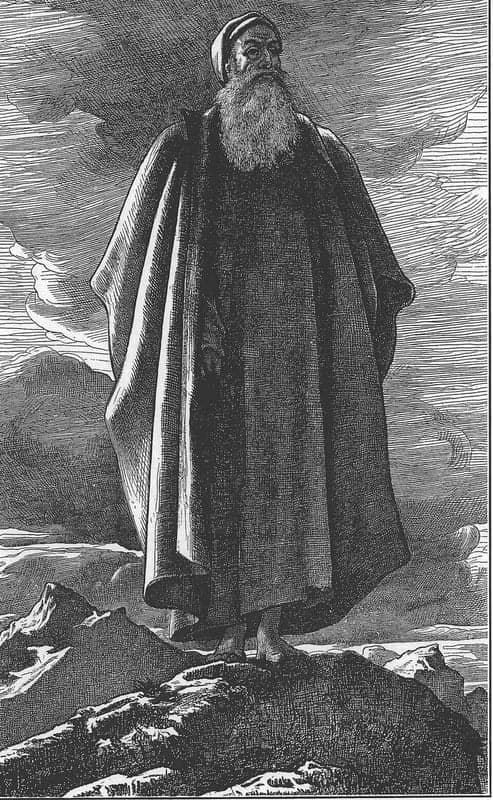
Frederic Leighton, Moses Views the Promised Land, 1881, public domain by date, via Wikimedia Commons, file Leighton_Moses_views_the_Promised_Land.jpg.
THE ARTWORKLeighton draws Moses alone on the mountain top in a heavy cloak, as on the day the LORD sent him up Mount Nebo after the Song to see the land he would not enter.
Summary
Deuteronomy 31:16 to 32:47 holds the LORD's command to write the Song, the Song itself and the charge Moses gave after it.
- The Song calls God the Rock five times, in verses 4, 15, 18, 30 and 31.
- Albert Barnes, in his Notes, Explanatory and Practical, groups the body of the Song under three heads: Israel's faithlessness, its chastisement and God's compassion.
- Paul and the writer of Hebrews quote the Song five times.
The Song Given as a Witness
Deuteronomy 31:16 to 30 tells why the Song was written and how Moses taught it to the assembly.
And the LORD said to Moses, “You will soon rest with your fathers, and these people will rise up and prostitute themselves with the foreign gods of the land they are entering. They will forsake Me and break the covenant I have made with them. On that day My anger will burn against them, and I will abandon them and hide My face from them, so that they will be consumed, and many troubles and afflictions will befall them. On that day they will say, ‘Have not these disasters come upon us because our God is no longer with us?’ And on that day I will surely hide My face because of all the evil they have done by turning to other gods.The LORD foretells the people's turn to other gods before He gives the Song, so the Song answers a betrayal He already knows is coming.
Now therefore, write down for yourselves this song and teach it to the Israelites; have them recite it, so that it may be a witness for Me against them.The LORD gives this command at the Tent of Meeting, where He had called Moses and Joshua to stand before Him in verse 14.
When I have brought them into the land that I swore to give their fathers, a land flowing with milk and honey, they will eat their fill and prosper. Then they will turn to other gods and worship them, and they will reject Me and break My covenant. And when many troubles and afflictions have come upon them, this song will testify against them, because it will not be forgotten from the lips of their descendants. For I know their inclination, even before I bring them into the land that I swore to give them.”The LORD knows the people's inclination before they enter the land, and Moses voices the same knowledge in Deuteronomy 31:27.
So that very day Moses wrote down this song and taught it to the Israelites. Then the LORD commissioned Joshua son of Nun and said, “Be strong and courageous, for you will bring the Israelites into the land that I swore to give them, and I will be with you.”Joshua's charge stands between the writing and the recital, since he must lead the generation the Song addresses.
Then Moses recited aloud to the whole assembly of Israel the words of this song from beginning to end:Chapter 31 ends here, and the next chapter gives the words Moses recited.
Barnes's Outline of the Song
Barnes sets verses 1 to 3 as the introduction and verse 43 as the conclusion of the Song.
An outline of the Song after Albert Barnes, Notes, Explanatory and Practical (1832 to 1869), with the movements of the text inside his three heads.
Barnes's first two heads, Israel's faithlessness and its chastisement, take 30 of the Song's 43 verses.
- Introduction
- Faithfulness and faithlessness
- Chastisement
- Compassion
- Conclusion
The 9 verse counts as a table
| Part of the Song | Verse counts | Barnes's part | Verse |
|---|---|---|---|
| The summons | 3 | Introduction | Deuteronomy 32:1 to 3 |
| The Rock | 3 | Faithfulness and faithlessness | Deuteronomy 32:4 to 6 |
| Jacob's portion | 8 | Faithfulness and faithlessness | Deuteronomy 32:7 to 14 |
| Jeshurun | 4 | Faithfulness and faithlessness | Deuteronomy 32:15 to 18 |
| His face hidden | 7 | Chastisement | Deuteronomy 32:19 to 25 |
| The enemy's boast | 8 | Chastisement | Deuteronomy 32:26 to 33 |
| Vengeance stored | 2 | Compassion | Deuteronomy 32:34 to 35 |
| Compassion | 7 | Compassion | Deuteronomy 32:36 to 42 |
| Nations rejoice | 1 | Conclusion | Deuteronomy 32:43 |
A bar row of the nine parts of the outline above, each bar the number of verses the part takes, coloured by the part of Barnes's division it belongs to.
The LORD Himself speaks in verses 20 to 27, 34 to 35 and 37 to 42, and the singer speaks the rest of the Song.
What Each Part of the Song Teaches
The Song's parts reach back to the warnings of Deuteronomy 31, and Rashi and Jamieson, Fausset and Brown comment on two of them.
The summons of heaven and earth, verses 1 to 3Deuteronomy 32:1 to 3; Rashi
Give ear, O heavens, and I will speak; hear, O earth, the words of my mouth. Let my teaching fall like rain and my speech settle like dew, like gentle rain on new grass, like showers on tender plants. For I will proclaim the name of the LORD. Ascribe greatness to our God!The first line names the two witnesses of Deuteronomy 31:28, so the Song itself takes the stand as testimony.
Rashi, Rabbi Shlomo Yitzchaki of Troyes in France (1040 to 1105), gives the reason for these witnesses in Rashi on Deuteronomy, his commentary on the Torah, at verse 1. Moses was mortal and would die, so he called witnesses that endure forever, who could answer anyone in Israel who later said the people had never accepted the covenant.
The Rock and His people, verses 4 to 18Deuteronomy 32:4 to 18; Jamieson, Fausset and Brown
He is the Rock, His work is perfect; all His ways are just. A God of faithfulness without injustice, righteous and upright is He. His people have acted corruptly toward Him; the spot on them is not that of His children, but of a perverse and crooked generation. Is this how you repay the LORD, O foolish and senseless people? Is He not your Father and Creator? Has He not made you and established you?The Song opens its case with the character of God before it names any fault in Israel.
Remember the days of old; consider the years long past. Ask your father, and he will tell you, your elders, and they will inform you. When the Most High gave the nations their inheritance, when He divided the sons of man, He set the boundaries of the peoples according to the number of the sons of God. But the LORD’s portion is His people, Jacob His allotted inheritance.Verse 9 gives the reason Israel stands apart among the nations in the rest of the Song.
The Berean text reads the sons of God at the end of verse 8, where the King James Version and other older versions read the children of Israel. The page God and the Nations sets out the readings of that verse with their holders.
He found him in a desert land, in a barren, howling wilderness; He surrounded him, He instructed him, He guarded him as the apple of His eye. As an eagle stirs up its nest and hovers over its young, He spread His wings to catch them and carried them on His pinions. The LORD alone led him, and no foreign god was with him. He made him ride on the heights of the land and fed him the produce of the field. He nourished him with honey from the rock and oil from the flinty crag, with curds from the herd and milk from the flock, with the fat of lambs, with rams from Bashan, and goats, with the choicest grains of wheat. From the juice of the finest grapes you drank the wine.These verses recall the wilderness years and the gifts of Canaan as the debt Israel owed.
But Jeshurun grew fat and kicked—becoming fat, bloated, and gorged. He abandoned the God who made him and scorned the Rock of his salvation. They provoked His jealousy with foreign gods; they enraged Him with abominations. They sacrificed to demons, not to God, to gods they had not known, to newly arrived gods, which your fathers did not fear. You ignored the Rock who brought you forth; you forgot the God who gave you birth.Verse 15 is the hinge of the first head, where plenty becomes the occasion of revolt.
Jeshurun is a poetical name for Israel in the Commentary Critical and Explanatory on the Whole Bible of Jamieson, Fausset and Brown. They take the picture of verse 15 from a well fed animal that turns vicious. The name returns in the blessing of Deuteronomy 33 and once more in Isaiah 44:2.
The chastisement, verses 19 to 33Deuteronomy 32:19 to 33
When the LORD saw this, He rejected them, provoked to anger by His sons and daughters. He said: “I will hide My face from them; I will see what will be their end. For they are a perverse generation—children of unfaithfulness. They have provoked My jealousy by that which is not God; they have enraged Me with their worthless idols. So I will make them jealous by those who are not a people; I will make them angry by a nation without understanding. For a fire has been kindled by My anger, and it burns to the depths of Sheol; it consumes the earth and its produce, and scorches the foundations of the mountains. I will heap disasters upon them; I will spend My arrows against them. They will be wasted from hunger and ravaged by pestilence and bitter plague; I will send the fangs of wild beasts against them, with the venom of vipers that slither in the dust. Outside, the sword will take their children, and inside, terror will strike the young man and the young woman, the infant and the gray-haired man.The LORD answers jealousy with jealousy in verse 21, and verses 23 to 25 spell out the troubles Deuteronomy 31:17 foretold.
I would have said that I would cut them to pieces and blot out their memory from mankind, if I had not dreaded the taunt of the enemy, lest their adversaries misunderstand and say: ‘Our own hand has prevailed; it was not the LORD who did all this.’” Israel is a nation devoid of counsel, with no understanding among them. If only they were wise, they would understand it; they would comprehend their fate. How could one man pursue a thousand, or two put ten thousand to flight, unless their Rock had sold them, unless the LORD had given them up? For their rock is not like our Rock, even our enemies concede. But their vine is from the vine of Sodom and from the fields of Gomorrah. Their grapes are poisonous; their clusters are bitter. Their wine is the venom of serpents, the deadly poison of cobras.Verse 31 sets the enemy's rock against Israel's Rock, the name of God the Song began with in verse 4.
Vengeance and compassion, verses 34 to 42Deuteronomy 32:34 to 42
“Have I not stored up these things, sealed up within My vaults? Vengeance is Mine; I will repay. In due time their foot will slip; for their day of disaster is near, and their doom is coming quickly.”John Gill, in his Exposition of the Old Testament, notes that the three Targums, the Septuagint and the Latin Vulgate read verse 35 as I will repay, the form Romans 12:19 quotes.
For the LORD will vindicate His people and have compassion on His servants when He sees that their strength is gone and no one remains, slave or free. He will say: “Where are their gods, the rock in which they took refuge, which ate the fat of their sacrifices and drank the wine of their drink offerings? Let them rise up and help you; let them give you shelter! See now that I am He; there is no God besides Me. I bring death and I give life; I wound and I heal, and there is no one who can deliver from My hand. For I lift up My hand to heaven and declare: As surely as I live forever, when I sharpen My flashing sword, and My hand grasps it in judgment, I will take vengeance on My adversaries and repay those who hate Me. I will make My arrows drunk with blood, while My sword devours flesh—the blood of the slain and captives, the heads of the enemy leaders.”Verse 39 is the Song's answer to verse 17, where Israel sacrificed to gods it had not known.
The conclusion and the charge, verses 43 to 47Deuteronomy 32:43 to 47
Rejoice, O heavens, with Him, and let all God’s angels worship Him. Rejoice, O nations, with His people; for He will avenge the blood of His children. He will take vengeance on His adversaries and repay those who hate Him; He will cleanse His land and His people.The last verse turns the Song outward, so its close is good news for Israel and the Gentiles alike.
Then Moses came with Joshua son of Nun and recited all the words of this song in the hearing of the people. When Moses had finished reciting all these words to all Israel, he said to them, “Take to heart all these words I testify among you today, so that you may command your children to carefully follow all the words of this law. For they are not idle words to you, because they are your life, and by them you will live long in the land that you are crossing the Jordan to possess.”Moses binds the Song to the law of the whole book as the people's life in the land.
The Day the Song Was Spoken
Numbers and Deuteronomy record the command to climb the mountain and its fulfilment.
On that same day the LORD said to Moses, “Go up into the Abarim Range to Mount Nebo, in the land of Moab across from Jericho, and view the land of Canaan, which I am giving to the Israelites as their own possession. And there on the mountain that you climb, you will die and be gathered to your people, just as your brother Aaron died on Mount Hor and was gathered to his people. For at the waters of Meribah-kadesh in the Wilderness of Zin, both of you broke faith with Me among the Israelites by failing to treat Me as holy in their presence. Although you shall see from a distance the land that I am giving the Israelites, you shall not enter it.”Moses had told the people in Deuteronomy 4:21 to 22 that he would die outside the land, and this command sets the day.
Then the LORD said to Moses, “Go up this mountain of the Abarim range and see the land that I have given the Israelites. After you have seen it, you too will be gathered to your people, as your brother Aaron was; for when the congregation contended in the Wilderness of Zin, both of you rebelled against My command to show My holiness in their sight regarding the waters.” Those were the waters of Meribah in Kadesh, in the Wilderness of Zin.Numbers records the same command earlier, before Joshua was appointed to succeed Moses.
Then Moses went up from the plains of Moab to Mount Nebo, to the top of Pisgah, which faces Jericho. And the LORD showed him the whole land—from Gilead as far as Dan, all of Naphtali, the land of Ephraim and Manasseh, all the land of Judah as far as the Western Sea, the Negev, and the region from the Valley of Jericho (the City of Palms) all the way to Zoar. And the LORD said to him, “This is the land that I swore to give Abraham, Isaac, and Jacob when I said, ‘I will give it to your descendants.’ I have let you see it with your own eyes, but you will not cross into it.” So Moses the servant of the LORD died there in the land of Moab, as the LORD had said.The book's last chapter records the word of Deuteronomy 32:52 kept to the letter.
“Moses again, when about to depart from this life, sang a fear-inspiring canticle in Deuteronomy. He left the song as a sort of testament to the people of Israel, to teach them the kind of funeral they should expect, if ever they abandoned God.”
Nicetas of Remesiana · Liturgical Singing 3 · on Deuteronomy 31:30Patristic
What the Song Leaves Unsaid
The Song names no king, no exile and no foreign nation, and the enemy of verses 27 to 33 has no name.
Deuteronomy 31 and 32 give no tune or instrument for the Song.
The Song in the New Testament
Paul and Hebrews draw on the Song's words about jealousy, vengeance and the worship of God's angels, and Paul echoes its words on demons.
I ask instead, did Israel not understand? First, Moses says: “I will make you jealous by those who are not a nation; I will make you angry by a nation without understanding.”Paul quotes Deuteronomy 32:21 to show that Moses foretold a people who were not a nation stirring Israel to jealousy.
I ask then, did they stumble so as to fall beyond recovery? Certainly not! However, because of their trespass, salvation has come to the Gentiles to make Israel jealous.Paul's next question shows that the jealousy of Deuteronomy 32:21 serves Israel's return to God.
Do not avenge yourselves, beloved, but leave room for God’s wrath. For it is written: “Vengeance is Mine; I will repay, says the Lord.”Paul forbids believers to take revenge because Deuteronomy 32:35 keeps it for God.
Hebrews and the rest of RomansHebrews 10:30; Romans 15:10; Hebrews 1:6; 1 Corinthians 10:20 to 22
For we know Him who said, “Vengeance is Mine; I will repay,” and again, “The Lord will judge His people.”Hebrews joins Deuteronomy 32:35 to verse 36 as a warning to those who already belong to God.
Again, it says: “Rejoice, O Gentiles, with His people.”Paul sets the call of Deuteronomy 32:43 beside other texts to show that the Gentiles were always meant to praise God with Israel.
And again, when God brings His firstborn into the world, He says: “Let all God’s angels worship Him.”Hebrews applies the call of Deuteronomy 32:43 to the Son brought into the world, whom the angels are to worship.
No, but the sacrifices of pagans are offered to demons, not to God. And I do not want you to be participants with demons. You cannot drink the cup of the Lord and the cup of demons too; you cannot partake in the table of the Lord and the table of demons too. Are we trying to provoke the Lord to jealousy? Are we stronger than He?Paul's warning against the table of demons uses the words of Deuteronomy 32:17 and 32:21 about Israel's idolatry.
Voices on the Song
Matthew Henry, Ambrose of Milan, John Chrysostom and Augustine of Hippo read the witness of Deuteronomy 31 and five verses of the Song.
The Song as a mirror in the day of troubleMatthew Henry, on Deuteronomy 31:21
“When their troubles come upon them, this song shall not be forgotten, but may serve as a glass to show them their own faces, that they may humble themselves, and return to him from whom they have revolted. Note, Those for whom God has mercy in store he may leave to fall, yet he will provide means for their recovery. Medicines are prepared before-hand for their cure.”
Matthew Henry · Commentary on the Whole Bible · on Deuteronomy 31:21Puritan
The eagle that carries its youngAmbrose of Milan, on Deuteronomy 32:11
“Finally, listen to Moses saying: He spread his wings and took them, and carried them on his shoulders (Deuteronomy 32:11): just as an eagle carries its offspring, which it is accustomed to examine; in order to hold and nurture those who have the true nature of birth, and to observe the grace of incorruptible nature; or to reject those in whom it has detected the weakness of a degenerate origin at a tender age.”
Ambrose of Milan · Interrogation of Job and David, Chapter V · on Deuteronomy 32:11Patristic
Fed with manna and longing for EgyptJohn Chrysostom, on Deuteronomy 32:15
“‘They ate,’ and drank, ‘and kicked.’ When fed with their manna they ought not to have asked for luxury, seeing they had known the evils which proceed from it. And they acted precisely as if a free child, when sent to school, should ask to be reckoned with the slaves, and to wait on them,-so did these also in seeking Egypt-and when receiving all needful sustenance, and such as becomes a free person, and sitting at his father's table, should have a longing for the ill-savored and noisy one of the servants.”
John Chrysostom · Homilies on Colossians 4 · on Deuteronomy 32:15Patristic
Mercy after the threateningsMatthew Henry, on Deuteronomy 32:24
“After many terrible threatenings of deserved wrath and vengeance, we have here surprising intimations of mercy, undeserved mercy, which rejoices against judgment, and by which it appears that God has no pleasure in the death of sinners, but would rather they should turn and live.”
Matthew Henry · Commentary on the Whole Bible · on Deuteronomy 32:24Puritan
The command to love enemiesAmbrose of Milan, on Deuteronomy 32:35
“But what better pattern can there be than that of Divine justice? For the Son of God says: ‘Love your enemies;’ and again: ‘Pray for those that persecute you and speak against you.’ So far does He remove the desire of vengeance from the perfect that He commands charity towards those who injure them. And since He had said in the Old Testament: ‘Vengeance is Mine, I will repay.’”
Ambrose of Milan · Epistle 63, Section 84 · on Deuteronomy 32:35Patristic
One God who strikes and healsAugustine of Hippo, on Deuteronomy 32:39
“He is God, so he also takes pity. He gets angry, and he takes pity. He gets angry and strikes; he takes pity and heals. He gets angry and does to death; he takes pity and brings to life. In one person he does this. It's not that he does some people to death and brings others to life, but in the same people he is both angry and gentle. He is angry with errors; he is gentle with bad habits put right. ‘I will strike and I will heal: I will kill and I will make alive.’ One and the same Saul, afterward Paul, he both laid low and raised up. He laid low an unbeliever; he raised up a believer. He laid low a persecutor; he raised up a preacher.”
Augustine of Hippo · SERMON 24.7 · on Deuteronomy 32:39Patristic
The Song of Moses and of the Lamb
And I saw something like a sea of glass mixed with fire, beside which stood those who had conquered the beast and its image and the number of its name. They were holding harps from God, and they sang the song of God’s servant Moses and of the Lamb: “Great and wonderful are Your works, O Lord God Almighty! Just and true are Your ways, O King of the nations! Who will not fear You, O Lord, and glorify Your name? For You alone are holy. All nations will come and worship before You, for Your righteous acts have been revealed.”Revelation 15:3 calls God's ways just, and Deuteronomy 32:4 says the same of the Rock's ways.
John Gill, in his Exposition of the New Testament, reads the song of Moses named here as the song Israel sang at the sea in Exodus 15. Adam Clarke reads it the same way in his Commentary on the Bible. So do Albert Barnes in his Notes, Explanatory and Practical and Oecumenius in his Commentary on Revelation.
The Song of Deuteronomy asks Israel, and every reader, to remember the Rock who made them and to return to Him before the day of trouble. In Revelation 15 the conquerors sing the song of Moses and of the Lamb, Jesus Christ.
Keep studying
Studies6
Doctrines12