

David Roberts, Nablous, 1839. CC0.
Genesis 12:6 to 7 · Place · Featured Study
Shechem
Shechem lay in the pass between Mount Ebal and Mount Gerizim, in the hill country of Ephraim.
Abram built his first altar in Canaan at Shechem, and Jesus sat down by Jacob's well beside it.
Abram traveled through the land as far as the site of the Oak of Moreh at Shechem. And at that time the Canaanites were in the land.
- Today
- Tell Balata, beside Nablus
- Region
- Joshua 20:7 places it in the hill country of Ephraim
- Site
- 32.214, 35.282
- First named
- Genesis 12:6 “…the Oak of Moreh at Shechem. And at…”
- Last named
- Acts 7:16 “…bones were carried back to Shechem and placed…”
Abram built his first altar in Canaan at Shechem, and Jesus sat down by Jacob's well beside it.
Summary
Shechem is the town where the LORD first promised the land to Abram's offspring. Israel came back to it to make its great choices.
- Jacob bought the plot where he camped for a hundred pieces of silver. Joseph's bones were later buried in it.
- Joshua gathered all the tribes there at the end of his life. He set up a stone as a witness.
- The leaders of Shechem made Abimelech king. Later the ten tribes broke with Rehoboam at the same town.
- John sets the meeting of Jesus and the Samaritan woman at Sychar, near the plot Jacob gave to Joseph.
The First Altar in the Land
The LORD's first promise of the land in Canaan was spoken at the oak of Moreh.
Abram traveled through the land as far as the site of the Oak of Moreh at Shechem. And at that time the Canaanites were in the land.Abram's first stop in Canaan was a town still held by its own people.
Then the LORD appeared to Abram and said, “I will give this land to your offspring.” So Abram built an altar there to the LORD, who had appeared to him.The altar answered a promise, since Abram owned no ground there yet.
Deuteronomy 11:30 sets the mountains of blessing and curse near the same oak of Moreh.
Shechem and Jacob's Road Home
Jacob returned from Paddan-aram by Peniel and Succoth to Shechem, and moved from there up to Bethel.
Peniel and Succoth are east of the Jordan, and Bethel is south of Shechem.
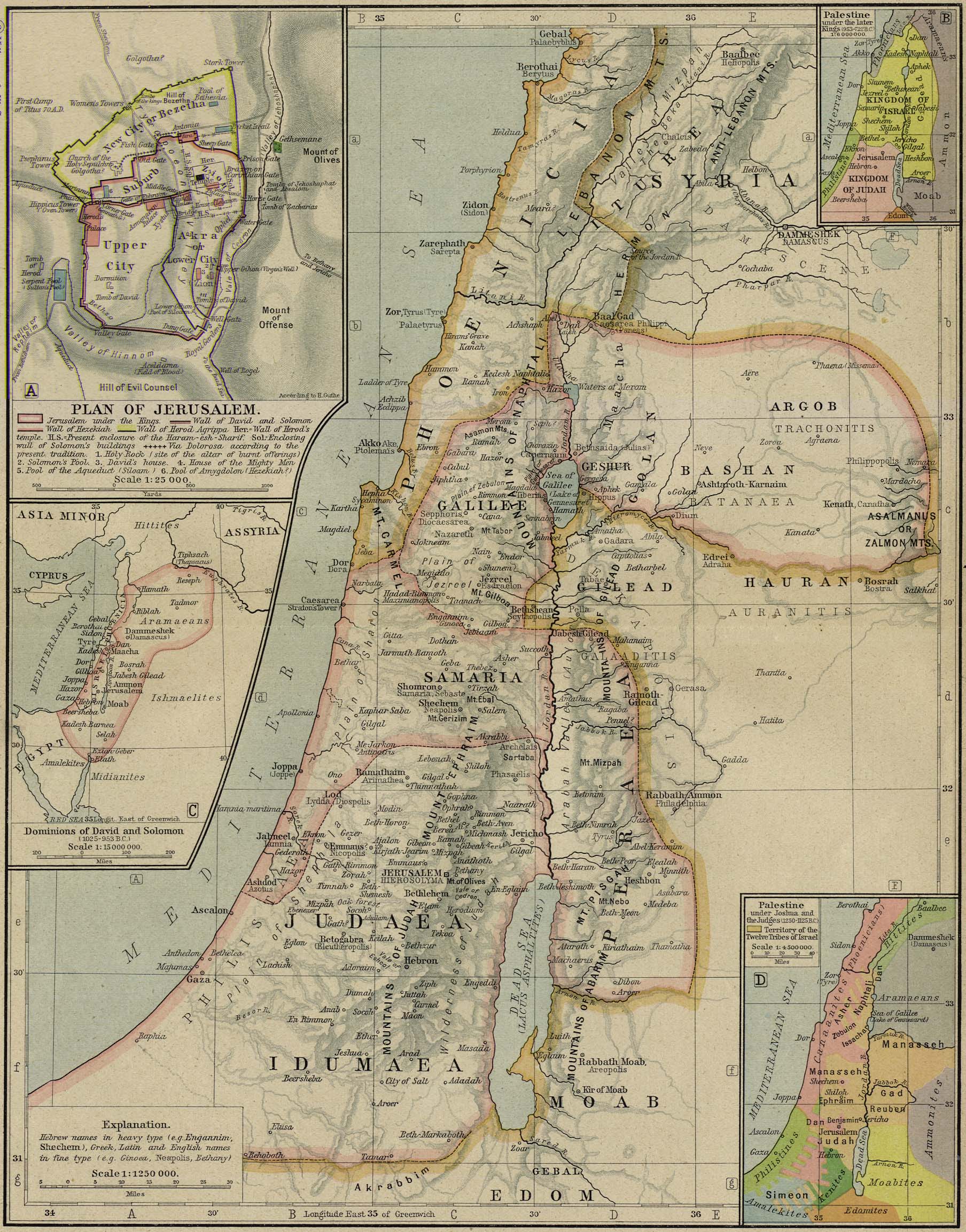
- Located: the site is known
- The route, in the order the text gives
- 1Peniel, Jacob named the place where he had seen God face to face. Genesis 32:30
- 2Succoth, Jacob built a house there and shelters for his livestock. Genesis 33:17
- 3Shechem, Jacob camped just outside the city and bought the ground. Genesis 33:18
- 4Bethel, God sent Jacob up to Bethel to build an altar. Genesis 35:1
- 5Mount Gerizim, The mountain of the blessing, south of the town. Deuteronomy 27:12
- 6Mount Ebal, The mountain of the curse, north of the town. Deuteronomy 27:13
- 7Sychar, Where Jesus met the woman at the well. John 4:5
- 8Dothan, Joseph's brothers had moved their flocks on to it. Genesis 37:17
Base map: Reference map of ancient Palestine, Rand McNally reference map (1926), public domain. Places with a place page stand at its coordinates and the others at the point OpenBible.info gives, set on the plate by Jerusalem and Damascus, as the plate prints them.
Four stations of Jacob's road in order, with the mountains, Sychar and Dothan marked off the route.
Sychar, Dothan
What Happened at Shechem, in Order
Scripture comes back to the town from Abram's altar to Jesus at Jacob's well.
Shechem holds the first promise of the land, the burial of Joseph, the covenant of Joshua and the split of the kingdom.
- Abram's arrivalThe LORD appears to Abram at the oak of MorehGenesis 12:7
- Jacob's returnJacob buys a plot from the sons of HamorGenesis 33:19
- DinahShechem son of Hamor takes Dinah by forceGenesis 34:2
- Before BethelJacob buries the foreign gods under the oak near ShechemGenesis 35:4
- Joseph sent outJoseph looks for his brothers at ShechemGenesis 37:14
- After the entryHalf the people stand before Gerizim and half before EbalJoshua 8:33
- Joshua's last daysJoshua assembles all the tribes at ShechemJoshua 24:1
- After Joshua's deathJoseph's bones are buried in Jacob's plotJoshua 24:32
- After GideonThe leaders of Shechem make Abimelech king by the oakJudges 9:6
- After SolomonAll Israel goes to Shechem to make Rehoboam king1 Kings 12:1
- Jesus in SamariaJesus sits by Jacob's well near SycharJohn 4:6
Eleven events in the order of the canon, each with its verse.
Joshua's last days, After Joshua's death, After Gideon, After Solomon, Jesus in Samaria
The plot Jacob boughtGenesis 33:19 and Joshua 24:32
Matthew Henry reads the purchase as Jacob paying for ground the promise already gave him.
“Though the land of Canaan was his by promise, yet, the time for taking possession not having yet come, he is content to pay for his own, to prevent disputes with the present occupants. Note, Dominion is not founded in grace.”
Matthew Henry · Commentary on the Whole Bible · on Genesis 33:19Puritan
And the bones of Joseph, which the Israelites had brought up out of Egypt, were buried at Shechem in the plot of land that Jacob had purchased from the sons of Hamor, Shechem’s father, for a hundred pieces of silver. So it became an inheritance for Joseph’s descendants.The ground Jacob paid for became the grave that kept Joseph's request of Genesis 50:25.
The kingdom divided at Shechem1 Kings 12:1 to 25
When all Israel saw that the king had refused to listen to them, they answered the king: “What portion do we have in David, and what inheritance in the son of Jesse? To your tents, O Israel! Look now to your own house, O David!” So the Israelites went home,The northern tribes answered the king's harsh words by leaving the house of David.
Then Jeroboam built Shechem in the hill country of Ephraim and lived there. And from there he went out and built Penuel.Jeroboam made the town the first seat of the northern kingdom.
Four Things the Text Says Plainly
Four facts of the town's record, each with its verse.
MOURNERS CAME FROM SHECHEM
After Jerusalem fell, eighty men came from Shechem, Shiloh and Samaria with offerings for the house of the LORD.
SHECHEM WENT TO THE LEVITES
The tribe of Ephraim gave Shechem to the remaining Kohathite clans of the Levites.
SHECHEM WAS A CITY OF REFUGE
Joshua set Shechem apart for the manslayer, one of the three towns Joshua 20:7 names together.
JOTHAM SPOKE FROM GERIZIM
Jotham climbed to the top of Mount Gerizim to call his parable down to the leaders of Shechem.
Shechem was a city of refuge, Jotham spoke from Gerizim
Between Ebal and Gerizim
The two mountains over the town framed the reading of the blessing and the curse.
When the LORD your God brings you into the land you are entering to possess, you are to proclaim the blessing on Mount Gerizim and the curse on Mount Ebal.Moses gave the two heights their parts before Israel had crossed the Jordan.
All Israel, foreigners and citizens alike, with their elders, officers, and judges, stood on both sides of the ark of the covenant of the LORD facing the Levitical priests who carried it. Half of the people stood in front of Mount Gerizim and half of them in front of Mount Ebal, as Moses the servant of the LORD had commanded earlier, to bless the people of Israel.The ceremony Moses commanded in Deuteronomy 11:29 was carried out in this valley.
Albert Barnes, on Joshua 24:1, notes that Shechem lay between Ebal and Gerizim, where the covenant had been rehearsed after the entry, and that the place itself recalled Abraham, Isaac and Jacob to Joshua's hearers. John Wesley, on Judges 9:7, calls the valley between the two mountains a famous place for the reading of the law with its blessings and curses.
What the Text Leaves Unsaid
Scripture names Jacob's well and gives no word on who dug it.
Are You greater than our father Jacob, who gave us this well and drank from it himself, as did his sons and his livestock?”The woman credits Jacob with giving the well, which is the one link the text records.
Genesis never mentions a well at Shechem, and Joshua 24 does not say where in the town the oak and the sanctuary stood.
Where Shechem Points
At the same ground Joshua called for a choice and Jesus spoke of worship in spirit and in truth.
But if it is unpleasing in your sight to serve the LORD, then choose for yourselves this day whom you will serve, whether the gods your fathers served beyond the Euphrates, or the gods of the Amorites in whose land you are living. As for me and my house, we will serve the LORD!”Joshua's challenge was given to a nation still carrying the gods its fathers served.
“Believe Me, woman,” Jesus replied, “a time is coming when you will worship the Father neither on this mountain nor in Jerusalem.Jesus moved the question of the right mountain to a coming hour.
“Note, The worship of God is not now, under the gospel, appropriated to any place, as it was under the law, but it is God's will that men pray every where. Our reason teaches us to consult decency and convenience in the places of our worship: but our religion gives no preference to one place above another, in respect to holiness and acceptableness to God.”
Matthew Henry · Commentary on the Whole Bible · on John 4:21Puritan
You worship what you do not know; we worship what we do know, for salvation is from the Jews.In the same answer Jesus kept the word that salvation is from the Jews.
Matthew Henry, John 4:22
The Voices on Shechem
Origen, Basil, Henry, and Jamieson, Fausset and Brown have each written on a scene at Shechem.
died 253 · Origen of Alexandria
Origen notes how the disciples marvelled at the conversation they found on their return.
“We learn that he is meek and lowly in heart and does not disdain to speak of such great matters with a woman carrying water who goes out of the city because of her great poverty and labors to draw water for herself. When the disciples arrive they are amazed, for they previously beheld the greatness of the divinity in him, and they marvel that so great a man was speaking with a woman.”
Origen of Alexandria · Commentary on the Gospel of John 13.166-67 · on John 4:27Patristic
died 379 · Basil of Caesarea
Basil of Caesarea draws a lesson about conscience from the stone Joshua set up under the oak.
“Moreover, Joshua, the son of Nun, even set up a stone as witness of his words (already a heap somewhere had been called a witness by Jacob), for he says, ‘Behold this stone shall be a witness unto you this day to the end of days, when ye lie to the Lord our God,’ perhaps believing that by God's power even the stones would speak to the conviction of the transgressors; or, if not, that at least each man's conscience would be wounded by the force of the reminder.”
Basil of Caesarea · On the Spirit 13.30 · on Joshua 24:27Patristic
1662 to 1714 · Matthew Henry
Matthew Henry reads the name Jacob gave his altar at Shechem.
“God had lately called him by the name of Israel, and now he calls God the God of Israel; though he is styled a prince with God, God shall still be a prince with him, his Lord and his God. Note, Our honours then become honours indeed to us when they are consecrated to God's honour; Israel's God is Israel's glory.”
Matthew Henry · Commentary on the Whole Bible · on Genesis 33:20Puritan
1802 to 1910 · Jamieson, Fausset & Brown
Jamieson, Fausset and Brown describe how quietly the ten tribes left Rehoboam at Shechem.
“It was received with mingled scorn and derision. The revolt was accomplished, and yet so quietly, that Rehoboam remained in Shechem, fancying himself the sovereign of a united kingdom, until his chief tax gatherer, who had been most imprudently sent to treat with the people, had been stoned to death.”
Jamieson, Fausset & Brown · Commentary Critical and Explanatory on the Whole Bible · on 1 Kings 12:15 to 18Reformed
Matthew Henry, Jamieson, Fausset & Brown
The Tomb at Shechem in Acts 7
Stephen's speech and Genesis name different buyers for the ground at Shechem.
Their bones were carried back to Shechem and placed in the tomb that Abraham had bought from the sons of Hamor at Shechem for a price he paid in silver.Stephen's sentence joins the two burial grounds of the patriarchs in one line.
Stephen compresses the historyJohn Wesley, 1755
John Wesley, in his Explanatory Notes upon the New Testament, holds that Stephen, running quickly over history his hearers knew well, had no need to recite every circumstance distinctly.
Where the fathers were laidAdam Clarke, 1832; John Gill, 1746 to 1748
Adam Clarke, on Acts 7:16, sets Genesis 50:13 and Joshua 24:32 beside Josephus, who has the eleven brothers buried at Hebron. John Gill, in his Exposition of the New Testament, takes Stephen's words of the twelve fathers carried to Shechem, since Jacob himself was buried at Machpelah.
The objection: Genesis records the burial of Jacob and of Joseph alone, so the resting place of the other brothers rests on later tradition.
The Savior of the World
At Shechem Joshua asked Israel whom it would serve, and in the same valley a Samaritan town heard Jesus for itself and called Him the Savior of the world. The text asks the reader to make Joshua's choice and to hear Christ in person, as the town did.
They said to the woman, “We now believe not only because of your words; we have heard for ourselves, and we know that this man truly is the Savior of the world.”In John's Gospel this title is spoken by the Samaritans of the town.
Sources
Scripture is the Berean Standard Bible.
- Matthew Henry, Commentary on the Whole Bible (1710), on Genesis 33:19 and 33:20 and John 4:21.
- Jamieson, Fausset and Brown, Commentary Critical and Explanatory on the Whole Bible (1871), on 1 Kings 12:15.
- Basil of Caesarea, On the Holy Spirit 13.30 (AD 375), on Joshua 24:27.
- Origen, Commentary on the Gospel of John 13.166 to 167, on John 4:27.
- Albert Barnes, Notes, Explanatory and Practical, on the Old and New Testaments, on Joshua 24:1.
- John Wesley, Explanatory Notes upon the Old Testament (1765), on Judges 9:7.
- John Wesley, Explanatory Notes upon the New Testament (1755), on Acts 7:16.
- Adam Clarke, Commentary on the Bible (1832), on Acts 7:16.
- John Gill, Exposition of the New Testament (1746 to 1748), on Acts 7:16.
- Rand McNally reference map of ancient Palestine, 1926, public domain.
Keep Studying
Read it4
People and groups6
Places8