
Numbers 1 and 26 · Debate · Featured Study
The Large Numbers of the Old Testament
Wesley, Petrie, Wenham and Humphreys each read the census totals of Numbers in a different way.
Numbers counts the men of Israel tribe by tribe, and the meaning of one Hebrew word decides how large the whole people was.
- The question
- What do the census totals of Numbers 1 and 26 count, and how large was the people that left Egypt?
- The texts
- Numbers 1:46, Numbers 26:51, Exodus 12:37, Numbers 3:43
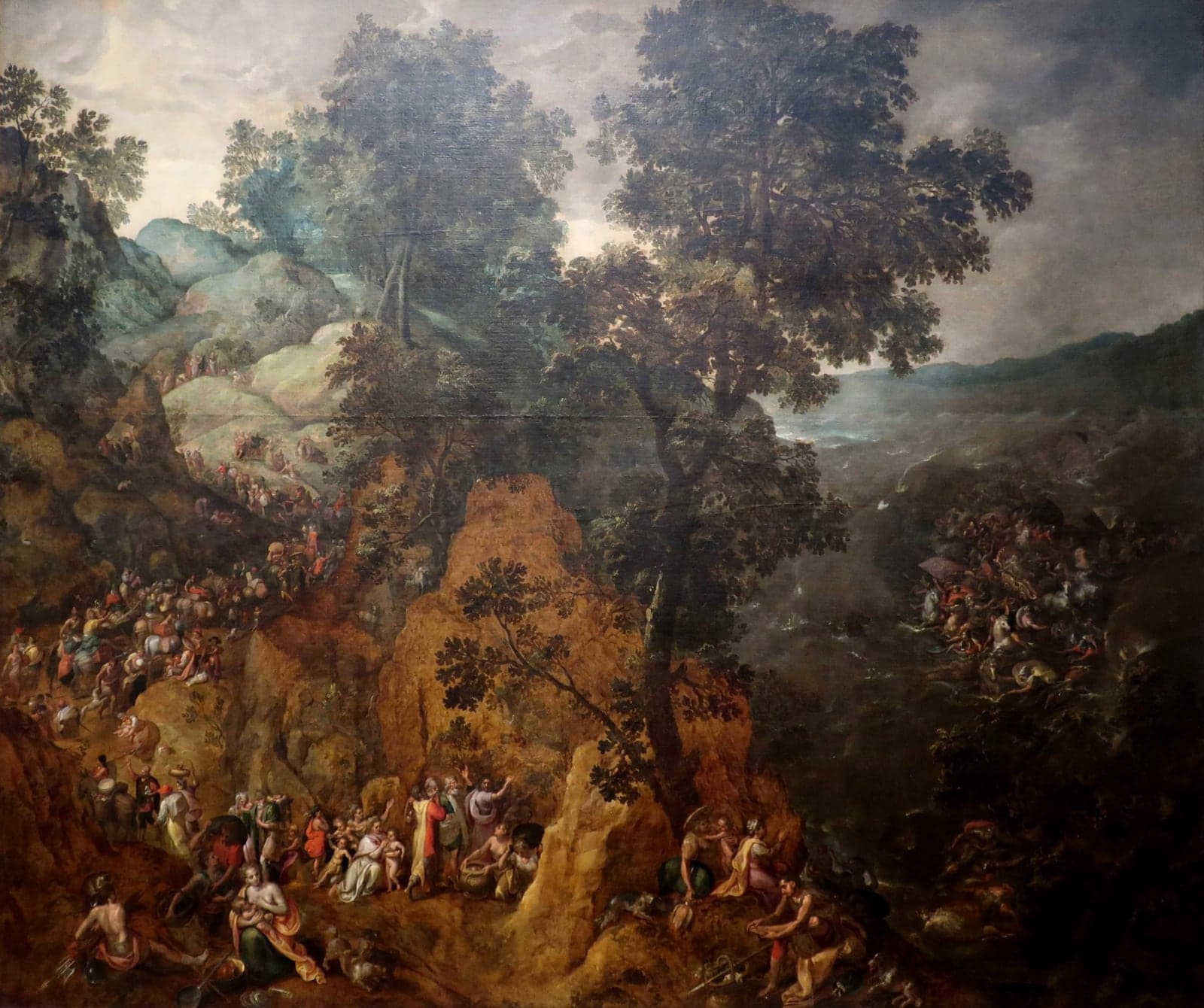
Gillis Mostaert the Elder, Landscape with the Israelites' Flight from Egypt, oil on canvas, second half of the sixteenth century, Schorr Collection. Public domain by date. Wikimedia Commons, File:Landscape_with_the_Israelites_Flight_from_Egypt_by_Gillis_Mostaert_the_Elder.JPG.
THE ARTWORKMostaert painted the people of the exodus as a column too long to count, climbing a mountain road while horsemen struggle in the water behind them.
Summary
Numbers counts the men of fighting age at Sinai and again on the plains of Moab, and readers divide over what the two totals record.
- The plain reading takes the totals as written and reckons the whole people at near two million.
- Petrie, Mendenhall, Wenham and Humphreys read the Hebrew word for a thousand as a family, a clan, an officer or a troop, and reckon a far smaller people.
- Every tribal figure in both lists has a hundreds digit between two and seven, the pattern the reduction readings start from.
- The copies of Samuel, Kings and Chronicles show numbers changing in copying, while the Greek Numbers carries the census figures as the Hebrew has them.
- The site holds the census to be a real count of a real people and sets out each reading with its holders.
The Figures the Text Gives
Numbers counts the men twenty years old and up at Sinai and again on the plains of Moab.
And all those counted totaled 603,550.The first count, taken at Sinai in the second year after the exodus, totals the men able to serve in the army.
These men of Israel numbered 601,730 in all.The second count, taken on the plains of Moab after the first generation had died, comes within two thousand of the first.
The Israelites journeyed from Rameses to Succoth with about 600,000 men on foot, besides women and children.The departure from Rameses gives the same scale in a round figure and sets the women and children beside the men.
a beka per person, that is, half a shekel, according to the sanctuary shekel, from everyone twenty years of age or older who had crossed over to be numbered, a total of 603,550 men.The silver of the sanctuary was weighed at half a shekel for each man counted, so the first total stands in a second account.
Between the two counts Simeon fell by 37,100 men and Manasseh grew by 20,500.
- First count, Numbers 1
- Second count, Numbers 26
The twenty-four counts as a table
| The tribe | Men twenty years old and up | The count | Verse |
|---|---|---|---|
| Reuben | 46,500 | First count, Numbers 1 | Numbers 1:21 |
| Reuben | 43,730 | Second count, Numbers 26 | Numbers 26:7 |
| Simeon | 59,300 | First count, Numbers 1 | Numbers 1:23 |
| Simeon | 22,200 | Second count, Numbers 26 | Numbers 26:14 |
| Gad | 45,650 | First count, Numbers 1 | Numbers 1:25 |
| Gad | 40,500 | Second count, Numbers 26 | Numbers 26:18 |
| Judah | 74,600 | First count, Numbers 1 | Numbers 1:27 |
| Judah | 76,500 | Second count, Numbers 26 | Numbers 26:22 |
| Issachar | 54,400 | First count, Numbers 1 | Numbers 1:29 |
| Issachar | 64,300 | Second count, Numbers 26 | Numbers 26:25 |
| Zebulun | 57,400 | First count, Numbers 1 | Numbers 1:31 |
| Zebulun | 60,500 | Second count, Numbers 26 | Numbers 26:27 |
| Ephraim | 40,500 | First count, Numbers 1 | Numbers 1:33 |
| Ephraim | 32,500 | Second count, Numbers 26 | Numbers 26:37 |
| Manasseh | 32,200 | First count, Numbers 1 | Numbers 1:35 |
| Manasseh | 52,700 | Second count, Numbers 26 | Numbers 26:34 |
| Benjamin | 35,400 | First count, Numbers 1 | Numbers 1:37 |
| Benjamin | 45,600 | Second count, Numbers 26 | Numbers 26:41 |
| Dan | 62,700 | First count, Numbers 1 | Numbers 1:39 |
| Dan | 64,400 | Second count, Numbers 26 | Numbers 26:43 |
| Asher | 41,500 | First count, Numbers 1 | Numbers 1:41 |
| Asher | 53,400 | Second count, Numbers 26 | Numbers 26:47 |
| Naphtali | 53,400 | First count, Numbers 1 | Numbers 1:43 |
| Naphtali | 45,400 | Second count, Numbers 26 | Numbers 26:50 |
A bar chart of each tribe's men at the first count, in Numbers 1, and at the second, in Numbers 26, set side by side.
Each total is the sum of the tribal figures listed before it, and the sums agree with the totals to the last digit. Five tribes fell between the counts and seven grew, so the whole moved by less than one man in three hundred.
How Each Reading Takes the Word for Thousand
The readings divide on what the Hebrew word eleph means in the census lists, and the size of the people follows from that choice.
| What eleph means in the lists | The whole people that left Egypt | Its holder |
|---|---|---|
| A thousand, as the figures are commonly read | About 1,800,000: the men, and twelve hundred thousand women and children beside them | John Wesley, Explanatory Notes upon the Old Testament |
| A family or tent group, the hundreds being its people | About 5,550, the sum of the hundreds | Flinders Petrie, Researches in Sinai |
| A clan, which sent a contingent counted in hundreds | No total for the whole people given | George Mendenhall, Journal of Biblical Literature, as Wenham and Humphreys report him |
| An officer, a different pointing of the same letters | About 72,000 | John Wenham, Tyndale Bulletin |
| A troop, with two kinds of eleph run together in copying | About 20,000 | Colin Humphreys, Vetus Testamentum |
Each Reading Stated
The plain reading rests on the totals as written, and the reduction readings rest on the shape of the tribal figures.
The totals as a count of the menWesley, Clarke, Gregory of Nazianzus, Augustine
John Wesley, in his Explanatory Notes upon the Old Testament (1765), read the men of Exodus 12:37 as men fit for war and reckoned the women and children at twelve hundred thousand more. Adam Clarke saw in the total of Numbers 1:46 the promise of increase kept to the seventy who went down into Egypt. Gregory of Nazianzus, in his forty-second oration, and Augustine, in The City of God, took the six hundred thousand of the exodus as the number of the men.
“About six hundred thousand men - The word means strong and able men fit for wars, beside women and children, which we cannot suppose to make less than twelve hundred thousand more. What a vast increase was this to arise from seventy souls, in little more than two hundred years.”
John Wesley · Explanatory Notes upon the Old Testament · on Exodus 12:37Evangelical
“All they that were numbered were six hundred thousand and three thousand and five hundred and fifty - What an astonishing increase from seventy souls that went down into Egypt, Gen 46:27, about 215 years before, where latterly they had endured the greatest hardships! But God’s promise cannot fail (Gen 16:5); and who can resist his will, and bring to naught his counsel?”
Adam Clarke · Commentary on the Bible · on Numbers 1:46Evangelical
Its holders point out that the total stands three times in the text, twice as the sum of stated parts and once as a weight of silver. The round figure of the exodus stands again in Numbers 11:21. The wilderness account already claims a supply of food and water that no size of people makes natural, so a large people sets the reader the same problem the book says God solved.
Eleph as a family or tent groupFlinders Petrie
Flinders Petrie, in Researches in Sinai (1906), held that the word had two senses, a thousand and a family or group, so that Manasseh's 32,200 could be read as thirty-two families and two hundred people. Read so, the two counts give 5,550 and 5,730 people. He set those totals beside the five or six thousand people he found living in Sinai, which he took to be its ancient number as well.
John Wenham answered that the figures will not bear it. Simeon at the first count has fifty-nine families and three hundred people, and Gad has fewer families, forty-five, and more than twice the people, six hundred and fifty.
Eleph as a clan and its contingentGeorge Mendenhall
George Mendenhall, in the Journal of Biblical Literature for 1958, read each tribal figure as two numbers: the clans a tribe sent, and the men those clans sent in all. He dated the lists to the time of the Judges, and later to the early monarchy. His article is reported here as John Wenham and Colin Humphreys read it, and the same objection from Simeon and Gad meets it.
Eleph as an officerJohn Wenham
John Wenham, in Large Numbers in the Old Testament, Tyndale Bulletin 18 (1967), read the word in the lists as allup, the chief or trained warrior that Genesis 36 names among the chiefs of Edom. On his reckoning the first count held 580 such men beside the rank and file counted in hundreds, and the whole migration came to about 72,000 people. He set beside his own the reading of R. E. D. Clark (1955), who took the thousands as officers and reckoned a people of about 140,000.
Colin Humphreys answered that the readings of Clark and Wenham cannot be squared with the 273 sons of Numbers 3:46 who outnumbered the Levites, the key to his own reading.
Eleph as a troopColin Humphreys
Colin Humphreys, in The Number of People in the Exodus from Egypt, Vetus Testamentum 48 (1998), read eleph in the lists as a troop. He proposed that a scribe ran two kinds of eleph together, so that a total of 598 troops holding 5,550 men was later read as 603,550 men. On his reckoning the men over twenty numbered about five thousand and the whole people about twenty thousand.
He rested the method on the surplus of firstborn sons over the Levites in Numbers 3:46, a figure he took as historical, tentatively by his own word. Its critics answer that the totals of Numbers 1:46 and 26:51 add from their parts as the text stands, and that the lists set eleph beside the word for a hundred in the same verses.
The site's tradition holds the census to be a real count of a real people, kept by God in the wilderness. The readings differ on what the written figures transmit, and each stands here with its holders, its evidence and the objection it faces.
What the Lists Themselves Show
The shape of the tribal figures, the count of the firstborn and the words of Moses each weigh in the question.
In the two lists every hundreds digit is between two and seven, and every tribal figure but two ends in two zeros. Petrie judged a spread like that more than a thousand to one against by chance, and Wenham put the odds near 200,000 to one.
The total number of the firstborn males a month old or more, listed by name, was 22,273.The firstborn sons a month old and up are counted here, and the readings divide on why the figure is so small beside the census.
The LORD did not set His affection on you and choose you because you were more numerous than the other peoples, for you were the fewest of all peoples.Moses calls Israel the fewest of all peoples, a verse the reduction readings cite.
The LORD your God has multiplied you, so that today you are as numerous as the stars in the sky.Moses also calls Israel as numerous as the stars in the sky, a verse the plain reading cites.
I will not drive them out before you in a single year; otherwise the land would become desolate and wild animals would multiply against you. Little by little I will drive them out ahead of you, until you become fruitful and possess the land.God promises to drive out the nations little by little, so that the land is not left desolate before Israel can fill it.
Four answers to the firstborn figureNumbers 3:43
The Pulpit Commentary says the figure has given rise to several conflicting theories and finds them all unsatisfactory. Some count only a son who first opened his mother's womb, others only the sons born since the exodus, and the commentary itself counts each eldest son not yet the head of a house. Colin Humphreys takes the figure as it stands and makes it the measure of the whole people.
The Hebrew words of the censuseleph, meah, paqad, mishpachah
Strong's concordance files the census figures under eleph as a thousand and gives the same letters a second entry, a family or an ox, with seven occurrences. That filing follows the plain reading of the census. The word for a hundred is meah. The verb behind numbered is paqad, to muster, and the clans of Numbers 1:2 are mishpachah, a family circle, a different word from eleph.
How Numbers Were Copied
Where Samuel, Kings and Chronicles tell one event, the copies sometimes carry two numbers for it, and the Berean notes name the witnesses.
| The passage | The two witnesses | The Berean text |
|---|---|---|
| 2 Samuel 24:9 and 1 Chronicles 21:5 | Samuel: Israel 800,000 and Judah 500,000; Chronicles: Israel 1,100,000 and Judah 470,000 | Each book keeps its own |
| 2 Samuel 10:18 and 1 Chronicles 19:18 | Samuel: seven hundred charioteers; Chronicles: seven thousand charioteers | Each book keeps its own |
| 1 Kings 4:26 | The Hebrew: 40,000 stalls; some Greek manuscripts and 2 Chronicles 9:25: four thousand | Four thousand |
| 2 Chronicles 36:9 | Most Hebrew manuscripts: Jehoiachin eight years old; one Hebrew manuscript, some Greek, the Syriac and 2 Kings 24:8: eighteen | Eighteen |
| 2 Samuel 24:13 | The Hebrew: seven years of famine; the Greek and 1 Chronicles 21:12: three years | Three years |
| 1 Samuel 6:19 | Most Hebrew manuscripts and the Greek: seventy men and fifty thousand men; a few late Hebrew manuscripts and Josephus: seventy men | Seventy men |
The copies themselves keep the second reading in each of these places, so the difference can be seen and weighed. The census of Numbers carries no such difference: the Septuagint, the Greek translation, gives the same tribal figures and the same totals as the Hebrew, with Gad set later in the order of the tribes.
Two readings of David's census2 Samuel 24:9
Adam Clarke and Albert Barnes held that one book or both lost the true figure in copying. Barnes, on the Samuel verse, and Jamieson, Fausset and Brown gave a second answer, that one writer counted in his total troops the other left out.
“In 2Sa 24:9 the numbers are different. The explanation there given is not so generally accepted as the supposition that the numbers have, in one passage or the other (or possibly in both), suffered corruption.”
Albert Barnes · Notes, Explanatory and Practical, on the Old and New Testaments (1832-1869) · on 1 Chronicles 21:5Evangelical
“It must also be observed that, exclusive of the troops before mentioned, there was an army of observation on the frontiers of the Philistines' country, composed of thirty thousand men, as appears from 2Sa 6:1; which, it seems, were included in the number of five hundred thousand of the people of Judah by the author of Samuel.”
Jamieson, Fausset & Brown · Commentary Critical and Explanatory on the Whole Bible · on 2 Samuel 24:9Reformed
How the Question Was Read
The fathers took the figure as written, and from the nineteenth century readers have asked whether it can stand as written and what it transmits.
- Fourth centuryGregory of NazianzusOration 42: six hundred thousand leave Egypt from Joseph alone.
- Fifth centuryAugustineThe City of God 15.8: six hundred thousand men of military age.
- 1710Matthew HenryOn Numbers 26:64: a new generation as numerous as the one cut off.
- 1765John WesleyOn Exodus 12:37: the men, and twelve hundred thousand more beside them.
- 1832Adam ClarkeOn 2 Samuel 24:9: copyists of the historical books made mistakes.
- 1862John William ColensoThe Pentateuch and Book of Joshua Critically Examined: the figures argued impossible.
- 1906Flinders PetrieResearches in Sinai, chapter 14.
- 1955R. E. D. ClarkThe thousands read as officers.
- 1958George MendenhallThe lists read as clans and their contingents.
- 1967John WenhamTyndale Bulletin 18.
- 1998Colin HumphreysVetus Testamentum 48.
A timeline of the readers who answered the question, each row naming the work.
Two further readings, shown with their weaknessColenso; Holzinger and Barnouin
John William Colenso gave the first part of his critical examination of the Pentateuch to the claim that the figures could not be true, and so that the history could not be. Wenham called it probably the most damaging argument ever brought against the history of the Old Testament, and answered that absurd figures are the least likely to have been invented. The copying record above gives a second answer.
Holzinger read the totals as codes, the letters of the community of Israel adding to 603 and those of a phrase of Numbers 1:3 to 551, and Barnouin, in 1977, read them as astronomical periods. Both are known here only through Colin Humphreys, who judged that no evidence supports Barnouin's theory.
What Numbers Leaves Unsaid
The book records the totals and leaves the rest of the people uncounted.
Numbers gives no reason for Simeon's fall between the two counts, and readers who link it to the plague after Baal of Peor and the Simeonite Zimri of Numbers 25:14 supply the link themselves. The book does not count the women, the children or the mixed multitude that went up from Egypt. How many went out of Egypt in all is not known.
What Every Reading Holds
Four teachings stand under every reading of the figures.
THE COUNT WAS COMMANDED
The LORD ordered the count of the men able to serve, tribe by tribe and name by name.
A GENERATION PASSED BETWEEN THE COUNTS
The men of the first count died in the wilderness, all but Caleb and Joshua, as the LORD had said.
THE PROMISE OF INCREASE
Read in any of these ways, the figures record a people grown from the household that went down into Egypt.
THE COPIES CAN BE CHECKED
Where the copies differ on a number, the parallel books and the other witnesses keep the second reading in view.
The Teachers on the Two Counts
Commentators of the eighteenth and nineteenth centuries read the justice and the mercy of God in the two counts.
A people as numerous as beforeNumbers 26:51
“These were the numbered - Very nigh as many as there were before, chap. i, 46. So wisely and marvelously did God at the same time manifest his justice in cutting off so vast a number; his mercy in giving such a speedy and numerous supply; and his truth in both.”
John Wesley · Explanatory Notes upon the Old Testament · on Numbers 26:51Evangelical
Another generation raised upNumbers 26:64 to 65
“The goodness of God to this people, notwithstanding their provocations. Though that murmuring race was cut off, yet God raised up another generation, which was as numerous as they, that, though they perished, yet the name of Israel might not be cut off, lest the inheritance of the promise should be lost for want of heirs.”
Matthew Henry · Commentary on the Whole Bible · on Numbers 26:64 to 65Puritan
“among these there was not a man . . . numbered . . . in the wilderness of Sinai--The statement in this verse must not be considered absolute. For, besides Caleb and Joshua, there were alive at this time Eleazar and Ithamar, and in all probability a considerable number of Levites, who had no participation in the popular defections in the wilderness.”
Jamieson, Fausset & Brown · Commentary Critical and Explanatory on the Whole Bible · on Numbers 26:64Reformed
The promise to Abraham fulfilled1 Chronicles 21:5
“So large a population at this early period, considering the limited extent of the country and comparing it with the earlier census (Nu 26:1-65), is a striking proof of the fulfilment of the promise (Ge 15:5).”
Jamieson, Fausset & Brown · Commentary Critical and Explanatory on the Whole Bible · on 1 Chronicles 21:5Reformed
The Readings Weighed
Each reading faces the objection its critics press hardest.
| The reading and its tradition | Held by | The objection it faces |
|---|---|---|
| The totals as written: the fathers and the Protestant commentators | Gregory of Nazianzus; Augustine; Henry; Wesley; Clarke | The firstborn figure, the small people of Deuteronomy 7:7 and the pattern of the hundreds |
| Eleph as a family: Petrie's survey of Sinai | Petrie | Wenham's arithmetic of two tribes |
| Eleph as a clan: the lists as tribal records | Mendenhall | Wenham's arithmetic, as against Petrie |
| Eleph as an officer: evangelical scholarship | Clark; Wenham | The firstborn figure, by Humphreys |
| Eleph as a troop: a mathematical reading | Humphreys | The written totals add up exactly |
Read the Great Books
These works state the readings in their holders' own words.
Researches in Sinai
W. M. Flinders Petrie · 1906
His chapter on the conditions of the exodus sets out the family reading of eleph and the hundreds digits it rests on.
READ IT FREE →Large Numbers in the Old Testament, Tyndale Bulletin 18
John W. Wenham · 1967
Wenham surveys the large numbers of the whole Old Testament, answers Petrie and Mendenhall, and argues for the officer reading.
READ IT FREE →The Number of People in the Exodus from Egypt, Vetus Testamentum 48
Colin J. Humphreys · 1998
Humphreys sets out the troop reading and the arithmetic of the Levites behind it.
THE ARTICLE AT BRILL →Explanatory Notes upon the Old Testament
John Wesley · 1765
His notes on Exodus 12 and Numbers 26 read the totals as written and draw the lesson of the two counts.
READ IT FREE →A People Counted by Name
The census lists every man by name, and the second count stands on the edge of the promised land.
“Take a census of the whole congregation of Israel by their clans and families, listing every man by name, one by one.Whatever the figures transmit, Numbers shows a God who knows His people by tribe and by name. He judged a generation in the wilderness and raised up another to take the land, and the reader of the census is meant to see His faithfulness in both counts.
Keep studying
Read it2
Studies7