
Deuteronomy 13 and 18 · Subject · Featured Study
True and false prophets
Moses' law on prophets in Deuteronomy 13 and 18, four contests between prophets in Kings and Jeremiah, and the warnings of Jesus and John.
Micaiah staked his word on one test before King Ahab: “If you ever return safely, the LORD has not spoken through me.”
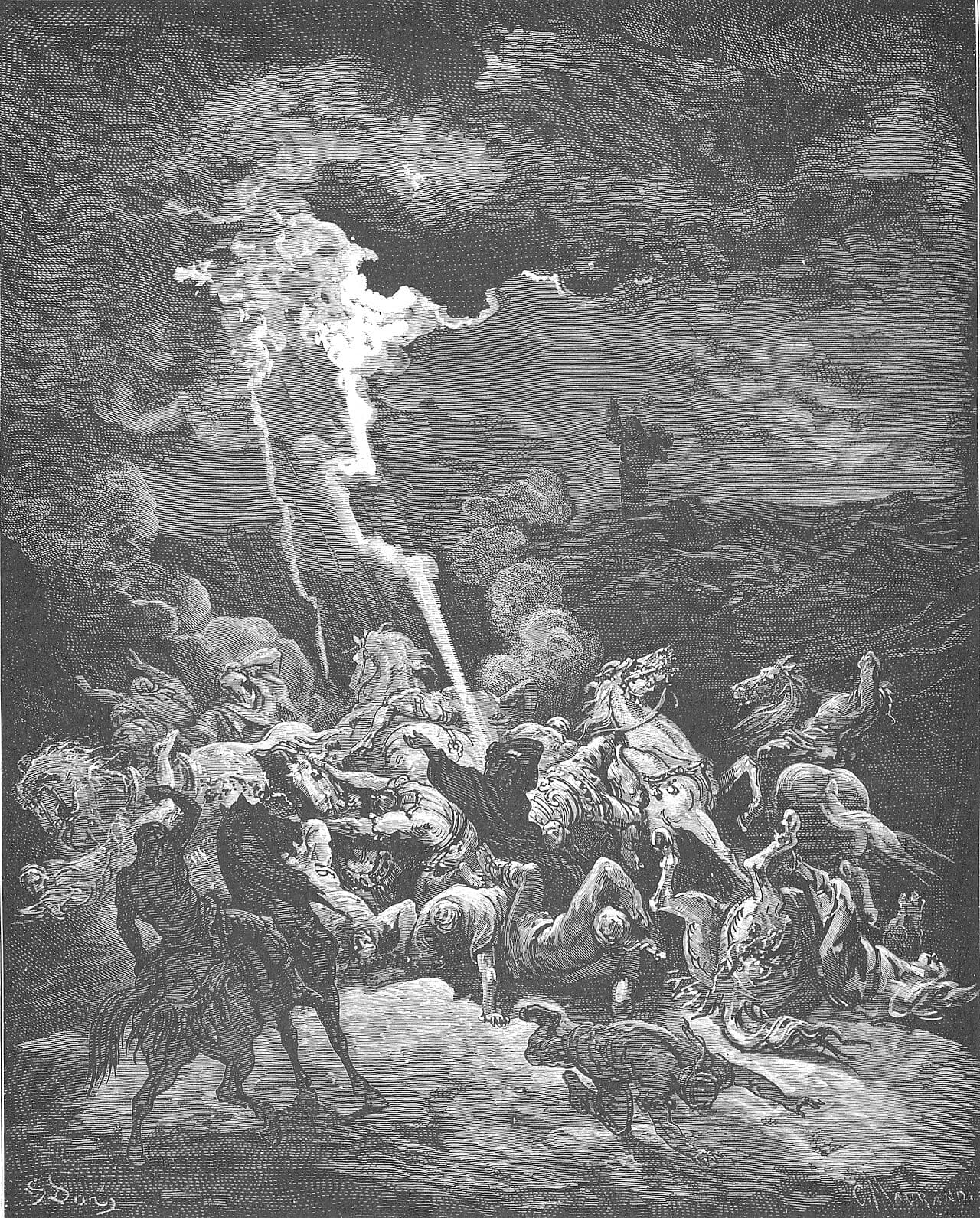
Gustave Doré, Elijah Destroys the Messengers of Ahaziah, 1866, from Doré's English Bible. Public domain by date of publication.
THE ARTWORKDoré drew the fire from heaven striking a captain's company of fifty, its horses rearing and its men thrown down, with Elijah standing small on the hilltop above them. King Ahaziah had sent to ask Baal-zebub, the god of Ekron, whether he would recover, and Elijah gave him the LORD's answer instead, which came to pass when the king died.
Summary
Deuteronomy tests a prophet in two ways: by what he says about the LORD, and by whether his word comes to pass.
- A prophet who calls Israel to other gods is refused even when his sign or wonder comes about.
- A message spoken in the LORD's name that does not come true is a message the LORD has not spoken.
- In Kings and Jeremiah the prophet the LORD sent often stood alone against many prophets He had not sent.
- Peter names Jesus as the prophet like Moses whom Deuteronomy 18:15 promised.
- Jesus and John give the church two more tests: the fruit of a life, and the confession that Jesus Christ has come in the flesh.
The Two Tests of Deuteronomy
Moses gives one test in Deuteronomy 13 and the other in Deuteronomy 18, in the land of Moab east of the Jordan.
If a prophet or dreamer of dreams arises among you and proclaims a sign or wonder to you, and if the sign or wonder he has spoken to you comes about, but he says, “Let us follow other gods (which you have not known) and let us worship them,” you must not listen to the words of that prophet or dreamer. For the LORD your God is testing you to find out whether you love Him with all your heart and with all your soul.The first test judges a prophet by the god his message serves.
But if any prophet dares to speak a message in My name that I have not commanded him to speak, or to speak in the name of other gods, that prophet must be put to death.” You may ask in your heart, “How can we recognize a message that the LORD has not spoken?” When a prophet speaks in the name of the LORD and the message does not come to pass or come true, that is a message the LORD has not spoken. The prophet has spoken presumptuously. Do not be afraid of him.The second test answers Israel's own question, and Moses calls the prophet who fails it presumptuous.
Five Questions to Ask of a Prophet
Moses gives two of the questions, and Jeremiah, Jesus and John give one each.
1Does his message lead to other gods, or speak in the LORD's name a word the LORD did not command?
- Verse
- Deuteronomy 13:1 to 5 and 18:20
- What it examines
- The message
2Does the word he speaks in the LORD's name come to pass?
- Verse
- Deuteronomy 18:21 to 22
- What it examines
- The outcome
3Does his promise of peace come true?
- Verse
- Jeremiah 28:9
- What it examines
- The outcome
4What fruit does his life bear?
- Verse
- Matthew 7:15 to 20
- What it examines
- The life
5Does the spirit confess that Jesus Christ has come in the flesh?
- Verse
- 1 John 4:1 to 3
- What it examines
- The message
A chain of five tests in canon order, each station giving its question, its verse and what it examines.
The tests from Jesus and from JohnMatthew 7:15 to 20; 1 John 4:1 to 3
Beware of false prophets. They come to you in sheep’s clothing, but inwardly they are ravenous wolves. By their fruit you will recognize them. Are grapes gathered from thornbushes, or figs from thistles? Likewise, every good tree bears good fruit, but a bad tree bears bad fruit. A good tree cannot bear bad fruit, and a bad tree cannot bear good fruit. Every tree that does not bear good fruit is cut down and thrown into the fire. So then, by their fruit you will recognize them.Jesus closes the Sermon on the Mount by telling His hearers to know a false prophet by what his life produces.
Beloved, do not believe every spirit, but test the spirits to see whether they are from God. For many false prophets have gone out into the world. By this you will know the Spirit of God: Every spirit that confesses that Jesus Christ has come in the flesh is from God, and every spirit that does not confess Jesus is not from God. This is the spirit of the antichrist, which you have heard is coming and which is already in the world at this time.John writes because many false prophets have gone out into the world, and he gives the duty of testing them to every believer he calls beloved.
Four Cases in Kings and Jeremiah
Each of these four contests in Kings and Jeremiah turned on one of the tests of Deuteronomy.
| The case | Sent by the LORD | Not sent by the LORD | The test that decided it |
|---|---|---|---|
| Bethel, 1 Kings 13:11 to 31 | The man of God from Judah | The old prophet of Bethel | The message: a later word may not overturn what the LORD has commanded |
| Mount Carmel, 1 Kings 18:19 to 40 | Elijah | The prophets of Baal | The message and the outcome: the God who answered by fire was shown to be God |
| Samaria, 1 Kings 22:6 to 28 | Micaiah son of Imlah | Zedekiah son of Chenaanah and about four hundred prophets | The outcome: Ahab did not return safely from Ramoth-gilead |
| The house of the LORD, Jeremiah 28 | Jeremiah | Hananiah son of Azzur | The outcome: the yoke of Babylon stayed, and Hananiah died that year |
Doré draws Micaiah's word coming to pass, with Ahab dying in his chariot at sunset.
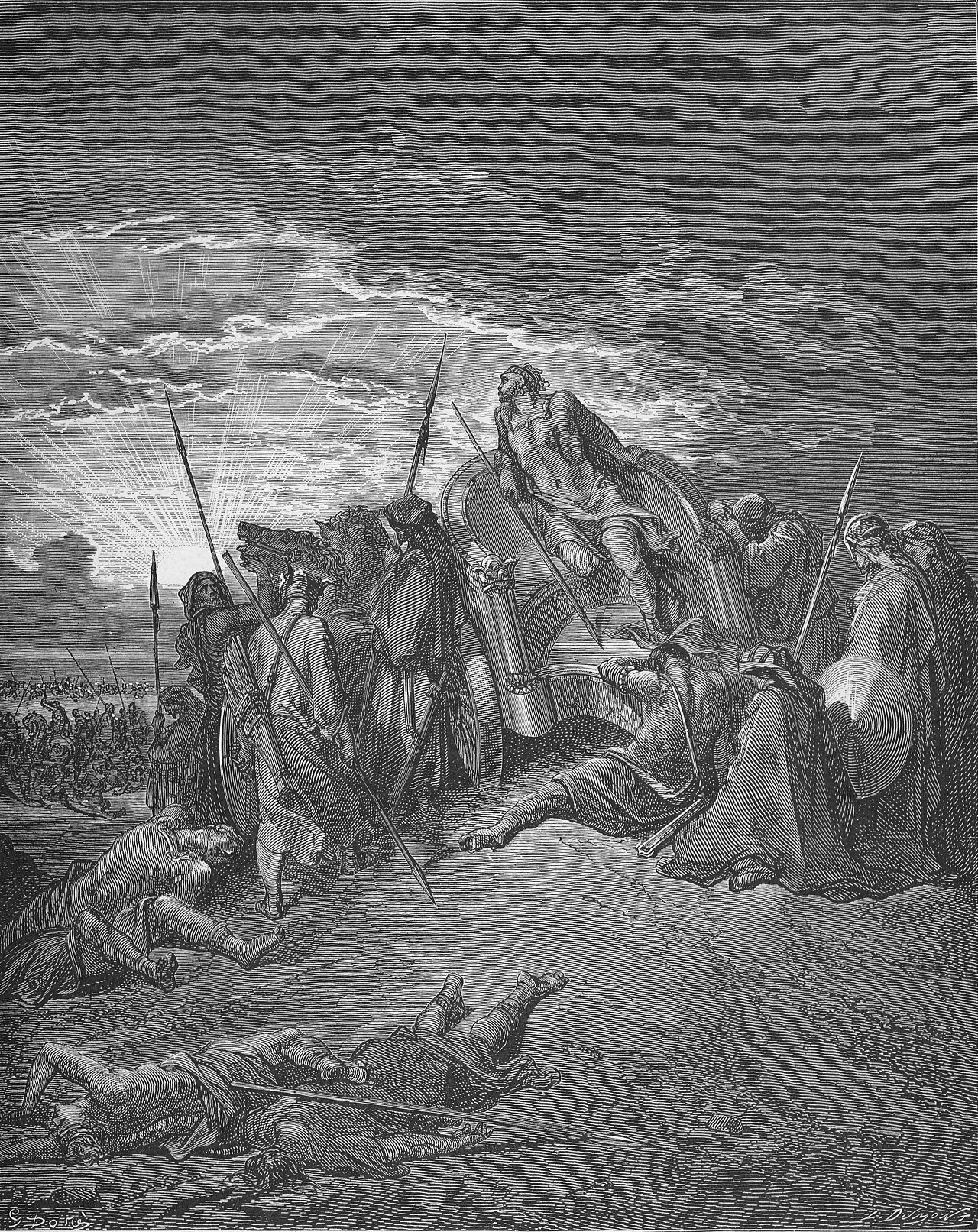
- The king propped up in his chariot1 Kings 22:35
- The chariot he asked to be turned1 Kings 22:34
- The setting sun1 Kings 22:36
- The battle that raged all day1 Kings 22:35
- Men without a master1 Kings 22:17
Gustave Doré, The Death of Ahab, 1866, from Doré's English Bible. Public domain by date of publication.
Five numbered parts of the engraving, each with its verse in 1 Kings 22.
Micaiah and the four hundred1 Kings 22:13 to 28
Then the messenger who had gone to call Micaiah instructed him, “Behold now, with one accord the words of the prophets are favorable to the king. So please let your words be like theirs, and speak favorably.” But Micaiah said, “As surely as the LORD lives, I will speak whatever the LORD tells me.”The king's messenger asks Micaiah to agree with the other prophets, and Micaiah binds himself to speak what the LORD tells him.
Then Zedekiah son of Chenaanah went up, struck Micaiah in the face, and demanded, “Which way did the Spirit of the LORD go when He departed from me to speak with you?” Micaiah replied, “You will soon see, on that day when you go and hide in an inner room.” And the king of Israel declared, “Take Micaiah and return him to Amon the governor of the city and to Joash the king’s son, and tell them that this is what the king says: ‘Put this man in prison and feed him only bread and water until I return safely.’” But Micaiah replied, “If you ever return safely, the LORD has not spoken through me.” Then he added, “Take heed, all you people!”Zedekiah strikes Micaiah for his word, and Ahab sends him to prison on bread and water until the king returns.
Ahab did not return. An arrow struck him between the joints of his armor, and he died that evening propped up in his chariot.
“Unity is not always the mark of a true church and a true ministry. Here were 400 men that prophesied with one mind and one mouth, and yet all in an error. Jehoshaphat cannot relish this sort of preaching; it is not like what he was used to.”
Matthew Henry · Commentary on the Whole Bible · on 1 Kings 22:12Puritan
Jeremiah and HananiahJeremiah 28:8 to 17
The prophets of old who preceded you and me prophesied war, disaster, and plague against many lands and great kingdoms. As for the prophet who prophesies peace, only if the word of the prophet comes true will the prophet be recognized as one the LORD has truly sent.”Jeremiah answers Hananiah's promise of peace with the test of Deuteronomy 18:22, since a word of peace is proved only when it comes true.
Then the prophet Jeremiah said to the prophet Hananiah, “Listen, Hananiah! The LORD did not send you, but you have persuaded this people to trust in a lie. Therefore this is what the LORD says: ‘I am about to remove you from the face of the earth. You will die this year because you have preached rebellion against the LORD.’” And in the seventh month of that very year, the prophet Hananiah died.Jeremiah's word against Hananiah comes to pass two months after it is spoken, in the seventh month of the year Hananiah prophesied.
Rashi, in his commentary on Deuteronomy 18:21, names this contest as the time Israel would ask how to recognize a message the LORD has not spoken. He sets Hananiah's promise that the temple vessels would come back from Babylon against Jeremiah's word that the rest would follow them into exile.
“When Jeremiah admonishes him, saying, ‘Listen, Hananiah, the Lord did not send you,’ he omits the title ‘prophet,’ for how could he call him a prophet who refused to be sent by the Lord? But the truth and order of history is preserved, as we said above, not according to what was but according to what was thought to be at the time. He says, in effect, ‘You have deceived the people with a falsehood, to prevent them from agreeing with the judgment of God. Hence, you know that this will be the year you die.’”
Jerome · Six Books on Jeremiah 5:62.2-4 · on Jeremiah 28:15 to 17Patristic
Elijah and the prophets of Baal1 Kings 18:21 to 39
Then Elijah approached all the people and said, “How long will you waver between two opinions? If the LORD is God, follow Him. But if Baal is God, follow him.” But the people did not answer a word. Then Elijah said to the people, “I am the only remaining prophet of the LORD, but Baal has four hundred and fifty prophets. Get two bulls for us. Let the prophets of Baal choose one bull for themselves, cut it into pieces, and place it on the wood but not light the fire. And I will prepare the other bull and place it on the wood but not light the fire. Then you may call on the name of your god, and I will call on the name of the LORD. The God who answers by fire, He is God.” And all the people answered, “What you say is good.”Elijah turns the contest on the first test of Deuteronomy 13, which god Israel will follow, and the people agree to let fire decide.
At the time of the evening sacrifice, Elijah the prophet approached the altar and said, “O LORD, God of Abraham, Isaac, and Israel, let it be known this day that You are God in Israel and that I am Your servant and have done all these things at Your command. Answer me, O LORD! Answer me, so that this people will know that You, the LORD, are God, and that You have turned their hearts back again.” Then the fire of the LORD fell and consumed the sacrifice, the wood, the stones, and the dust, and it licked up the water in the trench. When all the people saw this, they fell facedown and said, “The LORD, He is God! The LORD, He is God!”Elijah prays that Israel will know the LORD is God and that he has acted at the LORD's command, and the people confess it when the fire falls.
The man of God and the old prophet of Bethel1 Kings 13:11 to 31
But the man replied, “I cannot return with you or eat bread or drink water with you in this place. For I have been told by the word of the LORD: ‘You must not eat bread or drink water there or return by the way you came.’” Then the prophet replied, “I too am a prophet like you, and an angel spoke to me by the word of the LORD, saying, ‘Bring him back with you to your house, so that he may eat bread and drink water.’” The old prophet was lying to him, but the man of God went back with him, ate bread in his house, and drank water.The man of God refuses twice, then turns back when the old prophet claims that an angel spoke to him, and the narrator says he was lying.
While they were sitting at the table, the word of the LORD came to the prophet who had brought him back, and the prophet cried out to the man of God who had come from Judah, “This is what the LORD says: ‘Because you have defied the word of the LORD and have not kept the commandment that the LORD your God gave you, but you went back and ate bread and drank water in the place where He told you not to do so, your body shall never reach the tomb of your fathers.’”The true word of judgment comes through the same old prophet who had lied, and it falls on the man of God who obeyed the lie.
John Gill, in his Exposition of the Old Testament on 1 Kings 13:19, says the man of God knew the LORD's command for certain. He should have waited for the LORD to revoke it, rather than trust another man.
The commentators differ on why the old prophet lied. Adam Clarke, in his Commentary on the Bible on 1 Kings 13:18, finds the motive in curiosity about the prophecy against the altar. Albert Barnes, in his Notes on 1 Kings 13:11, judges a prophet content to live at Bethel, the chief seat of Jeroboam's new worship, to be without deep religious feeling.
The prophets of Jeremiah 23Jeremiah 23:16 to 32
This is what the LORD of Hosts says: “Do not listen to the words of the prophets who prophesy to you. They are filling you with false hopes. They speak visions from their own minds, not from the mouth of the LORD. They keep saying to those who despise Me, ‘The LORD says that you will have peace,’ and to everyone who walks in the stubbornness of his own heart, ‘No harm will come to you.’The LORD warns Jerusalem against comfort offered by prophets He did not send.
I did not send these prophets, yet they have run with their message; I did not speak to them, yet they have prophesied. But if they had stood in My council, they would have proclaimed My words to My people and turned them back from their evil ways and deeds.”These verses give the test of a prophet's effect, since a prophet who had stood in the LORD's council would have turned the people from their evil ways.
Let the prophet who has a dream retell it, but let him who has My word speak it truthfully. For what is straw compared to grain?” declares the LORD. “Is not My word like fire,” declares the LORD, “and like a hammer that smashes a rock?”These verses make the LORD's own word the measure for every claimed revelation.
“They would have encouraged and assisted the reformation of manners, would have made this their scope in all their preaching, to part between men and their sins; but it appeared that this was a thing they never aimed at, but, on the contrary, to encourage sinners in their sins.”
Matthew Henry · Commentary on the Whole Bible · on Jeremiah 23:22Puritan
Why a True Sign Can Come from a False Prophet
Deuteronomy 13:3 says the LORD lets the sign come about to test whether Israel loves Him.
Jesus gives the same warning to His disciples on the Mount of Olives, when they ask about the sign of His coming and the end of the age.
For false Christs and false prophets will appear and perform great signs and wonders that would deceive even the elect, if that were possible.This is the case Deuteronomy 13 describes, carried forward to the days before Jesus returns.
Rashi and Clarke on the sign that comes trueRashi on Deuteronomy; Adam Clarke, Commentary on the Bible
Rashi asks why God gives such a prophet power for a sign at all, and he answers from the same verse that God is trying His people. Adam Clarke, in his Commentary on the Bible on Deuteronomy 13:3, says God permits such impostors to arise to try the faith of His followers.
Vincent of Lérins on MontanusCommonitory
Vincent of Lérins, in his Commonitory, applies Deuteronomy 13 to Montanus and his writings.
Prophets at Court and in the Temple
Deuteronomy names the voices Israel was forbidden to hear, and Kings and Jeremiah place the false prophets before kings, priests and crowds.
THE DIVINERS OF CANAAN
Deuteronomy forbids Israel the voices the nations heard: diviners, sorcerers, mediums and those who inquire of the dead.
JEZEBEL'S TABLE
The prophets of Baal and of Asherah whom Elijah summoned to Carmel ate at the queen's table.
THE GATE OF SAMARIA
The four hundred prophesied before the kings of Israel and Judah as they sat on their thrones at the threshing floor.
THE HOUSE OF THE LORD
Hananiah of Gibeon spoke in the temple in the presence of the priests and all the people.
The Words for a Prophet
Four words, three Hebrew and one Greek, behind prophet, presumptuously, dares and false prophet.
NÂBÎYʼ (HEBREW, H5030)
A noun that means a prophet or an inspired man, and it stands 314 times in the Hebrew Bible.
ZÂDÔWN (HEBREW, H2087)
A noun that means arrogance, rendered presumptuously in Deuteronomy 18:22; the same word stands in Deuteronomy 17:12 of the man who refuses to listen to the priest or the judge.
ZÛWD (HEBREW, H2102)
A verb that means to seethe and so to act insolently; Deuteronomy 18:20 uses it of the prophet who dares to speak in the LORD's name.
PSEUDOPROPHḖTĒS (GREEK, G5578)
A noun that means a false prophet or religious impostor, first used in the New Testament in Matthew 7:15 and used again in 1 John 4:1.
What the Text Leaves Unsaid
The passages leave three questions open.
The text does not say how the word of the LORD came to the man who had just lied to the man of God (1 Kings 13:20).
The account in 1 Kings 22 does not say where the king of Israel found the prophets he assembled, or who trained them.
Deuteronomy 18 gives no rule for a prophecy whose time is not stated, and Jeremiah 28 shows a prophet setting his own term of two years.
The Prophet Like Moses
Peter and Rashi read the promise of Deuteronomy 18:15 in two ways.
The LORD your God will raise up for you a prophet like me from among your brothers. You must listen to him.Moses sets this promise between his two tests of a prophet, and Peter quotes it in Acts 3.
For Moses said, ‘The Lord your God will raise up for you a prophet like me from among your brothers. You must listen to Him in everything He tells you. Everyone who does not listen to Him will be completely cut off from among his people.’Peter quotes Deuteronomy 18 in Solomon's Colonnade and applies it to Jesus, whom God raised from the dead.
The last chapter of Deuteronomy says that no prophet had since risen in Israel like Moses, whom the LORD knew face to face, so the promise of Deuteronomy 18:15 stood open when the book closed.
Rashi, in his commentary on Deuteronomy 18:15, reads the promise of one prophet after another raised in Moses' place in every age.
Here Rashi's reading parts from the Christian confession. The church reads the verse of one prophet and confesses Jesus as the Messiah in whom Deuteronomy 18:15 is fulfilled.
Origen on the mediator of the new covenantCommentary on the Gospel of John
“It is written in Deuteronomy, ‘[The Lord] your God will raise up a prophet like me for you from your brothers. You shall hear him; and it shall be that every soul which will not hear that prophet shall be destroyed from his people.’ Therefore some prophet was specially expected who would be similar to Moses in some respect, to mediate between God and humanity, and who would receive the covenant from God and give the new covenant to those who became disciples.”
Origen of Alexandria · Commentary on the Gospel of John 6.90 · on Deuteronomy 18:15Patristic
Wesley on the Son greater than the servantExplanatory Notes upon the Old Testament
“But as far as the other prophets came short of him, our Lord Jesus went beyond him. Moses was faithful as a servant, but Christ as a son: his miracles more illustrious, his communion with the father more intimate: for he is in his bosom from eternity. Moses lies buried: but Christ is sitting at the right-hand of God, and of the increase of his government there shall be no end.”
John Wesley · Explanatory Notes upon the Old Testament · on Deuteronomy 34:12Evangelical
The Tests in the Early Church
The Didache and Polycarp carried the tests of Jesus and John into the early church, and later commentators differ on what the fruit of Matthew 7 is.
The Didache, in its eleventh chapter, tells the churches that not everyone who speaks in the Spirit is a prophet, only one who holds the ways of the Lord. It names a travelling apostle who stays three days, or who asks for money, a false prophet.
Do not treat prophecies with contempt, but test all things. Hold fast to what is good.Paul told the church at Thessalonica to test every prophecy and keep what is good, the charge the Didache turned into rules for its churches.
Polycarp on the confession of Christ in the fleshEpistle to the Philippians
“‘For whosoever does not confess that Jesus Christ has come in the flesh, is antichrist;’ and whosoever does not confess the testimony of the cross, is of the devil; and whosoever perverts the oracles of the Lord to his own lusts, and says that there is neither a resurrection nor a judgment, he is the first-born of Satan.”
Polycarp of Smyrna · Epistle to the Philippians 7 · on 1 John 4:3Patristic
What the fruit of Matthew 7 isJohn Wesley; Jamieson, Fausset and Brown; Jerome
John Wesley, in his Explanatory Notes upon the New Testament on Matthew 7:15, reads the fruit chiefly as the false prophet's teaching of the broad way, rather than his own walking in it.
Jamieson, Fausset and Brown, in their Commentary Critical and Explanatory on Matthew 7:16, read the fruit as the practical effect of the prophet's teaching. They set aside the older reading that the fruit is his doctrine.
“What is here spoken of false prophets we may apply to all whose dress and speech promise one thing, and their actions exhibit another. But it is specially to be understood of heretics, who by observing temperance, chastity, and fasting, surround themselves as it were with a garment of sanctity, but inasmuch as their hearts within them are poisoned, they deceive the souls of the more simple brethren.”
Jerome · Catena Aurea by Aquinas · on Matthew 7:15 to 16Patristic
Keeping what was receivedThe Didache, chapter 4
The Didache, in its fourth chapter, tells the believer to keep what he has received, adding nothing to it and taking nothing from it. Deuteronomy 12:32 gives the same command to Israel, in the verse just before the law of the false prophet.
Does the Office of Prophet Continue?
Two readings held by teachers who agree that the gift of prophecy is given today.
The teachers who hold them divide on whether the office of prophet stands in the church beside the gift.
Both readings test a prophetic word. Jane Hamon weighs it by its agreement with Scripture, with the character of God and with the fruit it bears. Mark Virkler, who trains every believer to hear God's voice, warns in Four Keys to Hearing God's Voice that even Satan's thoughts come as spontaneous thoughts, so every thought is taken captive.
Two or three prophets should speak, and the others should weigh carefully what is said.Paul tells the church at Corinth to weigh every prophetic word, so the tests of Moses and John stay in use where prophecy is given.
The office stands beside the giftBill Hamon, Jane Hamon, James W. Goll and Kenneth Hagin · Pentecostal and charismatic
These teachers hold that the office of prophet continues in the church together with the gift. Bill Hamon wrote on that ministry in Prophetic Ministry Can Empower or Devastate the Church, in Charisma Magazine in 1990. Jane Hamon distinguishes the gift, given widely among believers, from the office, a specific calling and recognition. Goll teaches that the office continues in both the spoken word and the seer's vision.
And it was He who gave some to be apostles, some to be prophets, some to be evangelists, and some to be pastors and teachers,This reading takes the verse to set prophets among the ministries Christ gives the church in every generation.
Ephesians 2:20 is the text this reading must answer, since there the apostles and prophets are the foundation on which the church is built.
The gift continues, and the foundation was laid onceJohn Piper, beside Wayne Grudem's The Gift of Prophecy in the New Testament and Today · Reformed Baptist
John Piper holds that the gift of prophecy continues and distinguishes it from the foundational office of apostles and prophets in Ephesians 2:20. His view stands close to Grudem's book of 1988, which treats prophecy today as impressions to be tested.
built on the foundation of the apostles and prophets, with Christ Jesus Himself as the cornerstone.This verse is the ground of the reading, since it names the apostles and prophets together as one foundation, laid once.
This reading must in turn explain Ephesians 4:11, written in the same letter.
Books to Read Next
Three older works that read these passages closely.
Commentary on the Whole Bible
Matthew Henry · 1710
Henry reads the agreement of the four hundred in 1 Kings 22 and the smooth words of the prophets of Jeremiah 23.
Commentary on Jeremiah
Jerome · fifth century
Jerome reads Jeremiah 23 and 28 phrase by phrase and sets the Septuagint beside the Hebrew.
Rashi on Deuteronomy
Rashi, in the translation of M. Rosenbaum and A. M. Silbermann · 1929 to 1934
Rashi gives the rabbinic reading of the sign of Deuteronomy 13 and of the prophet of Deuteronomy 18.
Read Rashi on Deuteronomy 18:21 at SefariaThe Prophet to Be Heard
Deuteronomy gave Israel two tests and one promise. A prophet was judged by whether he led the people to the LORD and whether his word came to pass, and the LORD promised a prophet like Moses with His own words in his mouth.
Peter names that prophet Jesus, the Servant whom God raised up and sent to bless His people. These texts ask the reader to listen to Him in everything He says, to test every word spoken in His name, and to hold fast to the LORD whatever sign is offered.
Keep studying
Read it4
Studies5
People8
Places3
Doctrines13