
Place
Jericho
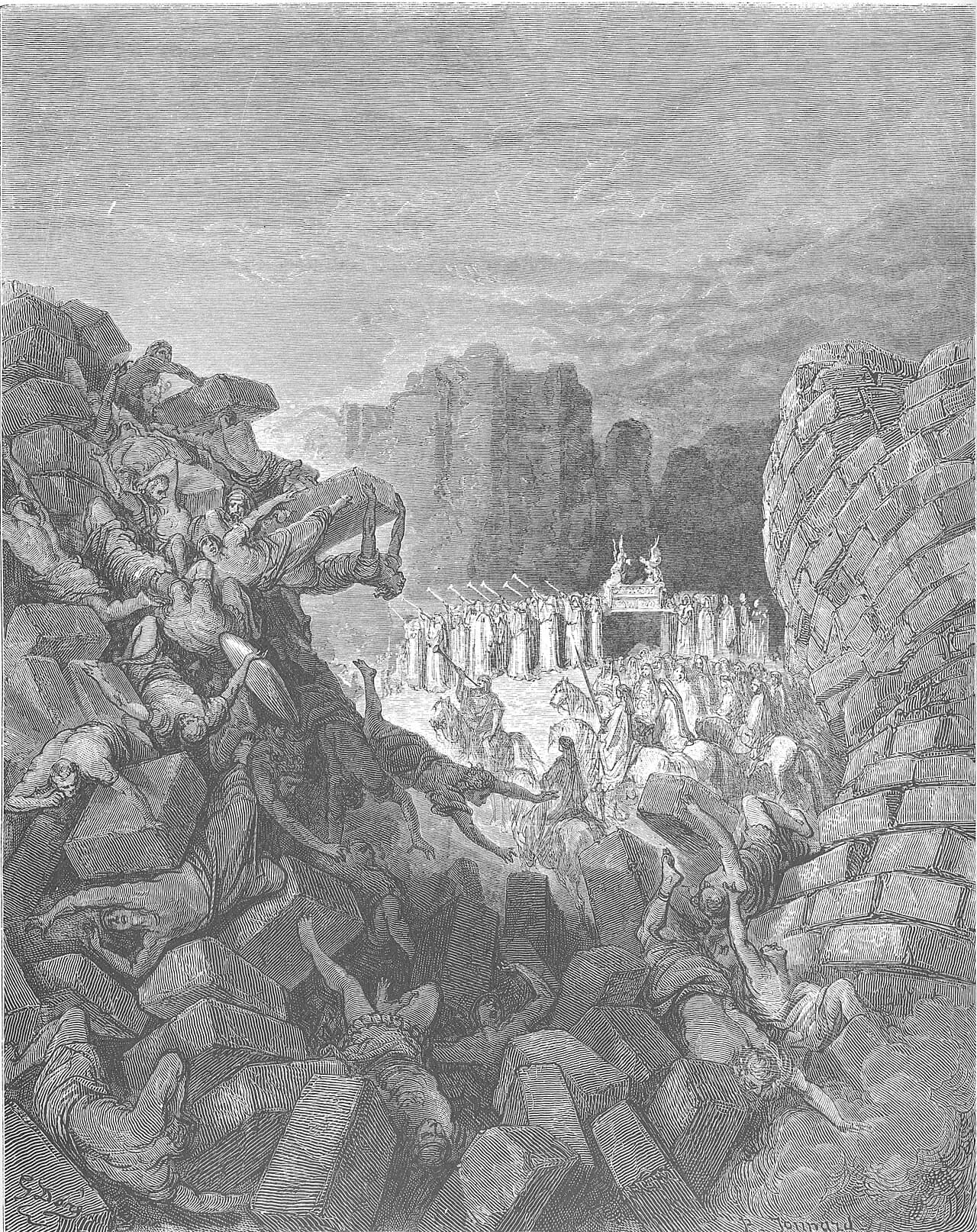
Gustave Doré, La Sainte Bible (Tours: Alfred Mame et fils, 1866). Public domain.
Summary
The city of palms whose walls fell flat at the seventh trumpet-circuit; Rahab's city, later rebuilt under a curse, and the road down from Jerusalem where the Samaritan proved neighbor.
- The first city Israel took inside Canaan, and it fell without a siege.
- Rahab of Jericho and her household lived, and Matthew names her in the line of Christ.
- Joshua cursed whoever would rebuild it, and 1 Kings 16:34 records the curse landing on Hiel.
- Elisha healed its poisoned spring, and Jesus walked through the city on his last road up to Jerusalem.
- The mound at Tell es-Sultan was walled and burned. The date of that burning is genuinely disputed.
On this page
In Scripture
- Verses
- 59
- Books
- 15
Near Jericho
- Gilgal7.1 km · 4.4 mi E
- Bethany beyond the Jordan11 km · 6.8 mi E
- Ephraim16 km · 10 mi NW
- Ai18 km · 11 mi W
- Bethany20 km · 13 mi SW
- Gibeah21 km · 13 mi W
Straight-line distances, computed from the gazetteer coordinates.
Where it is
the country around it
- Coordinates
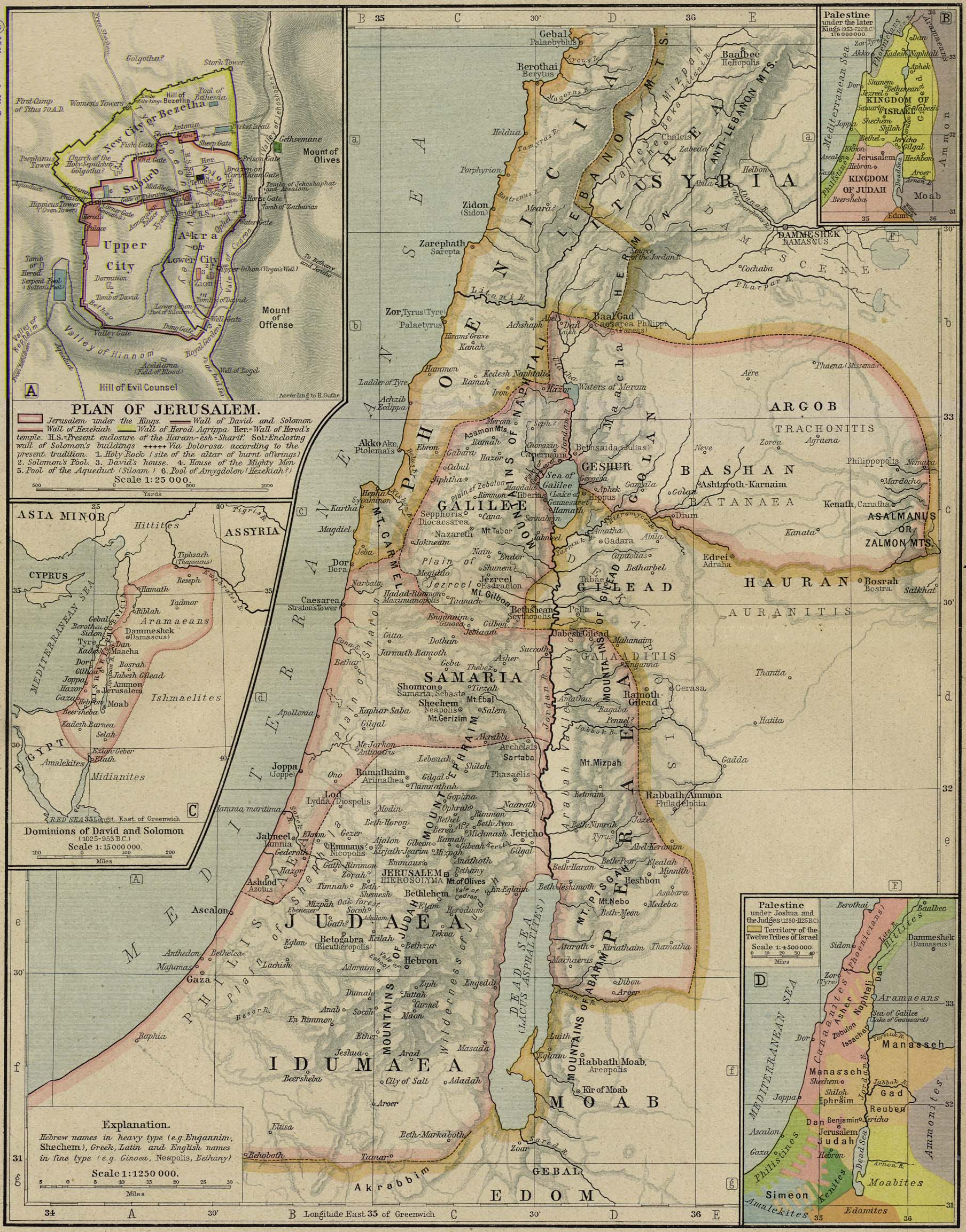
- 31.8706° N, 35.4439° Efind it on the Atlas →
- Region
- Jordan valley
- Kind of place
- City
1 place the record names with Jericho, the farthest 22 km away
- Located: the gazetteer fixes one site
- Placed: the point stands for an area, or is rounded
- ? Proposed: one candidate among several
- A dashed line ends at a place the gazetteer does not fix
Not located: Moab. The gazetteer records no location for it, so it is not marked.
Why Jericho matters
What has been found
the evidence, and where it is disputed
The fall of Jericho, outlined
Joshua 2 to 6, in the order it happens
Read Joshua 2 to 6, in the order it happens
- The spies, and the house of RahabJoshua 2:1Then Joshua son of Nun secretly sent two spies from Shittim, saying, “Go, inspect the land, especially Jericho.” So they went and entered the house of a prostitute named Rahab and stayed there.
- Rahab's confessionJoshua 2:11When we heard this, our hearts melted and everyone’s courage failed because of you, for the LORD your God is God in the heavens above and on the earth below.
- The scarlet cord in the windowJoshua 2:21“Let it be as you say,” she replied, and she sent them away. And when they had gone, she tied the scarlet cord in the window.
- The crossing, and the camp at GilgalJoshua 4:19On the tenth day of the first month the people went up from the Jordan and camped at Gilgal on the eastern border of Jericho.
- The Commander of the LORD's armyJoshua 5:14“Neither,” He replied. “I have now come as Commander of the LORD’s army.” Then Joshua fell facedown in reverence and asked Him, “What does my Lord have to say to His servant?”
- Six days, one silent circuit a dayJoshua 6:14So on the second day they marched around the city once and returned to the camp. They did this for six days.
- The seventh day, seven circuits, the shoutJoshua 6:20So when the rams’ horns sounded, the people shouted. When they heard the blast of the horn, the people gave a great shout, and the wall collapsed. Then all the people charged straight into the city and captured it.
- Rahab brought outJoshua 6:25And Joshua spared Rahab the prostitute, with her father’s household and all who belonged to her, because she hid the men Joshua had sent to spy out Jericho. So she has lived among the Israelites to this day.
- The curse on the rebuilderJoshua 6:26At that time Joshua invoked this solemn oath: “Cursed before the LORD is the man who rises up and rebuilds this city, Jericho; at the cost of his firstborn he will lay its foundations; at the cost of his youngest he will set up its gates.”
The curse of Joshua 6:26 is not the end of it. 1 Kings 16:34 reports it landing on Hiel of Bethel in Ahab's reign, and names the sons it cost him.
The Fall of Jericho: the full studyWhat happened here, in order
in the order the canon tells it
- Israel camps opposite JerichoNumbers 22:1Then the Israelites traveled on and camped in the plains of Moab near the Jordan, across from Jericho.
- Moses sees Jericho from Mount NeboDeuteronomy 34:1Then Moses went up from the plains of Moab to Mount Nebo, to the top of Pisgah, which faces Jericho. And the LORD showed him the whole land—from Gilead as far as Dan,
- Jericho named first in Benjamin's allotmentJoshua 18:22Jericho, Beth-hoglah, Emek-keziz, Beth-arabah, Zemaraim, Bethel,
- Eglon of Moab takes the City of PalmsJudges 3:13After enlisting the Ammonites and Amalekites to join forces with him, Eglon attacked and defeated Israel, taking possession of the City of Palms.
- David's humiliated envoys wait at Jericho2 Samuel 10:5When this was reported to David, he sent messengers to meet the men, since they had been thoroughly humiliated. The king told them, “Stay in Jericho until your beards have grown back, and then return.”
- Hiel rebuilds the city, and the curse lands1 Kings 16:34In Ahab’s days, Hiel the Bethelite rebuilt Jericho. At the cost of Abiram his firstborn he laid its foundation, and at the cost of Segub his youngest he set up its gates, according to the word that the LORD had spoken through Joshua son of Nun.
- Elijah and Elisha come to Jericho on Elijah's last day2 Kings 2:4And Elijah said to Elisha, “Please stay here, for the LORD has sent me on to Jericho.” But Elisha replied, “As surely as the LORD lives and as you yourself live, I will not leave you.” So they went to Jericho.
- The sons of the prophets ask Elisha2 Kings 2:5Then the sons of the prophets at Jericho came up to Elisha and said, “Do you know that the LORD will take your master away from you today?” “Yes, I know,” he replied. “Do not speak of it.”
- The city's water is called bad2 Kings 2:19Then the men of the city said to Elisha, “Please note, our lord, that the city’s location is good, as you can see. But the water is bad and the land is unfruitful.”
- Elisha heals the spring2 Kings 2:21and Elisha went out to the spring, cast the salt into it, and said, “This is what the LORD says: ‘I have healed this water. No longer will it cause death or unfruitfulness.’”
- Zedekiah overtaken in the plains of Jericho2 Kings 25:5but the army of the Chaldeans pursued the king and overtook him in the plains of Jericho, and all his army was separated from him.
- Captives clothed, fed and carried home to the City of Palms2 Chronicles 28:15Then the men who were designated by name arose, took charge of the captives, and provided from the plunder clothing for the naked. They clothed them, gave them sandals and food and drink, anointed their wounds, and put all the feeble on donkeys. So they brought them to Jericho, the City of Palms, to their brothers. Then they returned to Samaria.
- 345 men of Jericho return from exileEzra 2:34the men of Jericho, 345;
- The men of Jericho help rebuild Jerusalem's wallNehemiah 3:2The men of Jericho built next to Eliashib, and Zaccur son of Imri built next to them.
- The road down from Jerusalem to Jericho, in the parableLuke 10:30Jesus took up this question and said, “A man was going down from Jerusalem to Jericho when he fell into the hands of robbers. They stripped him, beat him, and went away, leaving him half dead.
- A blind beggar sitting by the roadLuke 18:35As Jesus drew near to Jericho, a blind man was sitting beside the road, begging.
- Bartimaeus calls out as Jesus leaves the cityMark 10:46Next, they came to Jericho. And as Jesus and His disciples were leaving Jericho with a large crowd, a blind beggar named Bartimaeus, the son of Timaeus, was sitting beside the road.
- Jesus enters JerichoLuke 19:1Then Jesus entered Jericho and was passing through.
- Zacchaeus called down out of the treeLuke 19:5When Jesus came to that place, He looked up and said, “Zacchaeus, hurry down, for I must stay at your house today.”
- The walls remembered as an act of faithHebrews 11:30By faith the walls of Jericho fell, after the people had marched around them for seven days.
- Rahab remembered for what her faith didJames 2:25In the same way, was not even Rahab the prostitute justified by her actions when she welcomed the spies and sent them off on another route?
Where it points
The voices
each quoted from the work named
EVERY little incident in a remarkable conversion like that of the harlot Rahab is worthy of notice. The Apostle James selected her as an illustration of the fact that faith is always attended by good works, and he asks, "Was she not justified by works when she had received the messengers?" while Paul quotes her as an instance of justification by faith, and says, "By faith the harlot Rahab perished not with them that believed not." If both these eminent Apostles found an illustration of an important Doctrine in her life, we may surely do the same.
Joshua adjured them at that time--that is, imposed upon his countrymen a solemn oath, binding on themselves as well as their posterity, that they would never rebuild that city. Its destruction was designed by God to be a permanent memorial of His abhorrence of idolatry and its attendant vices.
But as an example of free grace justifying men through an operative, as opposed to a mere verbal faith, none could be more suitable than a saved "harlot." As Abraham was an instance of an illustrious man and the father of the Jews, so Rahab is quoted as a woman, and one of abandoned character, and a Gentile, showing that justifying faith has been manifested in those of every class.
1 more teacher on these versesJohn Calvin
Zaccheus, make haste, and come down. It is a remarkable instance of favor, that the Lord anticipates Zaccheus, and does not wait for his invitation, but of his own accord asks lodging at his house.
Jericho in Scripture
59 verses name it, in 15 books
Open a book to read its mentions here. Text: Berean Standard Bible.
Old TestamentNew Testamentsegment width = share of mentions
Old Testament11 books · 53 mentions
Numbers9 mentions
- Numbers 22:1Then the Israelites traveled on and camped in the plains of Moab near the Jordan, across from Jericho.
- Numbers 26:3So on the plains of Moab by the Jordan, across from Jericho, Moses and Eleazar the priest issued the instruction,
- Numbers 26:63These were the ones numbered by Moses and Eleazar the priest when they counted the Israelites on the plains of Moab by the Jordan, across from Jericho.
- Numbers 31:12They brought the captives, spoils, and plunder to Moses, to Eleazar the priest, and to the congregation of Israel at the camp on the plains of Moab, by the Jordan across from Jericho.
- Numbers 33:48They set out from the mountains of Abarim and camped on the plains of Moab by the Jordan across from Jericho.
- Numbers 33:50On the plains of Moab by the Jordan across from Jericho, the LORD said to Moses,
- Numbers 34:15These two and a half tribes have received their inheritance across the Jordan from Jericho, toward the sunrise.”
- Numbers 35:1Again the LORD spoke to Moses on the plains of Moab by the Jordan across from Jericho:
1 further mention in Numbers, read them in the book.
Deuteronomy3 mentions
- Deuteronomy 32:49“Go up into the Abarim Range to Mount Nebo, in the land of Moab across from Jericho, and view the land of Canaan, which I am giving to the Israelites as their own possession.
- Deuteronomy 34:1Then Moses went up from the plains of Moab to Mount Nebo, to the top of Pisgah, which faces Jericho. And the LORD showed him the whole land—from Gilead as far as Dan,
- Deuteronomy 34:3the Negev, and the region from the Valley of Jericho (the City of Palms) all the way to Zoar.
Joshua26 mentions
- Joshua 2:1Then Joshua son of Nun secretly sent two spies from Shittim, saying, “Go, inspect the land, especially Jericho.” So they went and entered the house of a prostitute named Rahab and stayed there.
- Joshua 2:2And it was reported to the king of Jericho: “Behold, some men of Israel have come here tonight to spy out the land.”
- Joshua 2:3So the king of Jericho sent to Rahab and said, “Bring out the men who came to you and entered your house, for they have come to spy out the whole land.”
- Joshua 3:16the flowing water stood still. It backed up as far upstream as Adam, a city in the area of Zarethan, while the water flowing toward the Sea of the Arabah (the Salt Sea) was completely cut off. So the people crossed over opposite Jericho.
- Joshua 4:13About 40,000 troops armed for battle crossed over before the LORD into the plains of Jericho.
- Joshua 4:19On the tenth day of the first month the people went up from the Jordan and camped at Gilgal on the eastern border of Jericho.
- Joshua 5:10On the evening of the fourteenth day of the month, while the Israelites were camped at Gilgal on the plains of Jericho, they kept the Passover.
- Joshua 5:13Now when Joshua was near Jericho, he looked up and saw a man standing in front of him with a drawn sword in His hand. Joshua approached Him and asked, “Are You for us or for our enemies?”
18 further mentions in Joshua, read them in the book.
2 Samuel1 mention
1 Kings1 mention
2 Kings5 mentions
- 2 Kings 2:4And Elijah said to Elisha, “Please stay here, for the LORD has sent me on to Jericho.” But Elisha replied, “As surely as the LORD lives and as you yourself live, I will not leave you.” So they went to Jericho.
- 2 Kings 2:5Then the sons of the prophets at Jericho came up to Elisha and said, “Do you know that the LORD will take your master away from you today?” “Yes, I know,” he replied. “Do not speak of it.”
- 2 Kings 2:15When the sons of the prophets who were facing him from Jericho saw what had happened, they said, “The spirit of Elijah rests on Elisha.” And they went to meet him and bowed down to the ground before him.
- 2 Kings 2:18When they returned to Elisha, who was staying in Jericho, he said to them, “Didn’t I tell you not to go?”
- 2 Kings 25:5but the army of the Chaldeans pursued the king and overtook him in the plains of Jericho, and all his army was separated from him.
1 Chronicles2 mentions
- 1 Chronicles 6:78From the tribe of Reuben east of the Jordan opposite Jericho they were given Bezer in the wilderness, Jahzah,
- 1 Chronicles 19:5When someone came and told David about his men, he sent messengers to meet them, since the men had been thoroughly humiliated. The king told them, “Stay in Jericho until your beards have grown back, and then return.”
2 Chronicles1 mention
Ezra1 mention
Nehemiah2 mentions
Jeremiah2 mentions
- Jeremiah 39:5But the army of the Chaldeans pursued them and overtook Zedekiah in the plains of Jericho. They seized him and brought him up to Nebuchadnezzar king of Babylon at Riblah in the land of Hamath, where he pronounced judgment on him.
- Jeremiah 52:8but the army of the Chaldeans pursued the king and overtook Zedekiah in the plains of Jericho, and all his army was separated from him.
New Testament4 books · 6 mentions
Matthew1 mention
Mark1 mention
Luke3 mentions
- Luke 10:30Jesus took up this question and said, “A man was going down from Jerusalem to Jericho when he fell into the hands of robbers. They stripped him, beat him, and went away, leaving him half dead.
- Luke 18:35As Jesus drew near to Jericho, a blind man was sitting beside the road, begging.
- Luke 19:1Then Jesus entered Jericho and was passing through.
The account
Read the account as one telling
- About 8000 BC
About 8000 BC, the first known settlers came to this spring and built the tower and wall that make Jericho one of the oldest walled sites yet found anywhere. What the oldest city claim can honestly support is set out further up this page.
By the time Israel reached the Jordan, Jericho was a walled Canaanite city guarding the road into the hill country, the first city inside Canaan that Joshua's forces would have to take. That city's fall, the spies, the six silent days and the shout that brought the wall down, is the story told above.
After the conquest, Jericho was counted among the cities of the tribe of Benjamin, named first in the list at Joshua 18:22. A very different era followed a generation later, when Eglon of Moab, joined by Ammon and Amalek, took the City of Palms and held it until Ehud killed him, as Judges 3:13 records.
- ninth century BC
In the ninth century BC, a company of prophets lived at Jericho under Elisha. 2 Kings 2:5 calls them the sons of the prophets, and 2 Kings 2:19 records the men of the city telling him that its water was bad and its land unfruitful. Elisha healed the spring by casting salt into it, and that spring, Ain es-Sultan, is still called Elisha's spring today, the reason a city exists at all in this stretch of the Jordan valley.
- 586 BC
In 586 BC, Judah's last king, Zedekiah, fled Jerusalem as the Babylonians broke through its wall, and the Chaldean army overtook him in the plains of Jericho, 2 Kings 25:5, the same plains where Israel had first camped opposite the city under Joshua.
When the exiles returned from Babylon, 345 men of Jericho were counted among them, Ezra 2:34, and some of them went on to rebuild a stretch of the wall of Jerusalem, Nehemiah 3:2. The city that had once fallen to Israel's trumpets now sent its own men to raise a different city's wall.
By the Hasmonean and then the Herodian periods, the city itself had moved. New Testament Jericho grew about two kilometres from the old mound, where Ehud Netzer excavated a winter palace complex built first by the Hasmoneans and then rebuilt on a grand scale by Herod the Great. Herod wintered there and died at Jericho, and Josephus records his body carried from the city to Herodium for burial, in the Antiquities of the Jews, Book 17, and the Jewish War, Book 1.
A third site, modern Jericho, Arabic er-Riha, stands beside the tell today, so three places carry the name in sequence: the mound Joshua's Israel faced, the Roman-era town of Zacchaeus and Bartimaeus two kilometres off, and the modern city beside the ruin of the first. Jesus walked through that New Testament town on his last road to Jerusalem, an event this page tells more of below.
Common questions
Did the walls of Jericho really fall? What has archaeology found?
Readers differ; the positions are named
Tell es-Sultan was walled, it was burned, and mudbrick from its wall lies collapsed outward at the foot of the stone revetment, with grain stores found full and carbonised. What is disputed is the date of that layer. Kathleen Kenyon dated it to about 1550 BC and concluded there was no city left for Joshua to take, which is still the majority reading; Bryant Wood re-read the same pottery in 1990 and argued for about 1400 BC, and Piotr Bienkowski answered him in the same journal that year.
The evidence and the names are set out in full further up this page.
Why did Israel march in silence for six days?
The instruction came from the Commander of the LORD's army, whom Joshua met with a drawn sword before the siege began, and who told Joshua to take off his sandals. The march was one circuit a day for six days, silent except for the horns, and only on the seventh day did they circle seven times and shout. Hebrews credits the fall to faith rather than to any tactic.
Why was everything in the city destroyed? What is cherem?
Cherem is the Hebrew word for something given over to God irrevocably, either destroyed or handed to the sanctuary. At Jericho the living things fell under the ban while the silver, gold, bronze and iron went into the treasury of the LORD's house.
Genesis 15:16 frames the conquest as judgment long delayed, and the same law warns Israel that the same standard applies to Israel. The full range of readings on the ethics of the conquest is set out on the Joshua study.
Was Rahab's lie a sin? Why is she praised in Hebrews and James?
Readers differ; the positions are named
Scripture never comments on the lie. What it praises is what she believed and what she did with it: she confessed the LORD as God of heaven above and earth below before any army had crossed the Jordan, and she hid the spies.
Hebrews names her faith and James names her works, and both point at the same act. Readers have long disagreed about the lie itself, and the text leaves that question where it found it.
What was the curse on Jericho, and did it come true?
Joshua swore that whoever rebuilt Jericho would lay its foundation at the cost of his firstborn and set up its gates at the cost of his youngest. Centuries later, in Ahab's reign, Hiel of Bethel rebuilt the city and lost Abiram and Segub. The record says plainly that this happened according to the word the LORD had spoken through Joshua.
Why was Jesus in Jericho, and who did He meet there?
Jericho stood on the road up from the Jordan valley to Jerusalem, and Jesus passed through it on his way up to the city for the last time. Herod had rebuilt Jericho as a wealthy winter town on the profits of its balsam and date-palm groves, and that is why a chief tax collector, architelones in the Greek text, a title for someone who oversaw other collectors rather than working one toll booth, was stationed there. Jesus called that man, Zacchaeus, down out of a tree and told him that salvation had come to his house that day, and he also healed a blind beggar sitting by the road. The same road is the setting of the parable of the good Samaritan.
Why does Matthew say Jesus healed the blind men as He was leaving Jericho, while Luke says it happened as He was approaching?
Readers differ; the positions are named
Matthew says the healing happened as they were leaving Jericho, and Mark places it the same way, as Jesus and His disciples were leaving the city with a large crowd, naming one of the men Bartimaeus. Luke says the healing of a blind man happened as Jesus drew near to Jericho.
Readers have proposed more than one explanation: that Jericho named two real places by then, so a traveler could be leaving the old site and approaching the new one on the same stretch of road; that Luke arranges his material by topic rather than by strict sequence; or that two separate healings took place. No single reading has settled the question, and this page names the positions rather than choosing between them.
Is Jericho really the oldest city in the world?
Kathleen Kenyon's excavations at Tell es-Sultan found a Pre-Pottery Neolithic settlement with a stone tower and a town wall dated to around 8000 BC, among the earliest walled settlements yet found anywhere. The word oldest still needs care: the mound shows real gaps in occupation across its long history, so a continuously inhabited city from that tower to today overstates the evidence.
Among the oldest walled settlements known is the honest form of the claim, and the full case for it is set out further up this page.
Why is Jericho called the City of Palms?
Scripture uses that name more than once. Moses is shown the Valley of Jericho, the City of Palms, from Mount Nebo; Eglon of Moab takes the City of Palms; and captives are carried to Jericho, the City of Palms.
The name reflects the oasis the spring made possible. Josephus praises the city's palm groves and its balsam, the same balsam Mark Antony gave to Cleopatra according to his Antiquities, Book 15.
Notable art
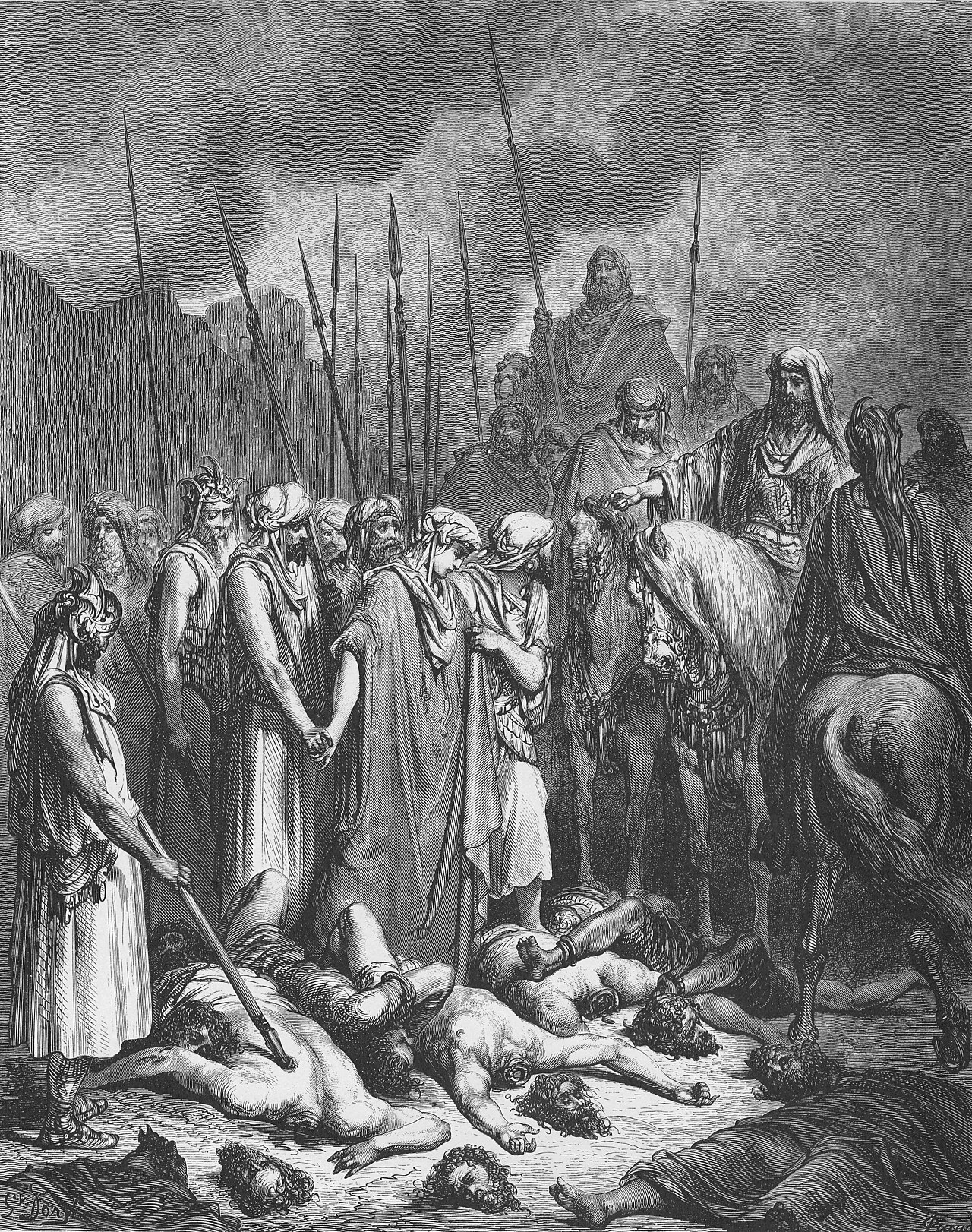
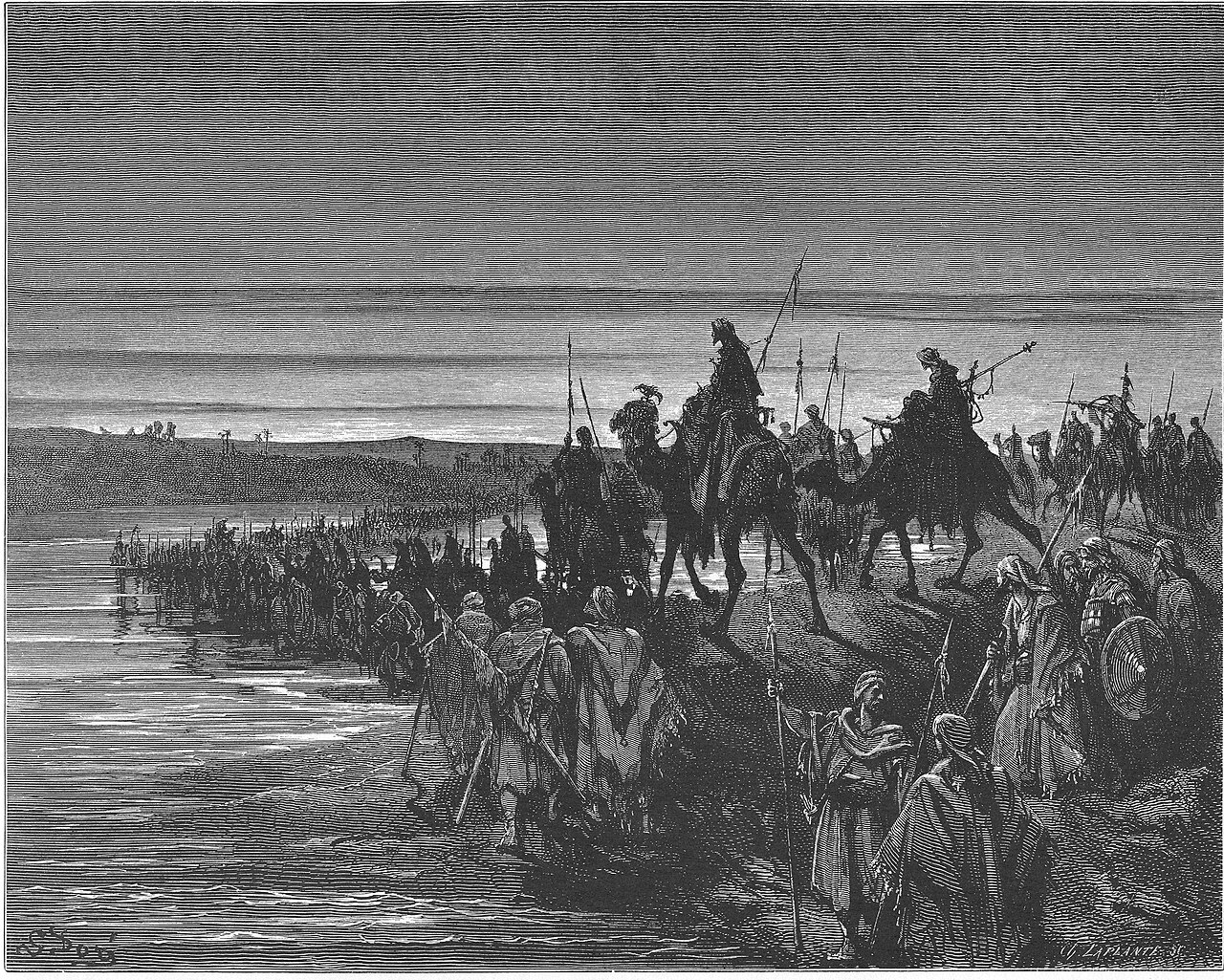
2 verified pieces depicting Jericho
Sources cited
- OpenBible.info Bible Geocoding: Jerichoread 2026-08-20The coordinates on this page. Used under CC-BY with attribution to OpenBible.info.
- Gustave Doré, La Sainte Bible (Tours: Alfred Mame et fils, 1866)The engravings on this page. Public domain.
- Kathleen M. Kenyon, Digging Up Jericho (1957)The excavation report behind the later dating, cited for the position it argues.
- Bryant G. Wood, "Did the Israelites Conquer Jericho?", Biblical Archaeology Review 16:2 (1990)The conservative re-dating of the destruction layer.
- Piotr Bienkowski, reply on the dating of Jericho, Biblical Archaeology Review 16:5 (1990)The answer to Wood, in the same journal.
- Charles H. Spurgeon, The Metropolitan Tabernacle Pulpit, Sermon No. 795Public domain, CCEL edition.
- Charles H. Spurgeon, The Metropolitan Tabernacle Pulpit, Sermon No. 3168Public domain, CCEL edition.
- John Calvin, CommentariesPublic domain, CCEL edition.
- Jamieson, Fausset & Brown, Commentary Critical and Explanatory on the Whole Bible (1871)Public domain.
- Ehud Netzer, Hasmonean and Herodian Palaces at Jericho (Israel Exploration Society, final reports, 2001-2013)The excavation of New Testament Jericho and the Hasmonean and Herodian winter palace complex.
- Flavius Josephus, Antiquities of the Jews, Book 15 and Book 17Cited at book level for Jericho's balsam and palm revenue and for Herod's death and funeral procession to Herodium.
Keep studying
On this page
Studies39
- The fall of Jericho, outlined
- Achan
- Baal of Peor
- Deuteronomy: the Study Guide
- Ehud and the Deliverance from Moab
- Gilgal
Show the next 6 titles
Show the next 6 titles
- Joshua: the Study Guide
- Joshua son of Nun
- Matthew, the Study Guide
- Rahab and the Scarlet Cord
- Ruth
- The Scarlet Thread
Show the next 6 titles
- The Canaanite Conquest
- The Crossing of the Jordan
- The death of Moses
- The devoted thing (herem)
- The Floating Axe Head: 2 Kings 6
- The land Israel did not take
Show the next 6 titles
Every page that names it1
Books that name it5
Doorway2
Keep this page