

Genesis 24 to 31 · Person · Featured Study
Laban
Genesis gives him one scene at his sister's betrothal in chapter 24 and follows him through Jacob's twenty years of service in chapters 29 to 31.
Laban ran out to greet Abraham's servant once he had seen the gold on his sister's wrists.
- The name means
- the Hebrew word laban means white (lexicon h3836)
- Family
- father: Bethuel; sister: Rebekah; daughters: Leah and Rachel; son-in-law and nephew: Jacob
- Places
- Haran, Paddan-aram
- First named
- Genesis 24:29 “…Rebekah had a brother named Laban, and he…”
- Last named
- Genesis 46:25 “…Jacob born to Bilhah, whom Laban gave to…”
Hendrick ter Brugghen, Jacob Reproaching Laban, 1627. Public domain.
Summary
Laban was the son of Bethuel, the brother of Rebekah and the father of Leah and Rachel.
- He agreed that his sister Rebekah should marry Isaac.
- He gave Jacob Leah first, though Jacob had worked for Rachel.
- Jacob worked for him twenty years, and he changed Jacob's pay ten times.
- He chased Jacob to Gilead, where the two men made a pact.
Where Laban Stands in Scripture
His first verse at the spring in Genesis 24 and his last in the list of Jacob's household in Genesis 46
The name Laban stands in 55 verses of the Berean text, and 54 of them are in Genesis. The one in Deuteronomy 1:1 is a place in the wilderness that shares the name.
Now Rebekah had a brother named Laban, and he rushed out to the man at the spring.The verse names Laban first as Rebekah's brother, the tie that later brings Jacob to his door.
These are the sons of Jacob born to Bilhah, whom Laban gave to his daughter Rachel—seven in all.Laban's name stands for the last time beside the maid he gave Rachel, whose sons went down to Egypt with Jacob.
Laban in Ten Turns
From the spring outside Nahor's town to the mound of witness in Gilead
Laban's story runs through two households, his sister's and his son-in-law's.
- Runs out to Abraham's servant at the springbefore Jacob cameGenesis 24:29
- Agrees with Bethuel that the match is from the LORDbefore Jacob cameGenesis 24:50
- Runs to meet his sister's son Jacob0Genesis 29:13
- Promises Rachel for seven years of workthe first monthGenesis 29:19
- Gives Leah at night in Rachel's place7Genesis 29:23
- Gives Jacob his second wife after the wedding week7Genesis 29:28
- Credits his wealth to Jacob's presence14Genesis 30:27
- Agrees to pay Jacob in speckled and spotted animals14Genesis 30:34
- Overtakes Jacob after a seven-day pursuit20Genesis 31:23
- Makes a covenant with Jacob at the mound and goes home20Genesis 31:44
Ten turns in the order Genesis tells them, each with its verse. The count of years comes from Jacob's own words in Genesis 31:41.
Credits his wealth to Jacob's presence, Agrees to pay Jacob in speckled and spotted animals, Overtakes Jacob after a seven-day pursuit, Makes a covenant with Jacob at the mound and goes home
His Story in Genesis
Genesis 24, then Genesis 29 to 31
When Abraham's servant came to Nahor's town to find a wife for Isaac, Laban brought him into the house and had straw and feed brought for his camels.
Laban and Bethuel answered, “This is from the LORD; we have no choice in the matter.Laban and his father give their consent in words that name the LORD.
Rebekah later sent her son Jacob to her brother, because Esau was planning to kill him. Laban welcomed him as his own flesh and blood, and after a month he asked Jacob to name his wages. Jacob offered seven years of work for Rachel, the younger daughter.
When morning came, there was Leah! “What have you done to me?” Jacob said to Laban. “Wasn’t it for Rachel that I served you? Why have you deceived me?”The morning after the feast, Jacob, who had deceived his own father, finds that he has been deceived.
Laban answered that his people did not give the younger daughter in marriage before the older, and he gave Rachel at the end of the wedding week for seven more years of work. When Jacob asked to go home, Laban said he had learned by divination that the LORD blessed him because of Jacob, and he asked him to stay for wages.
The flight and the pursuitGenesis 31:1 to 42
Jacob heard Laban's sons complain that he had grown rich at their father's expense, and he saw that Laban's attitude toward him had changed. While Laban was away shearing his sheep, Jacob left with his family and flocks, and Rachel took her father's household idols.
But that night God came to Laban the Aramean in a dream and warned him, “Be careful not to say anything to Jacob, either good or bad.”God's warning in the dream holds Laban back when he overtakes Jacob in Gilead.
Laban searched the tents for his gods and did not find them, because Rachel sat on them in her camel's saddle. Jacob then set out his twenty years of service: fourteen for the two daughters, six for the flocks, and his wages changed ten times.
The mound of witnessGenesis 31:43 to 55
But Laban answered Jacob, “These daughters are my daughters, these sons are my sons, and these flocks are my flocks! Everything you see is mine! Yet what can I do today about these daughters of mine or the children they have borne?Laban still claims everything Jacob has as his own, and then proposes a covenant.
Jacob set up a stone pillar, and the two households piled a mound of stones and ate beside it. Laban called on the God of Abraham and the God of Nahor to judge between them, and Jacob swore by the Fear of his father Isaac. Each man promised not to pass the mound to harm the other.
His World
The house of Nahor in Aram, its language and its household gods
Laban lived at Haran in Aram-naharaim, which Genesis also calls Paddan-aram, and Genesis 24 calls the place the town of Nahor, Abraham's brother. Genesis calls Laban the Aramean. His household kept idols that Rachel carried off, and The Teraphim sets out what such household gods were.
Laban called it Jegar-sahadutha, and Jacob called it Galeed.Laban's name for the heap is Aramaic and Jacob's is Hebrew, and the lexicon reads both as a cairn east of the Jordan.
The Family of Laban
His grandparents, his father, his sister, his daughters, their maids, his sons and his grandchildren
Laban's line ran from Abraham's brother Nahor to the mothers of Israel's tribes.
| Person | Tie to Laban | Verse |
|---|---|---|
| Nahor and Milcah | His grandparents; Nahor was Abraham's brother. | Genesis 24:24 |
| Bethuel | His father, whom Genesis calls the Aramean. | Genesis 28:5 |
| Rebekah | His sister, wife of Isaac and mother of Jacob and Esau. | Genesis 24:29 |
| Leah | His elder daughter, given to Jacob first. | Genesis 29:16 |
| Rachel | His younger daughter, for whom Jacob served. | Genesis 29:18 |
| Zilpah | His servant girl, given to Leah. | Genesis 29:24 |
| Bilhah | His servant girl, given to Rachel. | Genesis 29:29 |
| His sons | Unnamed; they kept his separate flocks. | Genesis 30:35 |
| Jacob's children | His grandchildren, whom he kissed and blessed at parting. | Genesis 31:55 |
Bilhah, His sons, Jacob's children
The Places of His Life
Haran, Gilead and Mizpah, each with its verse
Laban's pursuit crossed the Euphrates and ended at the mound of Mizpah in Gilead.
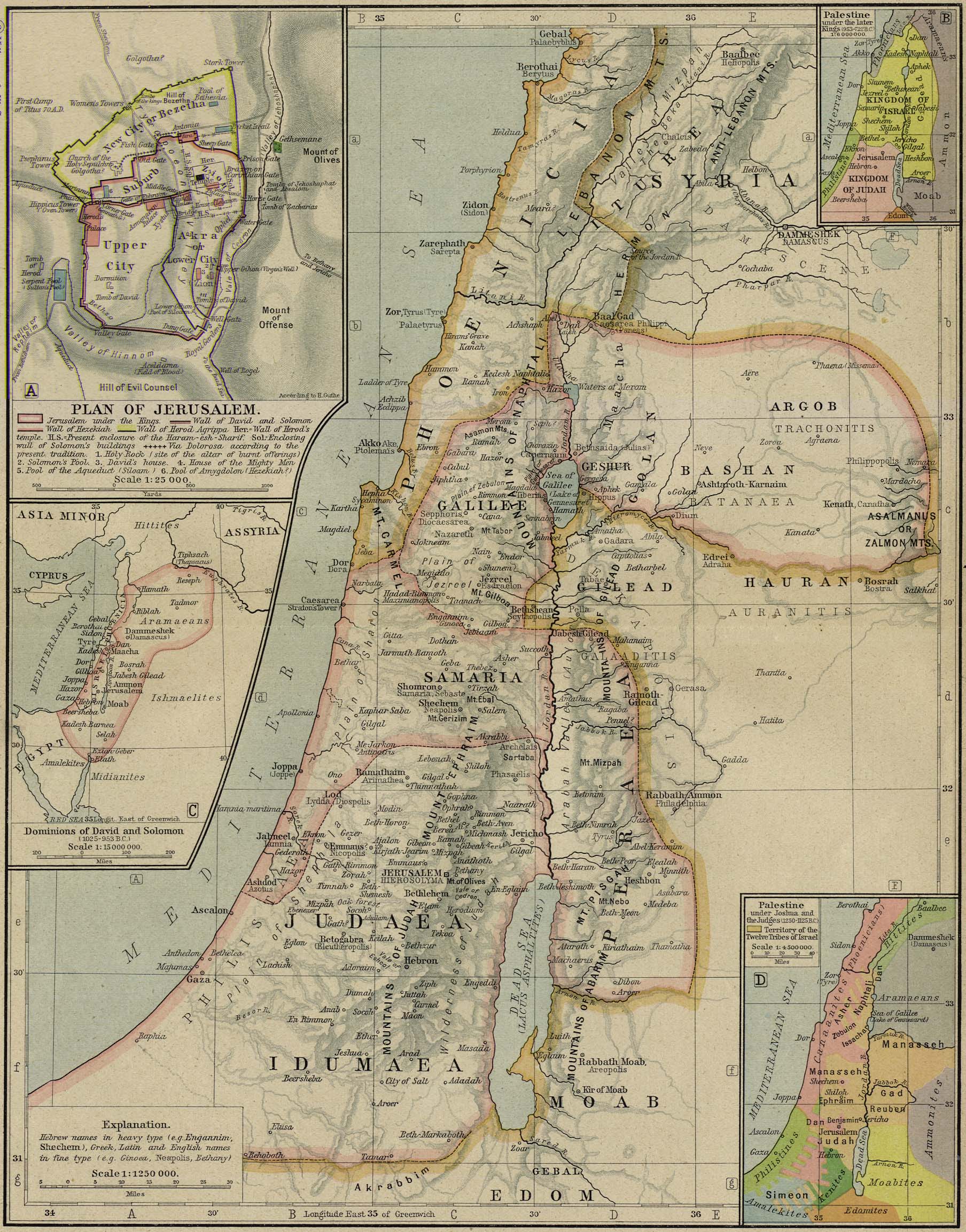
about 50 km (31 miles)
Beyond this plate: Haran (1); the route enters from the edge.
- Probable: a region OpenBible scores 500 to 799
- Proposed: a site OpenBible scores under 500 of 1,000
- The route, in the order the text gives
- 1Haran, Jacob served him here for twenty years. Genesis 31:41
- 2The hill country of Gilead, Laban overtook Jacob after seven days. Genesis 31:23
- 3?Mizpah, Galeed, The two men raised the mound and parted. Genesis 31:49
Base map: Reference map of ancient Palestine, Rand McNally reference map (1926), public domain. Places with a place page stand at its coordinates and the others at the point cited for each, set on the plate by Jerusalem and Damascus, as the plate prints them.
Three stations of the pursuit in the order Genesis gives them. Gilead is marked at the region OpenBible gives, and Mizpah at the site it scores highest, a proposal.
Where Scripture Stops
Three things Genesis leaves unsaid about him
Who was his wife?never named
Did he recover his gods?Genesis 31:34 to 35; 35:2 to 4
Later Jacob told his household to put away its foreign gods and buried them under the oak near Shechem, and Genesis does not say whether Rachel's idols were among them.
When did he die?not recorded
Genesis leaves Laban on his way home from Gilead and records no death or burial.
Where He Points
Hosea looks back to Jacob's service, and Matthew to a son born in Laban's house
Jacob fled to the land of Aram and Israel worked for a wife—for a wife he tended sheep.The prophets never name Laban, and Hosea recalls his household only as the place where Jacob tended sheep for a wife.
Abraham was the father of Isaac, Isaac the father of Jacob, and Jacob the father of Judah and his brothers.Leah bore Judah in Laban's household, and Matthew names him after Jacob in the line of the Messiah.
Voices on Laban
Four comments on his welcome, his custom, his bargain with Jacob and his wealth, from Matthew Henry to Jamieson, Fausset and Brown.
1662 to 1714 · Matthew Henry
Commentary on the Whole Bible
Laban's welcome to the servant
The quotation1 quotation
“‘O,’ thinks Laban, ‘here is a man that there is something to be got by, a man that is rich and generous; we will be sure to bid him welcome!’”
Matthew Henry · Commentary on the Whole Bible · on Genesis 24:30Puritan
1662 to 1714 · Matthew Henry
Commentary on the Whole Bible
A custom Laban invented
The quotation1 quotation
“We have reason to think there was no such custom of his country as he pretends; only he banters Jacob with it, and laughs at his mistake. Note, Those that can do wickedly and then think to turn it off with a jest, though they may deceive themselves and others, will find at last that God is not mocked.”
Matthew Henry · Commentary on the Whole Bible · on Genesis 29:26Puritan
1703 to 1791 · John Wesley
Explanatory Notes upon the Old Testament
Laban agrees to Jacob's bargain
The quotation1 quotation
“Laban was willing to consent to this bargain, because he thought if those few he had that were now speckled and spotted were separated from the rest, which was to be done immediately, the body of the flock which Jacob was to tend, being of one colour, either all black or all white, would produce few or none of mixt colours, and so he should have Jacob's service for nothing, or next to nothing.”
John Wesley · Explanatory Notes upon the Old Testament · on Genesis 30:34Evangelical
1802 to 1910 · Jamieson, Fausset & Brown
Commentary Critical and Explanatory on the Whole Bible
A blessing Laban could see
The quotation1 quotation
“This was a remarkable testimony that good men are blessings to the places where they reside. Men of the world are often blessed with temporal benefits on account of their pious relatives, though they have not always, like Laban, the wisdom to discern, or the grace to acknowledge it.”
Jamieson, Fausset & Brown · Commentary Critical and Explanatory on the Whole Bible · on Genesis 30:27Reformed
John Wesley, Jamieson, Fausset & Brown
Who Is the Aramean of Deuteronomy 26:5?
The words Israel spoke over its firstfruits read two ways, and one of them names Laban
and you are to declare before the LORD your God, “My father was a wandering Aramean, and he went down to Egypt few in number and lived there and became a great nation, mighty and numerous.Both readings turn on the verb of the first clause and on whom they take the Aramean to be.
Jacob, the wandering ArameanMatthew Henry, 1710; Albert Barnes; the Berean Standard Bible
Matthew Henry reads the Aramean as Jacob, called a Syrian because he lived twenty years in Paddan-aram and his wives and nearly all his children came from there. Albert Barnes, in his Notes, says the context shows the reference is to Jacob, in whom Abraham's family began to grow into a nation. The Berean text translates the line in this sense.
The objection: the Hebrew verb can mean to destroy, and the Targum of Onkelos takes it so.
Laban, who sought to destroy my fatherRashi, after Sifrei Devarim 301 and Onkelos; the Passover Haggadah
Rashi reads the line as an Aramean destroyed my father, and explains that Laban wished to exterminate the whole nation when he pursued Jacob, so that God counted his intent as a deed. He cites Sifrei Devarim and Onkelos, and he notes that the Haggadah for Passover reads it the same way.
The objection: Jacob, the father who went down to Egypt in the next clause, is the subject of the whole sentence, and Laban never went to Egypt.
Books to Read Next
One work is free to read online
Rashi on Deuteronomy
Rashi, translated by M. Rosenbaum and A. M. Silbermann · 1929 to 1934
Rashi gives the reading of Deuteronomy 26:5 that names Laban, with its sources.
Read at SefariaThe LORD Watched
At Bethel God promised Jacob that He would watch over him and bring him home, and in Laban's house He kept that word through twenty years of changed wages.
The story asks its reader to trust the God who saw Jacob's affliction and the toil of his hands, the God whose promise to Jacob ran on to Christ.
Sources
Scripture is the Berean Standard Bible.
- Strong's Hebrew dictionary, h3836, h3837, h1567 and h3026.
- Rashi on Deuteronomy 26:5, citing Sifrei Devarim 301:3 and Onkelos, in the Pentateuch with Rashi's commentary by M. Rosenbaum and A. M. Silbermann, 1929 to 1934, public domain.
- Matthew Henry, Commentary on the Whole Bible, 1710, on Genesis 24:30, Genesis 29:26 and Deuteronomy 26:5.
- John Wesley, Explanatory Notes upon the Old Testament, 1765, on Genesis 30:34.
- Jamieson, Fausset and Brown, Commentary Critical and Explanatory on the Whole Bible, 1871, on Genesis 30:27.
- Albert Barnes, Notes, Explanatory and Practical, on Deuteronomy 26:5.
- OpenBible.info, Bible Geocoding Data, ancient.jsonl, CC BY.
Keep Studying
Read it5
People and groups5