

Rembrandt van Rijn, Moses with the Ten Commandments (1659), Gemäldegalerie, Berlin. Public domain.
Summary
Moses was born a slave under a death sentence. He grew up in the house of the king who gave it. God sent him back to Egypt at eighty to lead Israel out.
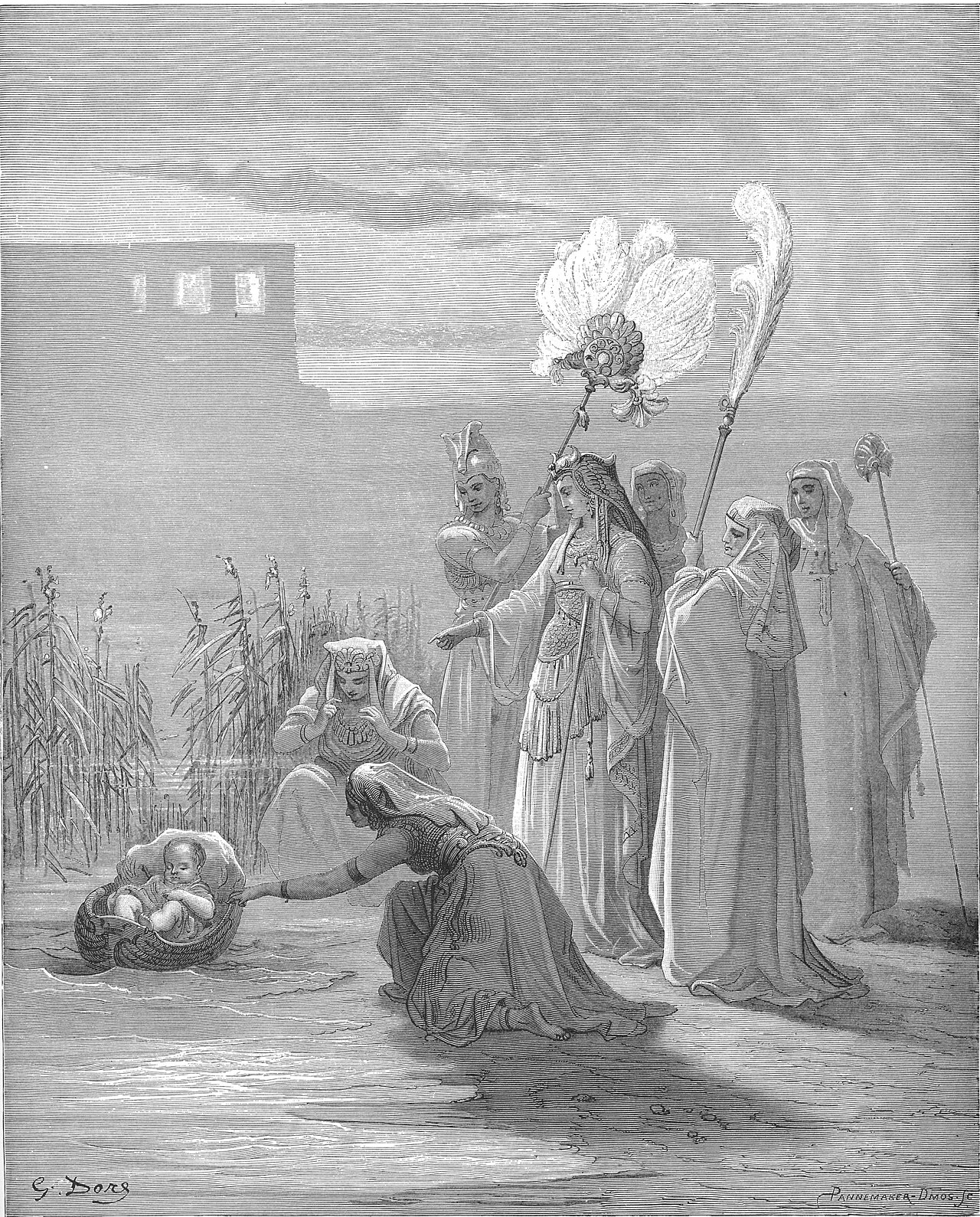
- Pharaoh's daughter took him out of the Nile. She named him for it.Exodus 2:10“I drew him out of the water
- God called him from a bush that burned and was not spent.Exodus 3:2but it was not consumed
- He led Israel out of Egypt and through the sea to Sinai.Exodus 14:21So the waters were divided
- God told him to speak to a rock. He hit it, and it cost him the land.Numbers 20:12you will not bring this assembly into the land that I have given them
- He died outside the land. Luke puts him in it later, with Jesus.Luke 9:31They appeared in glory and spoke about His departure
The four verses he stands on
Scripture says four things about Moses that it says about nobody else. Read these and the rest of the page follows.
The name God answers him with, at the bush.
Exodus 3:14God said to Moses, “I AM WHO I AM. This is what you are to say to the Israelites: ‘I AM has sent me to you.’”
How the LORD spoke with him.
Exodus 33:11Thus the LORD would speak to Moses face to face, as a man speaks to his friend. Then Moses would return to the camp, but his young assistant Joshua son of Nun would not leave the tent.
What the book says he was like.
Numbers 12:3Now Moses was a very humble man, more so than any man on the face of the earth.
What Israel said of him after he died.
Deuteronomy 34:10Since that time, no prophet has risen in Israel like Moses, whom the LORD knew face to face—
The family the text names around him
- Tribe
- Levi
- Father and mother
- Amram and Jochebed
- Brother and sister
- Aaron, who spoke for him, and Miriam, who watched the basket
- Wife
- Zipporah, a daughter of Jethro the priest of Midian
- Sons
- Gershom and Eliezer
- Successor
- Joshua son of Nun, appointed over Israel before Moses died
Exodus 6:20And Amram married his father’s sister Jochebed
The life, turn by turn
Moses lived a hundred and twenty years in three stretches of forty, and every turn in the life falls in the third.
Thirteen turns, and the verse each one rests on
- Egypt3 turns
The first forty years, in the house of the king who had ordered him drowned.
- 1Hidden in a basket in the reedsExodus 2:3she got him a papyrus basket and coated it with tar and…
- 2Raised and schooled in Pharaoh's houseActs 7:22So Moses was educated in all the wisdom of the Egyptians and…
- 3He kills an Egyptian and hides the bodyExodus 2:12he struck down the Egyptian and hid his body in the sand
- Midian3 turns
The second forty years, keeping another man's sheep in another country.
- 4He runs, and settles by a wellExodus 2:15But Moses fled from Pharaoh and settled in the land of Midian
- 5He marries Jethro's daughter ZipporahExodus 2:21and he gave his daughter Zipporah to Moses in marriage
- 6God calls him out of the bushExodus 3:4God called out to him from within the bush
- Israel7 turns
The third forty years, from the night Egypt let them go to the grave in Moab.
- 7Egypt lets Israel goExodus 12:31Then Pharaoh summoned Moses and Aaron by night and said
- 8Israel walks through the seaExodus 14:22with walls of water on their right and on their left
- 9He climbs Sinai to the summitExodus 19:20The LORD descended to the top of Mount Sinai and called Moses…
- 10He sees the calf and breaks the tabletsExodus 32:19shattering them at the base of the mountain
- 11The spies report, and forty years beginNumbers 14:34you shall bear your guilt forty years—a year for each day—and you…
- 12He strikes the rock at MeribahNumbers 20:11Then Moses raised his hand and struck the rock twice with his…
- 13He dies in Moab, the servant of the LORDDeuteronomy 34:5So Moses the servant of the LORD died there in the land…
Each band is one stretch of forty years, and each mark on it is a turn the text records, with the words of its verse under it.
Three bands of forty years. Egypt holds three turns, Midian holds three, and the forty years leading Israel hold seven, from the night Egypt let them go to the grave in Moab.
Where the three forties come from
A hundred and twenty at his death
Deuteronomy 34:7Moses was a hundred and twenty years old when he diedThe man himself
The turns above are what happened to him. These four verses are what he was like while it happened.
He did not want the job
Five times at the bush he put the errand back on God. He asked who he was to go, he asked for a name to give, he said they would not believe him, and he said he could not speak. His fifth answer was not an argument at all.
Exodus 4:13But Moses replied, “Please, Lord, send someone else.”
The mountain changed his face
He went up into the cloud and stayed forty days, and what he carried down showed on him. The people could see where he had been before he said a word about it.
Exodus 34:29And when Moses came down from Mount Sinai with the two tablets of the Testimony in his hands, he was unaware that his face had become radiant from speaking with the LORD.
He put himself between God and the nation
When Israel made the calf, God offered to destroy them and build a nation out of Moses instead. He refused the offer and asked to be struck out of God's book if that was the price of their pardon.
Exodus 32:32Yet now, if You would only forgive their sin.... But if not, please blot me out of the book that You have written.”
God buried him where nobody can visit
He saw the country from Nebo and died in Moab, and the grave has never been found. The book that ends with his death says the burial was God's own work.
Deuteronomy 34:6And He buried him in a valley in the land of Moab facing Beth-peor, and no one to this day knows the location of his grave.
What the teachers say
Two of them read the same afternoon in Egypt in opposite directions, and both are printed here in their own words.
The Egyptian he killed: two readings, four hundred years apart
Albert Barnes, reading Exodus 2:12 in his Notes, says the act cannot be defended and set the deliverance back by forty years.
“The slaying of the Egyptian is not to be justified, or attributed to a divine inspiration, but it is to be judged with reference to the provocation, the impetuosity of Moses’ natural character, perhaps also to the habits developed by his training at the court of Pharaoh. The act involved a complete severance from the Egyptians, but, far from expediting, it delayed for many years the deliverance of the Israelites.”
Albert Barnes · Notes, Explanatory and Practical, on the Old and New Testaments (1832-1869)
What Barnes says the forty years in Midian were for
Forty years of a very different training prepared Moses for the execution of that appointed work.
John Wesley, on the same verse in his Explanatory Notes, reads a warrant from heaven behind it and says at once that it sets no precedent.
“Probably it was one of the Egyptian task-masters, whom he found abusing his Hebrew slave. By special warrant from heaven (which makes not a precedent in ordinary cases) Moses slew the Egyptian, and rescued his oppressed brother.”
John Wesley · Explanatory Notes upon the Old Testament, 1765
Charles Spurgeon, preaching on the death of Moses, takes the title Deuteronomy gives him at the end and says he chose it.
“Moses is distinguished as ‘the servant of Jehovah.’ He was this of choice, for he willed to be the servant of God rather than to be great in the land of the Pharaohs.”
Charles Spurgeon · The Metropolitan Tabernacle Pulpit, Sermon No. 1966: “The Death of Moses” (lightly modernized text, CCEL edition), 1887
How Spurgeon says Moses kept that title to the end
Such he was most perseveringly throughout the whole of his life. Such he was most intensely, for he waited upon God for his directions, as a servant waits upon his master, and he endeavored to do all things according to the pattern which was shown him in the holy mountain.
The prophet Moses said would come
Moses told Israel that God would raise up a prophet like him, and that they were to listen to that prophet. Peter and Stephen both apply the promise to Jesus when they preach in Jerusalem.
Hebrews then sets the two men in one house and gives Moses his own honour inside it. Moses is the servant who was faithful in the house; Christ is the Son over it.
This site's tradition, Wesleyan-Pentecostal, reads the promise as kept in Jesus and reads God's covenant with Israel as standing.
The promise Moses leaves with Israel.
Deuteronomy 18:15The LORD your God will raise up for you a prophet like me from among your brothers. You must listen to him.
How Hebrews places him.
Hebrews 3:5Now Moses was faithful as a servant in all God’s house, testifying to what would be spoken later.
Matthew Henry, in his Commentary on the Whole Bible, calls that promise the plainest word about Christ anywhere in the law.
“Whether a succession of prophets be included in this promise or not, we are sure that it is primarily intended as a promise of Christ, and it is the clearest promise of him that is in all the law of Moses.”
Matthew Henry · Commentary on the Whole Bible, 1710
Questions readers ask
Seven questions, each opening on its own answer with the verses and the people who hold each reading.
When did the exodus happen?
Readers differ; the positions are named
Two dates are argued from two verses, and both readings are held by working scholars today.
1 Kings 6:1 dates Solomon's temple to the four hundred and eightieth year after Israel came out of Egypt, which puts the departure near 1446 BC. Eugene Merrill, Bryant Wood and Gleason Archer read the number as years and hold that date.
Exodus 1:11 names Rameses as a store city Israel built, and the pharaoh whose name that city carries reigned in the thirteenth century. Kenneth Kitchen, James Hoffmeier and much of Egyptology read the exodus into the reign of Rameses II, near 1260 BC.
No Egyptian text names Israel's departure, so the case on both sides is built from the biblical numbers and from the archaeology of the cities. This page names both and settles neither.
Where are Mount Sinai and the sea Israel crossed?
Readers differ; the positions are named
Neither site can be fixed from an inscription or an object found there.
For the mountain, the traditional site is Jebel Musa in the southern Sinai peninsula, where a Christian pilgrim tradition is attested by the late fourth century and where the pilgrim Egeria climbed around AD 381 to 384. Ras Safsafeh, Jebel Serbal, Har Karkom and Jebel al-Lawz in Saudi Arabia are each argued by others.
For the sea, the northern Gulf of Suez, the Bitter Lakes, Lake Timsah and the former Lake Ballah have all been proposed. No physical trace of a crossing has been recovered at any of them.
Why did one bad afternoon keep him out of the land?
God gives the reason in His own words at Numbers 20:12: Moses did not trust Him to show His holiness in the sight of Israel.
Albert Barnes sets out what went wrong in the act itself. Moses was told to speak and he struck; he struck twice; he called the people rebels; and he asked whether he and Aaron would bring them water, which pointed Israel at the two men rather than at God.
Basil of Caesarea, writing in the fourth century, says he wavered only slightly and that the sentence came at once for that alone. A man who stands for a nation is held to what he represents.
Did Moses write the sentence about his own humility?
Readers differ; the positions are named
Numbers 12:3 sits as a parenthesis inside a story where Miriam and Aaron attack Moses over his Cushite wife and he says nothing back. Three readings are on the table.
Jamieson, Fausset and Brown take it as Moses writing under inspiration what God had told him, and compare Paul defending himself in 2 Corinthians 11. The same commentary then offers a second reading, that the line looks like a gloss and may have been added later by Ezra or another prophet.
Adam Clarke offers a third. The Hebrew anav can mean depressed or afflicted rather than meek, so the verse would say that Moses was the most afflicted man in the land. The lexicon entry carries both senses. This page names all three and settles none.
Was the Angel who spoke from the bush the Son?
The text calls the speaker the angel of the LORD at Exodus 3:2, then calls him God and the LORD from 3:4 onward, which is why the question exists.
Justin Martyr in the second century, Hilary of Poitiers and Ambrose of Milan in the fourth, and Adam Clarke in the nineteenth all read the Angel of the bush as the Son before His birth. Augustine of Hippo leaves it open, asking whether the speaker was an angel standing in for his Lord. Matthew Henry names both positions in one sentence.
This site's tradition holds that the Angel is the Son, which is where the earliest witnesses stand, and Augustine's caution is named beside it.
Why is Moses painted with horns?
Because the Latin Vulgate rendered Exodus 34:29 as cornuta, horned. Adam Clarke explains the Hebrew behind it: karan means to shine out or dart forth, the way horns come from a head or rays come off a polished surface. The Latin took the horns and left the light.
The Berean Standard Bible reads that his face had become radiant. The horned Moses of Western painting and sculpture comes from that translation choice.
What is the dispute over the body of Moses in Jude 9?
Jude says the archangel Michael disputed with the devil over the body of Moses and would not bring a slanderous charge against him. Deuteronomy 34:6 says God buried him in a valley in Moab and that no one knows the grave.
Adam Clarke and Aphrahat the Persian Sage, writing in the fourth century, both read the hidden grave as a guard against Israel turning it into a shrine. Jamieson, Fausset and Brown record an older tradition among Jews and Christians that angels buried him, and treat it as tradition rather than fact.
Origen, in the third century, names his source: in On First Principles he cites a book he calls the Assumption of Moses as carrying this same dispute. The surviving copy of that book is damaged and does not contain the passage, so the link rests on Origen's testimony rather than on a line anyone can read today.
The pictures
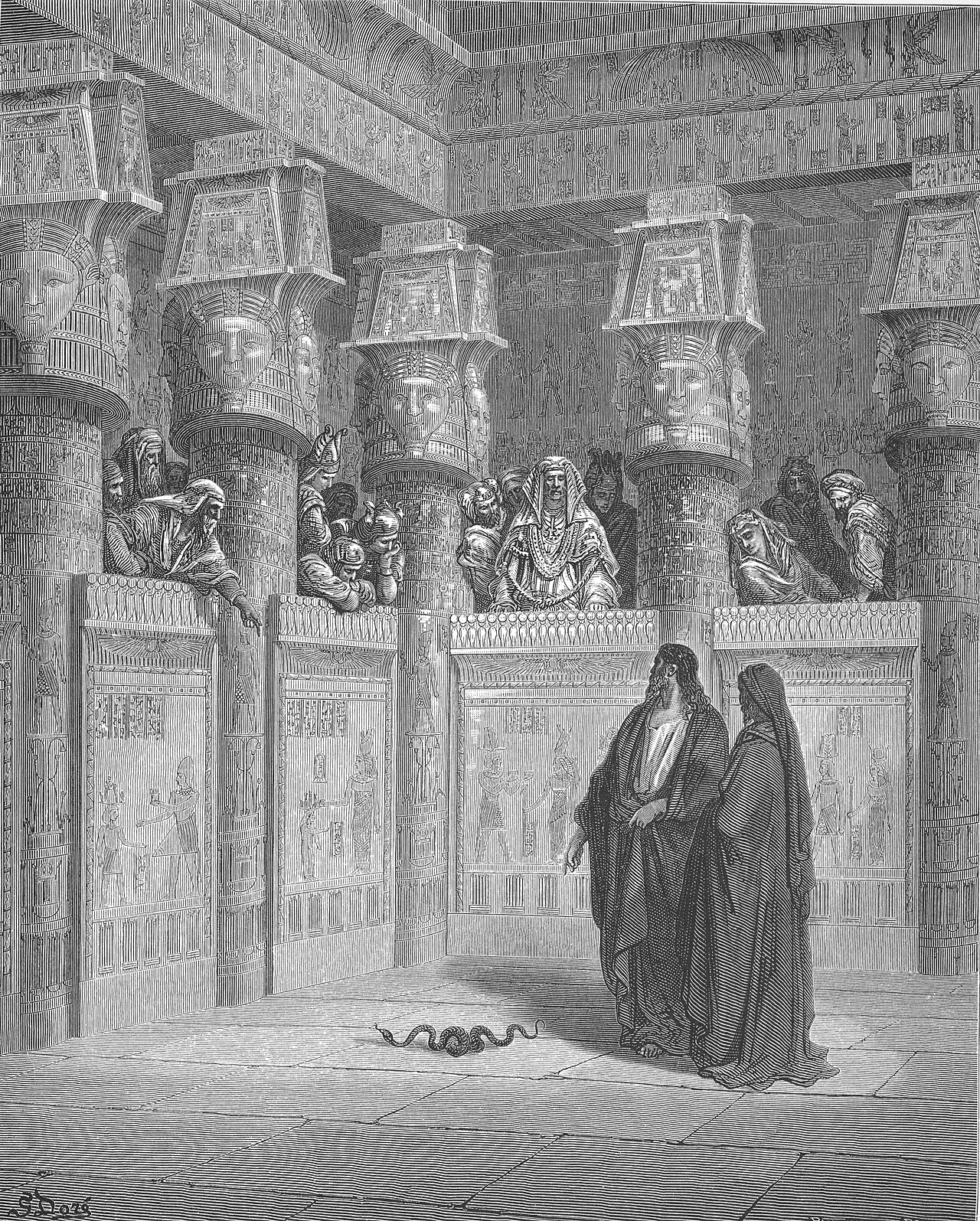
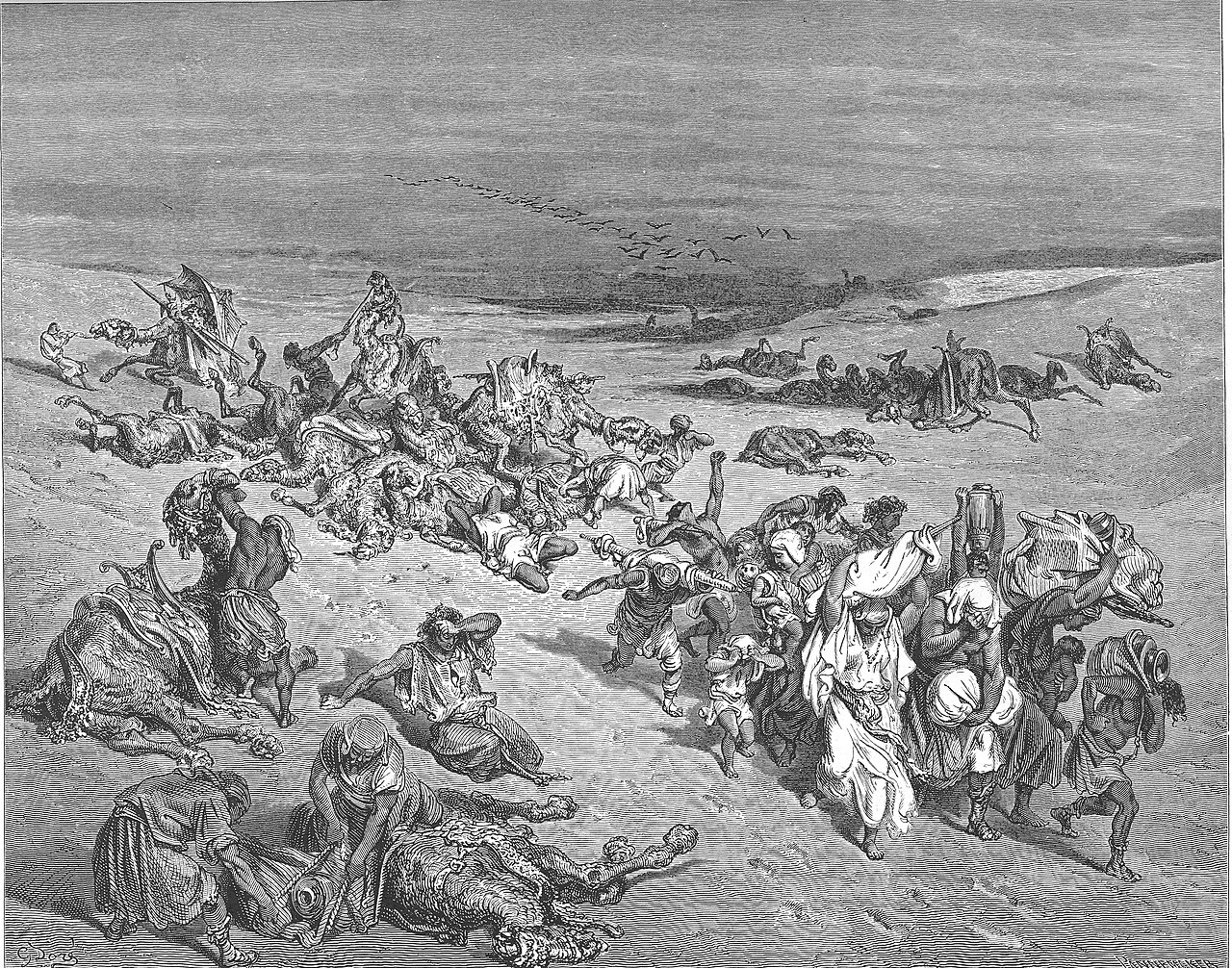
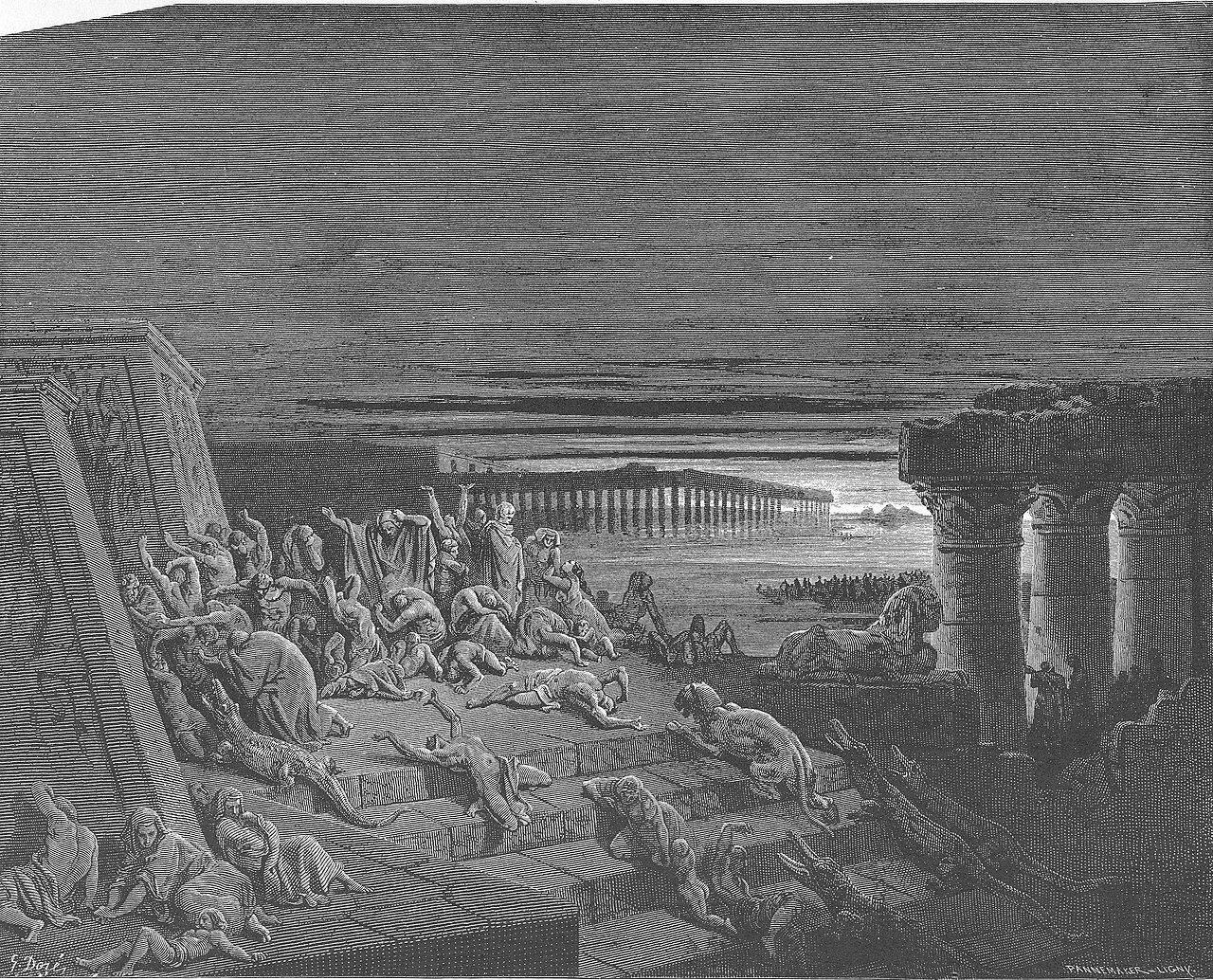
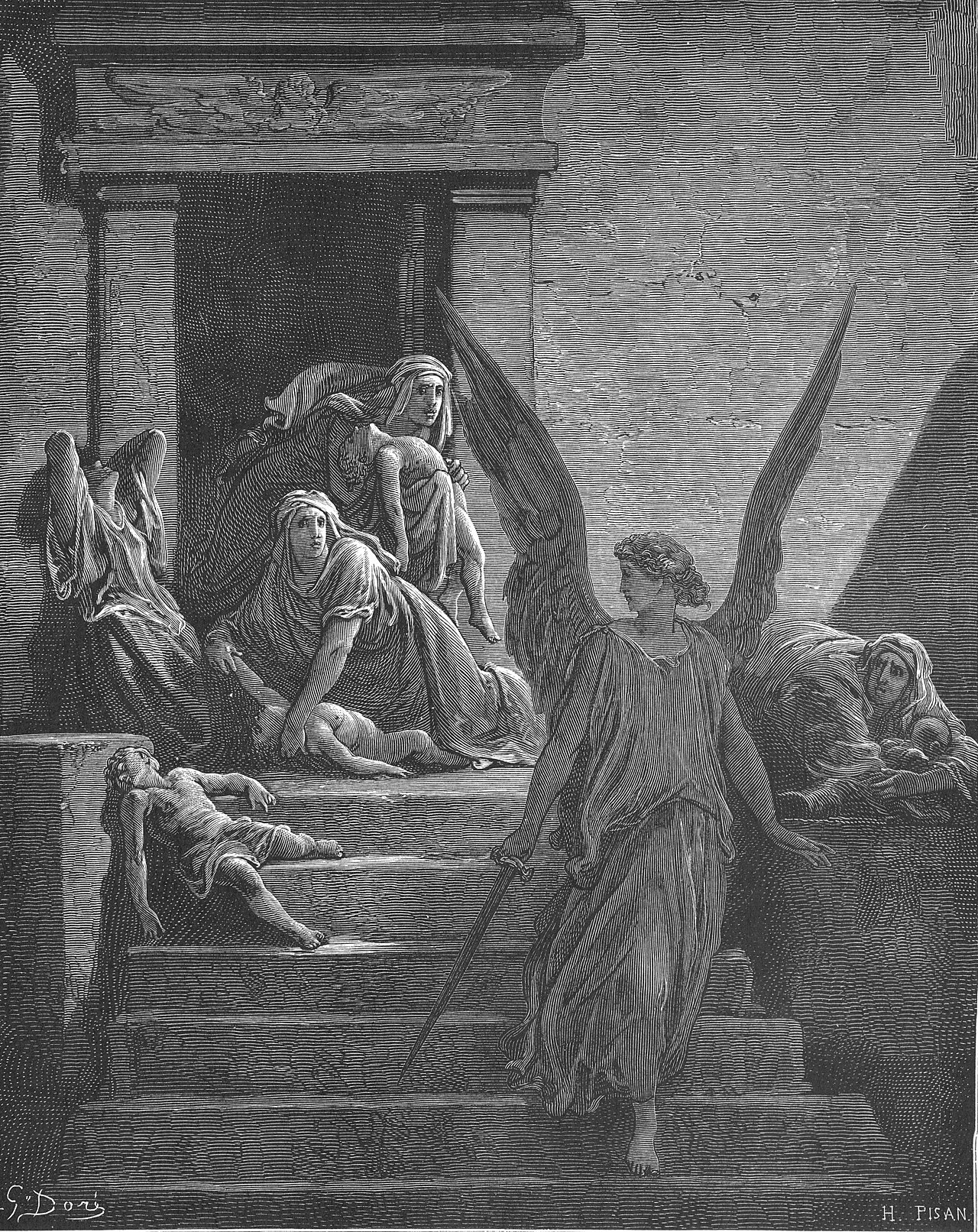
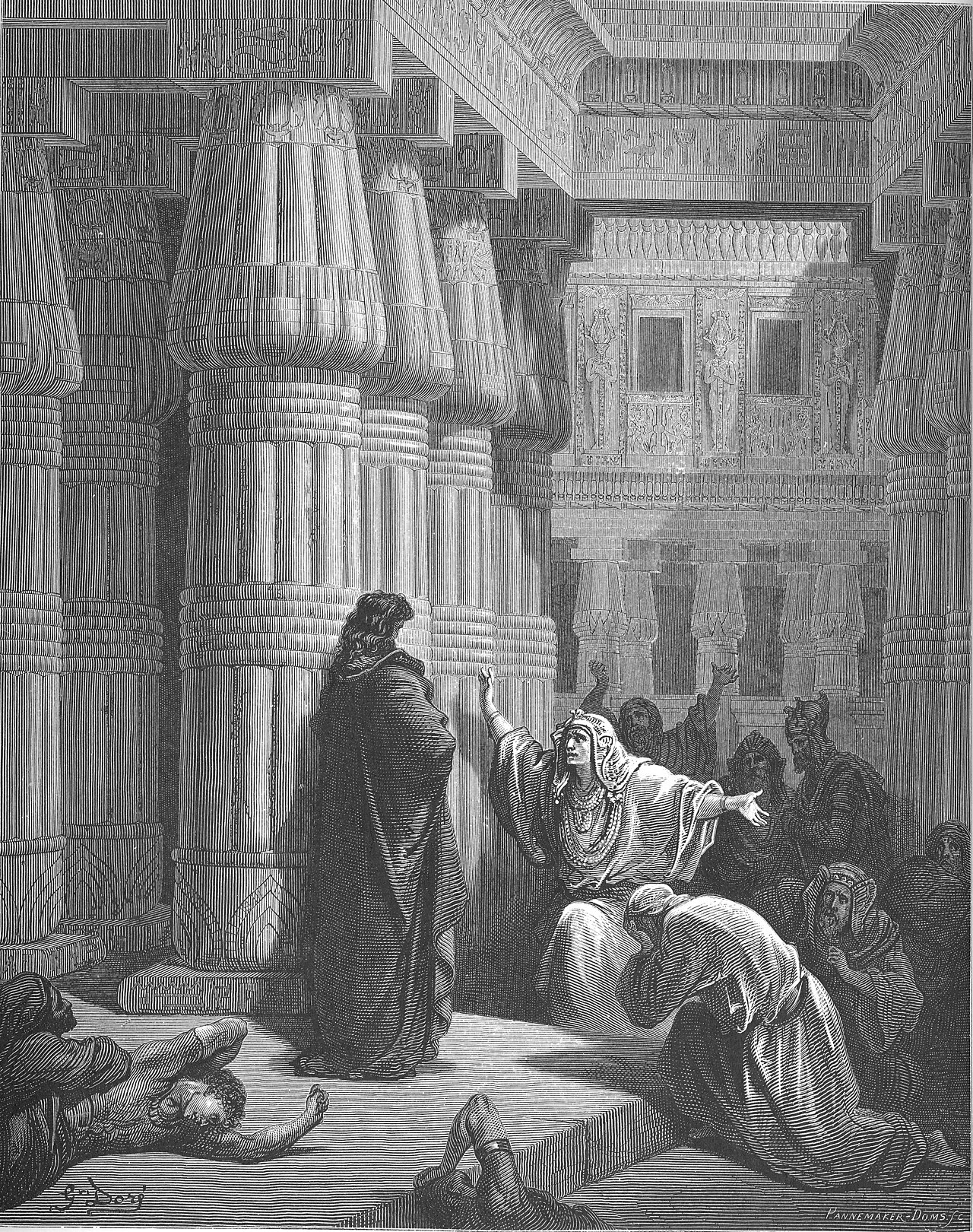
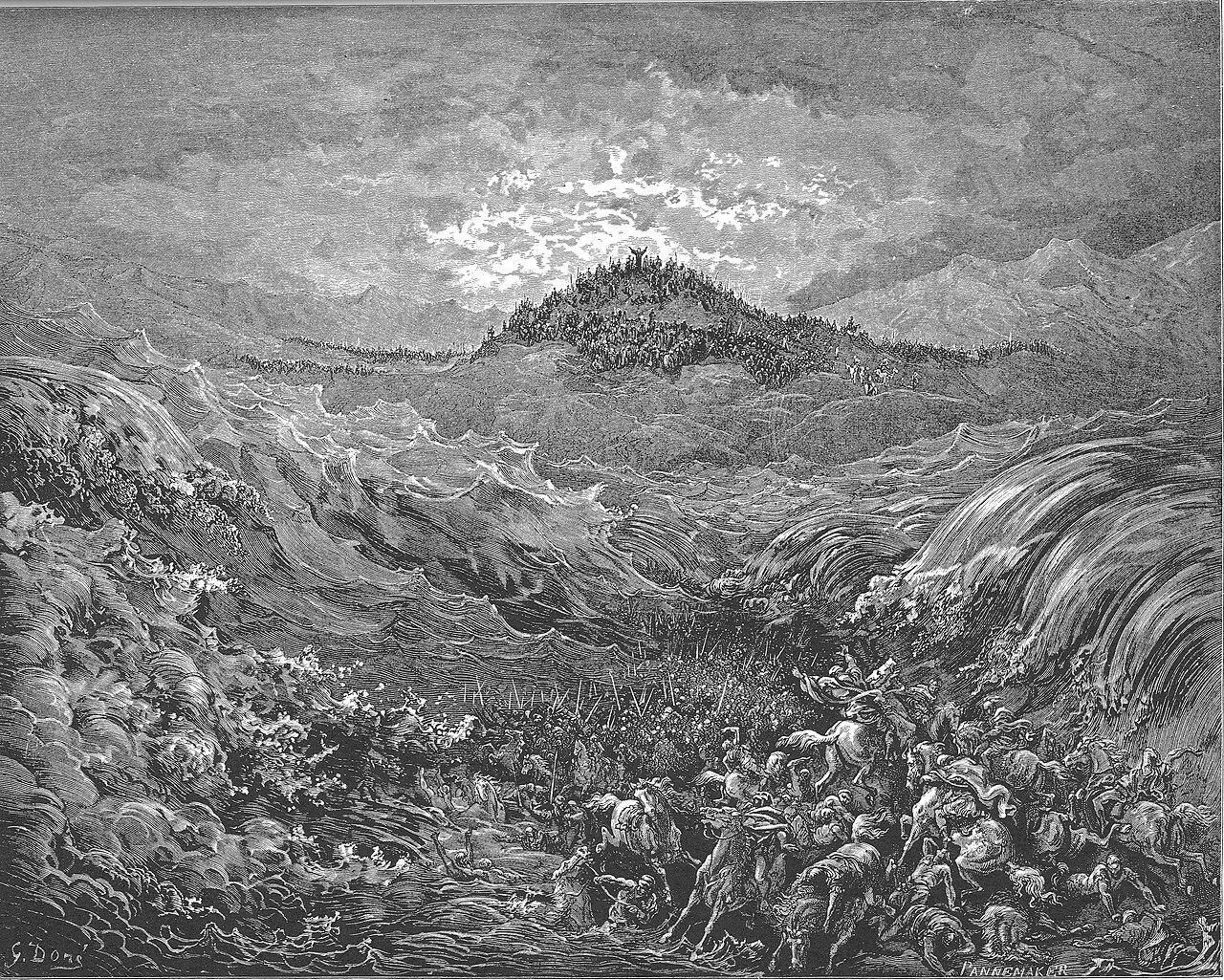
One plate stands here; the rest of the verified set opens under it, each piece named with the verses it renders.
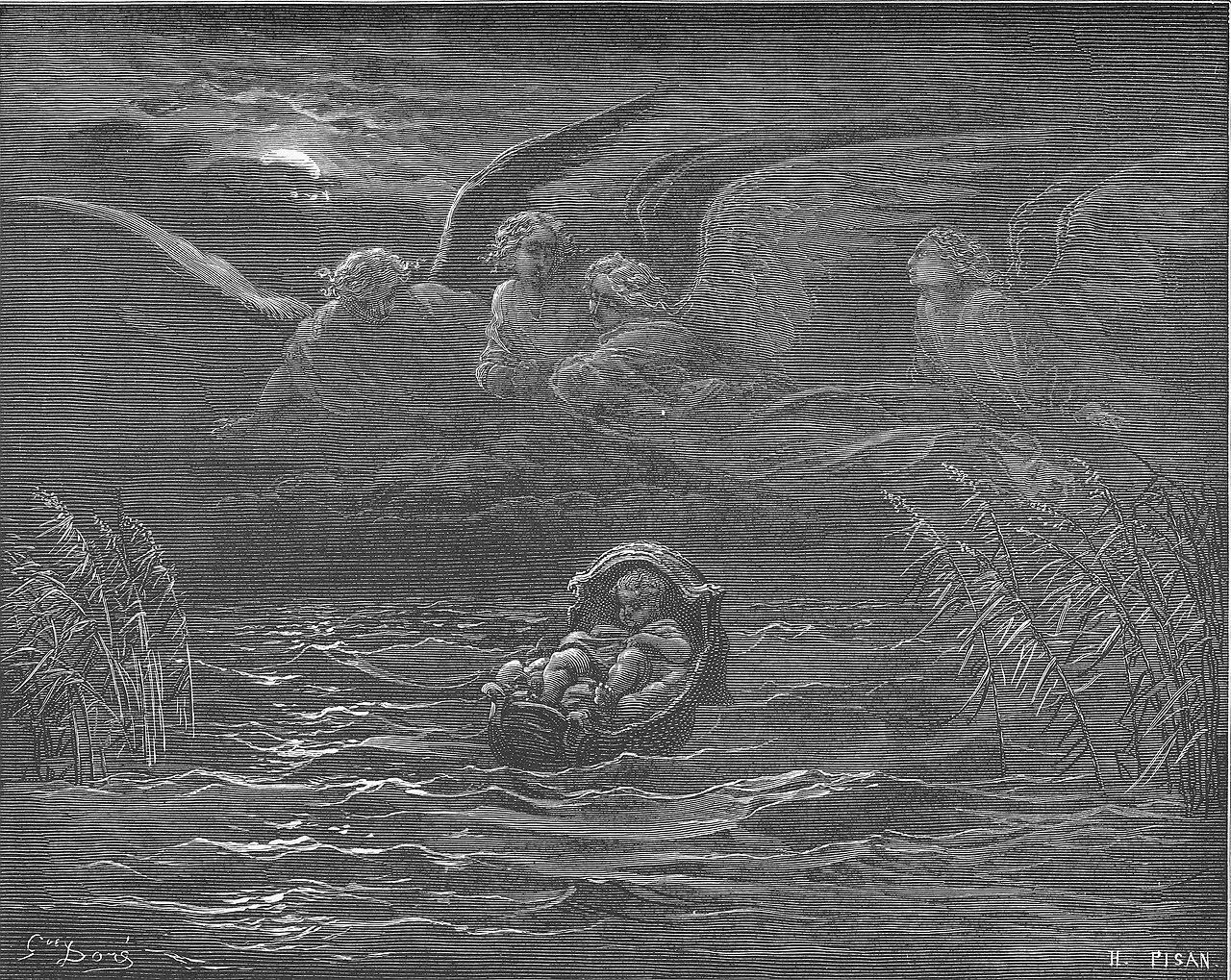
The other 15 verified plates
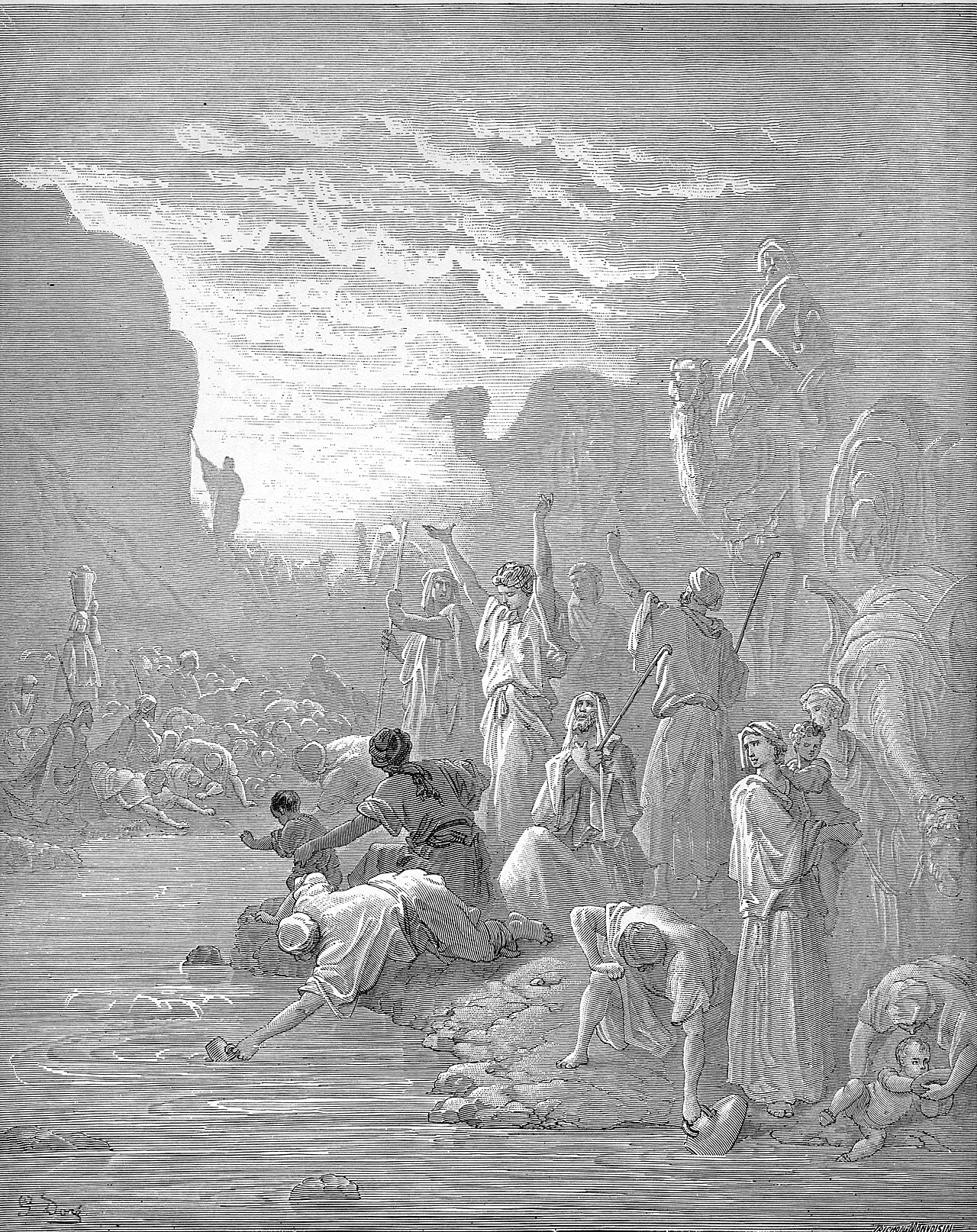
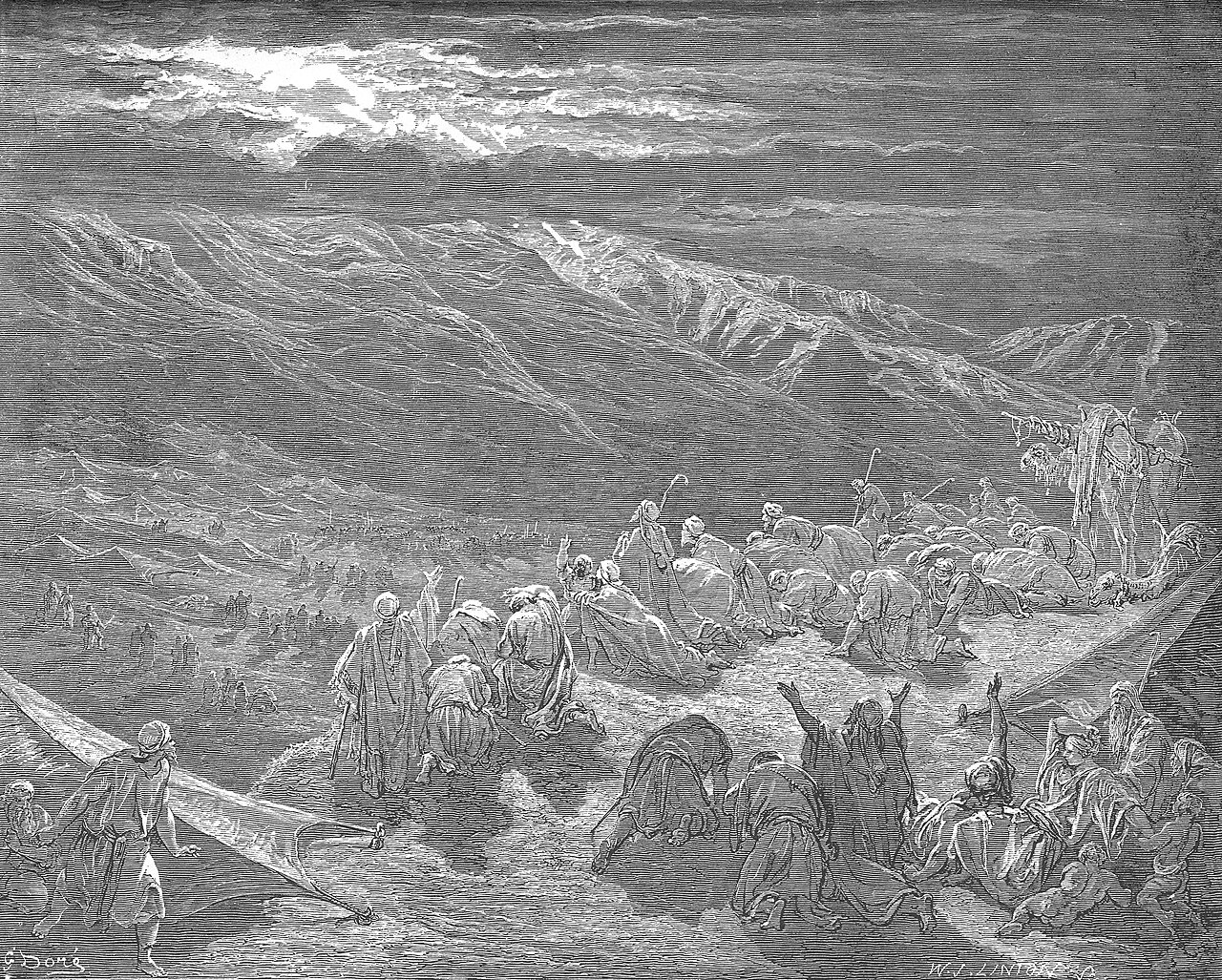
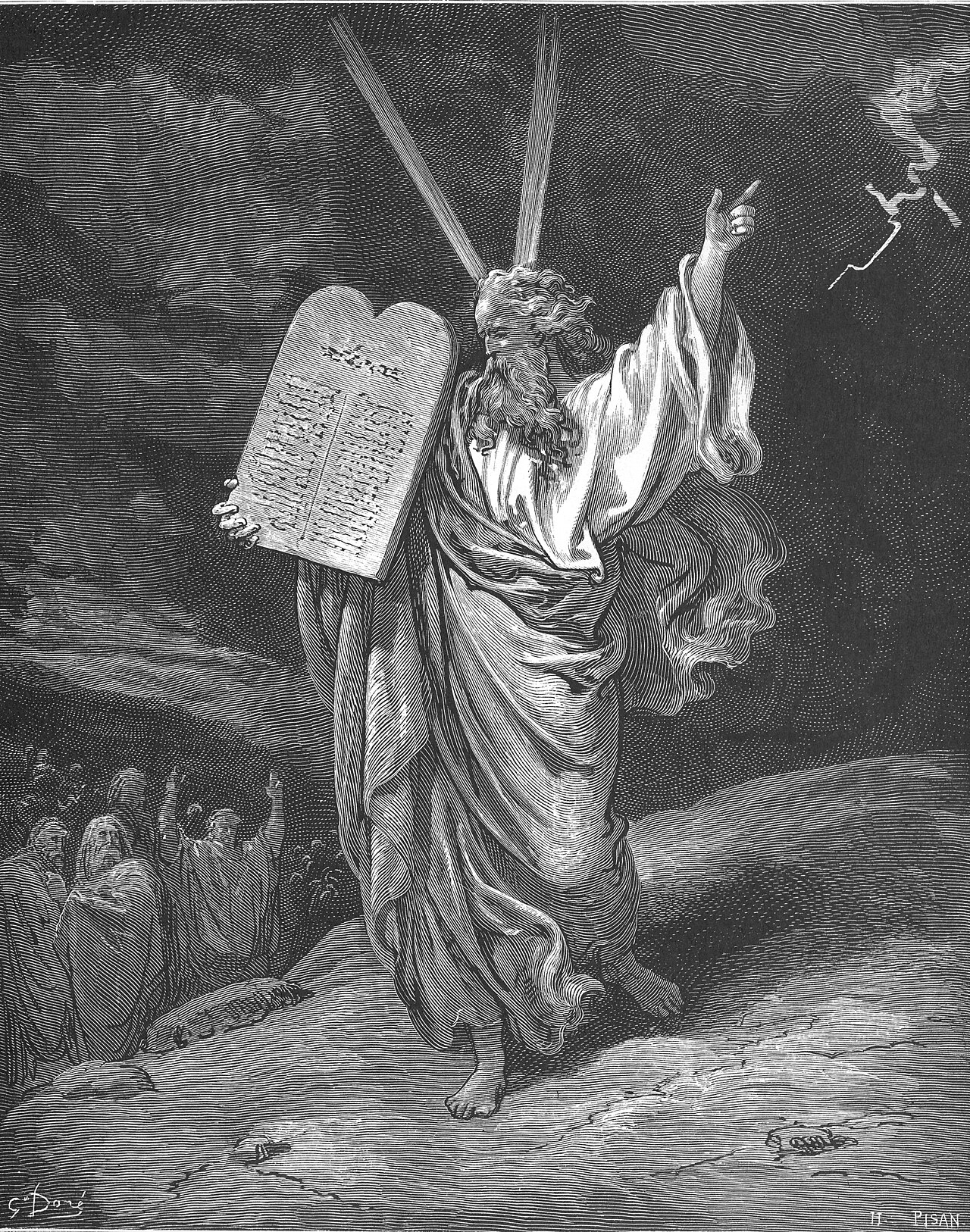
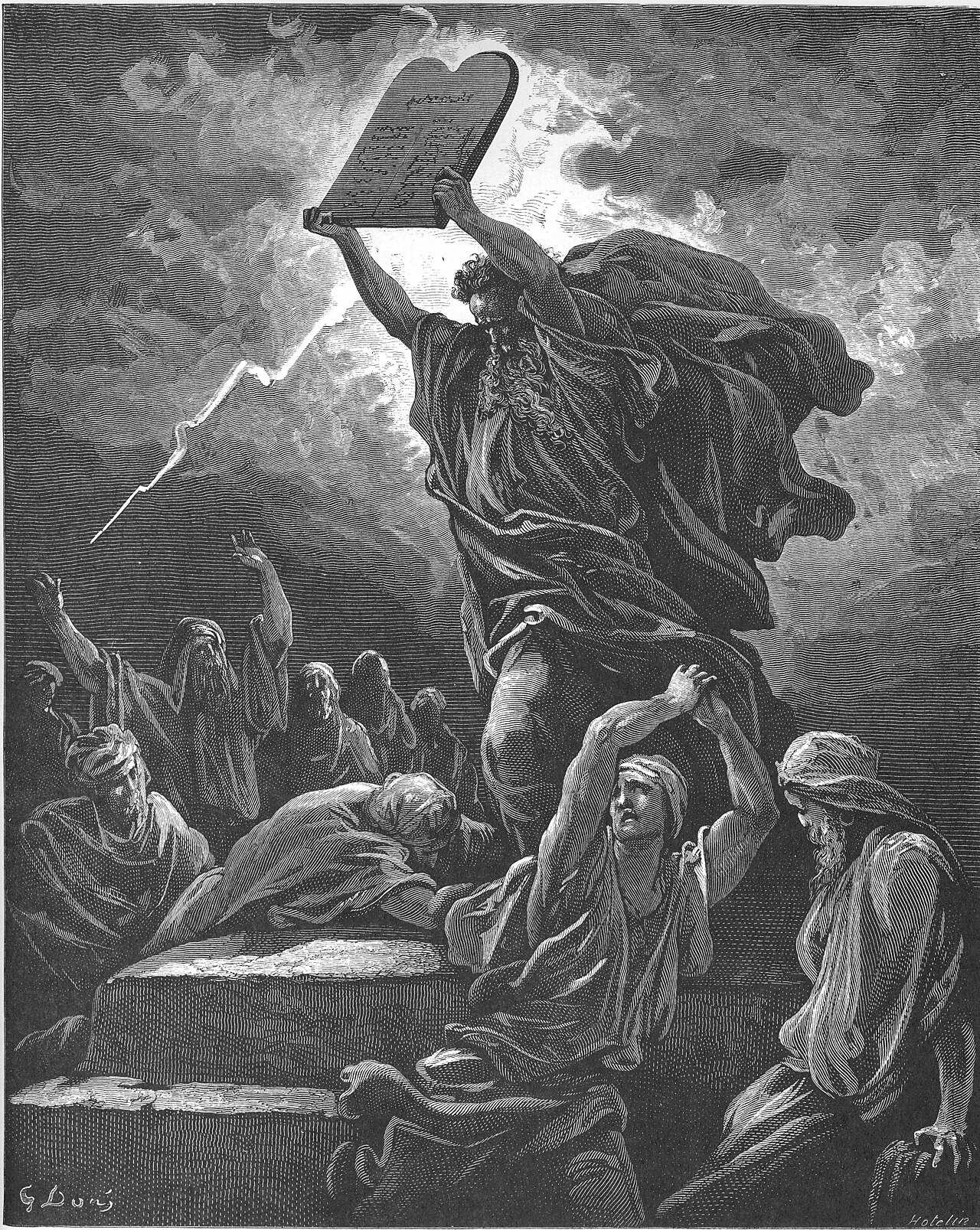
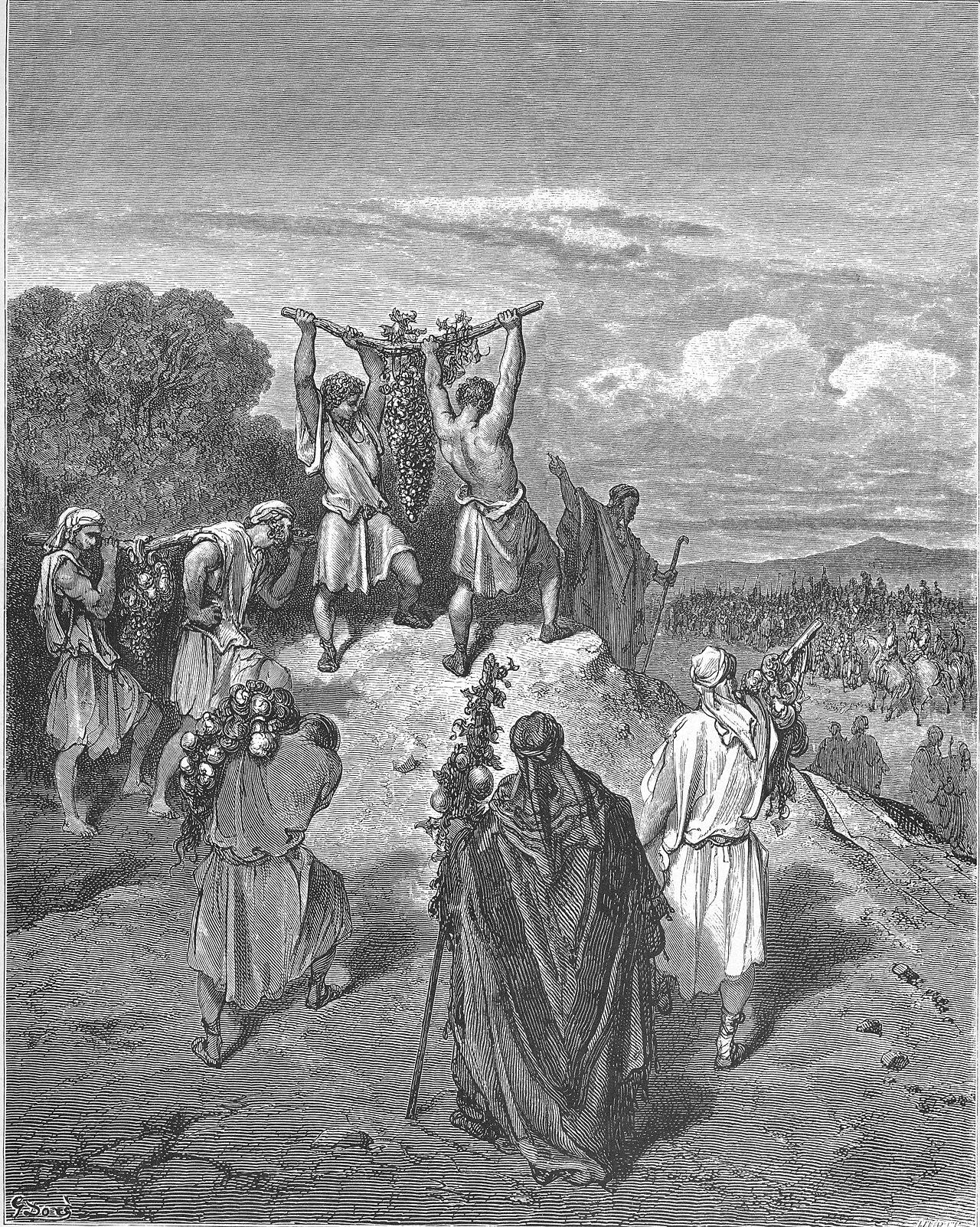
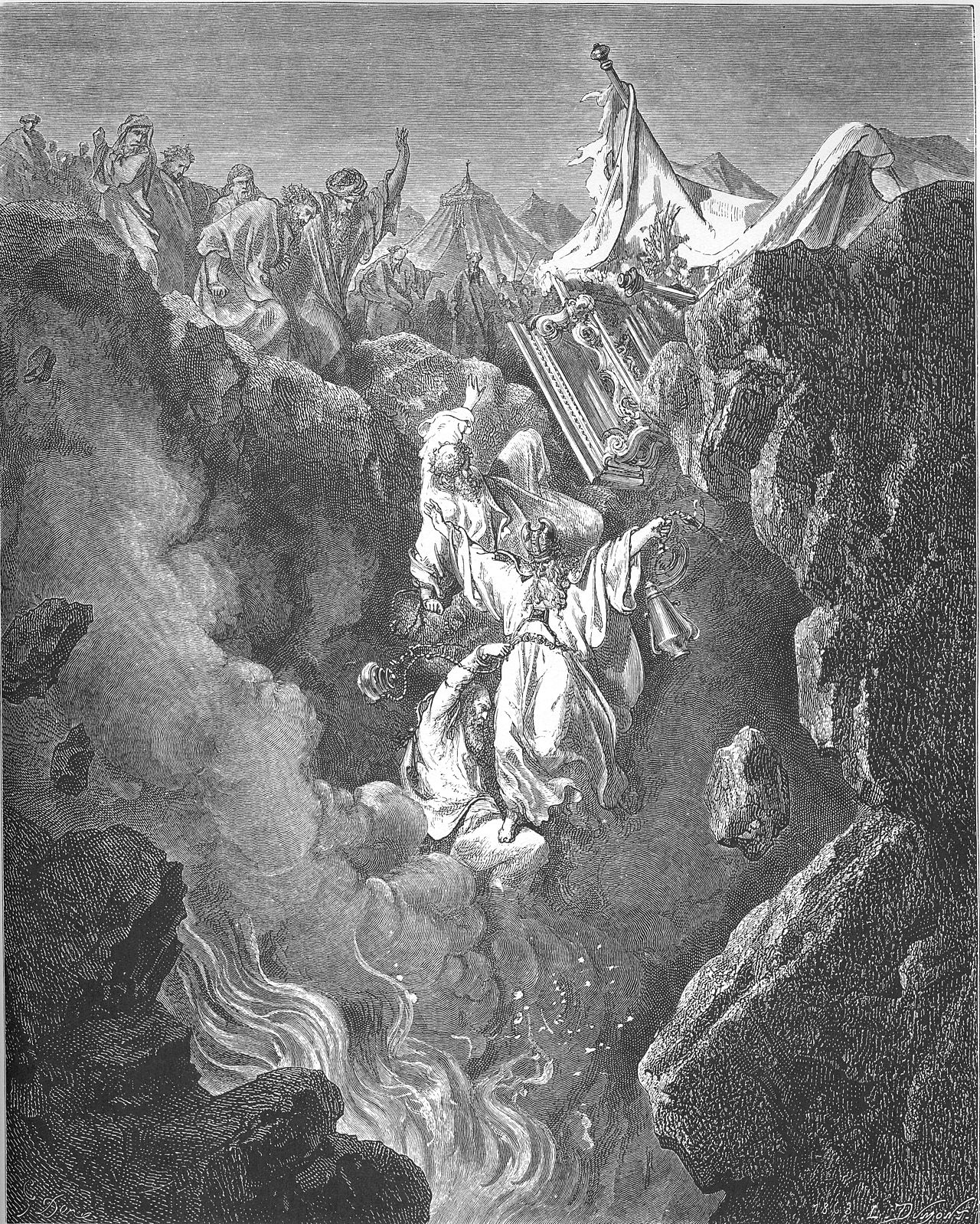
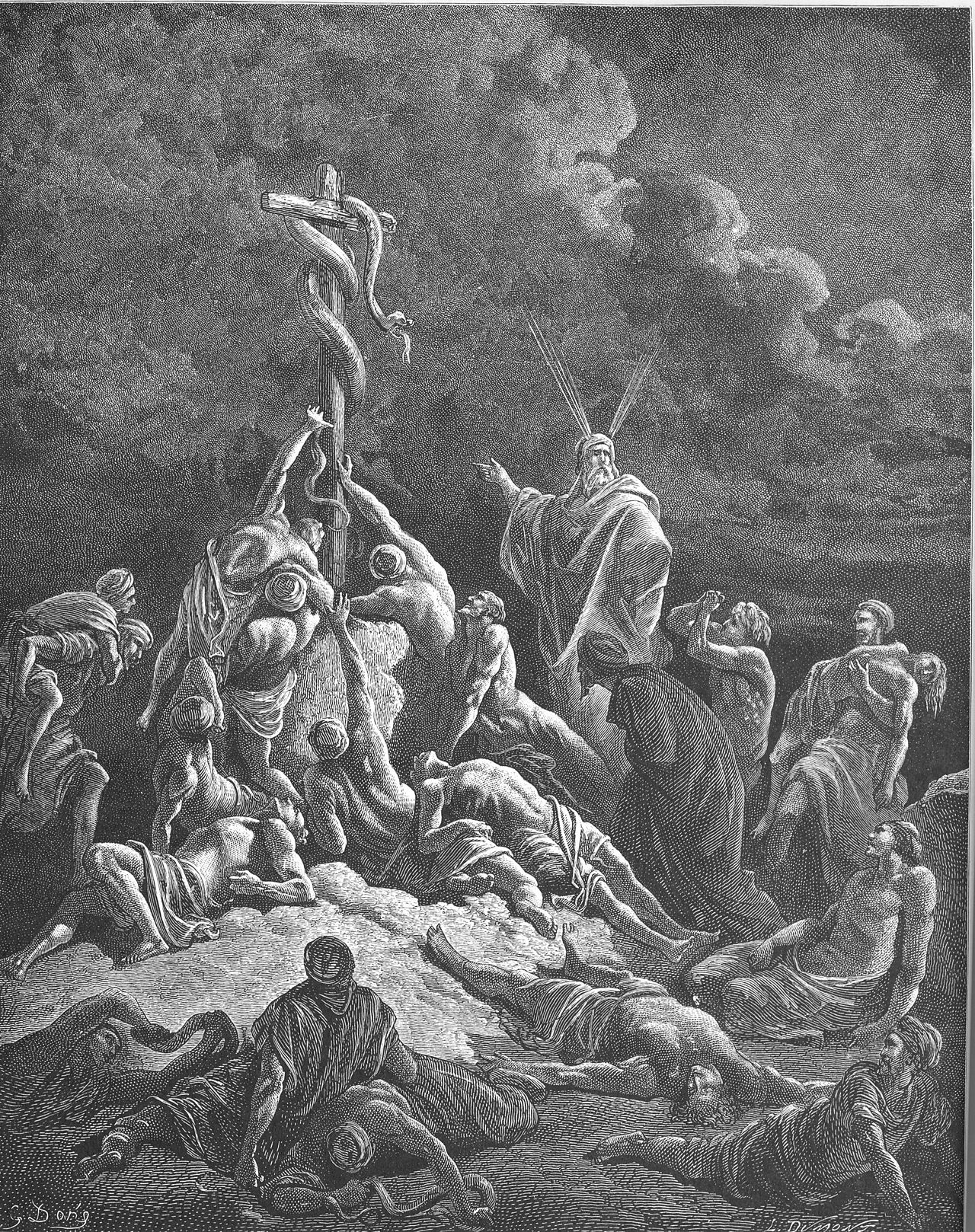
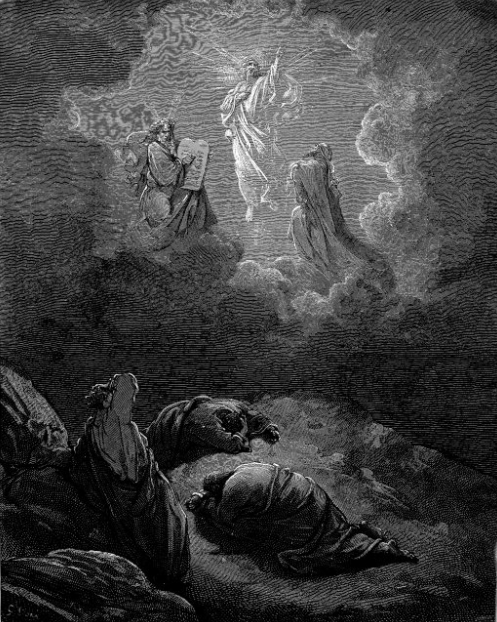
Sources
The works this page stands on, and where each one is used.
Berean Standard Bible
Every verse on this page, taken byte for byte from the site's verse store. Public domain since 2023.
Rembrandt van Rijn, Moses with the Ten Commandments (1659)
The painting at the head of the page. Gemäldegalerie, Berlin. Public domain.
Gustave Doré, The Holy Bible with Illustrations (1866)
The engravings. Public domain.
Albert Barnes, Notes, Explanatory and Practical, on the Old and New Testaments (1832 to 1869)
Quoted on the killing in Egypt, and read again on the rock at Meribah.
John Wesley, Explanatory Notes upon the Old Testament (1765)
Quoted on the killing in Egypt.
Charles Spurgeon, Metropolitan Tabernacle Pulpit, Sermon No. 1966 (1887)
Quoted on the title Deuteronomy gives him at his death. CCEL edition.
Matthew Henry, Commentary on the Whole Bible (1710)
Quoted on the promise of a prophet, and read again on the Angel at the bush.
Adam Clarke, Commentary on the Bible (1832)
Read in three of the questions: the Hebrew behind meek, the horns, and the hidden grave.
Jamieson, Fausset and Brown, Commentary Critical and Explanatory (1871)
Read on the parenthesis in Numbers and on the burial tradition.
The early Christian writers named in the questions
Justin Martyr, Origen, Basil of Caesarea, Hilary of Poitiers, Ambrose of Milan, Aphrahat and Augustine of Hippo, each placed by century rather than by a stored death year.
Carries the early and late chronologies of the exodus with the evidence for each.
Where it leads
Moses in Scripture
Open a book to read its mentions here. Text: Berean Standard Bible. Names repeat in Scripture, so some of these verses may speak of another person called Moses. The two marks are drawn from the chapters this page's own references stand in.
Old TestamentNew Testamentsegment width = share of mentions
Old Testament19 books · 734 mentions
Exodus281 mentions
- Exodus 2:10When the child had grown older, she brought him to Pharaoh’s daughter, and he became her son. She named him Moses and explained, “I drew him out of the water.”
- Exodus 2:11One day, after Moses had grown up, he went out to his own people and observed their hard labor. He saw an Egyptian beating a Hebrew, one of his own people.
- Exodus 2:13The next day Moses went out and saw two Hebrews fighting. He asked the one in the wrong, “Why are you attacking your companion?”
- Exodus 2:14But the man replied, “Who made you ruler and judge over us? Are you planning to kill me as you killed the Egyptian?” Then Moses was afraid and thought, “This thing I have done has surely become known.”
- Exodus 2:15When Pharaoh heard about this matter, he sought to kill Moses. But Moses fled from Pharaoh and settled in the land of Midian, where he sat down beside a well.
276 further mentions in Exodus, read them in the book.
Leviticus82 mentions
- Leviticus 1:1Then the LORD called to Moses and spoke to him from the Tent of Meeting, saying,
- Leviticus 4:1Then the LORD said to Moses,
- Leviticus 5:14Then the LORD said to Moses,
- Leviticus 6:1And the LORD said to Moses,
- Leviticus 6:8Then the LORD said to Moses,
77 further mentions in Leviticus, read them in the book.
Numbers221 mentions
- Numbers 1:1On the first day of the second month of the second year after the Israelites had come out of the land of Egypt, the LORD spoke to Moses in the Tent of Meeting in the Wilderness of Sinai. He said:
- Numbers 1:17So Moses and Aaron took these men who had been designated by name,
- Numbers 1:19just as the LORD had commanded Moses. So Moses numbered them in the Wilderness of Sinai:
- Numbers 1:44These were the men numbered by Moses and Aaron, with the assistance of the twelve leaders of Israel, each one representing his family.
- Numbers 1:48For the LORD had said to Moses:
216 further mentions in Numbers, read them in the book.
Deuteronomy35 mentions
- Deuteronomy 1:1These are the words that Moses spoke to all Israel in the wilderness east of the Jordan—in the Arabah opposite Suph—between Paran and Tophel, Laban, Hazeroth, and Dizahab.
- Deuteronomy 1:3In the fortieth year, on the first day of the eleventh month, Moses proclaimed to the Israelites all that the LORD had commanded him concerning them.
- Deuteronomy 1:5On the east side of the Jordan in the land of Moab, Moses began to explain this law, saying:
- Deuteronomy 4:41Then Moses set aside three cities across the Jordan to the east
- Deuteronomy 4:44This is the law that Moses set before the Israelites.
30 further mentions in Deuteronomy, read them in the book.
Joshua52 mentions
- Joshua 1:1Now after the death of His servant Moses, the LORD spoke to Joshua son of Nun, Moses’ assistant, saying,
- Joshua 1:2“Moses My servant is dead. Now therefore arise, you and all these people, and cross over the Jordan into the land that I am giving to the children of Israel.
- Joshua 1:3I have given you every place where the sole of your foot will tread, just as I promised to Moses.
- Joshua 1:5No one shall stand against you all the days of your life. As I was with Moses, so will I be with you; I will never leave you nor forsake you.
- Joshua 1:7Above all, be strong and very courageous. Be careful to observe all the law that My servant Moses commanded you. Do not turn from it to the right or to the left, so that you may prosper wherever you go.
47 further mentions in Joshua, read them in the book.
Judges5 mentions
- Judges 1:16Now the descendants of Moses’ father-in-law, the Kenite, went up with the men of Judah from the City of Palms to the Wilderness of Judah in the Negev near Arad. They went to live among the people.
- Judges 1:20Just as Moses had promised, Judah gave Hebron to Caleb, who drove out the descendants of the three sons of Anak.
- Judges 3:4These nations were left to test the Israelites, to find out whether they would keep the commandments of the LORD, which He had given their fathers through Moses.
- Judges 4:11Now Heber the Kenite had moved away from the Kenites, the descendants of Hobab the father-in-law of Moses, and had pitched his tent by the great tree of Zaanannim, which was near Kedesh.
- Judges 18:30The Danites set up idols for themselves, and Jonathan son of Gershom, the son of Moses, and his sons were priests for the tribe of Dan until the day of the captivity of the land.
1 Samuel2 mentions
- 1 Samuel 12:6Then Samuel said to the people, “The LORD is the One who appointed Moses and Aaron, and who brought your fathers up out of the land of Egypt.
- 1 Samuel 12:8When Jacob went to Egypt, your fathers cried out to the LORD, and He sent them Moses and Aaron, who brought your fathers out of Egypt and settled them in this place.
1 Kings4 mentions
- 1 Kings 2:3And keep the charge of the LORD your God to walk in His ways and to keep His statutes, commandments, ordinances, and decrees, as is written in the Law of Moses, so that you may prosper in all you do and wherever you turn,
- 1 Kings 8:9There was nothing in the ark except the two stone tablets that Moses had placed in it at Horeb, where the LORD had made a covenant with the Israelites after they had come out of the land of Egypt.
- 1 Kings 8:53For You, O Lord GOD, as Your inheritance, have set them apart from all the peoples of the earth, as You spoke through Your servant Moses when You brought our fathers out of Egypt.”
- 1 Kings 8:56“Blessed be the LORD, who has given rest to His people Israel according to all that He promised. Not one word has failed of all the good promises He made through His servant Moses.
2 Kings6 mentions
- 2 Kings 14:6Yet he did not put the sons of the murderers to death, but acted according to what is written in the Book of the Law of Moses, where the LORD commanded: “Fathers must not be put to death for their children, and children must not be put to death for their fathers; each is to die for his own sin.”
- 2 Kings 18:4He removed the high places, shattered the sacred pillars, and cut down the Asherah poles. He also demolished the bronze snake called Nehushtan that Moses had made, for up to that time the Israelites had burned incense to it.
- 2 Kings 18:6He remained faithful to the LORD and did not turn from following Him; he kept the commandments that the LORD had given Moses.
- 2 Kings 18:12This happened because they did not listen to the voice of the LORD their God, but violated His covenant—all that Moses the servant of the LORD had commanded—and would neither listen nor obey.
- 2 Kings 21:8I will never again cause the feet of the Israelites to wander from the land that I gave to their fathers, if only they are careful to do all I have commanded them—the whole Law that My servant Moses commanded them.”
1 further mention in 2 Kings, read them in the book.
1 Chronicles9 mentions
- 1 Chronicles 6:3The children of Amram: Aaron, Moses, and Miriam. The sons of Aaron: Nadab, Abihu, Eleazar, and Ithamar.
- 1 Chronicles 6:49But Aaron and his sons did all the work of the Most Holy Place. They presented the offerings on the altar of burnt offering and on the altar of incense to make atonement for Israel, according to all that Moses the servant of God had commanded.
- 1 Chronicles 15:15And the Levites carried the ark of God on their shoulders with the poles, as Moses had commanded in accordance with the word of the LORD.
- 1 Chronicles 21:29For the tabernacle of the LORD that Moses had made in the wilderness and the altar of burnt offering were presently at the high place in Gibeon,
- 1 Chronicles 22:13Then you will succeed, if you carefully follow the statutes and ordinances that the LORD commanded Moses for Israel. Be strong and courageous. Do not be afraid or discouraged.
4 further mentions in 1 Chronicles, read them in the book.
2 Chronicles12 mentions
- 2 Chronicles 1:3And Solomon and the whole assembly went to the high place at Gibeon because it was the location of God’s Tent of Meeting, which Moses the servant of the LORD had made in the wilderness.
- 2 Chronicles 5:10There was nothing in the ark except the two tablets that Moses had placed in it at Horeb, where the LORD had made a covenant with the Israelites after they had come out of Egypt.
- 2 Chronicles 8:13He observed the daily requirement for offerings according to the commandment of Moses for Sabbaths, New Moons, and the three annual appointed feasts—the Feast of Unleavened Bread, the Feast of Weeks, and the Feast of Tabernacles.
- 2 Chronicles 23:18Moreover, Jehoiada put the oversight of the house of the LORD into the hands of the Levitical priests, whom David had appointed over the house of the LORD, to offer burnt offerings to the LORD as is written in the Law of Moses, with rejoicing and song, as ordained by David.
- 2 Chronicles 24:6So the king called Jehoiada the high priest and said, “Why have you not required the Levites to bring from Judah and Jerusalem the tax imposed by Moses the servant of the LORD and by the assembly of Israel for the Tent of the Testimony?”
7 further mentions in 2 Chronicles, read them in the book.
Ezra3 mentions
- Ezra 3:2Then Jeshua son of Jozadak and his fellow priests, along with Zerubbabel son of Shealtiel and his associates, began to build the altar of the God of Israel to sacrifice burnt offerings on it, as it is written in the Law of Moses the man of God.
- Ezra 6:18They also appointed the priests by their divisions and the Levites by their groups to the service of God in Jerusalem, according to what is written in the Book of Moses.
- Ezra 7:6this Ezra came up from Babylon. He was a scribe skilled in the Law of Moses, which the LORD, the God of Israel, had given. The king had granted Ezra all his requests, for the hand of the LORD his God was upon him.
Nehemiah7 mentions
- Nehemiah 1:7We have behaved corruptly against You and have not kept the commandments, statutes, and ordinances that You gave Your servant Moses.
- Nehemiah 1:8Remember, I pray, the word that You commanded Your servant Moses when You said, ‘If you are unfaithful, I will scatter you among the nations,
- Nehemiah 8:1At that time all the people gathered together in the square before the Water Gate, and they asked Ezra the scribe to bring out the Book of the Law of Moses, which the LORD had commanded for Israel.
- Nehemiah 8:14And they found written in the Law, which the LORD had commanded through Moses, that the Israelites were to dwell in booths during the feast of the seventh month.
- Nehemiah 9:14You revealed to them Your holy Sabbath and gave them commandments and statutes and laws through Your servant Moses.
2 further mentions in Nehemiah, read them in the book.
Psalms8 mentions
- Psalms 77:20You led Your people like a flock by the hand of Moses and Aaron.
- Psalms 99:6Moses and Aaron were among His priests; Samuel was among those who called on His name. They called to the LORD and He answered.
- Psalms 103:7He made known His ways to Moses, His deeds to the people of Israel.
- Psalms 105:26He sent Moses His servant, and Aaron, whom He had chosen.
- Psalms 106:16In the camp they envied Moses, as well as Aaron, the holy one of the LORD.
3 further mentions in Psalms, read them in the book.
Isaiah2 mentions
- Isaiah 63:11Then His people remembered the days of old, the days of Moses. Where is He who brought them through the sea with the shepherds of His flock? Where is the One who set His Holy Spirit among them,
- Isaiah 63:12who sent His glorious arm to lead them by the right hand of Moses, who divided the waters before them to gain for Himself everlasting renown,
Jeremiah1 mention
Daniel2 mentions
- Daniel 9:11All Israel has transgressed Your law and turned away, refusing to obey Your voice; so the oath and the curse written in the Law of Moses the servant of God has been poured out on us, because we have sinned against You.
- Daniel 9:13Just as it is written in the Law of Moses, all this disaster has come upon us, yet we have not sought the favor of the LORD our God by turning from our iniquities and giving attention to Your truth.
Micah1 mention
New Testament12 books · 85 mentions
Matthew7 mentions
- Matthew 8:4Then Jesus instructed him, “See that you don’t tell anyone. But go, show yourself to the priest and offer the gift prescribed by Moses, as a testimony to them.”
- Matthew 17:3Suddenly Moses and Elijah appeared before them, talking with Jesus.
- Matthew 17:4Peter said to Jesus, “Lord, it is good for us to be here. If You wish, I will put up three shelters—one for You, one for Moses, and one for Elijah.”
- Matthew 19:7“Why then,” they asked, “did Moses order a man to give his wife a certificate of divorce and send her away?”
- Matthew 19:8Jesus replied, “Moses permitted you to divorce your wives because of your hardness of heart; but it was not this way from the beginning.
2 further mentions in Matthew, read them in the book.
Mark9 mentions
- Mark 1:44“See that you don’t tell anyone. But go, show yourself to the priest and present the offering Moses prescribed for your cleansing, as a testimony to them.”
- Mark 7:10For Moses said, ‘Honor your father and your mother’ and ‘Anyone who curses his father or mother must be put to death.’
- Mark 9:4And Elijah and Moses appeared before them, talking with Jesus.
- Mark 9:5Peter said to Jesus, “Rabbi, it is good for us to be here. Let us put up three shelters—one for You, one for Moses, and one for Elijah.”
- Mark 10:3“What did Moses command you?” He replied.
4 further mentions in Mark, read them in the book.
Luke10 mentions
- Luke 2:22And when the time of purification according to the Law of Moses was complete, His parents brought Him to Jerusalem to present Him to the Lord
- Luke 5:14“Do not tell anyone,” Jesus instructed him. “But go, show yourself to the priest and present the offering Moses prescribed for your cleansing, as a testimony to them.”
- Luke 9:30Suddenly two men, Moses and Elijah, began talking with Jesus.
- Luke 9:33As Moses and Elijah were leaving, Peter said to Jesus, “Master, it is good for us to be here. Let us put up three shelters—one for You, one for Moses, and one for Elijah.” (He did not know what he was saying.)
- Luke 16:29But Abraham replied, ‘They have Moses and the prophets; let your brothers listen to them.’
5 further mentions in Luke, read them in the book.
John12 mentions
- John 1:17For the law was given through Moses; grace and truth came through Jesus Christ.
- John 1:45Philip found Nathanael and told him, “We have found the One Moses wrote about in the Law, the One the prophets foretold—Jesus of Nazareth, the son of Joseph.”
- John 3:14Just as Moses lifted up the snake in the wilderness, so the Son of Man must be lifted up,
- John 5:45Do not think that I will accuse you before the Father. Your accuser is Moses, in whom you have put your hope.
- John 5:46If you had believed Moses, you would believe Me, because he wrote about Me.
7 further mentions in John, read them in the book.
Acts23 mentions
- Acts 3:22For Moses said, ‘The Lord your God will raise up for you a prophet like me from among your brothers. You must listen to Him in everything He tells you.
- Acts 6:11Then they prompted some men to say, “We heard Stephen speak words of blasphemy against Moses and against God.”
- Acts 6:14For we have heard him say that Jesus of Nazareth will destroy this place and change the customs that Moses handed down to us.”
- Acts 7:20At that time Moses was born, and he was beautiful in the sight of God. For three months he was nurtured in his father’s house.
- Acts 7:22So Moses was educated in all the wisdom of the Egyptians and was powerful in speech and action.
18 further mentions in Acts, read them in the book.
Romans4 mentions
- Romans 5:14Nevertheless, death reigned from Adam until Moses, even over those who did not sin in the way that Adam transgressed. He is a pattern of the One to come.
- Romans 9:15For He says to Moses: “I will have mercy on whom I have mercy, and I will have compassion on whom I have compassion.”
- Romans 10:5For concerning the righteousness that is by the law, Moses writes: “The man who does these things will live by them.”
- Romans 10:19I ask instead, did Israel not understand? First, Moses says: “I will make you jealous by those who are not a nation; I will make you angry by a nation without understanding.”
1 Corinthians2 mentions
2 Corinthians3 mentions
- 2 Corinthians 3:7Now if the ministry of death, which was engraved in letters on stone, came with such glory that the Israelites could not gaze at the face of Moses because of its fleeting glory,
- 2 Corinthians 3:13We are not like Moses, who would put a veil over his face to keep the Israelites from gazing at the end of what was fading away.
- 2 Corinthians 3:15And even to this day when Moses is read, a veil covers their hearts.
2 Timothy1 mention
Hebrews12 mentions
- Hebrews 3:2He was faithful to the One who appointed Him, just as Moses was faithful in all God’s house.
- Hebrews 3:3For Jesus has been counted worthy of greater glory than Moses, just as the builder of a house has greater honor than the house itself.
- Hebrews 3:5Now Moses was faithful as a servant in all God’s house, testifying to what would be spoken later.
- Hebrews 3:16For who were the ones who heard and rebelled? Were they not all those Moses led out of Egypt?
- Hebrews 7:14For it is clear that our Lord descended from Judah, a tribe as to which Moses said nothing about priests.
7 further mentions in Hebrews, read them in the book.
Jude1 mention
Keep studying
On this page
Studies24
On this person
On this passage
Every page that names them1
Books30
Show the next 6 titles
Doorway1
Keep this page