
Exodus · Group · Featured Study
The Elders of Israel
The elders led Israel's tribes beside Moses from Egypt to Sinai, and the law set them at the gates of Israel's towns.
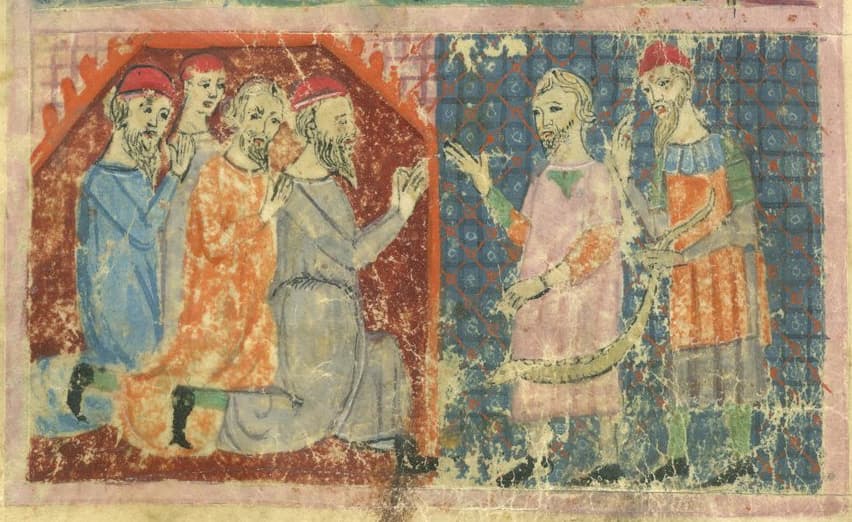
The elders kneel before Moses and Aaron at the signs of Exodus 4:30, a miniature in the Haggadah for Passover called the Sister Haggadah, second or third quarter of the fourteenth century, British Library, London. Public domain, via Wikimedia Commons, File:Moses_and_Aaron_performing_the_signs_to_the_Elders_of_Israel.jpg.
THE ARTWORKThe miniature stands in a Haggadah, the book read at the Passover table, and the elders were the men who first received the Passover charge in Exodus 12:21.
Moses told Joshua that he wished all the LORD's people were prophets.
Summary
The elders of Israel were the senior men of the tribes, who heard the LORD's word from Moses and acted for the people.
- The elders heard the LORD's message before Pharaoh did, and Moses gave them the charge of the first Passover.
- Seventy of the elders went up Sinai with Moses, saw the God of Israel, and ate and drank.
- The LORD put some of the Spirit that was on Moses on seventy elders, and they prophesied.
Gather the Elders of Israel
The elders are named at the bush, at Moses' return to Egypt and at the rock of Horeb.
Go, assemble the elders of Israel and say to them, ‘The LORD, the God of your fathers—the God of Abraham, Isaac, and Jacob—has appeared to me and said: I have surely attended to you and have seen what has been done to you in Egypt.The message from the bush reaches the people first through the men who lead them.
Then Moses and Aaron went and assembled all the elders of the Israelites,The first thing Moses and Aaron do on reaching Egypt is to obey the LORD's charge at the bush.
The Hebrew word zaqen
The Hebrew word for elder is zaqen, an adjective meaning old. Strong's lexicon counts 178 uses of it, and the King James Version renders it aged, ancient, elder, old and senator.
The elders as witnesses at HorebExodus 17:6; Rashi
Behold, I will stand there before you by the rock at Horeb. And when you strike the rock, water will come out of it for the people to drink.” So Moses did this in the sight of the elders of Israel.Water from the rock in the elders' sight answers the people's question whether the LORD was among them.
Rashi, in his commentary on Exodus 17:5, says the elders were taken as witnesses, so that no one could say there had been springs at the rock from of old.
The Elders from Egypt to Joshua
The elders act at every stage from the call of Moses to the generation after Joshua.
- Exodus 3:16 to 18The LORD sends Moses to assemble the elders
- Exodus 4:29 to 31Moses and Aaron assemble all the elders, and the people believe
- Exodus 12:21The elders are told to slaughter the Passover lambExodus 12:21
- Exodus 17:5 to 6Some of the elders see Moses strike the rock at HorebExodus 17:5 to 6
- Exodus 18:12Aaron and the elders eat bread with Jethro before GodExodus 18:12
- Exodus 19:7Moses sets the LORD's words before the eldersExodus 19:7
- Exodus 24:9 to 11Seventy elders see the God of Israel and eat and drink
- Exodus 24:14Moses leaves the elders below with Aaron and HurExodus 24:14
- Leviticus 4:15The elders lay their hands on the bull of the sin offering
- Leviticus 9:1Moses summons the elders on the eighth dayLeviticus 9:1
- Numbers 11:16 to 17The LORD tells Moses to bring seventy elders to the Tent of Meeting
- Numbers 11:24 to 25The Spirit rests on the seventy, and they prophesyNumbers 11:24 to 25
- Deuteronomy 21:19The elders of a city hear a case at its gate
- Deuteronomy 31:9The elders and the priests receive the law Moses wroteDeuteronomy 31:9
- Deuteronomy 31:28Moses assembles the elders of the tribes to hear his wordsDeuteronomy 31:28
- Joshua 24:31Israel serves the LORD in the days of the elders who outlived JoshuaJoshua 24:31
The timeline sets out sixteen texts in the order of the canon, each with what the elders do there.
The Seventy on the Mountain
Seventy elders go up Sinai with Moses after the blood of the covenant is sprinkled.
Then the LORD said to Moses, “Come up to the LORD—you and Aaron, Nadab and Abihu, and seventy of Israel’s elders—and you are to worship at a distance. Moses alone shall approach the LORD, but the others must not come near. And the people may not go up with him.”The order of approach set here frames all that the elders see in verses 9 to 11.
Then Moses went up with Aaron, Nadab and Abihu, and seventy of the elders of Israel, and they saw the God of Israel. Under His feet was a work like a pavement made of sapphire, as clear as the sky itself. But God did not lay His hand on the nobles of Israel; they saw Him, and they ate and drank.Nadab and Abihu share this meal and later die before the LORD for offering unauthorized fire, so nearness here gives no shelter from His holiness later (Leviticus 10:1 to 2).
- Who stands there
- The people, who are not to come up
- Who stands there
- Moses, Aaron, Nadab, Abihu and seventy elders
- Who stands there
- The elders, with Aaron and Hur to hear disputes
- Who stands there
- Moses with Joshua his attendant
- Who stands there
- Moses alone, forty days and forty nights
The chain follows the order of approach in Exodus 24, from the foot of the mountain to the cloud.
Clarke and Rashi on the elders who waitedExodus 24:14; Adam Clarke; Rashi
And he said to the elders, “Wait here for us until we return to you. Aaron and Hur are here with you. Whoever has a dispute can go to them.”This charge is Moses' last word to the elders before his forty days on the mountain.
Adam Clarke, in his Commentary on the Bible, doubts that the elders waited all forty days. He supposes they went back to the camp and that their report that Moses was lost moved the people to make the golden calf.
Now when the people saw that Moses was delayed in coming down from the mountain, they gathered around Aaron and said, “Come, make us gods who will go before us. As for this Moses who brought us up out of the land of Egypt, we do not know what has happened to him!”The people's words that Moses was delayed are the ground of Clarke's supposition.
Rashi, in his commentary on Exodus 24:14, reads Moses' words to the elders as spoken earlier, when he left the camp.
What the elders sawMatthew Henry; Jamieson, Fausset and Brown
Matthew Henry asks what the elders could have seen.
“They saw the place where the God of Israel stood (so the LXX.), something that came near a similitude, but was not; whatever they saw, it was certainly something of which no image nor picture could be made, and yet enough to satisfy them that God was with them of a truth.”
Matthew Henry · Commentary on the Whole Bible · on Exodus 24:10Puritan
Jamieson, Fausset and Brown, in their Commentary Critical and Explanatory on the Whole Bible, also deny any visible form of the divine nature on the ground of Deuteronomy 4:15. They speak of a symbol of His glory shown at a distance.
But He added, “You cannot see My face, for no one can see Me and live.”The LORD's word to Moses is the reason commentators ask what the elders of Exodus 24 saw.
The Elders and Jethro's Judges
Exodus 18 names the elders and the judges as two bodies.
Then Moses’ father-in-law Jethro brought a burnt offering and sacrifices to God, and Aaron came with all the elders of Israel to eat bread with Moses’ father-in-law in the presence of God.The elders eat with Jethro as Israel's representatives, the part they play throughout Exodus.
So Moses chose capable men from all Israel and made them heads over the people as leaders of thousands, of hundreds, of fifties, and of tens.Moses does what Jethro advised in verse 21, rank for rank.
Barnes and Gregory the Dialogist on Jethro's counselAlbert Barnes; Gregory the Dialogist
Albert Barnes, in his Notes on the Old Testament, observes that Jethro separates the work of the lawgiver from the work of the judge. Moses stands before God for the people and teaches them the statutes, while the judges hear the minor cases. Barnes reads the ranks of verse 25 as matching the military or civil divisions of the people.
Gregory the Dialogist draws from the chapter a rule for pastors.
“Hence Moses, who speaks with God, is judged by the reproof of Jethro, who was of alien race, because with ill-advised labour he devotes himself to the people's earthly affairs: and counsel too is presently given him, that he should appoint others in his stead for settling earthly strifes, and he himself should be more free to learn spiritual secrets for the instruction of the people.”
Gregory the Dialogist · The Book of Pastoral Rule, Part 2, Chapter 7 · on Exodus 18:21Patristic
Rashi's count of the leadersRashi on Exodus 18:21
By Rashi's count the leaders of tens alone outnumber the other three ranks together.
The 4 counts as a table
| Rank | Leaders, by Rashi's count | Verse |
|---|---|---|
| Leaders of thousands | 600 | Exodus 18:21 |
| Leaders of hundreds | 6,000 | Exodus 18:21 |
| Leaders of fifties | 12,000 | Exodus 18:21 |
| Leaders of tens | 60,000 | Exodus 18:21 |
Rashi gives these numbers on Exodus 18:21 and cites the Mekhilta and the Talmud, tractate Sanhedrin 18a.
Who chose the judgesDeuteronomy 1:13 to 15
Choose for yourselves wise, understanding, and respected men from each of your tribes, and I will appoint them as your leaders.” And you answered me and said, “What you propose to do is good.” So I took the leaders of your tribes, wise and respected men, and appointed them as leaders over you—as commanders of thousands, of hundreds, of fifties, and of tens, and as officers for your tribes.Moses' retelling has the tribes put the men forward and Moses appoint them, where Exodus 18:25 says only that Moses chose them.
Elders in Egypt and in the Law
The elders appear in Egypt, at the altar and at the city gate, and their name passes to the Sanhedrin and the church.
The elders of the congregation are to lay their hands on the bull’s head before the LORD, and it shall be slaughtered before the LORD.Here the elders act for the whole congregation, which has sinned without knowing it.
his father and mother are to lay hold of him and bring him to the elders of his city, to the gate of his hometown,The parents bring their son to the gate, which shows the town's elders sitting as its judges.
Clarke and Barnes on the elders in EgyptAdam Clarke; Albert Barnes
Adam Clarke, in his Commentary on the Bible, judged a regular government unlikely in Moses' day, but held that in Joseph's time the elders of each tribe formed a court of magistrates. Albert Barnes, in his Notes on the Old Testament, held that Israel kept its own national order in Egypt, and that its elders called the assembly of Exodus 4:31.
Aaron's first offering and the written lawLeviticus 9:1; Deuteronomy 31:9; Rashi
On the eighth day Moses summoned Aaron and his sons and the elders of Israel.Israel's leaders stand witness to the priesthood from its first offering.
Rashi, in his commentary on Leviticus 9:1, says Moses told the elders so that no one could say Aaron had entered the sanctuary on his own authority.
So Moses wrote down this law and gave it to the priests, the sons of Levi, who carried the ark of the covenant of the LORD, and to all the elders of Israel.Its keeping is shared, so the elders answer for the law beside the priests.
The seventy and the Great SanhedrinMishnah Sanhedrin 1:6
The Mishnah, in Sanhedrin 1:6, derives the Great Sanhedrin of seventy-one judges from Numbers 11:16, counting the seventy elders with Moses at their head. Rabbi Yehuda, in the same passage, held that Moses was not counted, so that the court was to have seventy.
Elders in the Gospels and ActsMatthew 16:21; Acts 14:23
From that time on Jesus began to show His disciples that He must go to Jerusalem and suffer many things at the hands of the elders, chief priests, and scribes, and that He must be killed and on the third day be raised to life.Matthew names the same council again at the trial, where the scribes and the elders had gathered (Matthew 26:57).
Paul and Barnabas appointed elders for them in each church, praying and fasting as they entrusted them to the Lord, in whom they had believed.The church carries the name of Israel's elders into its own order.
What the Text Leaves Unsaid
Four matters Scripture leaves open about the elders
Exodus 24 does not say how the seventy were chosen, and the Commentary Critical and Explanatory of Jamieson, Fausset and Brown notes that the principle of selection is not given.
Scripture does not say whether the seventy of Exodus 24 were the same men as the seventy of Numbers 11.
Numbers 11:26 says Eldad and Medad were among those listed, and it does not say why they stayed in the camp.
The text does not say how long the elders waited below the mountain after Moses went up.
The Spirit That Was on Moses
Moses' complaint in Numbers 11 brings the LORD down in the cloud to answer him.
Then the LORD said to Moses, “Bring Me seventy of the elders of Israel known to you as leaders and officers of the people. Bring them to the Tent of Meeting and have them stand there with you. And I will come down and speak with you there, and I will take some of the Spirit that is on you and put that Spirit on them. They will help you bear the burden of the people, so that you do not have to bear it by yourself.The seventy are men Moses already knows as leaders and officers, so the Spirit comes on men proven in service.
Then the LORD came down in the cloud and spoke to him, and He took some of the Spirit that was on Moses and placed that Spirit on the seventy elders. As the Spirit rested on them, they prophesied—but they never did so again.The prophesying gives the camp a sign it can see that the seventy were now set beside Moses.
Eldad and MedadNumbers 11:26 to 29; Matthew Henry
Two men, however, had remained in the camp—one named Eldad and the other Medad—and the Spirit rested on them. They were among those listed, but they had not gone out to the tent, and they prophesied in the camp.Two of the listed men receive the Spirit away from the tent, which shows the gift was the LORD's to give.
Joshua son of Nun, the attendant to Moses since youth, spoke up and said, “Moses, my lord, stop them!” But Moses replied, “Are you jealous on my account? I wish that all the LORD’s people were prophets and that the LORD would place His Spirit on them!”Moses' answer to Joshua refuses to keep the gift for himself.
“It is probable that Joshua himself was one of the seventy, which made him the more jealous for the honour of their order. He takes it for granted that they were not under any necessitating impulse, for the spirit of the prophets is subject to the prophets, and therefore he would have them either not to prophesy at all or to come to the tabernacle and prophesy in concert with the rest.”
Matthew Henry · Commentary on the Whole Bible · on Numbers 11:28Puritan
Whether the seventy prophesied againJohn Wesley; Adam Clarke
John Wesley, in his Explanatory Notes upon the Old Testament, held that the Spirit took up a settled abode on the seventy, since the gift was given for lasting use. Adam Clarke, in his Commentary on the Bible, read their prophesying as the civil and sacred work of their new office, and he counted exhorting the people to trust God a large part of it.
Two Voices on the Elders
Origen of Alexandria and Cyril of Jerusalem
Origen reads the LORD's words to Moses as asking for more than old age in an elder.
“But the Lord also says to Moses, ‘Choose for yourself presbyters whom you yourself know to be presbyters.’ Let us examine very carefully the word of the Lord. What does that addition appear to mean, which says, ‘Whom you yourself know to be presbyters’? Was it not obvious to the eyes of all that he was a presbyter, that is, old, who was bearing old age in his body?”
Origen of Alexandria · Homilies on Genesis 3:3 · on Numbers 11:16Patristic
Cyril of Jerusalem counts who stood at the tent and who stayed away.
“This Spirit descended upon the seventy elders in Moses' day. My object is to prove that he knew all things and worked according to his will. The seventy elders were chosen: ‘The Lord then came down in the cloud, and taking some of the spirit that was on Moses, he bestowed it on the seventy elders.’ It was not that the Spirit was divided, but his gifts were distributed according to the vessels and the capacity of the recipients. Now there were sixty-eight present, and they prophesied. Eldad and Medad were not present.”
Cyril of Jerusalem · Catechetical Lecture 16.25 · on Numbers 11:25Patristic
The Meal on the Mountain and Jethro's Visit
Two readings of the meal of Exodus 24:11, and two of when Jethro came to Moses
A covenant feast in God's presenceMatthew Henry; Albert Barnes
“They feasted upon the sacrifice, before God, in token of their cheerful consent to the covenant now made, their grateful acceptance of the benefits of it, and their communion with God, in pursuance of that covenant. Thus believers eat and drink with Christ at his table, Luke xxii.”
Matthew Henry · Commentary on the Whole Bible · on Exodus 24:11Puritan
Albert Barnes, in his Notes on the Old Testament, reads verse 11 as the rulers of Israel kept from harm while they ate and drank.
The objection: Rashi counts the same eating and drinking a fault.
Irreverence punished laterRashi
Rashi, in his commentaries on Exodus 24:10 and Numbers 11:16, follows Midrash Tanchuma. He holds that the elders gazed at God without reverence, like a man who eats while he speaks to the king. God put off their punishment to the fire at Taberah, Rashi says, so as not to mar the joy of the giving of the law.
Soon the people began to complain about their hardship in the hearing of the LORD, and when He heard them, His anger was kindled, and fire from the LORD blazed among them and consumed the outskirts of the camp.The fire at Taberah broke out when the people complained, before the seventy were named in the same chapter.
The objection: the LORD Himself had called the elders up to worship.
A visit after the law was givenAdam Clarke; Rashi
Adam Clarke, in his Commentary on the Bible, holds that Exodus 18 stands out of its order. Moses speaks in verse 16 of the statutes and laws of God, and Jethro's burnt offering suggests to Clarke that the tabernacle had been set up. Rashi, in his commentary on Exodus 18:13, dates the next day to the morrow of the Day of Atonement, after Moses came down from Sinai.
The objection: the narrative places the visit before the arrival at Sinai.
In the third month, on the same day of the month that the Israelites had left the land of Egypt, they came to the Wilderness of Sinai. After they had set out from Rephidim, they entered the Wilderness of Sinai, and Israel camped there in front of the mountain.Israel leaves Rephidim only here, though Exodus 18:5 already places Moses' camp at the mountain of God when Jethro comes.
Exodus 18 in its own orderAlbert Barnes
Albert Barnes, in his Notes on the Old Testament, takes the chapter in its place. He reads the many cases of verse 13 as arising from the spoil of the Amalekites and from the road since Elim.
The objection: Moses' own retelling sets the choice of judges at Horeb.
At that time I said to you, “I cannot carry the burden for you alone.The words at that time point back to the LORD's command to leave Horeb in Deuteronomy 1:6.
Books to Read Next
Three works on the elders, from the fourth century to the nineteenth
Catechetical Lectures
Cyril of Jerusalem · about 350
Cyril tells of the gift to the seventy elders and to Eldad and Medad in Lecture 16, on the Holy Spirit.
Read it at the Christian Classics Ethereal LibraryCommentary on the Whole Bible
Matthew Henry · 1706 to 1710
Henry comments on the elders' errand to Pharaoh in Exodus 3, the seventy on the mountain in Exodus 24 and Joshua's protest in Numbers 11.
Read it at the Christian Classics Ethereal LibraryNotes, Explanatory and Practical, on the Old Testament
Albert Barnes · 1832 to 1869
Barnes writes on the elders in Egypt, on Jethro's counsel and on the meal on the mountain in his notes on Exodus 4, 18 and 24.
All the LORD's People
‘In the last days, God says, I will pour out My Spirit on all people. Your sons and daughters will prophesy, your young men will see visions, your old men will dream dreams.Peter's quotation of Joel answers the wish Moses spoke in the camp.
Exalted, then, to the right hand of God, He has received from the Father the promised Holy Spirit and has poured out what you now see and hear.Peter speaks these words on the day of Pentecost to Jews from every nation under heaven then dwelling in Jerusalem (Acts 2:5).
The text asks the reader to receive the Spirit that Christ pours out and, like Moses, to be glad when the Spirit rests on others.
Keep studying
Read it4
Studies5
People3
Symbols2
Doctrines9
Peoples and groups1