
Exodus 1:8 to 14 · Place · Featured Study
The Brickfields of Egypt
Exodus 1 and 5 tell of the forced labour of Israel under Pharaoh's taskmasters, from the building of the store cities to the order on the straw.
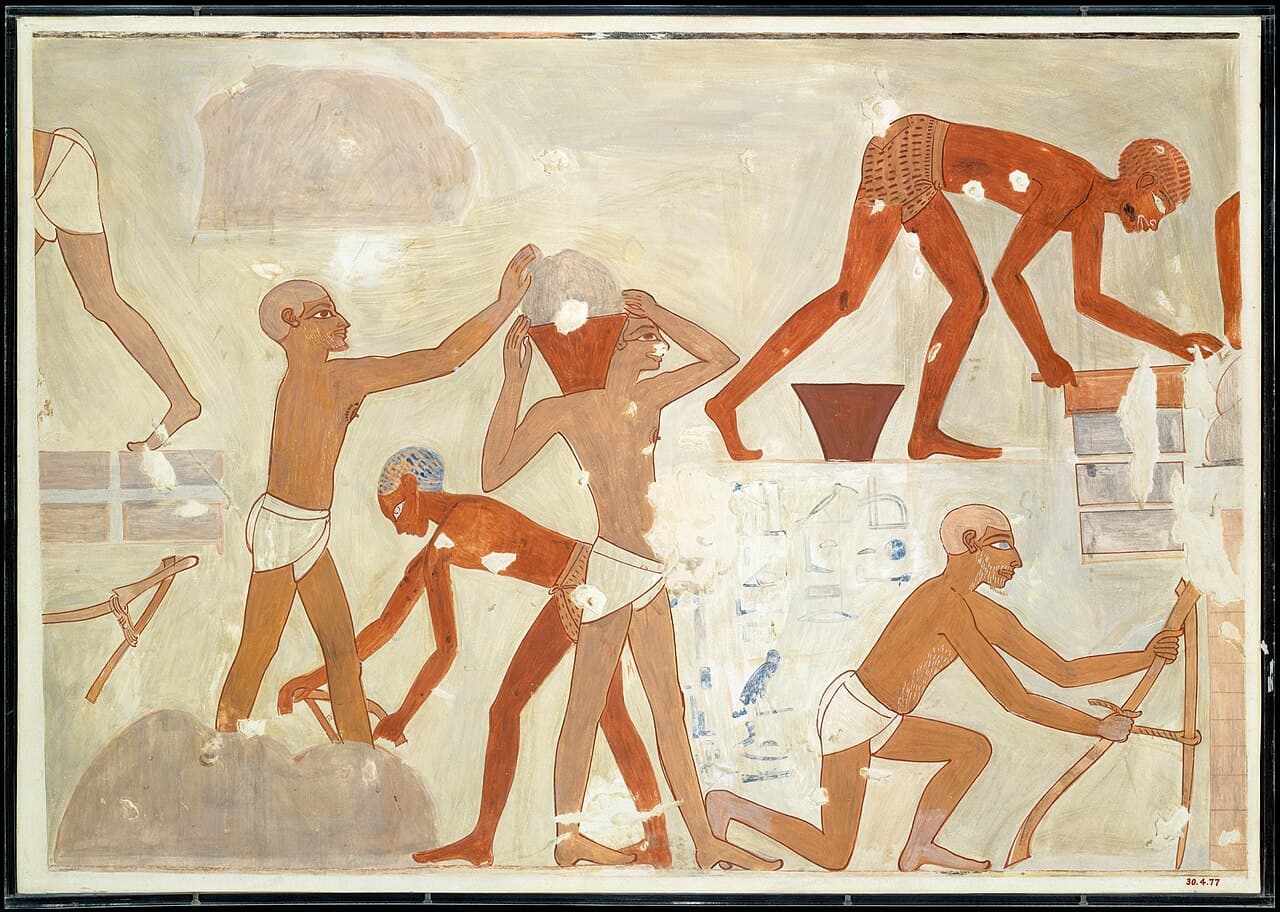
Brickmakers, from the tomb of Rekhmire at Thebes (about 1479 to 1425 BC), facsimile painted by Nina de Garis Davies, The Metropolitan Museum of Art, New York, 30.4.77. The tomb painting is public domain by date; the facsimile is released CC0 by the museum, via Wikimedia Commons, File:Brickmakers,_Tomb_of_Rekhmire_MET_DT10882.jpg.
THE ARTWORKThe tomb of Rekhmire, vizier under Thutmose III, shows the work of the brickfield in order: clay hoed and wetted, carried in jars, pressed into moulds and set out in rows to dry.
When Moses asked that the people go to worship, the king made their work harder.
Summary
The brickfields of Egypt were the works of the eastern Nile Delta where Israel made brick and built for Pharaoh.
- Exodus names two store cities of the labour, and their sites are still argued: Pithom at Tell el-Maskhuta or Tell Abu Suleyman, and Rameses most often at Qantir.
- In Exodus 5 Pharaoh took away the straw and held the people to the same number of bricks as before.
- Edouard Naville dug brick store chambers at Tell el-Maskhuta in 1883 and read the name Pithom on its stones.
- Scripture remembers Egypt as the iron furnace and the labour as a yoke from under which the LORD brought His people out.
Hard Service in Brick and Mortar
Exodus 1 sets the labour under a king who did not know Joseph.
A new king came to power in Egypt and feared that Israel, grown numerous, would join his enemies in a war.
So the Egyptians appointed taskmasters over the Israelites to oppress them with forced labor. As a result, they built Pithom and Rameses as store cities for Pharaoh.The verse is Pharaoh's answer to the fear of verse 10, and it names the cities that answer produced.
They worked the Israelites ruthlessly and made their lives bitter with hard labor in brick and mortar, and with all kinds of work in the fields. Every service they imposed was harsh.Brick and mortar are the first labour Egypt laid on Israel.
The words of the labourExodus 1:11 to 14 and Exodus 5:6
The Hebrew word for taskmasters is built on mas, H4522, which the lexicon defines as a burden, a tax in the form of forced labour. The store cities are cities of miskenah, H4543, a magazine, a word found seven times.
The word for ruthlessly is perek, H6531, severity. Bricks are levenah, H3843, which the lexicon derives from the whiteness of the clay, and the mortar is chomer, H2563, clay.
Rashi, the eleventh-century Jewish commentator of France, says in his commentary on Exodus 5:6 that the taskmasters were Egyptians and the foremen were Israelites. One taskmaster had charge of many foremen.
The word for foreman is shoter, H7860, which the lexicon defines as a scribe and by implication an official superintendent.
Adam Clarke notes that the taskmasters of Exodus 1:11 are called sarey missim, princes of the burdens, and that Exodus 5:6 uses another word, nogesim, exactors.
Moses sees the labourExodus 2:11
One day, after Moses had grown up, he went out to his own people and observed their hard labor. He saw an Egyptian beating a Hebrew, one of his own people.Moses' sight of one Hebrew beaten leads to the killing that drives him to Midian.
The Eastern Delta
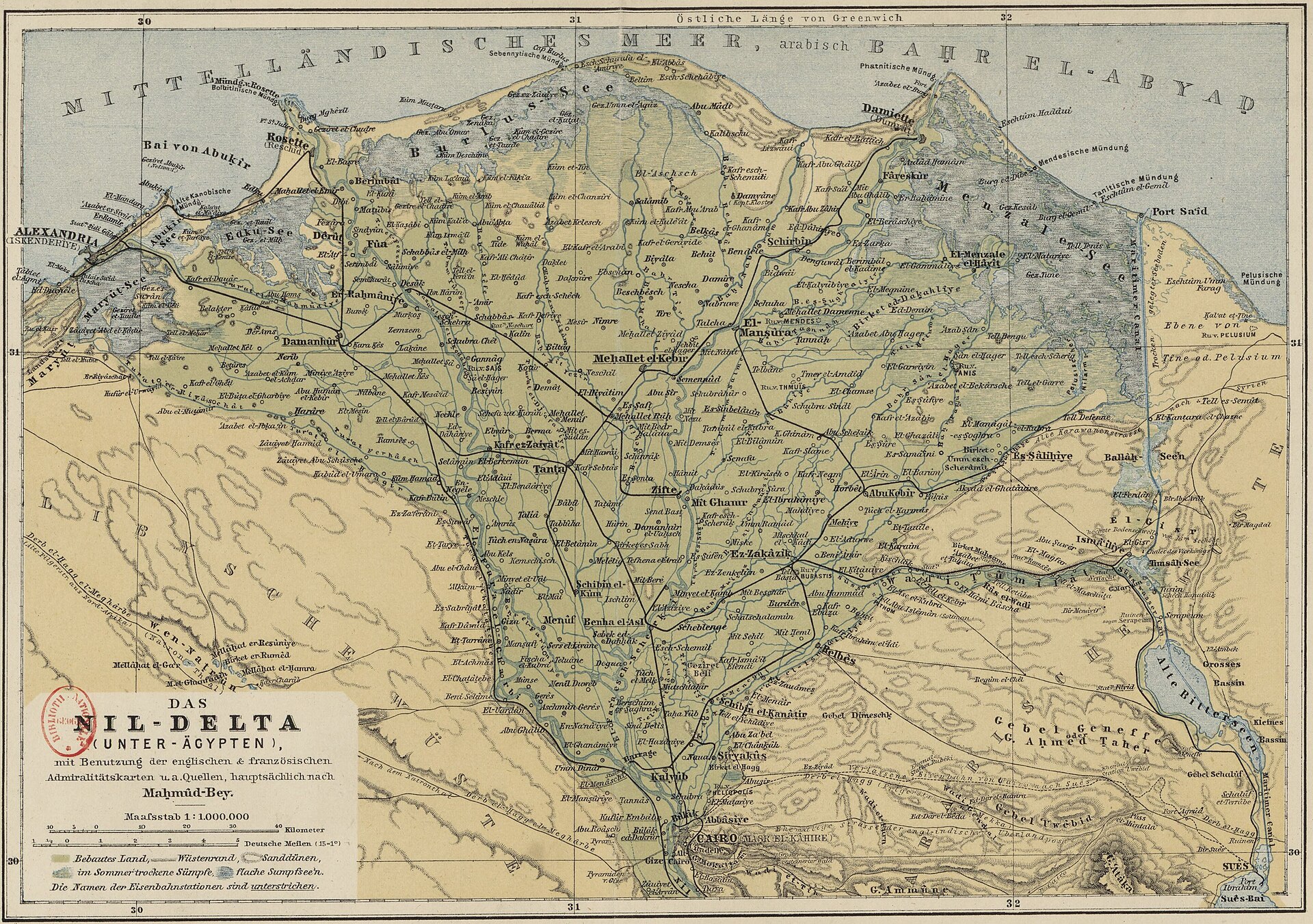
The store cities, Goshen and Succoth lie in the eastern Nile Delta, between the river and the Bitter Lakes.
- Located: the site is known
- Identified: the point stands for an area, or is rounded
50 km (31 miles)
- 1Rameses, Qantir, identified as Pi-Ramesse from Manfred Bietak's excavation, Probable Exodus 1:11
- 2Pithom, Tell el-Maskhuta; Naville, Proposed Exodus 1:11
- 3Pithom, Tell Abu Suleyman, west of Tell el-Maskhuta; Lepsius, as Naville reports him, Proposed Exodus 1:11
- 4Goshen, The eastern Delta with the Wadi Tumilat; Naville, Probable, as a region Genesis 47:6
- 5Succoth, Thuku, the district around Tell el-Maskhuta; Naville, Probable, as a region Exodus 12:37
Not placed: Pithom (3).
Base map: The Nile Delta (Lower Egypt), Ernst Debes, Wagner und Debes, Leipzig (19th century), public domain. Each place stands at its place page's coordinates, set on the plate by Bubastis and Suez, as the plate prints them.
Three proposed city sites and two regions, each with its certainty and the scholar who proposed it.
Pharaoh's Order on the Straw
Exodus 5 sets out Pharaoh's order to the taskmasters and what it cost the foremen.
After that, Moses and Aaron went to Pharaoh and said, “This is what the LORD, the God of Israel, says: ‘Let My people go, so that they may hold a feast to Me in the wilderness.’”Moses and Aaron brought the LORD's demand to Pharaoh for the first time.
But Pharaoh replied, “Who is the LORD that I should obey His voice and let Israel go? I do not know the LORD, and I will not let Israel go.”Pharaoh grounds his refusal on his ignorance of the LORD.
Make the work harder on the men so they will be occupied and pay no attention to these lies.”Pharaoh states the purpose of the order in his own words, to leave the men no room for the request.
| Stage | What the text says | Verse |
|---|---|---|
| Given | Until that day the people were supplied with straw for making bricks | Exodus 5:7 |
| Withdrawn | No straw was given, and the people had to get their own wherever they could find it | Exodus 5:11 |
| Required | The same quota of bricks as before, fulfilled each day and in no way reduced | Exodus 5:8 |
“May the LORD look upon you and judge you,” the foremen said, “for you have made us a stench before Pharaoh and his officials; you have placed in their hand a sword to kill us!”The foremen, beaten for the shortfall (Exodus 5:14), blamed Moses and Aaron.
So Moses returned to the LORD and asked, “Lord, why have You brought trouble upon this people? Is this why You sent me? Ever since I went to Pharaoh to speak in Your name, he has brought trouble on this people, and You have not delivered Your people in any way.”The LORD answers this complaint at the opening of chapter 6 with the promise to bring Israel out.
Rashi on the foremenExodus 5:14
Then the Israelite foremen, whom Pharaoh’s taskmasters had set over the people, were beaten and asked, “Why have you not fulfilled your quota of bricks yesterday or today, as you did before?”The verse shows Pharaoh's order falling first on the men answerable for the count.
Rashi says these foremen spared their brothers and did not press them, and so they bore the beating for the shortfall themselves.
He adds the teaching of Exodus Rabbah that for this kindness these foremen were later counted among the seventy elders of Numbers 11:16.
Josephus on the orderAntiquities of the Jews 2.13.4
In the Antiquities, the king stopped the chaff he had allowed for the bricks and made the Hebrews make bricks by day and gather chaff by night.
What the Text Says of the Labour
The verses answer what Israel built, what served for straw and what Pharaoh called the people, and later writers add to the first two.
STORE CITIES AND THE PYRAMIDS
Josephus, in Antiquities of the Jews 2.9.1, adds channels cut for the river, walls and ramparts built against its flood, and pyramids. His translator William Whiston noted that the larger pyramids seem much later and that the labour of the Israelites is said to have been in brick.
STUBBLE SERVED FOR STRAW
The people gathered the stubble of the fields to use as straw. Rashi says the straw was kneaded into the clay, and Albert Barnes dates the gathering to early spring, after the barley or wheat harvest.
PHARAOH CALLED THEM LAZY
Pharaoh twice took the request to sacrifice as proof that the people had too little work, and he called them slackers to their foremen's faces.
Brick in Ancient Egypt
A wall in a Theban tomb shows the brickfield at work.
The labour on this wall is the labour Exodus 1 and 5 name: clay, brick and the daily count.
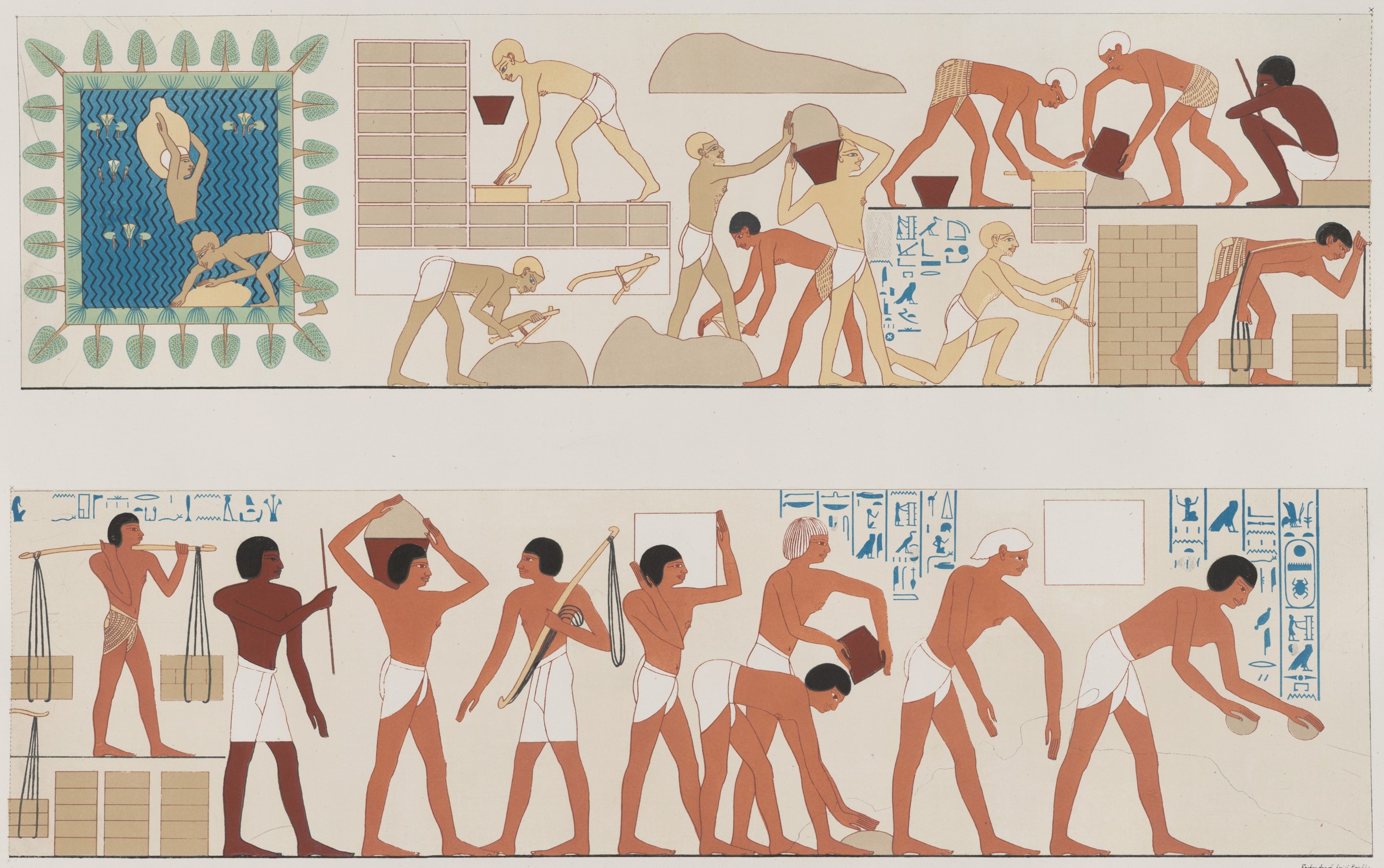
- The waterA jar filled with water
- Working the clayClay broken up with a hoeExodus 1:14
- Carrying the clayA load borne on the shoulderExodus 5:7
- Rows of bricksBricks standing in rowsExodus 5:8
- The mouldA man stooping over a mouldExodus 5:14
- The wallBricks laid course on course
- The yokeBricks slung from a yoke
- The rodA man holding a rod
Denkmaeler aus Aegypten und Aethiopien, Abtheilung III, Blatt 40 (Berlin, 1849), New York Public Library copy, trimmed to its painted bands. Public domain, via Wikimedia Commons.
Eight parts of the brickmaking scene in the tomb of Rekhmire at Thebes, from the 1849 copy.
Barnes on the straw and the brickAlbert Barnes
The loss of the straw multiplied the work, and Barnes explains why from the way the bricks were made.
“Some of the most ancient buildings in Egypt were constructed of bricks not burned, but dried in the sun; they were made of clay, or more commonly of mud, mixed with straw chopped into small pieces. An immense quantity of straw must have been wanted for the works on which the Israelites were engaged, and their labors must have been more than doubled by this requisition.”
Albert Barnes · Notes, Explanatory and Practical, on the Old and New Testaments (1832-1869) · on Exodus 5:7Evangelical
Brick as a royal monopolyJamieson, Fausset and Brown; Wilkinson
The Jamieson, Fausset and Brown commentary adds that brick-making appears to have been a government monopoly, since the ancient bricks are nearly all stamped with the name of a king.
J. G. Wilkinson, in his Manners and Customs of the Ancient Egyptians of 1837, read the hieroglyphs over a Theban painting of brickmakers as saying that the bricks were made for a building at Thebes. He held that the workers were foreign captives watched by taskmasters, and he called it an error to take them for Hebrews.
The Excavation of 1883
Edouard Naville dug Tell el-Maskhuta for the Egypt Exploration Fund and published his memoir in London in 1885.
The brick store chambersThe Store-City of Pithom, The Description of Pithom
North-east of the temple Naville came on thick walls of crude brick joined by thin layers of mortar. The walls stood two to three yards thick, smoothed as well as Nile mud allowed.
They enclosed rectangular chambers of various sizes with no passage from one to another. Naville took them for storehouses or granaries where the Pharaohs gathered provisions for armies about to cross the desert.
Rameses II and the storehousesThe Store-City of Pithom, The History of Pithom
Naville found nothing older than the monuments of Rameses II and held that this king built the city's enclosure and storehouses.
What the Text Leaves Unsaid
Exodus leaves three things about the labour unstated.
Exodus calls the king of the oppression Pharaoh and the king of Egypt, and it never gives his name.
Pharaoh's order fixes the quota by the count the people had met before, and the text never states that count.
Now the duration of the Israelites’ stay in Egypt was 430 years.The verse measures the whole stay in Egypt and leaves the years of hard service within it unmeasured.
The Iron Furnace
Deuteronomy, 1 Kings and Jeremiah give Egypt the same name.
Yet the LORD has taken you and brought you out of the iron furnace, out of Egypt, to be the people of His inheritance, as you are today.Moses names Egypt the iron furnace and the deliverance the making of a people for God's inheritance.
For they are Your people and Your inheritance; You brought them out of Egypt, out of the furnace for iron.Solomon pleads the same deliverance in his prayer for the people.
which I commanded your forefathers when I brought them out of the land of Egypt, out of the iron furnace, saying, ‘Obey Me, and do everything I command you, and you will be My people, and I will be your God.’Jeremiah joins the furnace to the covenant God spoke when Israel came out.
The furnace is kur, H3564, which the lexicon defines as a pot or furnace, a word found nine times.
The yoke and the basketExodus 6:6 and Psalm 81:6
Therefore tell the Israelites: ‘I am the LORD, and I will bring you out from under the yoke of the Egyptians and deliver you from their bondage. I will redeem you with an outstretched arm and with mighty acts of judgment.In the Berean text of Exodus this is the first verse to name the LORD as Israel's redeemer.
“I relieved his shoulder of the burden; his hands were freed from the basket.God speaks the deliverance from Egypt as the ground of the testimony the verse before says He ordained for Joseph.
Stephen before the councilActs 7:17 to 19
As the time drew near for God to fulfill His promise to Abraham, our people in Egypt increased greatly in number. Then another king, who knew nothing of Joseph, arose over Egypt. He exploited our people and oppressed our fathers, forcing them to abandon their infants so they would die.Stephen set the oppression inside God's keeping of His promise to Abraham.
Three Fathers on the Labour of Egypt
Three fathers of the fourth century drew lessons for the Christian life from the labour and from Moses' part in it.
Gregory of Nazianzus reads his own Passover hope in the bondage of Egypt.
“I have already lived through many paschs, which was the fruit of a long life. But now I desire a purer pasch: to depart from this Egypt, the heavy and dark Egypt of this life, and to be freed from the clay and bricks that held us in bondage and to pass over to the land of promise.”
Gregory of Nazianzus · LETTER 120 · on Exodus 1:14Patristic
Basil of Caesarea takes Pharaoh's charge of idleness and asks what leisure is for.
“Even Pharaoh knew that it was proper for one to seek God when he was unoccupied, and for this reason he reproached Israel: ‘You are unoccupied, you are idle, and you say, 'We shall offer prayers to the Lord, our God.' ‘ Now leisure itself is good and useful to him who is unoccupied, since it produces quiet for the acquisition of salutary doctrines. But the leisure of the Athenians was evil, ‘who used to spend all their leisure telling or listening to something new.’”
Basil of Caesarea · Exegetic Homilies 18.8 · on Exodus 5:17Patristic
Ambrose of Milan reads Moses' blow against the Egyptian who was beating a Hebrew as a victory first won within himself.
“Moses indeed killed the Egyptian and became a fugitive from the land of Egypt, in order to avoid the tyrant of that land. But he would not have killed that Egyptian man before he had first killed the Egyptian man of spiritual wickedness within himself, and had renounced the luxury of regal honors, considering the reproach of Christ a greater inheritance than the treasures of Egypt.”
Ambrose of Milan · On Cain and Abel 2.4.14 · on Exodus 2:12Patristic
The Sites and the Date in Dispute
Three readings place Pithom, and two dates place the labour.
Pithom at Tell el-MaskhutaEdouard Naville, The Store-City of Pithom (1885)
Inscriptions from the mound gave the name Pi Tum, the abode of the god Tum. Naville held the identification with the Pithom of Exodus 1:11 to rest on them, from the reign of Rameses II to Ptolemy Philadelphus. The objection: Lepsius argued that a Pi Tum already stood at Tell Abu Suleyman, and that two cities so near each other could not share one name.
Pithom at Tell Abu SuleymanLepsius, in the Zeitschrift of Berlin, as Naville reports it (1885)
Lepsius had identified Tell el-Maskhuta with Rameses in 1849, taking Rameses II, carved between the gods Ra and Tum on its monolith, for the god of the place. After Naville's dig he held to that view and looked for Pithom farther west. The objection: Naville answered that the argument takes for granted the very point under discussion.
Pithom near Heliopolis and Rameses at HeroopolisJamieson, Fausset and Brown, Commentary (1871), on Exodus 1:11
Jamieson, Fausset and Brown place Pithom on the eastern Pelusiac branch of the Nile, about twelve Roman miles from Heliopolis. They identify Rameses with Heroopolis, as the Septuagint names it, between that branch and the Bitter Lakes. The objection: a Latin inscription Naville found at Tell el-Maskhuta reads ERO CASTRA, the camp of Ero. Naville held that Pithom took the name Heroopolis under the Greek kings, which the Romans shortened to Ero.
The early date, about 1446 BCEugene Merrill, Kingdom of Priests (1987); Bryant Wood, The Rise and Fall of the 13th-Century Exodus-Conquest Theory (2005)
1 Kings 6:1 counts 480 years from the exodus to the fourth year of Solomon, and on that count the exodus falls under Amenhotep II. On the name Rameses, the holders point to Genesis 47:11, which already calls the district of Jacob's family the district of Rameses, so Exodus 1:11 can give the name later readers knew. The objection: no king bore the name Rameses before the Nineteenth Dynasty.
The late date, in the thirteenth century BCKenneth Kitchen, On the Reliability of the Old Testament (2003); James Hoffmeier, Israel in Egypt (1996)
The holders identify the store city Rameses with Pi-Ramesse, the capital Rameses II built, and they read the 480 years of 1 Kings 6:1 as twelve generations of forty. The objection: Jephthah counts three hundred years of Israel in the land in Judges 11:26, which agrees with the longer count.
The One Who Gives Rest
Exodus 2:24 says that God heard the groaning of Israel and remembered His covenant with Abraham, Isaac and Jacob.
Come to Me, all you who are weary and burdened, and I will give you rest. Take My yoke upon you and learn from Me; for I am gentle and humble in heart, and you will find rest for your souls. For My yoke is easy and My burden is light.”Israel left its yoke of brick in Egypt, and Christ offers rest to the weary.
It is for freedom that Christ has set us free. Stand firm, then, and do not be encumbered once more by a yoke of slavery.The next two verses show that Paul means circumcision taken as an obligation to obey the whole law.