
Leviticus 13 · Leviticus 14 · Subject · Featured Study
Tsara'at: the affliction of Leviticus 13 and 14
Leviticus 13 and 14 have a priest examine a mark on the skin, on cloth or on a house, and they set out the cleansing that brings the healed back into the camp.
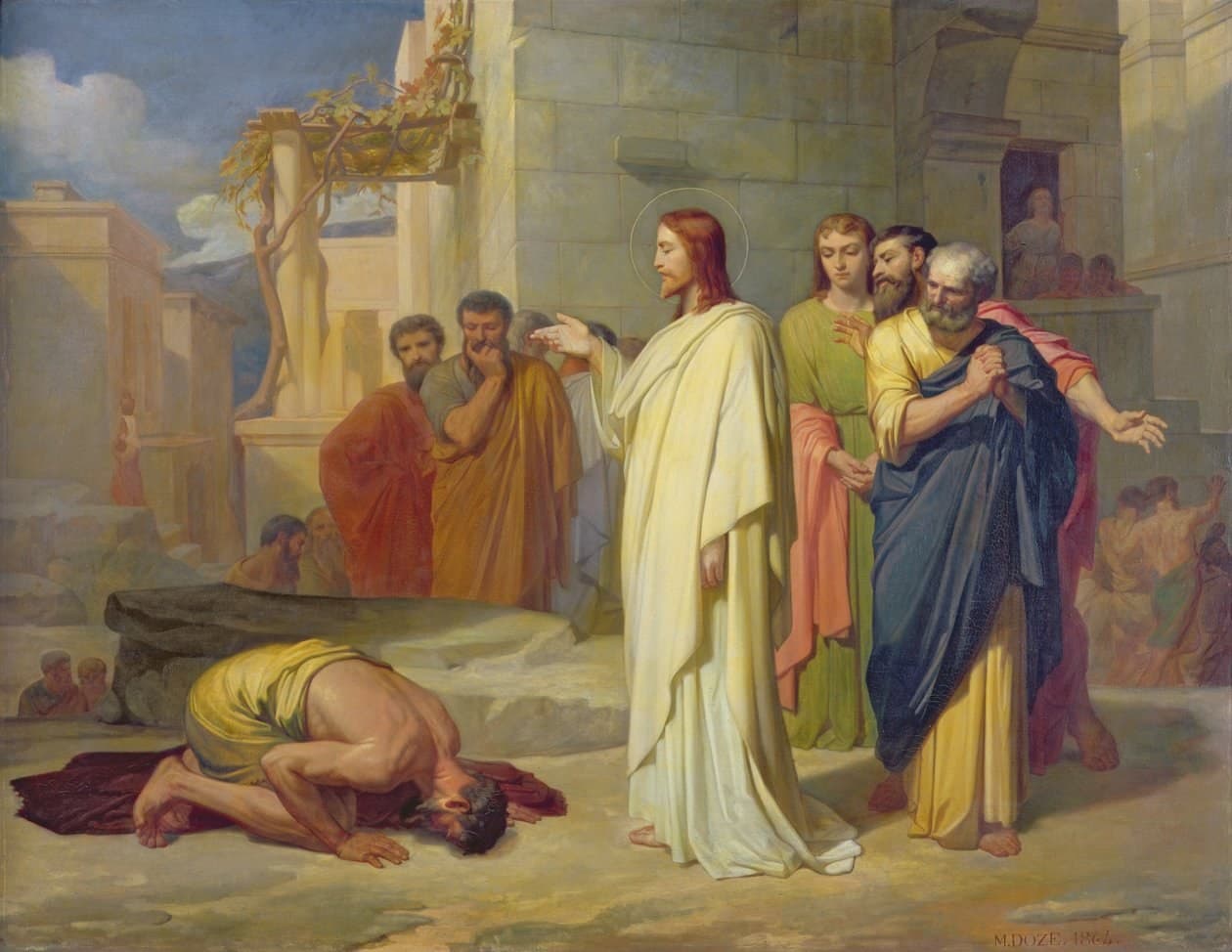
Jean-Marie Melchior Doze, Jesus Healing the Leper, 1864, signed and dated on the canvas. Public domain by date (published before 1930), via the Internet Archive.
THE ARTWORKDoze painted the leper bowed to the ground before Jesus, who stretches out His hand toward him as the disciples look on.
The law that judged a spot on a man's skin also judged a green or red mark in his clothes.
Summary
Tsara'at is the Hebrew name for the affliction, and only a priest could pronounce the one who had it clean or unclean.
- A diseased person had to wear torn clothes, cry out ‘Unclean, unclean!’ and live alone in a place outside the camp.
- Miriam in Numbers, and Naaman, Gehazi and King Uzziah in the histories, are struck with the affliction or healed of it.
- Jesus touched a leper, made him clean, and sent him to the priest with the offering Moses prescribed.
Seven Passages on Tsara'at
The law gives the affliction two chapters, and the histories show it striking a prophetess, a foreign commander and a king.
“When someone has a swelling or rash or bright spot on his skin that could become an infectious skin disease, he must be brought to Aaron the priest or to one of his sons who is a priest.The law opens with the three marks that send a person to the priest.
A diseased person must wear torn clothes and let his hair hang loose, and he must cover his mouth and cry out, ‘Unclean, unclean!’ As long as he has the infection, he remains unclean. He must live alone in a place outside the camp.These verses set the dress, the cry and the dwelling of the one pronounced unclean.
If any fabric is contaminated with mildew—any wool or linen garment,The law turns here from the body to garments of wool and linen.
“When you enter the land of Canaan, which I am giving you as your possession, and I put a contamination of mildew into a house in that land,Here the law turns from cloth to the house, and from the camp to the land of Canaan.
As the cloud lifted from above the Tent, suddenly Miriam became leprous, white as snow. Aaron turned toward her, saw that she was leprous,The camp does not move on until Miriam has spent seven days outside it, as verse 15 records.
So Naaman went down and dipped himself in the Jordan seven times, according to the word of the man of God, and his flesh was restored and became like that of a little child, and he was clean.An Aramean commander is made clean at the word of Elisha, with no priest and no birds.
Uzziah, with a censer in his hand to offer incense, was enraged. But while he raged against the priests in their presence in the house of the LORD before the altar of incense, leprosy broke out on his forehead.Verse 21 records that the king lived in isolation until his death, cut off from the house of the LORD.
The Examination and the Cleansing
The examination takes six steps in Leviticus 13, and the cleansing takes six in Leviticus 14.
- What the priest does
- A swelling, rash or bright spot is brought to Aaron.
- Verse
- Leviticus 13:2
- What the priest does
- White hair in the spot and a sore deeper than the skin mean the person is unclean.
- Verse
- Leviticus 13:3
- What the priest does
- A white spot no deeper than the skin, its hair not turned white, is isolated.
- Verse
- Leviticus 13:4
- What the priest does
- He isolates the person seven days more when the mark is unchanged and has not spread.
- Verse
- Leviticus 13:5
- What the priest does
- A sore that has faded and not spread is a rash; the person washes his clothes and is clean.
- Verse
- Leviticus 13:6
- What the priest does
- If the rash spreads after that, the priest looks once more and pronounces him unclean.
- Verse
- Leviticus 13:7 to 8
Six numbered cards joined by arrows.
- What is done
- He goes outside the camp and finds that the skin disease has healed.
- Verse
- Leviticus 14:3
- What is done
- The rite of the first day, drawn below.
- Verse
- Leviticus 14:4 to 8
- What is done
- He shaves his head, his beard and his eyebrows, washes his clothes and bathes again.
- Verse
- Leviticus 14:9
- What is done
- He brings two male lambs, a ewe lamb, flour and a log of oil to the Tent of Meeting.
- Verse
- Leviticus 14:10 to 12
- What is done
- The guilt offering's blood, then oil, is put on his right earlobe, thumb and big toe.
- Verse
- Leviticus 14:14 to 18
- What is done
- The sin offering, the burnt offering and the grain offering are made, and he is clean.
- Verse
- Leviticus 14:19 to 20
Six steps.
From the Camp to the Tent of Meeting
Leviticus 14 brings the healed man back first to the camp and then to the Tent of Meeting.
A drawing marks seven parts of the first day's rite in Leviticus 14:4 to 8, from the two birds to the healed man's return to the camp.
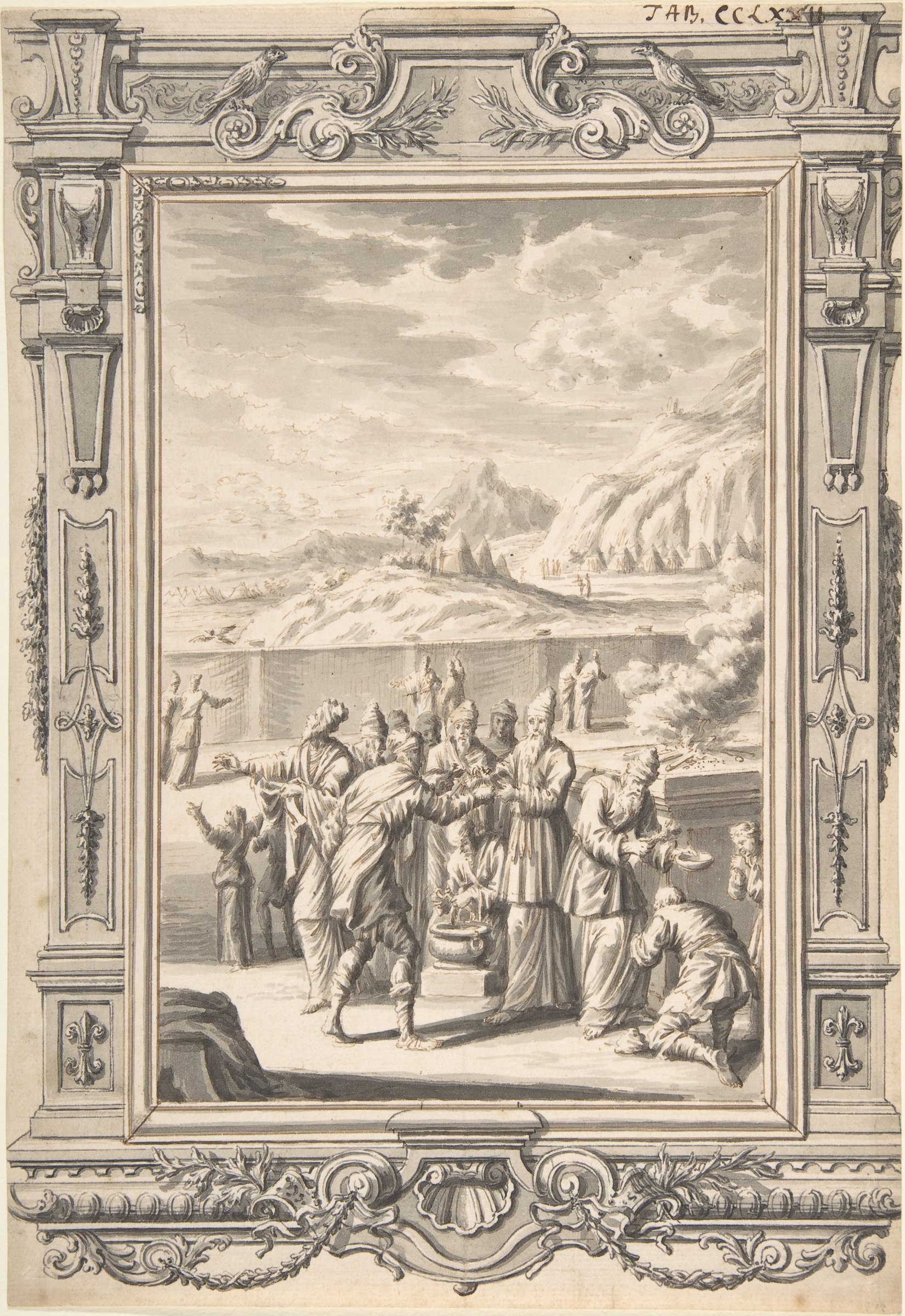
- The two live birdsbrought to the priestLeviticus 14:4
- The bird held over the potone bird is slaughtered hereLeviticus 14:5
- The clay potfresh water under the bloodLeviticus 14:5
- The priest's bundlethe cedar, yarn and hyssop dipped in the bloodLeviticus 14:6
- The one sprinkledseven times, then pronounced cleanLeviticus 14:7
- The live bird let gointo the open fieldLeviticus 14:7
- The camphe may enter it after washingLeviticus 14:8
Johann Daniel Preissler, Johann Melchior Füssli and Matthias Scheits, ‘The law of the leper in the day of his cleansing’, about 1730. Public domain by age; The Metropolitan Museum of Art.
Each label carries its verse in Leviticus 14.
Two stages of the returnLeviticus 14:8 to 11
“The leper was excluded not only from the sanctuary but from the camp. The ceremony of restoration which he had to undergo was therefore twofold. The first part, performed outside the camp, entitled him to come within and to mix with his brethren, Lev 14:3-9. The second part, performed in the court of the tabernacle and separated from the first by an interval of seven days, restored him to all the privileges of the covenant with Yahweh, Lev. 14:10-32.”
Albert Barnes · Notes, Explanatory and Practical, on the Old and New Testaments (1832-1869) · on Leviticus 14:1Evangelical
The earlobe, the thumb and the toeLeviticus 8:23 and 14:14
Moses slaughtered the ram and took some of its blood and put it on Aaron’s right earlobe, on the thumb of his right hand, and on the big toe of his right foot.Leviticus 14:14 puts the blood of the cleansed man's guilt offering on the same three places as at the ordination of the priests.
The poor man's offeringLeviticus 14:21 to 32
If, however, the person is poor and cannot afford these offerings, he is to take one male lamb as a guilt offering to be waved to make atonement for him, along with a tenth of an ephah of fine flour mixed with olive oil for a grain offering, a log of olive oil, and two turtledoves or two young pigeons, whichever he can afford, one to be a sin offering and the other a burnt offering.The law lowers the cost of the eighth day and keeps the lamb of the guilt offering.
“But it is observable that though a meaner sacrifice was accepted from the poor, yet the very same ceremony was used for them as was for the rich; for their souls are as precious and Christ and his gospel are the same to both. Let not us therefore have the faith of our Lord Jesus Christ with respect of persons, Jam. ii.”
Matthew Henry · Commentary on the Whole Bible · on Leviticus 14:21 to 22Puritan
Cloth and housesLeviticus 13:47 to 59 and 14:33 to 53
On the seventh day the priest shall reexamine it, and if the mildew has spread in the fabric, weave, knit, or leather, then regardless of how it is used, it is a harmful mildew; the article is unclean. He is to burn the fabric, weave, or knit, whether the contaminated item is wool or linen or leather. Since the mildew is harmful, the article must be burned up.A mark that spreads in cloth or leather ends in the fire, and no offering is named.
Then he shall take the cedar wood, the hyssop, the scarlet yarn, and the live bird, dip them in the blood of the slaughtered bird and the fresh water, and sprinkle the house seven times. And he shall cleanse the house with the bird’s blood, the fresh water, the live bird, the cedar wood, the hyssop, and the scarlet yarn. Finally, he is to release the live bird into the open fields outside the city. In this way he will make atonement for the house, and it will be clean.A house the priest pronounces clean is cleansed with the two birds, as the healed man was.
What the Text Says and What Is Often Said
Two things a reader may suppose about the leper are answered by the verse beside each.
FROM HEAD TO FOOT
A reader may suppose that a leper stayed unclean however far the disease spread. Verse 13 has the priest pronounce clean the person whose whole body has turned white. Adam Clarke, in his Commentary on the Bible, takes the partial and the total forms as different kinds or stages of the disease.
THE PRIEST EXAMINES
A reader may suppose that the priest healed the leper. John Wesley, in his Explanatory Notes upon the Old Testament, ascribes the healing to God and the cleansing to the priest's rite.
Outside the Camp
The law sent the unclean outside the camp, and the Mishnah later set rules for the inspection and the rite.
Sent out of the campNumbers 5:2 to 3
“Command the Israelites to send away from the camp anyone with a skin disease, anyone who has a bodily discharge, and anyone who is defiled by a dead body. You must send away male and female alike; send them outside the camp so they will not defile their camp, where I dwell among them.”The reason the law gives for the exclusion is the LORD's dwelling among the people.
Those who lived apart2 Kings 7:3; Luke 17:12 to 13
Now there were four men with leprosy at the entrance of the city gate, and they said to one another, “Why just sit here until we die?Shut outside Samaria in the siege, these four men become the ones who bring the city its good news.
As He entered one of the villages, He was met by ten lepers. They stood at a distance and raised their voices, shouting, “Jesus, Master, have mercy on us!”Luke sets the law of Leviticus 13:46 in a village of Jesus' day.
Who may look and who may declareMishnah Negaim 3:1
The Mishnah, in Negaim 3:1, allows anyone to inspect a mark and only a priest to declare it clean or unclean.
The rite as the Mishnah sets it outMishnah Negaim 14:1
In Negaim 14:1 the water is a quarter of a log in a new earthen flask, and the slaughtered bird is buried in the man's presence. The cedar and the hyssop are bound with the scarlet wool, dipped with the wing tips and tail of the live bird, and sprinkled seven times on the back of his hand.
The Words of the Affliction
Three words from the lexicon, each in a verse where it stands
TSARA'AT, THE AFFLICTION (HEBREW, H6883)
The lexicon gives leprosy and counts 35 uses.
NEGA, MARK OR STROKE (HEBREW, H5061)
The lexicon gives a blow, and by implication a spot, and counts 78 uses.
TSARA, TO BE STRICKEN (HEBREW, H6879)
The lexicon gives to be stricken with leprosy and counts 20 uses. In this verse its participle names Gehazi as he leaves Elisha.
What Leviticus Leaves Unsaid
Three questions the two chapters leave open
How the disease was healedLeviticus 14:3
The law tells the priest to look for healing and prescribes no treatment for the disease.
Whether it passed from body to bodyLeviticus 13:46
The chapters send the unclean person to live alone outside the camp and do not say whether the disease passed from one body to another.
What the two birds stand forLeviticus 14:7
Leviticus 14 says what is done with the two birds and does not say what they signify.
The Lepers Cleansed in the Gospels
Jesus cleansed lepers by touch and by word, and He still sent them to the priests.
Moved with compassion, Jesus reached out His hand and touched the man. “I am willing,” He said. “Be clean!” And immediately the leprosy left him, and the man was cleansed. Jesus promptly sent him away with a stern warning: “See that you don’t tell anyone. But go, show yourself to the priest and present the offering Moses prescribed for your cleansing, as a testimony to them.”The touch comes first in this account, and the command to show himself to the priest follows it.
When Jesus saw them, He said, “Go, show yourselves to the priests.” And as they were on their way, they were cleansed.Here the cleansing comes while the ten obey, before any priest has seen them.
The blind receive sight, the lame walk, the lepers are cleansed, the deaf hear, the dead are raised, and the good news is preached to the poor.Jesus names the cleansing of lepers among the works He has John the Baptist told of in prison.
Three Teachers on the Cleansed Leper
Three teachers, from the second century to the eighteenth, read the leper's cleansing in the light of Christ.
“And the offering of fine flour, sirs,’ I said, ‘which was prescribed to be presented on behalf of those purified from leprosy, was a type of the bread of the Eucharist, the celebration of which our Lord Jesus Christ prescribed, in remembrance of the suffering which He endured on behalf of those who are purified in soul from all iniquity, in order that we may at the same time thank God for having created the world, with all things therein, for the sake of man, and for delivering us from the evil in which we were, and for utterly overthrowing principalities and powers by Him who suffered according to His will.”
Justin Martyr · Dialogue with Trypho, Chapter XLI · on Leviticus 14:10Patristic
“And why did he touch him, since the law forbade the touching of a leper? He touched him to show that ‘all things are clean to the clean.’ Because the filth that is in one person does not adhere to others, nor does external uncleanness defile the clean of heart.”
Origen of Alexandria · Fragments on Matthew 2.2-3 · on Mark 1:41Patristic
“And this was all that the law could do, in that it was weak through the flesh; it taught the leper to cry, Unclean, unclean, but the gospel has put another cry into the lepers' mouths, Luke xvii. 12, 13 , where we find ten lepers crying with a loud voice, Jesus, Master, have mercy on us. The law only shows us our disease; the gospel shows us our help in Christ.”
Matthew Henry · Commentary on the Whole Bible · on Leviticus 13:45Puritan
Whether Tsara'at Is Leprosy
Christian commentators and the rabbis give three readings, each with an objection drawn from the text.
A disease of the skin known to physiciansAdam Clarke, Commentary on the Bible, on Leviticus 13:2; Albert Barnes, Notes, Explanatory and Practical, on Leviticus 13:12
The objection is that the law applies the word to cloth, leather and the walls of a house, which no disease of the body reaches.
A plague sent for sin, slander firstTalmud Arakhin 16a; Rashi on Leviticus 13:46 and 14:4
Rabbi Yohanan, as the Talmud reports him in Arakhin 16a, names seven sins for which the marks come, and slander stands first. Rashi, on Leviticus 13:46, says the one who parted others by slander must dwell apart, and on Leviticus 14:4 he says that birds are brought because they chatter.
In cases of infectious skin diseases, be careful to diligently follow everything the Levitical priests instruct you. Be careful to do as I have commanded them. Remember what the LORD your God did to Miriam on the journey after you came out of Egypt.Moses joins the law of skin disease to the memory of what the LORD did to Miriam.
The objection is that Leviticus 13 names no sin and gives one law for anyone who has the mark.
An uncleanness that pictured sinAlbert Barnes, Notes, Explanatory and Practical, on Leviticus 13:45; Adam Clarke, Commentary on the Bible, on Leviticus 14:53
Barnes calls the leper a living parable of the sin of which death is the wages. Clarke holds that the disease was strongly emblematical of sin, and he says the released bird might as well be called the scape-bird.
The objection is that the two chapters give the rite without drawing a lesson from it, and Barnes himself notes that the law for cloth prescribes no rite at all.
Books on Tsara'at
Four works on the affliction are free to read online, from the Mishnah to Matthew Henry.
The Mishnah, tractate Negaim
The rabbis of the Mishnah · about 200
Its fourteen chapters set out the examination of the marks and the rite of cleansing.
Read it on SefariaThe Babylonian Talmud, tractate Arakhin
The rabbis of the Talmud · about 500
The tractate treats the vows of a person's value in Leviticus 27, and folio 16a turns to the marks.
Read it on SefariaCommentary on the Torah
Rashi · eleventh century
Rashi reads Leviticus 13 and 14 verse by verse, often with its source in the Sifra.
Read it on SefariaCommentary on the Whole Bible, volume 1
Matthew Henry · 1710
The first volume covers Genesis to Deuteronomy chapter by chapter.
Read it on CCELClean Outside the Gate
The law kept the unclean outside the camp until a priest pronounced them clean.
And so Jesus also suffered outside the city gate, to sanctify the people by His own blood. Therefore let us go to Him outside the camp, bearing the disgrace He bore.The letter calls the reader out to Christ in the place the law kept for the unclean.
For if the blood of goats and bulls and the ashes of a heifer sprinkled on those who are ceremonially unclean sanctify them so that their bodies are clean, how much more will the blood of Christ, who through the eternal Spirit offered Himself unblemished to God, purify our consciences from works of death, so that we may serve the living God!The letter argues from the lesser cleansing to the greater one.
Keep studying
Read it5