
Judith 1 to 16 · Apocrypha · A Study Resource Beside the Canon
Judith
A book of the Apocrypha in sixteen chapters, in which a widow of Bethulia goes out to the Assyrian camp and the town is delivered.
Clement of Rome held up Judith to the church at Corinth as an example of courage, in a letter of about AD 96.
- Date
- about the middle of the second century BC, by Cowley's dating; Ball proposed 79 to 70 BC (probable)
- Occasion
- The book tells how a widow of Bethulia delivered her town from the army of Holofernes, and it was written for Jewish readers in Hebrew, now lost.
- Edition
- Judith in the King James Version Apocrypha, 1769 text (eBible.org), from the store; the Berean Standard Bible for the canon
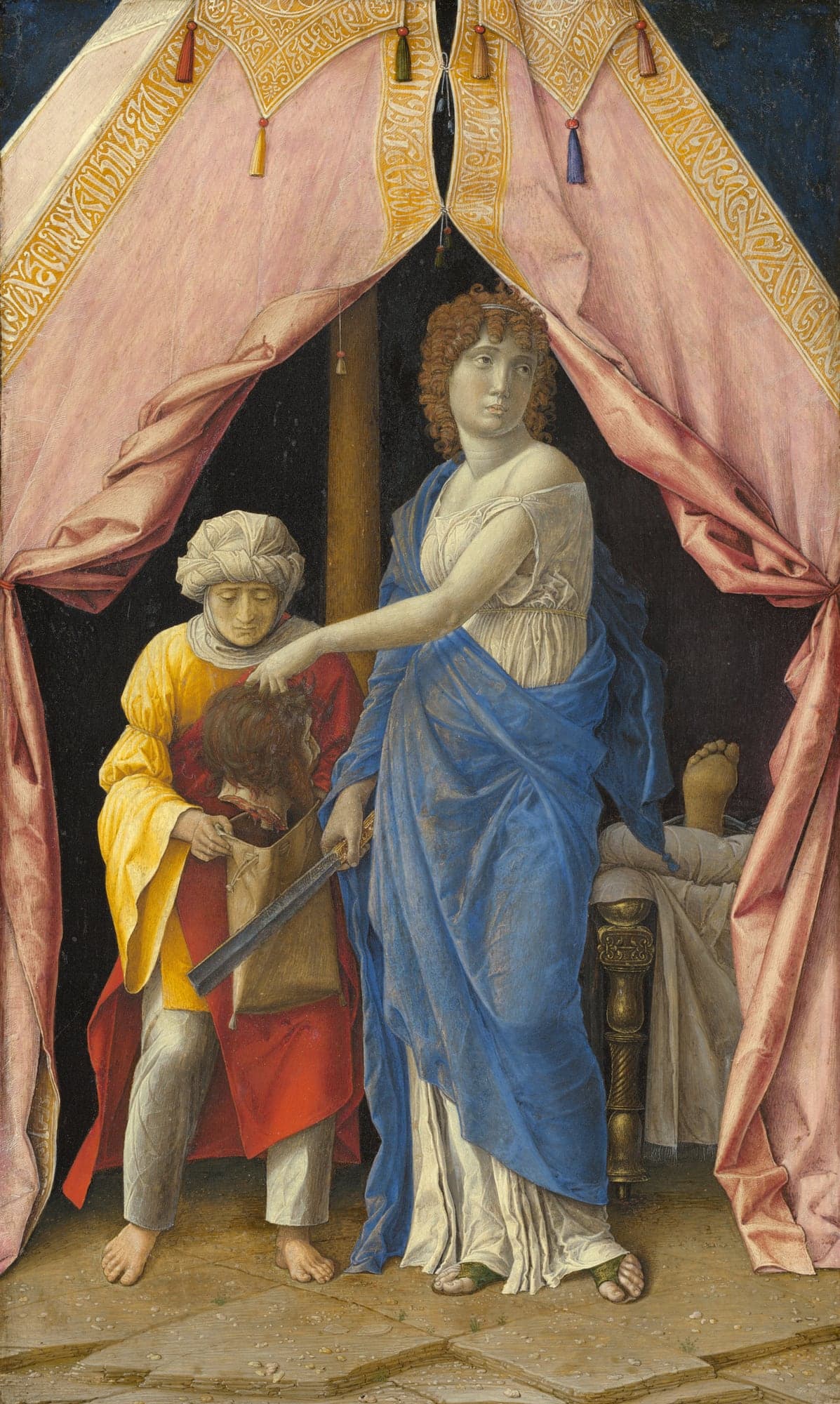
Andrea Mantegna or a follower (possibly Giulio Campagnola), Judith with the Head of Holofernes, c. 1495 to 1500, National Gallery of Art. Public domain; CC0 (NGA open access), via Wikimedia Commons.
THE ARTWORKThe panel shows Judith 13:9 to 10, where Judith gives the head of Holofernes to her maid and the maid puts it in her bag of meat. It stands here because the whole book turns on that night in the tent.
Summary
Judith is a book of sixteen chapters that the Catholic and Orthodox churches receive as Scripture and the Hebrew canon leaves out. Cowley gives the heroine's name as meaning a Jewish woman, though Esau's Hittite wife bears the same name at Genesis 26:34.
- Chapters 1 to 7 tell the campaign of Holofernes and the siege of Bethulia; chapters 8 to 16 tell how the widow Judith went out to his camp and came home with his head.
- Cowley (1913) held that the book was written in Hebrew, now lost, about the middle of the second century BC, and that it survives in Greek.
- Its first verse sets Nebuchadnezzar on the throne at Nineveh, and readers differ on whether the book records history, history under other names, or a story set in a historical frame.
- Trent (1546) lists Judith among the books of the Old Testament, Article VI (1571) reads it for example of life and not for doctrine, and Westminster (1646) gives it no authority.
- Moses Isserles records a Jewish custom of eating cheese at Hanukkah for the milk Judith gave the enemy.
The Book of Judith
Sixteen chapters from the Greek Old Testament, read beside the Bible as a study resource.
Judith tells of a widow of the town of Bethulia who saved her people from an Assyrian army. The book stands in the Greek Old Testament the early church read, and in the Apocrypha of the 1611 King James Bible.
The site holds the sixty-six books of the Bible as Scripture and reads Judith beside them. Judith is quoted from the King James Version Apocrypha, 1769 text, with chapter and verse.
The oldest Christian use of the book names Judith beside Esther.
“Many women, fortified by the grace of God, have accomplished many heroic actions. The blessed Judith, when the city was besieged, asked permission of the elders to be allowed to go into the foreigners' camp. By exposing herself to danger she went out for love of her country and of the people who were besieged, and the Lord delivered Holophernes into the hand of a woman. To no less danger did Esther, who was perfect in faith, expose herself, in order to save the twelve tribes of Israel that were to be destroyed.”
Clement of Rome · 1 CLEMENT 55.3-6 · on Esther 4:16Patristic
The Book at a Glance
The first seven chapters build the threat, and the last nine tell the deliverance.
Judith falls into two halves: five acts of threat in chapters 1 to 7, and seven acts of deliverance in chapters 8 to 16.
- The war on the MedesChapter 1: Nebuchadnezzar defeats Arphaxad of the Medes.
- The march westChapters 2 and 3: Holofernes marches west with 120,000 foot and 12,000 horse.
- The passChapter 4: Israel fasts, and the high priest Joacim orders Bethulia to hold the pass.
- Achior's warningChapters 5 and 6: Achior the Ammonite warns Holofernes and is left bound below Bethulia.
- Five daysChapter 7: the army seizes the springs, and the elders agree to yield in five days.
- The widowChapter 8: Judith rebukes the elders for their oath.
- The prayerChapter 9: Judith prays for the town.
- Into the campChapters 10 and 11: she wins the trust of Holofernes.
- The fourth nightChapters 12 and 13: at his feast on the fourth day she kills him.
- The routChapters 14 and 15: Israel attacks at dawn and the Assyrians scatter.
- The thanksgivingChapter 16: Judith sings her hymn of thanks.
- Her old ageChapter 16: she is honoured in her town until her death.
A sequence of twelve acts in the book's order, each with its chapters.
The deliverance takes more of the book than the threat: 193 verses against 146.
The two counts as a table
| Half | Verses | Verse |
|---|---|---|
| Chapters 1 to 7, the threat | 146 | |
| Chapters 8 to 16, the deliverance | 193 |
Two bars from zero, in verses of the English text quoted here.
The Story
A town without water, a widow who will not wait five days, and a night in the enemy's tent.
Holofernes camps below Bethulia and takes its springs. After thirty-four days the cisterns are empty, and the governor Ozias promises the people to give up the town if no help comes in five days (Judith 7:20 and 7:30).
Judith had been a widow three years and four months, fasting and wearing sackcloth (Judith 8:4 to 6). She calls the elders and tells them their oath was wrong, because it set a day for God to act, and asks who they are to put God to the test (Judith 8:11 to 12).
She prays at the hour of the evening incense in Jerusalem (Judith 9:1) and goes down to the camp with her maid.
At his banquet Holofernes drinks more wine than he has ever drunk in one day (Judith 12:20). Left alone with him, Judith takes down his own sword from the bedpost (Judith 13:6): "she smote twice upon his neck with all her might, and she took away his head from him" (Judith 13:8).
The head is hung on the town wall, the Assyrian camp finds its general dead, and the army flees (Judith 14:11 to 15:3).
She goes home to Bethulia, never remarries, frees her maid, and dies at 105 (Judith 16:21 to 23).
Judith Beside the Canon
Judith's phrase, her father and her song each have a source in the canon.
Judith repeats a phrase of Judges 4 three times: in her prayer, when she shows the head, and in her song (Judith 9:10, 13:15 and 16:6).
“I will certainly go with you,” Deborah replied, “but the road you are taking will bring you no honor, because the LORD will be selling Sisera into the hand of a woman.” So Deborah got up and went with Barak to Kedesh,Deborah's word gives the phrase Judith takes up.
Most blessed among women is Jael, the wife of Heber the Kenite, most blessed of tent-dwelling women.Deborah's song blesses Jael among women, as Ozias blesses Judith above all women at Judith 13:18.
Judith prays to the God of her father Simeon, who was given a sword to avenge the defiling of a maid (Judith 9:2). She means Simeon's sword at Shechem after Dinah was defiled.
Three days later, while they were still in pain, two of Jacob’s sons (Dinah’s brothers Simeon and Levi) took their swords, went into the unsuspecting city, and slaughtered every male.Her song opens with timbrels and cymbals (Judith 16:2), as Miriam led the women with tambourines after the sea.
Then Miriam the prophetess, Aaron’s sister, took a tambourine in her hand, and all the women followed her with tambourines and dancing.Her song says at Judith 16:16 that every sacrifice is too little for God, and Adam Clarke took the line for an imitation of Isaiah 40:16.
“And Lebanon is not sufficient - The image is beautiful and uncommon. It has been imitated by an apocryphal writer, who however comes far short of the original: - ‘For all sacrifice is too little for a sweet savor unto thee: And all the fat is not sufficient for thy burnt-offering.’ Judith 16:16. Does not the prophet mean here that all the burnt-offerings and sacrifices that could be offered were insufficient to atone for sin?”
Adam Clarke · Commentary on the Bible · on Isaiah 40:16Evangelical
Where the Book Came From
A Hebrew book now lost, a Greek text in three forms, and a date argued from its contents.
A. E. Cowley, writing in R. H. Charles's Apocrypha and Pseudepigrapha, held that Judith was written in Hebrew for Jewish readers. The Hebrew is lost, and the book survives in a Greek translation in three forms, from which the Old Latin and the Syriac were made.
Jerome made his Latin from an Aramaic copy. Origen, as Cowley reports him, said the Jews of his day did not use the book.
Cowley dated the book to about the middle of the second century BC, with Schürer, Hilgenfeld and Nöldeke, on three grounds. The author writes his own day into the story: Israel has no king, and the high priest Joakim governs with a council of elders. The book was written to make a people hold out against the enemies of their religion in a desperate hour. Its theology is that of the Pharisees, and Judith keeps even the eves of the Sabbaths and the new moons (Judith 8:6).
He reported Ball's later date of about 79 to 70 BC. Clement of Rome cites the book near the end of the first century AD, so the Greek was in use by then.
The book's setting joins names from three ages. Its first verse puts "Nabuchodonosor, who reigned in Nineve" against Arphaxad of the Medes (Judith 1:1), and chapter 4 has the people "newly returned from the captivity" with the temple rededicated (Judith 4:3).
Cowley set the record beside it: Nebuchadnezzar did not reign at Nineveh and died in 562 BC, and the return from exile came about 536 BC. Citing Diodorus, he found the names Holofernes and Bagoas among the officers of the Persian king Artaxerxes Ochus, about 350 BC.
Readers weigh these names in five ways. The page Bethulia and the Question of History sets out all five readings, each with its holders and its hardest objection.
Who Receives the Book
The churches have read Judith three ways: as Scripture, as reading for life, and as a book with no authority.
| When | Who | What they hold |
|---|---|---|
| 1546 | The Council of Trent, session 4 | lists Judith among the books of the Old Testament |
| 1571 | The Church of England, Article VI | reads it for example of life and instruction of manners, and not to establish doctrine |
| 1646 | The Westminster Confession 1.3 | holds the Apocrypha no part of the canon, not being of divine inspiration |
| 1672 | The Synod of Jerusalem, Question III | counts Judith with the other books as genuine parts of Scripture |
| 1784 | The Methodist Articles of Religion, Article V | lists the canonical books and drops Article VI's paragraph on the other books |
The Catholic and Orthodox churches receive Judith as Scripture on the ground that the early church read it in the Greek Old Testament, as Clement and Augustine did. The Synod of Jerusalem argued that the church which handed down the Gospels handed down these books as parts of Scripture too. The Hebrew canon never received it.
The site stands with the Methodist Article V, from Wesley's abridgment of 1784. It reads Judith for its history of reception and its picture of courage and prayer, and rests no doctrine on it.
The Hard Questions
The book praises a deed won by deceit, receives an Ammonite, and ends its song with fire and worms.
Judith prays, "Smite by the deceit of my lips the servant with the prince" (Judith 9:10), and then tells Holofernes, "I will declare no lie to my lord this night" (Judith 11:5). The book praises her for what follows, and the people bless her as the great glory of Israel (Judith 15:9 to 10).
The same question is asked of Jael, the canon's parallel, and Protestant commentators have answered it in two ways.
Jael's deed was murderJamieson, Fausset and Brown on Judges 4:21
“Then Jael took a nail of the tent--most probably one of the pins with which the tent ropes are fastened to the ground. Escape was almost impossible for Sisera. But the taking of his life by the hand of Jael was murder.”
Jamieson, Fausset & Brown · Commentary Critical and Explanatory on the Whole Bible · on Judges 4:21Reformed
Jael's courage earns its praiseAlbert Barnes on Judges 4:21
“If we can overlook the treachery and violence which belonged to the morals of the age and country, and bear in mind Jael’s ardent sympathies with the oppressed people of God, her faith in the right of Israel to possess the land in which they were now slaves, her zeal for the glory of Yahweh as against the gods of Canaan, and the heroic courage and firmness with which she executed her deadly purpose, we shall be ready to yield to her the praise which is her due. See Jdg 3:30 note.”
Albert Barnes · Notes, Explanatory and Practical, on the Old and New Testaments (1832-1869) · on Judges 4:21Evangelical
Achior the Ammonite is circumcised and joined to the house of Israel (Judith 14:10), where the Law shuts the Ammonite out.
No Ammonite or Moabite or any of their descendants may enter the assembly of the LORD, even to the tenth generation.Cowley's note on Judith 14:10 answers that Achior "became a proselyte at once" and that "the author overlooks the law" of Deuteronomy 23:3. The Mishnah records a later answer (Yadayim 4:4): Rabbi Joshua admitted an Ammonite convert to the assembly over Rabban Gamaliel's objection from this law, because Sennacherib had long since mixed the nations.
The song ends with the nations punished by "fire and worms in their flesh" for ever (Judith 16:17), the picture Isaiah gives and Jesus repeats.
“As they go forth, they will see the corpses of the men who have rebelled against Me; for their worm will never die, their fire will never be quenched, and they will be a horror to all mankind.”where ‘their worm never dies, and the fire is never quenched.’The vengeance in the line is the Lord's, "in the day of judgment" (Judith 16:17), and not the people's. Cowley read it as a judgement after death, "a later and more definite doctrine" than Malachi's day of the LORD (Malachi 4:5). He wrote that the fire and worms come from Isaiah 66:24, the picture the New Testament gives of hell.
The Voices
Clement of Rome, Augustine, Jerome, Isserles, Pope and Cowley, from the first century to the twentieth.
Jerome wrote that the Hebrews keep Judith among the Hagiographa, whose authority for settling disputes "is judged less appropriate". He translated it, he said, "because this book is found by the Nicene Council to have been counted among the number of the Sacred Scriptures"; the canons of Nicaea that survive list no books.
How this text has been taughtJudith, five teachers beside Jerome
| Teacher | Century | How he read the book |
|---|---|---|
| Clement of Rome, 1 Clement 55 | 1st | an example of a woman who risked her life for her people |
| Augustine, On Christian Doctrine 2.8.13 | 4th to 5th | a book in his list of the Old Testament, beside Tobit and Esther |
| Moses Isserles, gloss on Shulchan Arukh, Orach Chayim 670:2 | 16th | the story behind a Hanukkah custom of eating cheese |
| Hugh Pope, Catholic Encyclopedia | 20th | a narrative of facts, not an allegory |
| A. E. Cowley, Apocrypha and Pseudepigrapha | 20th | historical fiction written to encourage a people in a time of trial |
Read the Great Books
Four works on Judith, each free to read.
Judith, King James Version Apocrypha
The King James translators · 1611
It gives the whole book in the King James English.
Read it free at eBible.orgThe Apocrypha and Pseudepigrapha of the Old Testament, vol. I
R. H. Charles, ed.; Judith by A. E. Cowley · 1913
Cowley sets out the book's language, date, places and names, and annotates the text verse by verse.
Read it free at archive.orgBook of Judith, in the Catholic Encyclopedia, vol. 8
Hugh Pope · 1910
Pope states the reading of the book as history in its strongest form.
Read it free at New AdventThe First Epistle of Clement
Clement of Rome · c. AD 96
Chapter 55 names the women whose courage saved their people.
Read it free at New AdventA Book Read Beside the Bible
Judith teaches by its prayer and its courage, and the canon is the measure it is read by.
Judith's prayer names the God of the weak and the helper of the oppressed, a truth the canon states in its own words.
But God chose the foolish things of the world to shame the wise; God chose the weak things of the world to shame the strong.Keep studying
Studies7