
Mazzaroth
Twelve constellation groupings; one biblical word (Job 38:32). Bullinger and Seiss read them as a gospel-arc; modern critics trace their figures to Albumazar, not Adam. The objections below are presented at full strength, and the founder's own slot on the page is his to fill.
Canst thou bring forth Mazzaroth in his season?
Summary
Mazzaroth is one biblical word (Job 38:32) and twelve constellation groupings. Bullinger and Seiss read the figures as a gospel arc; modern critics trace them to Albumazar, not Adam. Both cases are presented at full strength.
- The gospel-in-the-stars tradition has named defenders and a real line of descent.
- The early church held two minds about the heavens as witness.
- The critical case against the tradition is stated at full strength.
- Scripture's own star-witness texts anchor whatever is claimed.
Mazzaroth Job 38:32
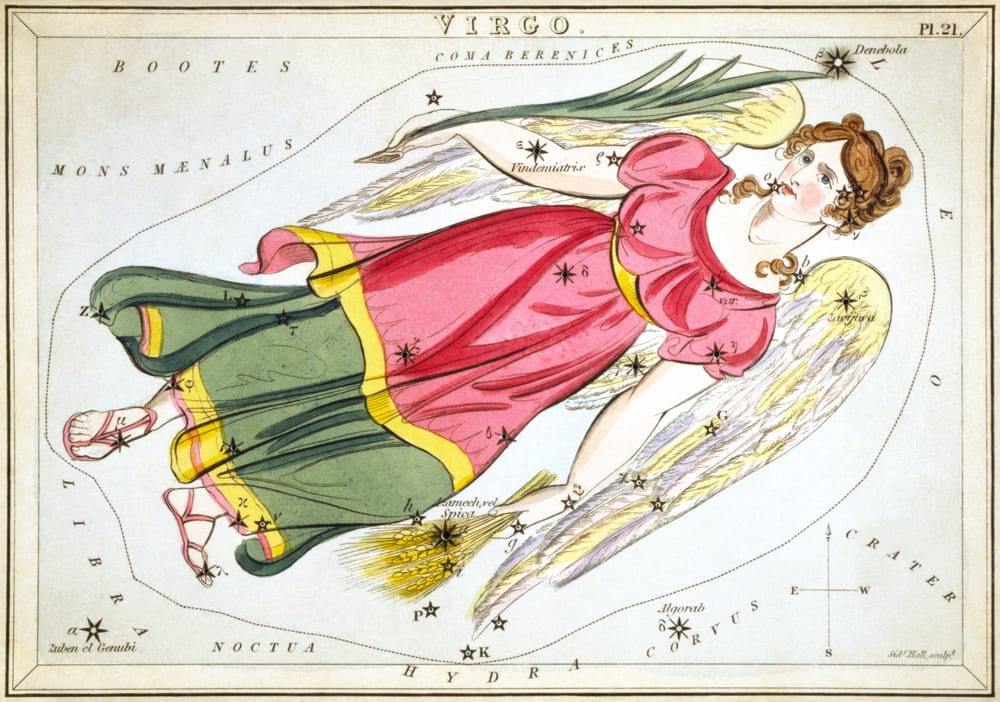
Virgo
Promised SeedHebrew (per Bullinger): Bethulah: a virgin (Arabic: a branch)
The reading · Rolleston · Seiss · Bullinger
The promised Seed of the woman (Gen 3:15); the virgin-born Branch. The star Tsemech read as “the Branch.”
The three decans
Readings: Rolleston, Mazzaroth (1862) · Seiss, The Gospel in the Stars (1882) · Bullinger, The Witness of the Stars (1893), all public domain. Sources cited in full below.
Biblical references to the heavens as witness
Ps 19:1, "The heavens declare the glory of God; and the firmament showeth his handiwork" (ASV).
The textual foundation for reading creation itself as revelatory, see the full Psalms hub for the Psalm's own pivot from sky to Scripture at v7. Job 9:9 (KJV), "Which maketh Arcturus, Orion, and Pleiades, and the chambers of the south." (Hebrew Ash / Kesil / Kimah; ASV renders the first name "the Bear," not "Arcturus", a translation difference worth noting before Bullinger's Arcturus reading is built on it.) Job 38:31–32, the only biblical occurrence of Mazzaroth; God names Mazzaroth, Pleiades, Orion, Arcturus in rapid succession, the rhetorical force humbling-by-creational-majesty rather than instructing on star-reading, see the Job hub for the whirlwind speech in full. Gen 1:14, "Let there be lights in the firmament of heaven to divide the day from the night; and let them be for signs (othoth), and for seasons, and for days and years" (ASV).
Whether signs extends beyond calendar function to typological message is the contested hermeneutical question.
Job 38:32 — KJV
Canst thou bring forth Mazzaroth in his season? or canst thou guide Arcturus with his sons?
— The only OT use of the word Mazzaroth. The context (Job 38:31–33) is God listing the celestial constellations: Pleiades, Orion, Mazzaroth, Arcturus and his sons. Whatever Mazzaroth is, it is among the named heavenly bodies God brings forth in their seasons.
Psalm 19:1, the legible-book reading
The heavens - They are as a legible book, wherein he that runs may read it. The glory - His eternal power and Godhead, his infinite wisdom and goodness.
— John Wesley, Explanatory Notes upon the Bible (1765), on Psalms 19:1. A legible book of general revelation is not the same claim as a decoded gospel-message — the distinction the rest of this page turns on.
Bullinger and Seiss as primary-source defenders
E.W. Bullinger, The Witness of the Stars (1893, public domain). Anglican clergyman, dispensationalist; compiled the constellation-gospel reading systematically. Joseph A. Seiss, The Gospel in the Stars (1882, public domain). Lutheran clergyman; the earlier and in some ways more rigorous treatment. Frances Rolleston, Mazzaroth, or the Constellations (1862, public domain). The 19th-century upstream source both Bullinger and Seiss draw from.
Their core claim: the gospel was revealed to the antediluvian patriarchs, encoded in the constellation names and decans, transmitted through the nations, distorted into pagan astrology, and recoverable by tracing constellation-names back to their roots.
The 12-sign Mazzaroth: at a glance
| Sign | Hebrew/Aramaic | Bullinger/Seiss reading |
|---|---|---|
| Virgo | Bethulah | the promised seed |
| Libra | Mozanaim | the price paid |
| Scorpio | Akrab | the conflict |
| Sagittarius | (none ancient) | the triumphant |
| Capricorn | Gedi | the sacrifice |
| Aquarius | Deli | outpoured blessing |
| Pisces | Dagim | multiplied people |
| Aries | Taleh | substitute lamb |
| Taurus | Shor | judgment |
| Gemini | Teomim | the united |
| Cancer | Sartan | the sheepfold |
| Leo | Aryeh | the triumphant king |
Order traditionally read counter-clockwise from Virgo (per Bullinger).
Hebrew glosses follow Bullinger's 1893 text (he glosses Bethulah as a virgin, with an Arabic sense of a branch, and Mozanaim as the scales, weighing); consult the primary text for the full twelve.
Ancient Jewish constellation traditions
Josephus, Antiquities 1.2.3 (Whiston PD 1737): credits the sons of Seth with discovering astronomy and recording it on two pillars (one of brick, one of stone), built so that the record would survive even if the stone pillar were destroyed by flood. Talmudic references to mazzalot (constellations) appear in various passages (Rodkinson PD where surfaced). Rabbinic tradition is mixed: some sources engage constellation symbolism, others explicitly distance Torah from astrology. Philo of Alexandria (Yonge PD) picks up elements. The rabbis did not endorse Bullinger's specific constellation-gospel reading. But Jewish engagement with constellation-symbolism is historical fact.
The PD primary sources
| Year | Author | Work | Position |
|---|---|---|---|
| 1865 | Frances Rolleston | Mazzaroth | first popular Christian gospel-in-the-stars |
| 1882 | Joseph A. Seiss | Gospel in the Stars | systematic exposition |
| 1893 | E.W. Bullinger | Witness of the Stars | critical synthesis with sources |
All three are public-domain. Modern proponents (e.g. Missler) draw from these primary sources.
Patristic reception: two minds in the early church
Patristic reception is split. Origen engages constellation-imagery typologically in his Homilies on Genesis (PD NPNF). Clement of Alexandria holds a similar posture. But Augustine, City of God 5.1–7 (PD NPNF) explicitly warns against astrology. And does so in ways the Gospel-in-the-Stars defender must answer. The patristic counterweight is real. The church's patristic inheritance is not a single voice on this question.
Patristic engagement
| Father | Engagement | Verdict |
|---|---|---|
| Origen | mentions Christian zodiac reading | non-committal |
| Clement of Alexandria | uses celestial typology | partial endorsement |
| Augustine | warns against astrological reading | negative |
| Tertullian | rejects pagan zodiac | negative |
— No patristic systematic gospel-in-the-stars exposition. The Christian astronomical typology of Bullinger/Seiss is a 19th-century synthesis, not an ancient tradition.
The tradition's line of descent: and its living carriers
The tradition holds that the constellation-figures descend from a primeval, patriarchal astronomy, ultimately Sethite or Noahic, carried across the nations and preserved even through hands that no longer understood what they carried. On this reading, transmission through later astronomers (including the medieval Arabic star-catalogues) is exactly what Bullinger's thesis expects: the names survived; the meaning waited to be read again in the light of the Promise.
The tradition has living carriers today. Troy Brewer, Looking Up: A Practical Guide to Understanding Astronomy in the Bible (2017), stands in the Bullinger/Seiss line for today's readers, the constellations preserve the gospel narrative across human history. D. James Kennedy (The Real Meaning of the Zodiac, 1989) and Chuck Missler (Cosmic Codes) carried it to a generation before him. Named and cited so readers can go to them.
Where the page stands
The Mazzaroth feature presents the Bullinger/Seiss reading at full strength because:
- It has been an active strand of Christian devotional reading since the 19th century
- Job 38:32 names the thing as a divine ordering of the heavens
- The figures (whatever their cultural origin) carry typological weight in the 19th-century synthesis
What the record shows:
- The Bullinger/Seiss readings are a 19th-century Christian synthesis; 1st-millennium-BC Hebrew astronomy does not contain them
- No text names Adam, Seth, or any other biblical figure as the one who named the constellations
- Scripture condemns astrology, reading the stars to predict events (Deut 4:19; Isa 47:13)
The Bible's own star-witness: Balaam's star and the Morning Star
Scripture itself binds a star to the Messiah. Num 24:17, Balaam's oracle: "There shall come forth a star out of Jacob, and a sceptre shall rise out of Israel" (ASV). Jewish messianic reception ran with the image, most visibly when Bar Kokhba (the leader of the AD 132 revolt against Rome, "son of the star") took the title on the strength of this verse, per Rabbi Akiva's application of it to him: Israel was watching the sky for her Messiah.
Matthew reports Gentile magi reading a star as the sign of the King's birth, Matt 2:2, "where is he that is born King of the Jews? for we saw his star in the east, and are come to worship him" (ASV). And the New Testament closes the loop from the other end: Rev 22:16, Jesus claims the image directly: "I am the root and the offspring of David, the bright, the morning star" (ASV).
See the Matthew hub for the fuller narrative and the Numbers and Revelation hubs for Balaam's oracle and the Bridegroom's self-claim in context.
2 Pet 1:19, the landing
And we have the word of prophecy made more sure; whereunto ye do well that ye take heed, as unto a lamp shining in a dark place, until the day dawn, and the day-star arise in your hearts.
— ASV. Peter ranks the prophetic word above any heavenly sign. The heavens genuinely declare God's glory (Ps 19:1–6; Rom 1:20) — but faith comes by hearing the word of Christ (Rom 10:17), not by reading it off Orion.
The wells · where the tradition is written down
Three books carry the story
The gospel-in-the-stars reading holds that the constellations preserve, in pictures older than paganism's corruption of them, the first great promise of Genesis 3:15. Its modern recovery runs through three books: all public domain, all quotable in full, and all worth reading at the well itself.
The three books, and the antecedent they invoke
Frances Rolleston: Mazzaroth; or, the Constellations (London: Rivingtons, 1862–63)
The wellspring. A lifetime's study of the ancient star-names, tracing their Hebrew and Semitic roots toward the primeval promise. Every later telling of the tradition drinks from this book. Her full text is kept online at Mazzaroth.info. (PD; author d. 1864.)
Joseph A. Seiss: The Gospel in the Stars; or, Primeval Astronomy (Philadelphia: E. Claxton, 1882)
The Lutheran preacher who gave the tradition its most devotional voice, sign by sign, for an American audience. (PD.)
E. W. Bullinger: The Witness of the Stars (London, 1893)
The most systematic build-out: sign by sign, decan by decan, with woodcut star-charts; the version most quoted today. (PD; author d. 1913.) His thesis, verbatim:
“These pictures were designed to preserve, expound, and perpetuate the one first great promise and prophecy of Gen. iii. 15, that all hope for Man, all hope for Creation, was bound up in a coming Redeemer.”
Two of his sign-name readings, from the archive full text: Virgo: “Bethulah, which means a virgin, and in the Arabic a branch”; Libra: “Mozanaim, the Scales, weighing.”
E. W. Bullinger, The Witness of the Stars (1893), Public Domain (archive.org/details/witnessofstars00bull).
The antecedent the tradition invokes
Josephus (Antiquities1.2.3, Whiston tr., PD) records that the descendants of Seth "were the inventors of that peculiar sort of wisdom which is concerned with the heavenly bodies," and inscribed their discoveries on two pillars so the knowledge would survive the flood. The tradition reads this as the memory of a primeval, patriarchal astronomy: the sky named before Babel corrupted the naming.
Scripture's own star-Messiah
The star the Bible names
Scripture itself binds a star to the Messiah: from Balaam's oracle, through the magi who followed a star to the King, to the risen Lord's own last self-naming.
“There shall come forth a star out of Jacob, and a sceptre shall rise out of Israel.”
Balaam's oracle: the Bible's own star-and-scepter image of the coming ruler.
“Where is he that is born King of the Jews? for we have seen his star in the east, and are come to worship him.”
The magi read a star toward a King: the star-of-Jacob expectation was alive in the east (Targum Onkelos on Num 24:17), and it walked them to Bethlehem.
“I am the root and the offspring of David, the bright, the morning star.”
Jesus claims Balaam's star for himself: by direct word, in the last chapter of the canon.
How strong the image was
The star-of-Jacob image carried such messianic force that the leader of the AD 132 revolt took his very name from it: Simon “Bar Kokhba”: son of the star — hailed by Rabbi Akiva on the strength of Numbers 24:17. Israel was watching the sky for her Messiah; the true Morning Star had already come.
Edersheim, Life and Times of Jesus the Messiah, App. IX (1883, PD); Targum Onkelos / Pseudo-Jonathan on Num 24:17.
The tradition's own guardrail
Witness, never divination
The tradition's own teachers drew this line first: the witness of the stars is the opposite of astrology. Bullinger and Seiss both taught that astrology is the corruptionof the primeval witness: the signs turned from God's promise to man's fortune. Scripture draws the same line.
The heavens declare
Ps 19:1–6— the heavens declare God's glory; “their line is gone out through all the earth.” Ps 147:4 — he “telleth the number of the stars; he calleth them all by their names.” Gen 1:14 — the lights are “for signs, and for seasons.” This is the ground the tradition builds on.
The word made more sure
“We have the word of prophecy made more sure; whereunto ye do well that ye take heed, as unto a lamp shining in a dark place.”
2 Pet 1:19 — whatever the sky witnesses, the prophetic Word stands surer still, and faith comes by hearing it (Rom 10:17).
The corruption is fenced off
Deut 18:9–14 forbids divination; Deut 4:19 forbids worshipping the host of heaven; Isa 47:13–14 mocks “the astrologers, the stargazers, the monthly prognosticators.” The witness of the stars preaches the Promise — it never tells fortunes.
The workbench · live from the floor
Three doors to the words themselves
The tradition turns on a handful of Hebrew words. Each opens onto its full workbench page: every tagged occurrence in the corpus. Counts are read live from the open word floor.
the twelve signs / constellations of the zodiac
The title word. Its one canonical occurrence is Job 38:32, where God himself names the Mazzaroth, leading them forth in their season, inside the speech that spreads the heavens before Job. (Cf. the cognate mazzālôṯ, 2 Kgs 23:5.)
1 tagged occurrence in the corpus so far →
Orion, one of the constellations the Bible names outright
Scripture names this constellation four times (Job 9:9; 38:31; Amos 5:8; Isa 13:10): “Canst thou loose the bands of Orion?” Bullinger read the figure as the glorious Prince of the Taurus decans. Every tagged occurrence is on the workbench.
4 tagged occurrences in the corpus so far →
canopy, chamber (nuptial)
The Ps 19:5 word-door: the sun “as a bridegroom coming out of his chuppah,” the Psalm that anchors the whole tradition, where the heavens declare the glory of God and their line goes out through all the earth.
3 tagged occurrences in the corpus so far →
Lexical data: Strong's (PD) & BDB (PD); tagged occurrences from Hebrew text data (CC BY 4.0), the live word floor.
The gallery · the sky as history drew it
Four plates from the great atlases
Four public-domain plates: the zodiac's deep antiquity across cultures, a seventeenth-century Christian sky, and two of the figures the tradition reads.


Sources
Every witness on this page, and where to go deeper
- Scripture — Job 38:31–33; Job 9:9; Amos 5:8; Ps 19; Ps 147:4; Gen 1:14; Gen 3:15; Gen 49:9; Num 24:17; Deut 4:19; Deut 18:9–14; Isa 47:13–14; Rom 1:20; Rom 10:17; 2 Pet 1:19; Mat 2:2; Rev 5:5; Rev 22:16 — Public Domain (MannaFest floor).
- Frances Rolleston, Mazzaroth; or, the Constellations (1862–63) — Public Domain (archive.org/details/mazzarothorconst00roll). Full text kept online at Mazzaroth.info.
- Joseph A. Seiss, The Gospel in the Stars (1882) — Public Domain (archive.org/details/gospelinstarsor00seisgoog).
- E. W. Bullinger, The Witness of the Stars (1893) and The Companion Bible, App. 12 — Public Domain (archive.org/details/witnessofstars00bull).
- Flavius Josephus (Whiston tr.), Antiquities 1.2.3 — Public Domain (CCEL).
- Ancient Jewish reception — Alfred Edersheim, The Life and Times of Jesus the Messiah, App. IX (1883) — Public Domain (CCEL); Targum Onkelos / Pseudo-Jonathan on Num 24:17.
- The tradition's living carriers — Troy Brewer, Looking Up: A Practical Guide to Understanding Astronomy in the Bible (2017); D. James Kennedy, The Real Meaning of the Zodiac (1989); Chuck Missler, Cosmic Codes — modern works, named and cited so readers can go to them; brief quotation only.
- Hebrew lexical data — Strong's (PD) & BDB (PD); H4216 (mazzārôṯ), H3685 (kᵉsîl), H2646 (chuppah); tagged occurrences from Hebrew text data (CC BY 4.0), the live word floor.
- Imagery (license verified server-side against the Wikimedia Commons API) — Dendera zodiac (Denon, 1802); Julius Schiller, Coelum Stellatum Christianum, plate 34 (1627); Johann Bayer, Uranometria, Orion & Leo plates (1603); Urania's Mirror sign cards (1824) — all Public Domain (Wikimedia Commons), attribution shown under each image.
This page presents the gospel-in-the-stars as its own books teach it, every source cited and every quotation attributed. The gospel itself rests on the written Word: the stars are called as a witness to the Promise, never as its ground.