
Deuteronomy 20:1 to 20 · Debate · Featured Study
War and Peace: Just War and Christian Nonresistance
Deuteronomy 20 opens with the LORD's promise in verse 1, sends four kinds of men home in verses 5 to 8, and devotes six nations in verses 16 to 18.
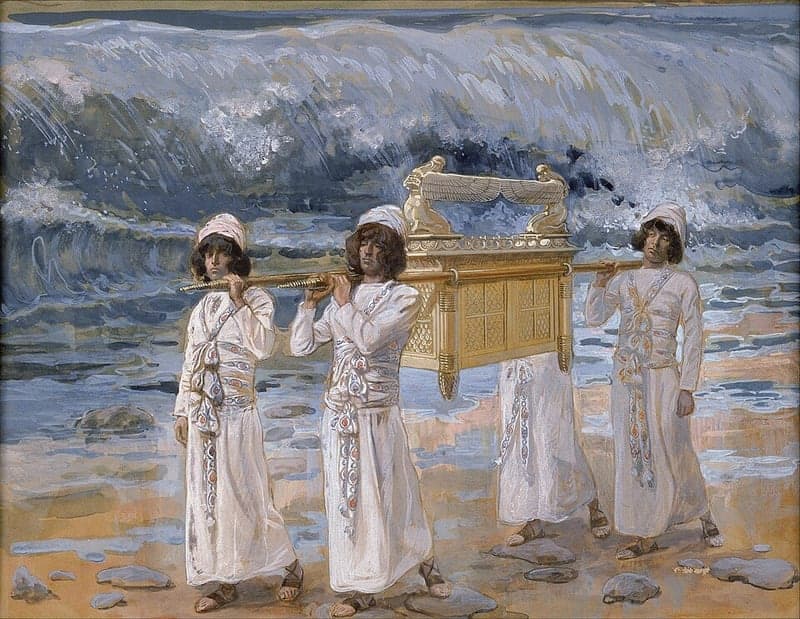
James Tissot, The Ark Passes Over the Jordan, about 1896 to 1902. Public domain by date. Wikimedia Commons, File:James Jacques Joseph Tissot - The Ark Passes Over the Jordan - Google Art Project.jpg.
THE ARTWORKTissot painted four priests carrying the ark over the dry bed of the Jordan with the water standing behind them, as Israel crossed into the land where the laws of Deuteronomy 20 would be kept.
Moses gave Israel a priest to speak before battle and an offer of peace to make before a siege, and the church has argued ever since whether a disciple of Jesus may carry the sword.
Summary
Deuteronomy 20 orders how Israel goes to war, and Christian readers draw two answers from it and from the New Testament.
- The law forbids an army to cut down the fruit trees of a city it besieges.
- The just war reading, held by Augustine and Bonaventure, allows a war waged under lawful authority for a just cause.
- The reading of nonresistance, held by Justin Martyr and Tertullian, holds that Jesus took the sword from every disciple.
The Texts Both Readings Weigh
Deuteronomy gives Israel its law of war, and three New Testament verses speak of soldiers and the sword.
When you go out to war against your enemies and see horses, chariots, and an army larger than yours, do not be afraid of them; for the LORD your God, who brought you out of the land of Egypt, is with you.The law of war opens with the promise that the LORD is with Israel's army, so its wars are fought under His command.
Then some soldiers asked him, “And what should we do?” “Do not take money by force or false accusation,” he said. “Be content with your wages.”John the Baptist answers soldiers who ask what they should do, and both readings build their case about soldiering on his reply.
For he is God’s servant for your good. But if you do wrong, be afraid, for he does not carry the sword in vain. He is God’s servant, an agent of retribution to the wrongdoer.Paul calls the ruler who carries the sword God's servant, and both readings must say whose sword this is.
“Put your sword back in its place,” Jesus said to him. “For all who draw the sword will die by the sword.Jesus stops the disciple who struck the high priest's servant, and the readings divide on how far His command reaches.
The Two Readings Side by Side
Each reading answers the same four questions, and each answer names the father or teacher who gave it and his work.
An outline of four numbered questions with two answers under each, the first from the just war reading and the second from nonresistance.
The Two Readings
Each reading has its holders, its works and its case from the text.
The just war reading
Augustine of Hippo, in his Questions on Joshua, writes that it is not lawful for everyone to wage war. He defines just wars as those that avenge injuries. In his Reply to Faustus, as Thomas Aquinas gathers it in the Catena Aurea on Luke 3:14, he calls soldiers who use their arms ministers of the law and defenders of the public safety. What he blames in war is the desire to injure, the cruelty of revenge and the lust of power. Bonaventure, in his Collations on the Ten Commandments, applies Romans 13:4 to the minister of the law, who may slay a man by law with a just intention. Thomas Aquinas, in the Summa Theologiae, names three things a just war requires: the authority of the ruler, a just cause and a right intention.
The reading of Christian nonresistance
Justin Martyr, in his Dialogue with Trypho, writes that Christians who were once filled with war and slaughter have changed their swords into ploughshares. In his First Apology he adds that Christians who once murdered one another now refrain from making war on their enemies. Tertullian, in On Idolatry, asks whether a believer may enter military service. He answers that there is no agreement between the standard of Christ and the standard of the devil. Later holders of this reading, Menno Simons and Leo Tolstoy among them, are set out with their works on the page An Eye for an Eye in the Law of Moses.
The Laws of War in Deuteronomy 20
Five laws of the chapter are read by the commentators, and each side draws on them.
The priest's word before battle
When you are about to go into battle, the priest is to come forward and address the army, saying to them, “Hear, O Israel, today you are going into battle with your enemies. Do not be fainthearted or afraid; do not be alarmed or terrified because of them. For the LORD your God goes with you to fight for you against your enemies, to give you the victory.”A priest speaks to the army before the officers do, so the battle begins with a word about God.
Matthew Henry, in his Commentary on the Whole Bible, reports that Jewish writers call this priest the anointed of the war. He reads the title as a fit name for Christ, the captain of salvation.
The men sent home
Furthermore, the officers are to address the army, saying, “Has any man built a new house and not dedicated it? Let him return home, or he may die in battle and another man dedicate it. Has any man planted a vineyard and not begun to enjoy its fruit? Let him return home, or he may die in battle and another man enjoy its fruit. Has any man become pledged to a woman and not married her? Let him return home, or he may die in battle and another man marry her.” Then the officers shall speak further to the army, saying, “Is any man afraid or fainthearted? Let him return home, so that the hearts of his brothers will not melt like his own.”The officers send home four kinds of men, so Israel's army is made of those free to fight.
Clement of Alexandria, in the second book of his Stromata, calls these exemptions the humanity of the law. Matthew Henry writes that God would not be served in His wars by pressed men.
The offer of peace
When you approach a city to fight against it, you are to make an offer of peace. If they accept your offer of peace and open their gates, all the people there will become forced laborers to serve you. But if they refuse to make peace with you and wage war against you, lay siege to that city.A city that accepts the offer becomes Israel's forced labourers, so peace here means surrender on Israel's terms.
Adam Clarke, in his Commentary on the Bible, reads the offer as made only to cities beyond the nations that verses 16 to 18 devote to destruction.
The cities devoted
However, in the cities of the nations that the LORD your God is giving you as an inheritance, you must not leave alive anything that breathes. For you must devote them to complete destruction—the Hittites, Amorites, Canaanites, Perizzites, Hivites, and Jebusites—as the LORD your God has commanded you, so that they cannot teach you to do all the detestable things they do for their gods, and so cause you to sin against the LORD your God.The cities of the land are devoted to destruction, and verse 18 gives the reason, that they would teach Israel their worship.
Albert Barnes, in his Notes, Explanatory and Practical, writes that the forbearance of verses 10 to 15 was not to be shown to the Canaanite nations. The page The Canaanite Conquest sets out the readings of this command.
The trees spared
When you lay siege to a city for an extended time while fighting against it to capture it, you must not destroy its trees by putting an axe to them, because you can eat their fruit. You must not cut them down. Are the trees of the field human, that you should besiege them? But you may destroy the trees that you know do not produce fruit. Use them to build siege works against the city that is waging war against you, until it falls.The army may cut only trees that bear no fruit, so even a siege must spare what feeds people.
Clement of Alexandria reads the law as forbidding the razing of an enemy's land. Albert Barnes notes that the Egyptians seem to have cut down the fruit trees in their wars.
More Laws of War in Deuteronomy
Deuteronomy gives laws for war in four chapters, from the muster to the camp.
| The law | What it orders | Verses |
|---|---|---|
| The newly married man | He is not sent to war for one year. | Deuteronomy 24:5 |
| The commanders | The officers appoint commanders once the army is set. | Deuteronomy 20:9 |
| The distant cities | The men are put to the sword, and the women, children and livestock are taken. | Deuteronomy 20:13 to 15 |
| The captive woman | She mourns a full month before marriage and may never be sold. | Deuteronomy 21:10 to 14 |
| The holy camp | The camp is kept clean because the LORD walks in it. | Deuteronomy 23:9 to 14 |
What the Texts Leave Unsaid
The texts leave three questions open.
Deuteronomy 20 governs the wars of Israel under the LORD's command and says nothing of the wars of other nations. Luke 3:14 gives no word on whether the men who asked should stay in the army or leave it.
Jesus answered, “My kingdom is not of this world; if it were, My servants would fight to prevent My arrest by the Jews. But now My kingdom is not of this realm.”Jesus speaks here of His own servants, as He spoke to one disciple in Gethsemane, and gives no rule for a magistrate or an army.
What the Gospel Adds to the Law of War
Two sayings of the prophets and of Jesus are read by each side in its own way.
Love your enemies
You have heard that it was said, ‘Love your neighbor’ and ‘Hate your enemy.’ But I tell you, love your enemies and pray for those who persecute you,Jesus sets love for the enemy beside the saying about hating him, and both readings must say how a soldier keeps it.
Augustine, in the Catena Aurea on Matthew 5:44, holds that the precepts of patience are kept in the readiness of the heart. He adds that a commonwealth that keeps them will wage even war with good will, to establish peace and righteousness among the vanquished. Tertullian, in his Apology, answers that Christians pray for their persecutors and for the very rulers they are charged with betraying.
Swords into plowshares
Then He will judge between the nations and arbitrate for many peoples. They will beat their swords into plowshares and their spears into pruning hooks. Nation will no longer take up the sword against nation, nor train anymore for war.Justin and Tertullian read this promise as fulfilled in the church, where the reading of nonresistance finds its ground.
Justin Martyr, in his First Apology, reads the word that went out from Jerusalem as the preaching of the twelve apostles. Thomas Aquinas, in his Commentary on Isaiah, reads the verse as a promise of peace to the converted, with the turned swords as its sign.
How the Teachers of the Church Taught It
Three teachers of the church speak to the sword and the soldier, from the fourth, the ninth and the eighteenth centuries.
Hilary of Poitiers on the sword of His mouthfourth century
“The Lord then bids him return his sword into its sheath, because He would destroy them by no weapon of man, but by the sword of His mouth.”
Hilary of Poitiers · Catena Aurea by Aquinas · on Matthew 26:52Patristic
Rabanus Maurus on patience under arrestninth century
“It behoved also that the Author of grace should teach the faithful patience by His own example, and should rather train them to endure adversity with fortitude, than incite them to self-defence.”
Rabanus Maurus · Catena Aurea by Aquinas · on Matthew 26:52Patristic
Matthew Henry on the discipline of war1710
“And it is observable that the discipline of war here prescribed is so far from having any thing in it harsh or severe, as is usual in martial law, that the intent of the whole is, on the contrary, to encourage the soldiers, and to make their service easy to them.”
Matthew Henry · Commentary on the Whole Bible · on Deuteronomy 20:19 to 20Puritan
The Readings Weighed
Each reading has one text its holders must answer.
| Reading | Held by | Tradition |
|---|---|---|
| Just war | Augustine; Bonaventure; Thomas Aquinas; John Chrysostom | The Catholic and Orthodox fathers; the medieval schools |
| Christian nonresistance | Justin Martyr; Tertullian; later Menno Simons and Leo Tolstoy | The early fathers; the Anabaptists; the Christian nonresistance movement |
The just war reading and Gethsemane
A disciple drew his sword in Jesus' defence, and Jesus still told him to put it back. Hilary of Poitiers, in the Catena Aurea on Matthew 26:52, answers that most who have used the sword in judgment or in self-defence die of fever or accident.
Nonresistance and the soldiers in the church
The Apostolic Constitutions admit to the church a soldier who keeps the rule John gave. John Chrysostom, in his Baptismal Instructions, points to the centurion Cornelius to show that military service is no hindrance to virtue.
Read the Great Books
Four works by two fathers, a medieval teacher and an English commentator, from the second century to 1710.
Dialogue with Trypho
Justin Martyr · second century
Justin answers a Jewish teacher on the prophecies of Christ, and chapter 110 sets out the two comings of Christ.
On Idolatry
Tertullian · third century
Tertullian also sets the limits of the honour a Christian gives to kings and magistrates, short of idolatry.
Collations on the Ten Commandments
Bonaventure · 1267
The sixth collation reads Paul on rulers and the command not to resist evil side by side.
Commentary on the Whole Bible
Matthew Henry · 1710
Henry comments on Deuteronomy 20 verse by verse and applies its laws to the Christian's warfare.
Live at Peace with Everyone
Romans 12 and the Beatitudes give the disciple's part in keeping peace.
Romans 12:18 asks peace of the disciple as far as it depends on him, a duty both readings lay on every Christian. Augustine and Tertullian divide over the soldier, and both hold that the disciple must leave repayment to God.
If it is possible on your part, live at peace with everyone. Do not avenge yourselves, beloved, but leave room for God’s wrath. For it is written: “Vengeance is Mine; I will repay, says the Lord.”Paul quotes the Scriptures to show that vengeance belongs to the Lord, which is why the disciple may leave it with Him.
Blessed are the peacemakers, for they will be called sons of God.The blessing on peacemakers is the end both readings say they serve.
Keep studying
Studies10