
Genesis 34 · Person · Featured Study
Dinah at Shechem
Genesis 30, 34 and 46 follow her from Paddan-aram to Shechem and down to Egypt.
Dinah is the one daughter of Jacob that Genesis names, the seventh and last child Leah bore him.
- The name means
- Judgment
- Born
- in Paddan-aram
- Family
- father: Jacob; mother: Leah; brother: Simeon; brother: Levi; brother: Reuben; brother: Judah; brother: Issachar; brother: Zebulun
- Places
- Paddan-aram, Shechem, Bethel, Egypt
- First named
- Genesis 30:21
- Last named
- Genesis 46:15
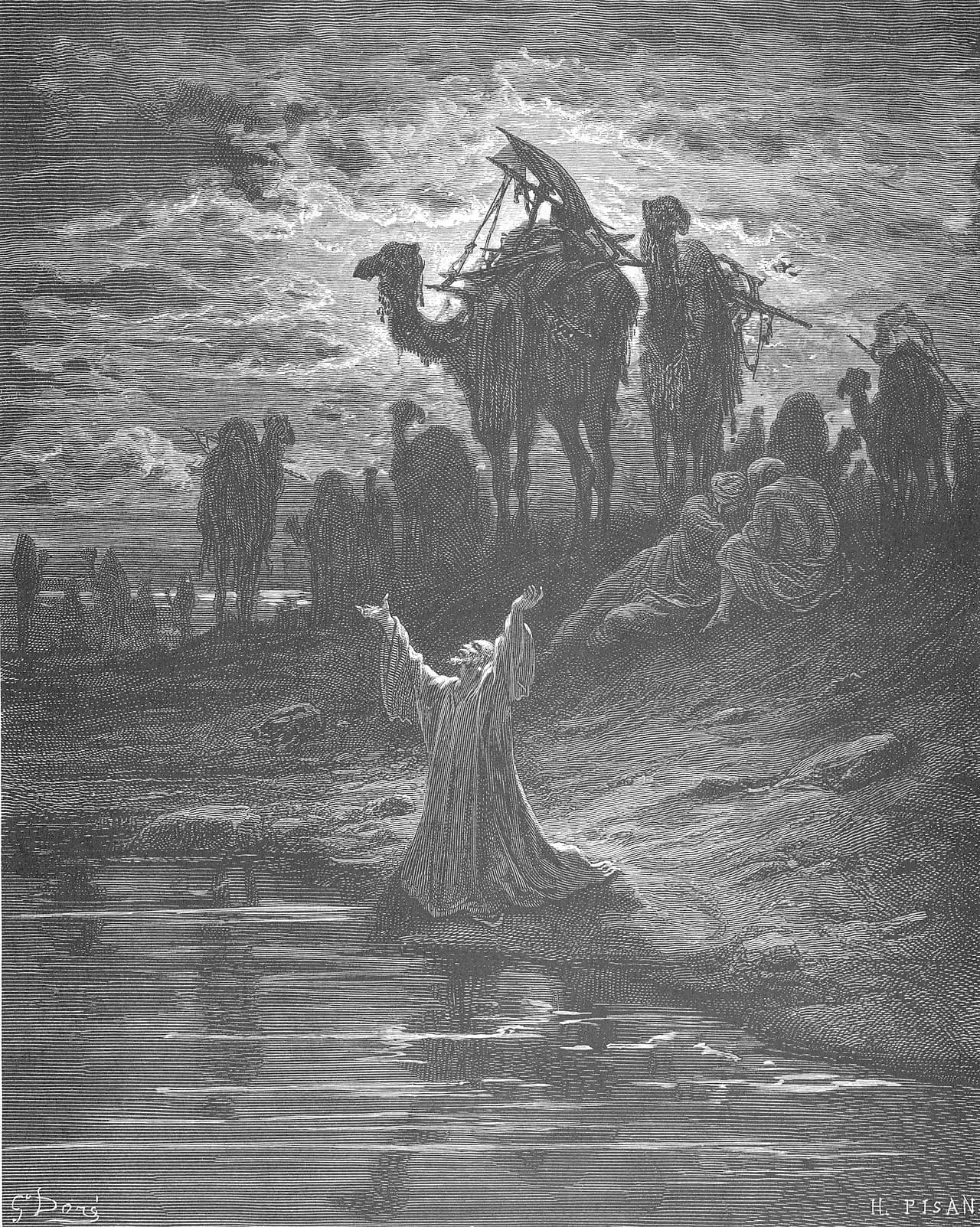
Gustave Doré, Jacob Prays for Protection, Doré's English Bible, 1866. Public domain, via Wikimedia Commons.
THE ARTWORKDoré drew Jacob kneeling by night beside water, with his camels and household behind him, on the road home that ends at Shechem. The plate stands here for the prayer of Genesis 32:11, where Jacob fears an attack on the mothers and children with him.
Summary
Dinah, the daughter of Jacob and Leah, was seized and violated by Shechem, the son of the ruler of the region, and her brothers answered with deceit and the sword.
- Shechem then asked for her as his wife, and his father Hamor offered Jacob's family land and trade.
- Jacob's sons demanded that every male of the city be circumcised, and then Simeon and Levi killed them all.
- Jacob feared the vengeance of the peoples of the land, and on his deathbed he cursed the anger of the two brothers.
Where Dinah Stands in Scripture
Two verses outside Genesis 34 name Dinah, one at her birth and one in the count of Jacob's household.
After that, Leah gave birth to a daughter and named her Dinah.The verse gives her name with no reason, where each of Leah's sons is named with one.
These are the sons of Leah born to Jacob in Paddan-aram, in addition to his daughter Dinah. The total number of sons and daughters was thirty-three.The verse places her in the household that went down to Egypt.
Genesis 34, Turn by Turn
The timeline runs from Jacob's arrival at Shechem to his last words in Egypt.
- Jacob arrives safely from Paddan-aramoutside Shechem, Genesis 33:18
- Dinah goes out to visit the daughters of the landShechem, Genesis 34:1
- Shechem seizes herShechem, Genesis 34:2
- Hamor asks for her as Shechem's wifeJacob's camp, Genesis 34:8
- The sons answer deceitfullyJacob's camp, Genesis 34:13
- Every male of the city is circumcisedthe city gate, Genesis 34:24
- The city's men are slain and Dinah taken outShechem's house, Genesis 34:25 to 26
- A terror from God falls on the citiesthe road to Bethel, Genesis 35:5
- Jacob curses the anger of Simeon and LeviEgypt, Genesis 49:5 to 7
Nine turns are drawn, each with the verse that records it.
What Happened at Shechem
The chapter moves from Jacob's camp outside Shechem to his household's move to Bethel.
Jacob's camp lay just outside the city, on ground he had bought from the sons of Hamor, so the two households were neighbours when the chapter opens.
The act and the offerGenesis 34:1 to 12
When Shechem son of Hamor the Hivite, the prince of the region, saw her, he took her and lay with her by force.The narrator names the act as force before any word of love or marriage is spoken.
And his soul was drawn to Dinah, the daughter of Jacob. He loved the young girl and spoke to her tenderly. So Shechem told his father Hamor, “Get me this girl as a wife.”The verse sets his love and his request after the act, so neither undoes the force named in the verse before it.
When Jacob’s sons heard what had happened, they returned from the field. They were filled with grief and fury, because Shechem had committed an outrage in Israel by lying with Jacob’s daughter—a thing that should not be done.The brothers' grief and fury rest on the narrator's own verdict that this should not be done.
Then Shechem said to Dinah’s father and brothers, “Grant me this favor, and I will give you whatever you ask. Demand a high dowry and an expensive gift, and I will give you whatever you ask. Only give me the girl as my wife!”The offer turns the wrong into a bargain between two households.
The deceit and the slaughterGenesis 34:13 to 29
But because Shechem had defiled their sister Dinah, Jacob’s sons answered him and his father Hamor deceitfully. “We cannot do such a thing,” they said. “To give our sister to an uncircumcised man would be a disgrace to us. We will consent to this on one condition, that you become circumcised like us—every one of your males.The narrator calls the answer deceitful, and the sign of the covenant becomes its bait.
Will not their livestock, their possessions, and all their animals become ours? Only let us consent to them, and they will dwell among us.”Hamor wins the city over with the hope of taking Jacob's livestock and goods.
Three days later, while they were still in pain, two of Jacob’s sons (Dinah’s brothers Simeon and Levi) took their swords, went into the unsuspecting city, and slaughtered every male. They killed Hamor and his son Shechem with their swords, took Dinah out of Shechem’s house, and went away.The killing waits until the men are still in pain from the circumcision and cannot defend themselves.
Jacob’s other sons came upon the slaughter and looted the city, because their sister had been defiled. They took their flocks and herds and donkeys, and everything else in the city or in the field. They carried off all their possessions and women and children, and they plundered everything in their houses.The plunder carries the revenge past the guilty man to the households of a whole city.
Jacob's rebuke and the road to BethelGenesis 34:30 to 35:5
Then Jacob said to Simeon and Levi, “You have brought trouble upon me by making me a stench to the Canaanites and Perizzites, the people of this land. We are few in number; if they unite against me and attack me, I and my household will be destroyed.” But they replied, “Should he have treated our sister like a prostitute?”The verse sets Jacob's fear for his household against the brothers' defence of their sister.
As they set out, a terror from God fell over the surrounding cities, so that they did not pursue Jacob’s sons.God's terror on the cities answers the danger Jacob named in Genesis 34:30.
How Genesis Names the Act
Three Hebrew words carry the chapter's judgment on the act.
The verb of Genesis 34:2 is anah, which Strong's Hebrew lexicon glosses as to depress. Genesis 34:5, 13 and 27 call the act a defiling with the verb tame, to be foul, and Genesis 34:7 calls it nevalah, a word for moral folly and for a crime.
The same verb in the law and in David's houseDeuteronomy 22 and 2 Samuel 13
If a man encounters a virgin who is not pledged in marriage, and he seizes her and lies with her, and they are discovered, then the man who lay with her must pay the young woman’s father fifty shekels of silver, and she must become his wife because he has violated her. He must not divorce her as long as he lives.The law uses the verb of Genesis 34:2 for a man who seizes a virgin, and it binds him to pay her father and marry her.
“No, my brother!” she cried. “Do not humiliate me, for such a thing should never be done in Israel. Do not do this disgraceful thing! Where could I ever take my shame? And you would be like one of the fools in Israel! Please speak to the king, for he will not withhold me from you.” But Amnon refused to listen to her, and being stronger, he violated her and lay with her.Tamar calls the deed nevalah, the word of Genesis 34:7, and the narrator uses anah, the verb of Genesis 34:2, for what Amnon did.
The gate of the city
Radak, a Jewish commentator of Provence (1160 to 1235), explains in his commentary on Genesis that the city gate was where the elders and leading citizens met. He points to Deuteronomy 25:7 and Ruth 4:1 for the same custom.
So Hamor and his son Shechem went to the gate of their city and addressed the men of their city: “These men are at peace with us. Let them live and trade in our land; indeed, it is large enough for them. Let us take their daughters in marriage and give our daughters to them.Hamor and Shechem take the terms to the men of the city in that public place.
The Family of Dinah
Dinah's kin are Leah's household, with Rachel's line beside it and the house of Hamor across from it.
| Person | Tie to Dinah | Verse |
|---|---|---|
| Jacob | Her father, who heard of the act while his sons were in the field. | Genesis 34:5 |
| Leah | Her mother, Jacob's wife and Rachel's elder sister. | Genesis 29:16 |
| Simeon | Her full brother, Leah's second son, who killed the men of the city. | Genesis 29:33 |
| Levi | Her full brother, Leah's third son, who killed beside Simeon. | Genesis 29:34 |
| Reuben, Judah, Issachar and Zebulun | Her other full brothers, sons of Leah. | Genesis 29:32 |
| Rachel | Her mother's younger sister and Jacob's wife. | Genesis 29:16 |
| Joseph | Her half brother, Rachel's son. | Genesis 30:24 |
| Shechem | The son of Hamor, killed by Simeon and Levi. | Genesis 34:26 |
| Hamor | The Hivite ruler of the region, Shechem's father. | Genesis 34:6 |
- Person
- Jacob
- Tie to Dinah
- Her father, who heard of the act while his sons were in the field.
- Verse
- Genesis 34:5
- Person
- Leah
- Tie to Dinah
- Her mother, Jacob's wife and Rachel's elder sister.
- Verse
- Genesis 29:16
- Person
- Simeon
- Tie to Dinah
- Her full brother, Leah's second son, who killed the men of the city.
- Verse
- Genesis 29:33
- Person
- Levi
- Tie to Dinah
- Her full brother, Leah's third son, who killed beside Simeon.
- Verse
- Genesis 29:34
- Tie to Dinah
- Her other full brothers, sons of Leah.
- Verse
- Genesis 29:32
- Person
- Rachel
- Tie to Dinah
- Her mother's younger sister and Jacob's wife.
- Verse
- Genesis 29:16
- Person
- Joseph
- Tie to Dinah
- Her half brother, Rachel's son.
- Verse
- Genesis 30:24
- Person
- Shechem
- Tie to Dinah
- The son of Hamor, killed by Simeon and Levi.
- Verse
- Genesis 34:26
- Person
- Hamor
- Tie to Dinah
- The Hivite ruler of the region, Shechem's father.
- Verse
- Genesis 34:6
The Places of Her Life
Four places stand in her life, from the country of her birth to the land where she was counted with Jacob's household.
20 km (12 miles)
- 1Paddan-aram, Jacob came from there to Shechem with his household. Genesis 33:18
- 2Shechem, Jacob set up an altar there and named it El-Elohe-Israel. Genesis 33:20
- 3Bethel, God sent Jacob there to build an altar after the slaughter. Genesis 35:1
- 4Egypt, Dinah went down with all of Jacob's offspring. Genesis 46:7
Not located: Paddan-aram, Egypt.
The coastline is simplified; each place stands at its place page's coordinates.
Shechem and Bethel are drawn on the map, and the key also names Paddan-aram and Egypt, in the order Genesis reaches them.
Questions the Chapter Raises
Readers ask four questions of Genesis 34, and the commentators answer each.
What does the name Dinah mean?Rashi, John Gill, Jerome
Rashi, a Jewish commentator of France (1040 to 1105), reports in his commentary on Genesis a reading from the Talmud, Berakhot 60a. In it Leah judged against herself and prayed that the child be a daughter, so that Rachel would not bear fewer sons than the servants.
How old was Dinah?Albert Barnes, Matthew Henry
Genesis gives no age. Albert Barnes, in his Notes on the Old Testament, reckons that she was probably in her thirteenth year, and that Jacob spent six or seven years between Succoth and Shechem. Matthew Henry, in his Commentary on the Whole Bible, counts seven or eight years from Jacob's coming into Canaan to the call to Bethel.
Why did Jacob say nothing of the wrong done to her?Jamieson, Fausset & Brown, Matthew Henry, Sforno
Sforno, a Jewish commentator of Italy (about 1475 to 1550), explains in his commentary on the Torah why Hamor came to Jacob. He says Hamor saw that Jacob's answer had been silence and began to fear reprisals.
“We may wonder that, in speaking of it to his sons, he did not represent it as a heinous sin, an atrocious violation of the laws of God and man, but dwelt solely on the present consequences. It was probably because that was the only view likely to rouse the cold-blooded apathy, the hardened consciences of those ruffian sons.”
Jamieson, Fausset & Brown · Commentary Critical and Explanatory on the Whole Bible · on Genesis 34:30Reformed
“Jacob knew indeed that God had promised to preserve and perpetuate his house; but he might justly fear that these vile practices of his children would amount to a forfeiture, and cut off the entail. Note, When sin is in the house, there is reason to fear ruin at the door. The tender parents foresee those bad consequences of sin which the wicked children have no dread of.”
Matthew Henry · Commentary on the Whole Bible · on Genesis 34:30Puritan
Why does God send Jacob to Bethel next?Rashi, Matthew Henry
Then God said to Jacob, “Arise, go up to Bethel, and settle there. Build an altar there to the God who appeared to you when you fled from your brother Esau.”The command sends Jacob back to the place where he made his vow.
Rashi, in the same commentary on Genesis and drawing on Genesis Rabbah 81:2, reads the trouble that came on Jacob's daughter as the price of his delay in keeping his vow at Bethel. He adds that the foreign gods Jacob buried came from the spoil of Shechem.
“Note, The way of duty is the way of safety. While there was sin in Jacob's house, he was afraid of his neighbours; but now that the strange gods were put away, and they were all going together to Bethel, his neighbours were afraid of him.”
Matthew Henry · Commentary on the Whole Bible · on Genesis 35:5Puritan
What the Text Leaves Unsaid
Genesis keeps two silences around Dinah, one inside Genesis 34 and one after it.
Dinah speaks no word in Genesis. The chapter records what Shechem felt, what Hamor offered, what her brothers said and what Jacob feared, and it records nothing of her grief, her wishes or her answer to the talk of marriage.
Genesis records no husband and no child for her after Genesis 34, and readers who supply them are going beyond the text.
Where the Anger of Simeon and Levi Led
Jacob's last words on the two brothers came to pass in the allotment of the land.
Simeon and Levi are brothers; their swords are weapons of violence. May I never enter their council; may I never join their assembly. For they kill men in their anger, and hamstring oxen on a whim. Cursed be their anger, for it is strong, and their wrath, for it is cruel! I will disperse them in Jacob and scatter them in Israel.These words are Jacob's last judgment on the slaughter at Shechem, given years later on his deathbed.
The inheritance of the Simeonites was taken from the territory of Judah, because the share for Judah’s descendants was too large for them. So the Simeonites received an inheritance within Judah’s portion.Simeon's share is cut out of Judah's, so the tribe's towns lie inside another tribe's portion.
For the Levites, then, there were forty-eight cities in all, together with their pasturelands, within the territory of the Israelites.The Levites hold cities scattered through the other tribes, as Genesis 49:7 foretold.
Levi's zeal blessed at SinaiExodus 32 and Deuteronomy 33
So Moses stood at the entrance to the camp and said, “Whoever is for the LORD, come to me.” And all the Levites gathered around him. He told them, “This is what the LORD, the God of Israel, says: ‘Each of you men is to fasten his sword to his side, go back and forth through the camp from gate to gate, and slay his brother, his friend, and his neighbor.’” The Levites did as Moses commanded, and that day about three thousand of the people fell dead. Afterward, Moses said, “Today you have been ordained for service to the LORD, since each man went against his son and his brother; so the LORD has bestowed a blessing on you this day.”Levi's sword, which Jacob cursed for the slaughter at Shechem, is turned to the LORD's service at the golden calf.
Concerning Levi he said: “Give Your Thummim to Levi and Your Urim to Your godly one, whom You tested at Massah and contested at the waters of Meribah. He said of his father and mother, ‘I do not consider them.’ He disregarded his brothers and did not know his own sons, for he kept Your word and maintained Your covenant.Moses' blessing of Levi praises a zeal that set God's covenant above kin.
Voices on Genesis 34
Two commentators, writing in 1710 and 1871, judge Shechem's act and Hamor's terms in their own words.
Matthew Henry weighs the act by the household where it was done. Jamieson, Fausset & Brown find the fault of Hamor and Shechem in what they left undone during the talks.
“Uncleanness is folly; for it sacrifices the favour of God, peace of conscience, and all the soul can pretend to that is sacred and honourable, to a base and brutish lust. This folly is most shameful in Israel, in a family of Israel, where God is known and worshipped, as he was in Jacob's tents, by the name of the God of Israel.”
Matthew Henry · Commentary on the Whole Bible · on Genesis 34:7Puritan
“They betray no jealousy of the powerful shepherds; on the contrary, they show every desire to establish friendly intercourse. But their conduct was unjustifiable in neither expressing regret nor restoring Dinah to her family; and this great error was the true cause of the negotiations ending in so unhappy a manner.”
Jamieson, Fausset & Brown · Commentary Critical and Explanatory on the Whole Bible · on Genesis 34:8 to 10Reformed
How Clarke and Barnes named the actAdam Clarke, 1832; Albert Barnes, 1832 to 1869
Adam Clarke, in his Commentary on the Bible, judges from Genesis 34:2 to 3 that Dinah gave no consent and that the whole was an act of violence. He adds that she was then held by force in Shechem's house. Albert Barnes, in his Notes on the Old Testament, heads the chapter as the rape of Dinah and the revenge of her brothers.
Were Simeon and Levi Right?
Readers have long divided over whether the brothers' revenge was a crime or a just zeal.
The revenge condemnedMatthew Henry; Jamieson, Fausset & Brown; Cyril of Alexandria
This reading rests on Jacob's two judgments, the rebuke of Genesis 34:30 and the curse of Genesis 49:7. Matthew Henry and Jamieson, Fausset & Brown both weigh the brothers' use of circumcision.
“Religion is never more injured, nor are God's sacraments more profaned, than when they are thus used for a cloak of maliciousness. Nay, if Jacob's sons had not had this bloody design, I do not see how they could justify their offering the sacred sign of circumcision, the seal of God's covenant, to these devoted Canaanites, who had no part nor lot in the matter.”
Matthew Henry · Commentary on the Whole Bible · on Genesis 34:15 to 16Puritan
“Nothing is said of their teaching the people to worship the true God, but only of their insisting on their being circumcised; and it is evident that they did not seek to convert Shechem, but only made a show of religion--a cloak to cover their diabolical design.”
Jamieson, Fausset & Brown · Commentary Critical and Explanatory on the Whole Bible · on Genesis 34:13Reformed
Cyril of Alexandria, writing in the fifth century, draws from the chapter a lesson for those in the church who would avenge a wrong.
“Those who are brothers according to faith to the injured one, if they are in the priestly order, like Levi, are among the subjects (Simon, in fact, is interpreted as ‘obedience’). They are extremely displeased if somebody who is their intimate friend according to faith is offended. However, they should not proceed to demand blood, nor should they expect extremely severe punishments for the corruptors, so as not to listen to Christ, who said to them, ‘You have made me hateful, so that I am now evil in the eyes of all the inhabitants of the land.’”
Cyril of Alexandria · Glaphyra on Genesis, 5.4-5 · on Genesis 34:30Patristic
The chapter itself weighs against this reading, because it ends on the brothers' question and records no answer from Jacob there.
The zeal defendedAmbrose of Milan; the brothers' question, Genesis 34:31
This reading rests on the brothers' question at Genesis 34:31. Ambrose, in On the Blessings of the Patriarchs, takes the brothers' side on the matter of their sister's honour.
“For the brothers supplied the reasons for their own misfortune when they claimed to their father that they, although young in years, were vindicators and avengers of a wrong done to the sense of respect and of a violation of chastity. Surely the holy Jacob could not have condemned the fact that they did not permit their sister to be unavenged, in the position of a harlot, who had lost her virginity and did not have the consolation of a vindication.”
Ambrose of Milan · On the Blessings of the Patriarchs · on Genesis 49:5Patristic
Jacob's dying words weigh against this reading, since they curse the brothers' anger, and their answer killed every man of a city for the act of one.
Books to Read Next
Five works from the fourth century to the nineteenth read Genesis 34 closely.
On the Blessings of the Patriarchs
Ambrose of Milan · fourth century
Ambrose reads Jacob's words on Simeon and Levi with the wrong done to Dinah in view.
Glaphyra on Genesis
Cyril of Alexandria · fifth century
Cyril reads the household of Jacob as a figure of the church and its priests.
Commentary on the Whole Bible
Matthew Henry · 1710
Henry follows Genesis 34 verse by verse and judges Shechem, the brothers and Jacob alike.
Commentary on the Bible
Adam Clarke · 1832
Clarke weighs the Hebrew words of the chapter one by one.
Commentary Critical and Explanatory on the Whole Bible
Jamieson, Fausset & Brown · 1871
The authors comment on Hamor's terms, the brothers' deceit and Jacob's rebuke.
Him Who Judges Justly
Genesis 34 names a real wrong done to a young girl, and it names the wrong plainly. Paul tells believers in Romans 12:19 to leave vengeance to God, who says that He will repay.
Peter writes in 1 Peter 2:23 that when Christ suffered He made no threats but entrusted Himself to Him who judges justly. The chapter asks the reader to call the wrong by its name, as Genesis does, and to leave judgment with God.
Keep studying
Doctrines5
Peoples and groups1