
Numbers 12 · Exodus 33 · Hebrews 3 · Subject · Featured Study
Mouth to Mouth: How God Spoke with Moses
Numbers 12 read beside Exodus 33, Deuteronomy, John, Hebrews and 1 Corinthians, with the Hebrew of the LORD's answer and the readings of Jewish and Christian commentators.
Miriam and Aaron asked whether the LORD spoke only through Moses, and the LORD came down in the cloud to answer them.
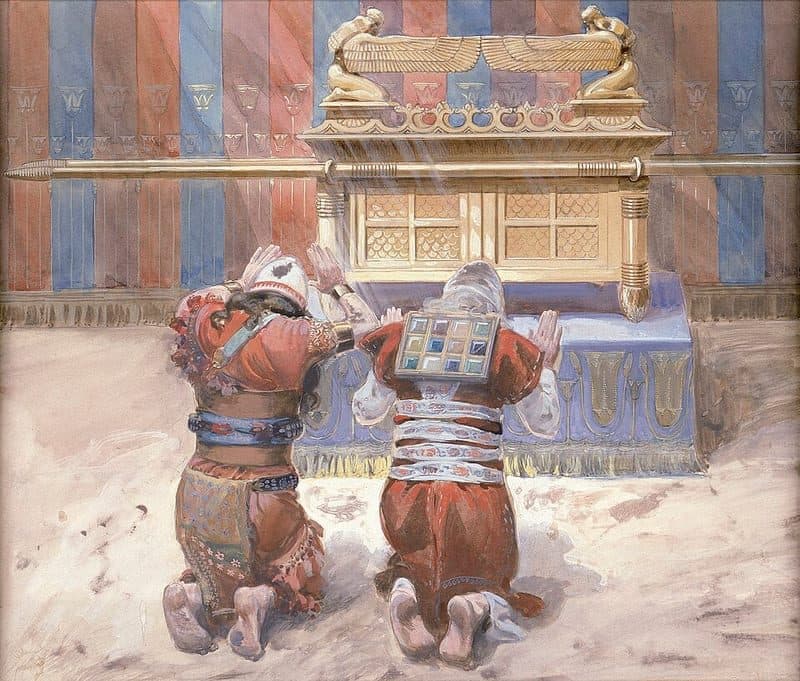
James Tissot, Moses and Joshua in the Tabernacle, about 1896. Public domain by date, via Wikimedia Commons.
THE ARTWORKTissot painted Moses and Joshua kneeling before the ark inside the tent, where Exodus 33:11 says the LORD spoke with Moses face to face.
Summary
In His answer the LORD sets out how His speaking with Moses differed from His speaking with any other prophet.
- The Hebrew of Numbers 12:8 says mouth to mouth, where Exodus 33:11 and Deuteronomy 34:10 say face to face.
- Miriam became leprous for her words, Moses prayed for her, and she was brought back into the camp after seven days.
- Hebrews 3 quotes the LORD's word that Moses was faithful in all His house and sets Jesus over that house as the Son.
The LORD's Answer at the Tent
The complaint and the LORD's answer in Numbers 12, with Exodus 33:11 and Deuteronomy 34:10
The complaint came at Hazeroth, soon after the LORD had put His Spirit on seventy elders and they prophesied.
Then Miriam and Aaron criticized Moses because of the Cushite woman he had married, for he had taken a Cushite wife. “Does the LORD speak only through Moses?” they said. “Does He not also speak through us?” And the LORD heard this.The complaint opens with Moses' marriage and turns into a claim that the LORD speaks through Miriam and Aaron as well.
He said, “Hear now My words: If there is a prophet among you, I, the LORD, will reveal Myself to him in a vision; I will speak to him in a dream. But this is not so with My servant Moses; he is faithful in all My house.Here the LORD answers the claim of Numbers 12:2, granting that He speaks to prophets and naming what sets Moses apart.
I speak with him face to face, clearly and not in riddles; he sees the form of the LORD. Why then were you unafraid to speak against My servant Moses?”This verse holds the Hebrew phrase of the page's title, peh el peh, which the Berean text renders face to face.
Two other passages use the words face to face of the LORD and Moses, one from his lifetime and one from his death.
Thus the LORD would speak to Moses face to face, as a man speaks to his friend. Then Moses would return to the camp, but his young assistant Joshua son of Nun would not leave the tent.This verse uses the other phrase, panim el panim, and shows that the LORD spoke with Moses this way before Numbers 12.
Since that time, no prophet has risen in Israel like Moses, whom the LORD knew face to face—The account of Moses' death names this knowing as the mark that no later prophet in Israel matched.
The Shape of the LORD's Answer
The clauses of Numbers 12:6 to 8 in a table, and a drawing of what set Moses apart
| Row | To a prophet, Numbers 12:6 | To Moses, Numbers 12:8 |
|---|---|---|
| First clause | I, the LORD, will reveal Myself to him in a vision | I speak with him face to face, clearly and not in riddles |
| Second clause | I will speak to him in a dream | he sees the form of the LORD |
| Between them, Numbers 12:7 | But this is not so with My servant Moses | he is faithful in all My house |
To a prophet the LORD spoke in a vision, a dream and riddles, and to Moses He spoke mouth to mouth.
One panel for each way of speaking
- In a visionA sight shown to the prophet, which Clarke calls an emblematic appearanceNumbers 12:6
- In a dreamA word given while the prophet sleepsNumbers 12:6
- In riddlesA dark saying to be worked out, as the almond branch shown to JeremiahJeremiah 1:11
- Mouth to mouthPlain speech face to face, clearly and not in riddlesNumbers 12:8
- The form of the LORDHe looks intently on it, the sense of the Hebrew verb yabbitNumbers 12:8
One panel for each way of speaking
The panels are not drawn to a measure. The three dark panels on the left are the ways the LORD names for a prophet, and the one light panel on the right is the way He names for Moses.
Four panels, the prophet's three ways of speaking stacked on the left and Moses' one way on the right with two numbered marks.
From the Complaint to Miriam's Return
Numbers 12 in five scenes, from the complaint to the seven days outside the camp
The complaint and the humble manNumbers 12:1 to 3
Now Moses was a very humble man, more so than any man on the face of the earth.The narrator calls Moses more humble than any man on earth, and the next verse shows the LORD answering for him.
Origen, in his Commentary on the Song of Songs, finds the two complaints hard to join.
“So then in the book of Numbers we find Moses taking an Ethiopian wife—that is to say, one who is dark or black. Because of her Mary and Aaron speak ill of him and say with indignation, ‘Has the Lord spoken to Moses only? Has he not also spoken to us?’ Now on careful consideration the narrative here seems to lack coherence. What has their saying ‘Has the Lord spoken to Moses only? Has he not also spoken to us?’ to do with their indignation about the Ethiopian woman?”
Origen of Alexandria · Commentary on the Song of Songs 2:1 · on Numbers 12:2Patristic
The summons to the Tent of MeetingNumbers 12:4 to 5
And suddenly the LORD said to Moses, Aaron, and Miriam, “You three, come out to the Tent of Meeting.” So the three went out, and the LORD came down in a pillar of cloud, stood at the entrance to the Tent, and summoned Aaron and Miriam. When both of them had stepped forward,The LORD settles the dispute Himself, at the place where He met with Moses.
Henry reads the scene as a trial.
“Judges of old sat in the gate of the city to try causes, and so on this occasion the shechinah in the cloud of glory stood at the door of the tabernacle, and Aaron and Miriam, as delinquents, were called to the bar.”
Matthew Henry · Commentary on the Whole Bible · on Numbers 12:4 to 5Puritan
The anger and the skin diseaseNumbers 12:9 to 10
So the anger of the LORD burned against them, and He departed. As the cloud lifted from above the Tent, suddenly Miriam became leprous, white as snow. Aaron turned toward her, saw that she was leprous,The cloud lifts before Miriam is struck, so the judgment follows the LORD's departure.
Rashi explains the order with a parable of a king who tells his son's tutor to punish the boy only after the king has gone, because he pities him.
Moses prays for his sisterNumbers 12:11 to 13
So Moses cried out to the LORD, “O God, please heal her!”Moses, the one spoken against, is the one who cries out for Miriam's healing.
Henry draws a lesson from the prayer.
“So Miriam here was healed by the prayer of Moses, whom she had abused, and Abimelech by the prayer of Abraham, Gen. xx. Moses might have stood off, and have said, ‘She is served well enough, let her govern her tongue better next time;’ but, not content with being able to say that he had not prayed for the inflicting of the judgment, he prays earnestly for the removal of it.”
Matthew Henry · Commentary on the Whole Bible · on Numbers 12:13Puritan
Seven days outside the campNumbers 12:14 to 15
But the LORD answered Moses, “If her father had but spit in her face, would she not have been in disgrace for seven days? Let her be confined outside the camp for seven days; after that she may be brought back in.” So Miriam was confined outside the camp for seven days, and the people did not move on until she was brought in again.The LORD sets a limit of seven days, and the whole people waits for Miriam before moving on.
Rashi says the people waited for Miriam as a reward for the time she waited by the river for the infant Moses, citing Exodus 2:4 and the Talmud, Sotah 9b.
What the Text Says of Moses and the Prophets
Two things often said of Numbers 12, each tested by a verse
MOSES SAW THE FACE OF GOD
The LORD let Moses see His back from a cleft of the rock and kept His face from being seen.
THE LORD SPOKE ONLY THROUGH MOSES
The LORD's answer says He makes Himself known to prophets as well, and the difference it names is the manner of His speaking.
The Hebrew of Numbers 12:6 to 8
Six words of the LORD's answer and the phrase of Exodus 33:11, with their meanings in the lexicon
| Hebrew | Meaning in the lexicon | Verse |
|---|---|---|
| mar'ah | A vision, and also a mirror | Numbers 12:6 |
| chalom | A dream | Numbers 12:6 |
| peh el peh | Mouth to mouth, from peh, the mouth | Numbers 12:8 |
| mar'eh | A view or an appearance, rendered clearly in the Berean text | Numbers 12:8 |
| chidah | A puzzle or a dark saying, rendered riddles | Numbers 12:8 |
| temunah | A shape, a likeness or a similitude, rendered form | Numbers 12:8 |
| panim el panim | Face to face, from panim, the face, the phrase of Exodus 33:11 and Deuteronomy 34:10 | Exodus 33:11 |
What Numbers 12 Leaves Unsaid
Two questions the chapter leaves open
The chapter does not name the Cushite woman. Wesley takes her to be Zipporah, called a Cushite because she was a Midianite.
Moses agreed to stay with the man, and he gave his daughter Zipporah to Moses in marriage.Zipporah, a daughter of the priest of Midian, is the wife of Moses whom Exodus names.
Numbers does not describe the form of the LORD that Moses saw, and Deuteronomy says that Israel saw no form at Horeb.
So since you saw no form of any kind on the day the LORD spoke to you out of the fire at Horeb, be careful that you do not act corruptly and make an idol for yourselves of any form or shape, whether in the likeness of a male or female,Moses grounds the ban on idols in the form Israel did not see at Horeb, the same word Numbers 12:8 uses of Moses.
A Prophet like Moses, and the Son over the House
How Deuteronomy, John, Hebrews and Paul read the LORD's words in Numbers 12
Clarke writes that no later prophet was as highly privileged as Moses until Jesus Christ came, the prophet Moses promised in Deuteronomy 18:15.
I will raise up for them a prophet like you from among their brothers. I will put My words in his mouth, and he will tell them everything I command him.The LORD promises to put His words in the mouth of the coming prophet, the word Numbers 12:8 uses for His speech with Moses.
John's Gospel names Moses and the sight of God in its first chapter.
For the law was given through Moses; grace and truth came through Jesus Christ. No one has ever seen God, but the one and only Son, who is Himself God and is at the Father’s side, has made Him known.John answers the refusal of Exodus 33:20 by naming the Son, at the Father's side, as the one who has made God known.
Origen, in his Commentary on the Song of Songs, joins Exodus 33 to the words of Jesus in Matthew 11:27.
“Like to these is the saying of God to Moses: ‘Lo, I have set you in a cleft of the rock, and you shall see my back parts.’ That rock which is Christ is therefore not completely closed but has clefts. But the cleft of the rock is he who reveals God to men and makes him known to them; for ‘no one knows the Father, save the Son.’”
Origen of Alexandria · Commentary on the Song of Songs 3.15 · on Exodus 33:23Patristic
Hebrews takes up the LORD's words of Numbers 12:7.
Now Moses was faithful as a servant in all God’s house, testifying to what would be spoken later. But Christ is faithful as the Son over God’s house. And we are His house, if we hold firmly to our confidence and the hope of which we boast.The writer keeps Moses' title of servant from Numbers 12:7 and gives Jesus the title of Son over the same house.
Paul's Greek for the dim seeing in 1 Corinthians 13:12 is a mirror and an ainigma, an obscure saying, and the Hebrew word for the prophet's vision in Numbers 12:6, mar'ah, also means a mirror.
Now we see but a dim reflection as in a mirror; then we shall see face to face. Now I know in part; then I shall know fully, even as I am fully known.Paul promises every believer the face to face seeing that Numbers 12:8 gives Moses above the prophets.
Two Teachers on Moses
Clement of Rome on his humility and Gregory of Nazianzus on the sight of God
Clement of Rome, writing to the church at Corinth, holds up Moses' humility.
“Moses was called ‘faithful in all God's house.’ God used him to bring his judgment on Egypt with scourges and torments. Yet even he, despite the great glory he was given, did not boast. But when he was granted an oracle from the bush, he said, ‘Who am I that you send me? I have a feeble voice and a slow tongue.’ And again he says, ‘I am but steam from a pot.’”
Clement of Rome · Letter to the Corinthians 17 · on Numbers 12:7Patristic
Gregory of Nazianzus, in his second Theological Oration, tells his own climb toward God in the words of Exodus 33.
“What is this that has happened to me, O friends and initiates and fellow lovers of the truth? I was running to lay hold on God, and thus I went up into the mount and drew aside the curtain of the cloud and entered away from matter and material things. And as far as I could I withdrew within myself. And then when I looked up, I scarce saw the back parts of God, although I was sheltered by the rock, the Word that was made flesh for us.”
Gregory of Nazianzus · Theological Oration 2:3 · on Exodus 33:22Patristic
How Moses Saw the Form and Lived
Two readings of Numbers 12:8 beside Exodus 33:20, and the objection to each
The form was a sight of the glory short of God's faceJohn Wesley, Explanatory Notes upon the Old Testament, 1765, on Numbers 12:8
Wesley takes the form as a singular manifestation of the glorious presence, short of the face or essence of God, which no one can look on and live. Jamieson, Fausset and Brown read the face and the back in Exodus 33 as figures for a display of majesty as far as human weakness allows. Henry writes that a full sight of God's glory would overpower any mortal man.
The objection: Rashi, after Sifrei Bamidbar 103, cites Exodus 33:20 against reading mar'eh in Numbers 12:8 as a sight of the Presence.
But He added, “You cannot see My face, for no one can see Me and live.”Wesley and Rashi both cite this verse, so each reading has to leave room for it.
The clear sight of Numbers 12:8 is the clearness of the speech, and no sight of the Divine PresenceRashi on Numbers 12:8, after Sifrei Bamidbar 103
Rashi reads mar'eh as the clearness of the communication, given in its plainest form and not hidden in riddles as in Ezekiel 17:2. Sforno describes the difference as speech that came to Moses while he was awake, and Clarke takes face to face in Exodus 33:11 as speech in Moses' own language with no shape to be seen.
The objection: Wesley and Jamieson, Fausset and Brown hold that Moses was given a sight of the glory, and the Hebrew verb in Numbers 12:8 means to look intently.
The LORD continued, “There is a place near Me where you are to stand upon a rock, and when My glory passes by, I will put you in a cleft of the rock and cover you with My hand until I have passed by.The LORD sets Moses on the rock and promises that His glory will pass by, a sight the reading of speech alone has to explain.
Books on Numbers 12
Two works to read whole
Rashi on Numbers
Rashi, in the English of M. Rosenbaum and A. M. Silbermann · 1929 to 1934
Rashi explains the words of Numbers 12 verse by verse and names the midrash he draws each reading from.
Read Rashi on Numbers 12 at SefariaExplanatory Notes upon the Old Testament
John Wesley · 1765
Wesley's short notes on Numbers 12 and Exodus 33 explain each phrase and set it beside the verses that bear on it.
The Light in the Face of Jesus Christ
The LORD spoke with Moses as with no other prophet, and still He kept His face hidden from him. Every reader who wants to know God is sent to Jesus, in whom the Father is seen.
For God, who said, “Let light shine out of darkness,” made His light shine in our hearts to give us the light of the knowledge of the glory of God in the face of Jesus Christ.This verse answers the request of Moses in Exodus 33:18 to see the glory of God.
Keep studying
Peoples and groups1
Symbols1