
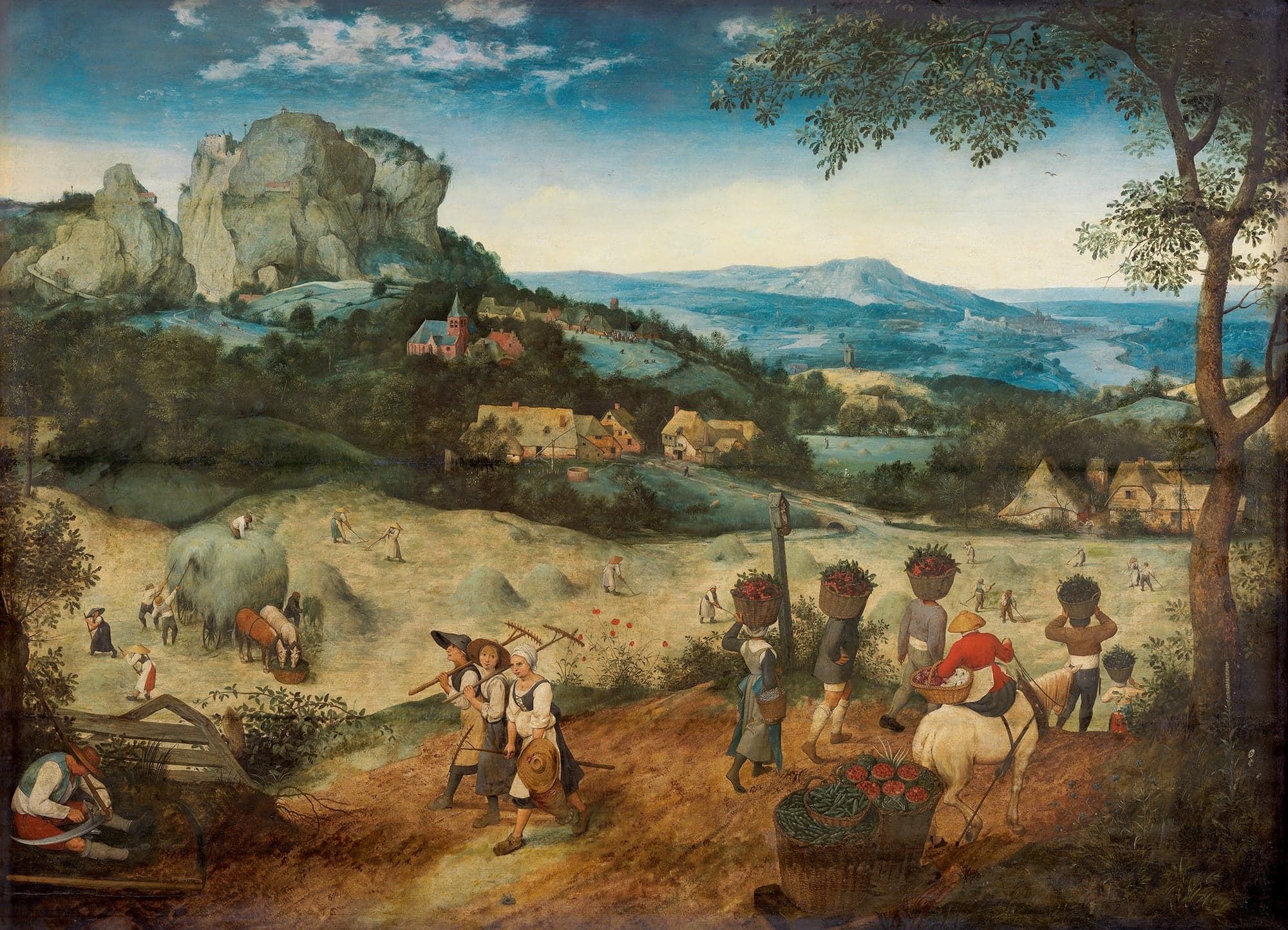
Exodus 34:21 · Passage · Diligence
Six Days You Shall Labor
Exodus 34:21 sets six days of labor beside a seventh of rest, and Deuteronomy 5:12 to 15 extends that rest to the servants of the house.
In Hebrews the Greek verb for diligence, spoudazo, names the effort it takes to enter God's rest.
Six days you shall labor, but on the seventh day you shall rest; even in the seasons of plowing and harvesting, you must rest.
- The passage
- Exodus 34:21, Deuteronomy 5:12 to 15
- Books
- Exodus, Deuteronomy
- Hold in memory
- Exodus 34:21
Summary
Diligence, as this command shapes it, is steady effort through every season of the year, held to a measure. The worker gives six days fully to the field and the household, and he does not let the weeks of greatest pressure take the seventh. The same discipline that keeps him at work keeps him from overwork, so diligence and rest belong to one habit.
- Exodus 34:21 belongs to the covenant the LORD renewed after the golden calf, on the second pair of tablets.
- The rest held in plowing and in harvest, the weeks when farm work could least wait.
- In the wilderness the double manna of the sixth day let Israel rest on the seventh without going hungry.
- Amos and Nehemiah condemn Israelites who broke the rest for the sake of trade.
The Command at the Renewed Covenant
Exodus 34 gives the laws of the covenant again after Israel's sin at Sinai.
Diligence in Scripture is steady work done in its season. A diligent person has to know when to press on and when to stop, and Exodus 34:21 answers both in one sentence. The fourth commandment at Exodus 20:9 had first given Israel its six days of labor.
The question is how the six days and the seventh shape a diligent life. Exodus 34 sets the command in a renewed covenant, and the manna and Proverbs show work done ahead of need. Deuteronomy 5:12 to 15 gives the rest to the whole household, and the prophets show the rest broken for gain. Three commentators, Adam Clarke, John Gill and Matthew Henry, speak to work in the busy seasons.
Moses broke the first tablets at the foot of the mountain when he saw the golden calf and the dancing. In chapter 34 the LORD called him back up.
Then the LORD said to Moses, “Chisel out two stone tablets like the originals, and I will write on them the words that were on the first tablets, which you broke.The order to cut new tablets shows that the LORD Himself restored the covenant Israel had broken.
And the LORD said, “Behold, I am making a covenant. Before all your people I will perform wonders that have never been done in any nation in all the world. All the people among whom you live will see the LORD’s work, for it is an awesome thing that I am doing with you.The LORD names His own work as the wonder Israel will see, before He gives Israel the laws for its work.
The LORD also said to Moses, “Write down these words, for in accordance with these words I have made a covenant with you and with Israel.” So Moses was there with the LORD forty days and forty nights without eating bread or drinking water. He wrote on the tablets the words of the covenant—the Ten Commandments.Moses writes these laws down as the words of the covenant, so the clause on plowing and harvest is part of the covenant itself.
Work Closed by Rest in Six Sayings of the Law
Outside the Ten Commandments the books of Moses name the six days of work in six more verses.
In each of the six sayings the six days of work end in rest, whether the verb charges Israel to work or only allows it.
| Verse | What the six days are for | The verb in the Berean text | Charge or permission |
|---|---|---|---|
| Exodus 16:26 | Gathering the manna in the wilderness | you may gather | Permission |
| Exodus 23:12 | Work in the week before the seventh-day rest | you are to do your work | Charge |
| Exodus 31:15 | Work before the Sabbath given as a sign | work may be done | Permission |
| Exodus 34:21 | Labor through plowing and harvest | you shall labor | Charge |
| Exodus 35:2 | Work in the weeks of building the tabernacle | work may be done | Permission |
| Leviticus 23:3 | Work before the day of sacred assembly | work may be done | Permission |
The STEP Bible tagging from Tyndale House marks the verb ta'avod in Exodus 34:21 as an imperfect and glosses it "you will labor". The verb of rest in the same verse, tishbot, has the same form. In Exodus 31:15 the verb, a form of asah, to do, is also an imperfect, glossed "it will be done". Either reading gives the worker full days of labor and a day on which his labor stops.
Through Plowing and Harvest
The clause added in Exodus 34:21 reaches into the breaking of the ground and the reaping of the grain.
John Gill, in his Exposition of the Old Testament, calls plowing and reaping "both very busy seasons". He writes that such works, "though they might require haste and expedition, yet the sabbath was not to be broken on account of them".
Adam Clarke, in his Commentary on the Bible, saw the clause broken by farmers who worked on a fine Sabbath when the harvest weather had been bad. He wrote that "many break the Sabbath on the pretense of absolute necessity" and asked, "But is not the above command pointed directly against this?"
Proverbs praises the son who works while the crop is ready.
He who gathers in summer is a wise son, but he who sleeps during harvest is a disgraceful son.The proverb makes work in its season the mark of a wise son, which is the diligence Exodus 34:21 then limits with a day of rest.
The manna had already taught Israel this order before Sinai.
Then on the sixth day, when they prepare what they bring in, it will be twice as much as they gather on the other days.”The promise comes before the gathering, so Israel's extra work on the sixth day rested on the LORD's word.
Understand that the LORD has given you the Sabbath; that is why on the sixth day He will give you bread for two days. On the seventh day, everyone must stay where he is; no one may leave his place.”Moses calls the double portion a gift, so the rest of the seventh day depended on the LORD's provision.
The Command for the Household in Deuteronomy 5
Moses repeats the commandment east of the Jordan in the land of Moab, in the fortieth year after Israel left Egypt.
Observe the Sabbath day by keeping it holy, as the LORD your God has commanded you.The command is spoken again to the people about to settle on their own farms, where the measure of work would govern every household.
In the verses that follow Moses repeats the fourth commandment and names everyone in the house who rests, down to the ox and the donkey.
Remember that you were a slave in the land of Egypt, and that the LORD your God brought you out of there with a mighty hand and an outstretched arm. That is why the LORD your God has commanded you to keep the Sabbath day.Israel is to remember its own forced labor in Egypt, so the rest it gives is given by people who once had none.
The Law of the covenant in Exodus had already given the same reason for the rest of working animals and of the servant's son.
For six days you are to do your work, but on the seventh day you must cease, so that your ox and your donkey may rest and the son of your maidservant may be refreshed, as well as the foreign resident.The law gives the day a purpose beyond Israel's own families, the refreshment of animals and of people with the least power in the house.
In Deuteronomy the six days belong to a household, and a master who works his people without a break fails the command as much as an idle man does.
Diligence Turned to Greed
A prophet in the days of King Uzziah and a governor after the exile both met Israelites who worked through the seventh day for gain.
asking, “When will the New Moon be over, that we may sell grain? When will the Sabbath end, that we may market wheat? Let us reduce the ephah and increase the shekel; let us cheat with dishonest scales.Amos sets the traders' impatience with the rest beside their cheating, so the same greed drives both.
In those days I saw people in Judah treading winepresses on the Sabbath and bringing in grain and loading it on donkeys, along with wine, grapes, and figs. All kinds of goods were being brought into Jerusalem on the Sabbath day. So I warned them against selling food on that day.The governor's report shows that the habit outlived the exile and reached the restored city.
In both scenes the work done on the seventh day comes from greed and the fear of loss. True diligence works hard for six days and lets the seventh stand, and the traders' haste could not wait for it to pass.
A Weekly Day or a Seventh Year
Both readings make the clause a limit on work at the busiest time, whether the limit falls on a day or on a year.
Christian commentators read the clause on plowing and harvest of the weekly Sabbath, and rabbis reported by John Gill read it of the sabbatical year.
The weekly Sabbath in the busy seasonsJohn Gill; Matthew Henry; Adam Clarke
Gill calls this reading "the common sense of the law, as it is understood", and Clarke applies it to the farmers of his day. Matthew Henry, in his Commentary on the Whole Bible, reads the rest as kept "even in earing time, and in harvest, the most busy times of the year". He adds that "harvest-work will prosper the better for the religious observance of the sabbath-day in harvest-time".
The objection: Leviticus 25 sets sowing and pruning in a pattern of six years and a seventh, so the words of the clause fit the seventh year as well as the seventh day.
For six years you may sow your field and prune your vineyard and gather its crops. But in the seventh year there shall be a Sabbath of complete rest for the land—a Sabbath to the LORD. You are not to sow your field or prune your vineyard.This law gives the land six years of sowing and one of rest, so the measure of six and one reaches the field as well as the worker.
The plowing and harvest of the seventh yearRabbis cited by Maimonides and by Jarchi, as John Gill reports them
Gill reports another reading from Maimonides, on the Mishnah tractate Sheviith, chapter 1. Its teachers "say, it is forbidden to plough in the sixth year what cannot be reaped but in the seventh". Gill adds that Jarchi "observes, that some of their Rabbins say, this is to be understood of the ploughing of the seventh year". Jarchi also reports "others" who "say the text speaks only of the sabbath".
The objection: the clause stands inside a sentence about the seventh day, and Exodus 34:21 names no year.
Diligence That Keeps the Seventh Day
Exodus 34:21 asks for a worker who gives the six days his full strength and sets the work down on the seventh even when the field is ready. Paul asks the church for the same steady effort over the long season of doing good.
Let us not grow weary in well-doing, for in due time we will reap a harvest if we do not give up.Paul borrows the farmer's harvest for the reward of steady work, so the diligence of the field becomes a picture of the Christian life.
Sources
Scripture is the Berean Standard Bible.
- The tagged Hebrew Old Testament and Greek New Testament, with Strong's numbers, morphology and glosses (STEP Bible, Tyndale House, Cambridge, CC BY 4.0)
- Adam Clarke, Commentary on the Bible, on Exodus 34:21.
- John Gill, Exposition of the Old Testament (1748 to 1763), on Exodus 34:21, with his note citing Maimonides on the Mishnah, Sheviith, chapter 1, and Jarchi.
- Matthew Henry, Commentary on the Whole Bible, volume 1, on Exodus 34:18 to 27.
Keep Studying
In this value5
People and groups6