
Exodus 12 · Exodus 13 · Mishnah Pesachim 10 · Subject · Featured Study
The Seder, the Meal Exodus 12 Is Kept By
The foods, the four cups, the children's questions and the retelling of the Jewish Passover supper, traced from Exodus to the rabbis.
Since the Temple fell, the Jewish Passover table has held matzah and maror, and of the lamb only a memorial.
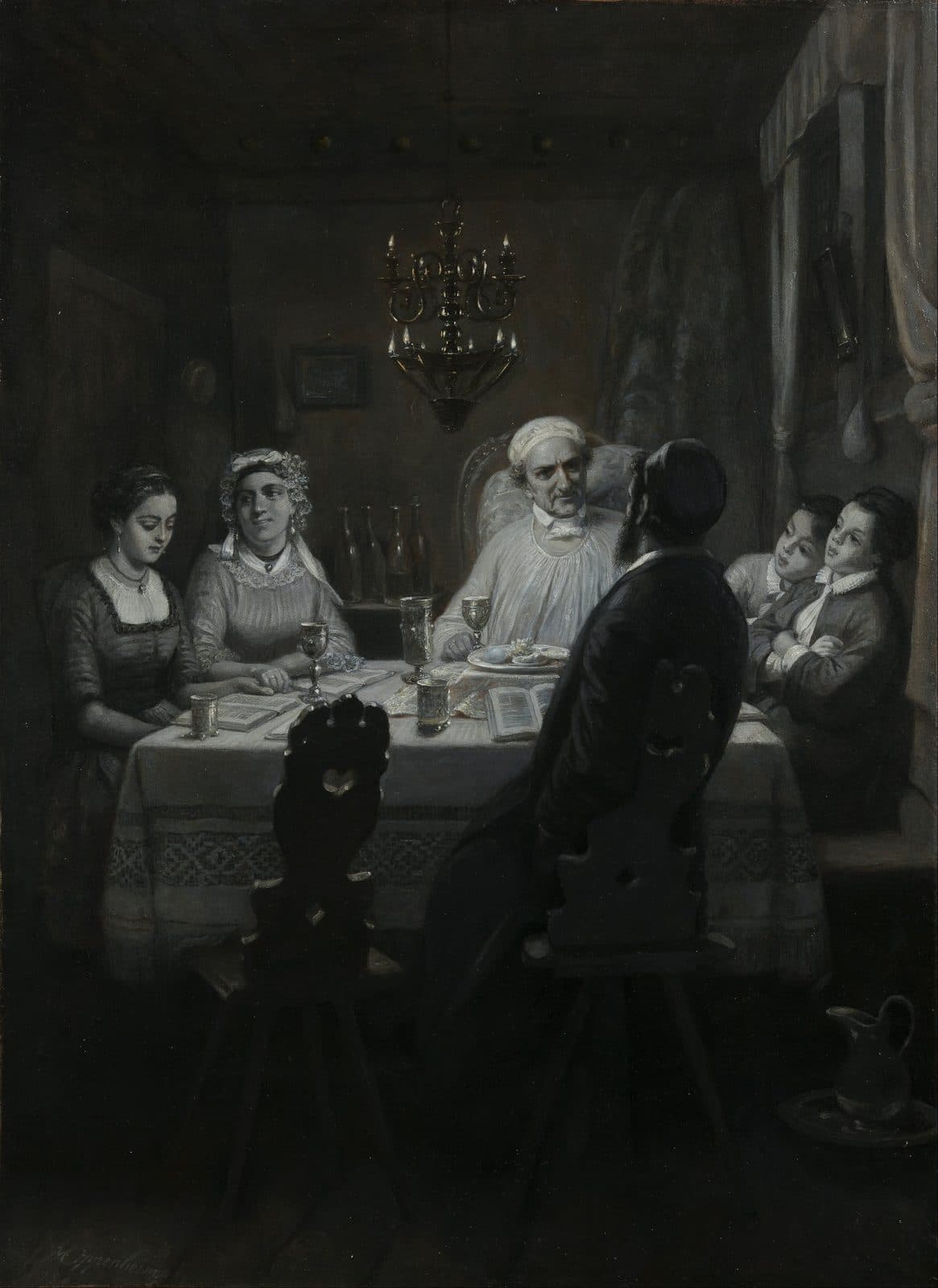
Moritz Daniel Oppenheim, Seder (The Passover Meal), about 1867. Public domain by date, published before 1930, via Wikimedia Commons.
THE ARTWORKOppenheim painted a German Jewish household at the seder in shades of grey. The father leans on cushions at the head of the table, and the boys turn toward him.
Summary
The seder is the ordered meal by which the night of Exodus 12 is kept, and its oldest written order is chapter 10 of Mishnah Pesachim.
- Exodus commands the lamb, the unleavened bread and the bitter herbs, and it tells parents to answer their children's question.
- The Mishnah adds four cups of wine, a set order of dipping and blessing, and the Hallel sung in two parts.
- Rabban Gamaliel held that no one had done his duty who had not spoken of the Passover lamb, the matzah and the bitter herbs.
- Whether the Last Supper was itself a Passover meal is argued from Luke 22:15 on one side and John 18:28 on the other.
Four Verses Behind the Meal
Two verses on the food and the day, and two on a child's question and a parent's answer
They are to eat the meat that night, roasted over the fire, along with unleavened bread and bitter herbs.This verse names the three foods Rabban Gamaliel later required every household to explain.
And this day will be a memorial for you, and you are to celebrate it as a feast to the LORD, as a permanent statute for the generations to come.The command to keep the day for the generations to come is why the meal outlived the night in Egypt.
When your children ask you, ‘What does this service mean to you?’ you are to reply, ‘It is the Passover sacrifice to the LORD, who passed over the houses of the Israelites in Egypt when He struck down the Egyptians and spared our homes.’” Then the people bowed down and worshiped.And on that day you are to explain to your son, ‘This is because of what the LORD did for me when I came out of Egypt.’The Order of the Night
| Step | What the Mishnah sets down | Mishnah |
|---|---|---|
| Before nightfall | No one eats from late afternoon until dark, and even the poorest reclines and receives four cups of wine | Mishnah Pesachim 10:1 |
| The first cup | A blessing over the day and a blessing over the wine, in an order the houses of Shammai and Hillel dispute | Mishnah Pesachim 10:2 |
| The first dipping | Lettuce is dipped and eaten before the bread is brought | Mishnah Pesachim 10:3 |
| The table | Matzah, lettuce, haroset and two cooked dishes, and in the Temple the body of the Passover lamb | Mishnah Pesachim 10:3 |
| The second cup | The son asks his father, or the father prompts him with how this night differs from all others | Mishnah Pesachim 10:4 |
| The retelling | The father begins with shame, ends with praise, and expounds Deuteronomy 26:5 to the end of the passage | Mishnah Pesachim 10:4 |
| The three things | The Passover lamb, the matzah and the bitter herbs are named and explained | Mishnah Pesachim 10:5 |
| The first part of the Hallel | Psalm 113, or Psalms 113 and 114, closed by a blessing for redemption | Mishnah Pesachim 10:6 |
| The third cup | The meal is eaten, and the grace after the meal is said over it | Mishnah Pesachim 10:7 |
| The fourth cup | The Hallel is finished with the blessing of song, and no further course follows the lamb | Mishnah Pesachim 10:7 to 8 |
From the Command to the Custom
Some commands of Exodus 12 belonged to the night in Egypt, and the Mishnah turned others into the order of a meal eaten at rest.
| What Exodus commands | What the Mishnah sets down | Verse |
|---|---|---|
| The lamb eaten roasted over the fire, with unleavened bread and bitter herbs | Matzah and lettuce on the table, and meat eaten only roasted on this night (Mishnah Pesachim 10:3 to 4) | Exodus 12:8 |
| The meal eaten in haste, dressed for travel, with sandals and staff | The meal eaten reclining, even by the poorest in Israel (Mishnah Pesachim 10:1) | Exodus 12:11 |
| The children ask what the service means | The son asks, and the father teaches him by his understanding (Mishnah Pesachim 10:4) | Exodus 12:26 |
| The father explains to his son what the LORD did for him | In every generation each one regards himself as having come out of Egypt (Mishnah Pesachim 10:5) | Exodus 13:8 |
| The day kept as a memorial for the generations to come | Praise to the One who brought them from slavery to freedom, and the Hallel (Mishnah Pesachim 10:5 to 6) | Exodus 12:14 |
The dress of hasteExodus 12:11
Albert Barnes, on Exodus 12:11, writes that the Jews held the girded robe, the sandals and the staff to belong to the first Passover alone. He finds no trace of their later use.
This is how you are to eat it: You must be fully dressed for travel, with your sandals on your feet and your staff in your hand. You are to eat in haste; it is the LORD’s Passover.The verse dresses a people about to leave, which is why a meal eaten at rest could not keep it.
The one place of sacrificeDeuteronomy 16:5 to 6
Deuteronomy moves the slaughter of the lamb from each house to the place the LORD would choose for His name.
You are not to sacrifice the Passover animal in any of the towns that the LORD your God is giving you. You must only offer the Passover sacrifice at the place the LORD your God will choose as a dwelling for His Name. Do this in the evening as the sun sets, at the same time you departed from Egypt.This law left no place to slay the lamb once the Temple was gone.
What Exodus Says and What Is Said of It
Three things often said of the seder, each with the verse that tests it
THE FOUR CUPS
The four cups first appear in the Mishnah, which requires them even for the poorest, and Alfred Edersheim notes that the wine was enjoined by tradition and is not mentioned in the Law.
THE FOUR QUESTIONS
The children's question stands in one line, at Exodus 12:26 and again at Exodus 13:14. In the Mishnah the father teaches how the night differs, and Joshua Kulp writes that later copyists revised that list with the questions familiar to them.
THE SEDER PLATE
The Mishnah names no plate. The plate with an egg and meat from the forearm roasted over coals is set out in the Shulchan Arukh, Orach Chayim 473:4, with the gloss of the Rema.
The Lamb, the Temple and the Year 70
The count in Josephus, the date in Ab, and the memorials kept at the table since
Josephus reports that the Passover lambs were slain from the ninth hour to the eleventh, with no fewer than ten people to each lamb. A count taken under Cestius found 256,500 of them.
The Temple burned in the month of Ab in the year 70.
What the Mishnah remembersMishnah Pesachim 10:3 and Mishnah Pesachim 10:6
The Mishnah sets the lamb apart as a thing of the Temple. Rabbi Akiva's blessing asks God to bring His people to future festivals in a rebuilt city, where they will eat again of the sacrifices and the Passover lambs.
The two cooked dishesTalmud Pesachim 114b
In the Babylonian Talmud, at Pesachim 114b, Rav Yosef requires two kinds of cooked food, one in memory of the Passover lamb and one in memory of the festival offering.
The question that changedMishnah Pesachim 10:4 and the Haggadah
The father in the Mishnah speaks of meat eaten only roasted on this night. The Haggadah in use today asks instead why all recline, and Sefaria's record of the book says its text was compiled in the times of the Mishnah and the Talmud, with later medieval additions.
The Words of the Meal
Five Hebrew words from the lexicon, each in the verse where it stands
PESACH, PASSOVER (HEBREW, H6453)
The lexicon gives an exemption and counts 49 uses, and Exodus 12:11 calls the meal the LORD's Passover.
MATSAH, UNLEAVENED BREAD (HEBREW, H4682)
The lexicon counts 53 uses, and the plural matsot stands beside the roasted lamb.
MAROR, BITTER HERB (HEBREW, H4844)
The lexicon gives a bitter herb and counts three uses.
ZIKKARON, MEMORIAL (HEBREW, H2146)
The lexicon gives a memento, a thing or a day to be remembered.
NAGAD, TO TELL (HEBREW, H5046)
The lexicon gives the root sense of standing out in front.
What the Text Leaves Unsaid
Three questions Exodus, the Gospels and the Mishnah leave open
Exodus names no wine and no cups, and beyond the answer to the child it gives the father no fixed words for the night.
The Gospels' accounts of the last meal name the bread and the cup, and none of them names a lamb on the table.
While they were eating, Jesus took bread, spoke a blessing and broke it, and gave it to the disciples, saying, “Take it; this is My body.” Then He took the cup, gave thanks, and gave it to them, and they all drank from it. He said to them, “This is My blood of the covenant, which is poured out for many.Mark names the Passover lamb at Mark 14:12, so its absence from this account of the table stands out.
The Mishnah gives no date for its order, and it does not say who first set the cups or the questions.
The Passover Lamb and the Lord's Table
Luke 22 and 1 Corinthians 10, where the New Testament meets the meal
And He said to them, “I have eagerly desired to eat this Passover with you before My suffering. For I tell you that I will not eat it again until it is fulfilled in the kingdom of God.”These words at the table are the plainest text for reading the meal as the Passover.
In the same way, after supper He took the cup, saying, “This cup is the new covenant in My blood, which is poured out for you.Alfred Edersheim took this cup after supper to be the third cup of the meal.
Is not the cup of blessing that we bless a participation in the blood of Christ? And is not the bread that we break a participation in the body of Christ?Edersheim joined Paul's words here to the cup after supper in Luke.
Henry and Wesley on the Night
Three passages of Matthew Henry and one of John Wesley, from their commentaries on Exodus 12 and 13
Henry explains why the law made so much of the bread that a child would notice.
“The care and strictness enjoined in this matter were designed, (1.) To make the feast the more solemn, and consequently the more taken notice of by their children, who would ask, ‘Why is so much ado made?’ (2.) To teach us how solicitous we should be to put away from us all sin, 1 Cor. v. 7 .”
Matthew Henry · Commentary on the Whole Bible · on Exodus 13:7Puritan
Henry counts later generations among those the night delivered.
“Mercies to our fathers are mercies to us; we reap the benefit of them, and therefore must keep up a grateful remembrance of them. We stand upon the bottom of former deliverances, and were in the loins of our ancestors when they were delivered. Much more reason have we to say that in the death and resurrection of Jesus Christ we were redeemed.”
Matthew Henry · Commentary on the Whole Bible · on Exodus 13:14 to 16Puritan
Wesley sets the first Passover night beside the night Jesus was betrayed.
“This first passover night was a night of the Lord, much to be observed; but the last passover night, in which Christ was betrayed, was a night of the Lord, much more to be observed, when a yoke heavier than that of Egypt was broke from off our necks, and a land better than that of Canaan set before us.”
John Wesley · Explanatory Notes upon the Old Testament · on Exodus 12:42Evangelical
Henry ties the congregation's keeping of the feast to the Lord's Supper.
“All that share in God's mercies should join in thankful praises for them. Though it was observed in families apart, yet it is looked upon as the act of the whole congregation; for the smaller communities constituted the greater. The New-Testament passover, the Lord's supper, ought not to be neglected by any who are capable of celebrating it.”
Matthew Henry · Commentary on the Whole Bible · on Exodus 12:47Puritan
Two Questions of Date
Whether the Last Supper was a Passover meal, and how old the seder's order is, each with its holders
A Passover meal on the evening of Nisan 14Alfred Edersheim, The Temple: Its Ministry and Services, 1874
Edersheim held that Jesus and the disciples ate the Paschal Supper on the night before He died. He read the Passover of John 18:28 as the festival offering of the next day, which a man defiled in Pilate's hall could not eat.
On the first day of the Feast of Unleavened Bread, when the Passover lamb was to be sacrificed, Jesus’ disciples asked Him, “Where do You want us to prepare for You to eat the Passover?”Mark dates the preparation to the day the Passover lamb was sacrificed.
The objection: John places the Passover after the arrest, on the day Pilate handed Jesus over.
It was the day of Preparation for the Passover, about the sixth hour. And Pilate said to the Jews, “Here is your King!”The objection rests on this verse, which puts the trial before the Passover meal.
A meal on the evening before the PassoverF. W. Farrar, The Life of Christ, 1874, Excursus X
Farrar held that the Last Supper was eaten on Thursday, Nisan 13, as a meal with a Paschal character eaten the evening before the Jewish Passover.
Then they led Jesus away from Caiaphas into the Praetorium. By now it was early morning, and the Jews did not enter the Praetorium, to avoid being defiled and unable to eat the Passover.Farrar's reading rests on the Passover still to be eaten on the morning of the trial.
The objection: Luke reports that Jesus called this meal the Passover He had eagerly desired to eat with the disciples.
The Mishnah's order as the supper of Christ's timeAlfred Edersheim, The Temple: Its Ministry and Services, 1874, chapter 12
Edersheim set the Mishnah's account beside the Gospels and read the Last Supper through its cups, its dipping and its Hallel.
The objection: Sefaria dates the tractate between about 190 and 230, more than a century after the Temple fell.
An order shaped after the Temple fellJoshua Kulp, Mishnah Yomit, on Mishnah Pesachim 10
Kulp writes that most scholars today do not think an ordered seder existed while the Temple stood. In his reading the rabbis shaped the meal after the destruction as one answer to the loss of the lamb.
The objection: the Gospels already have the bread, a cup after supper and a hymn at the end of the meal.
And when they had sung a hymn, they went out to the Mount of Olives.Matthew ends the meal with a hymn, which Edersheim takes as the second part of the Hallel.
Books on the Seder
Three works a reader can open free, earliest first
The Wars of the Jews
Flavius Josephus, translated by William Whiston · 1737
Whiston's translation gives the siege and the burning of the city in its sixth book.
Read it at Project GutenbergThe Temple: Its Ministry and Services
Alfred Edersheim · 1874
Edersheim's twelfth chapter gives the course of the supper as the Mishnah and the Talmud describe it.
Read it at the Christian Classics Ethereal LibraryThe Life of Christ
F. W. Farrar · 1874
Farrar's tenth excursus sets out the case for a supper eaten the evening before the Passover.
Read volume 2 at the Internet ArchiveKeep the Feast
Exodus told each father to answer his child with what the LORD had done for him, and the seder still turns on that answer. Paul gives the church its answer in Christ, and the Lord's Supper is the church's telling of it.
Get rid of the old leaven, that you may be a new unleavened batch, as you really are. For Christ, our Passover lamb, has been sacrificed. Therefore let us keep the feast, not with the old bread, leavened with malice and wickedness, but with the unleavened bread of sincerity and of truth.Paul draws the church's daily life from the feast of Exodus 12.
Keep studying
Studies6
Doctrines7
Peoples and groups1