
Genesis 46:8 to 27 · Subject · Featured Study
The Seventy Who Went Down and the Seventy-Five of Acts
In the Masoretic Text Jacob's household numbers seventy, and in the Septuagint of Genesis 46:27 and in Stephen's speech in Acts 7:14 it numbers seventy-five.
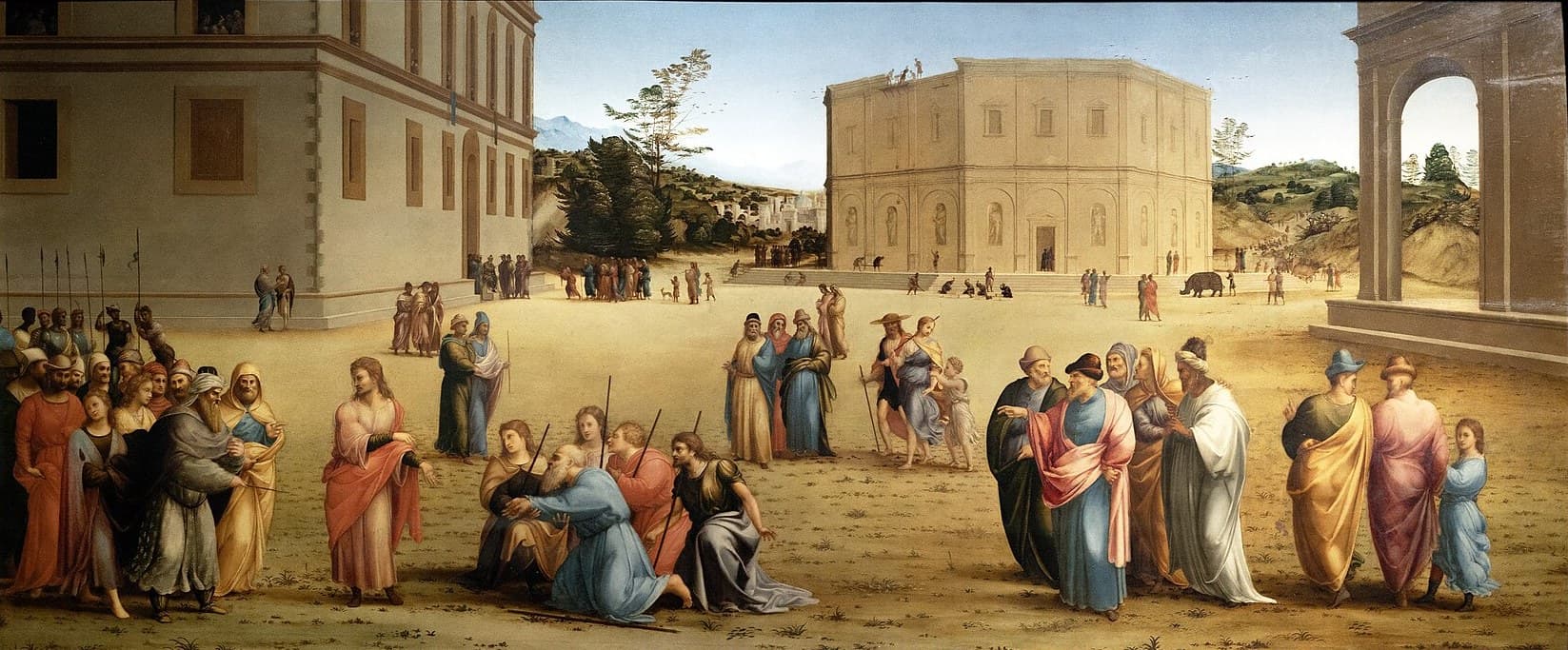
Francesco Granacci, Joseph Presents His Father and Brothers to Pharaoh, about 1515 to 1517. Public domain, via Wikimedia Commons.
THE ARTWORKGranacci painted Genesis 47, where Joseph brings his father and his brothers before Pharaoh after the household of Jacob has come down into Egypt.
Jacob's household went down to Egypt few enough to be listed one by one.
Summary
Genesis 46:8 to 27 lists the sons of Israel who went to Egypt under their four mothers and closes with two totals.
- In the Masoretic Text the totals for Leah, Zilpah, Rachel and Bilhah are thirty-three, sixteen, fourteen and seven, which add to seventy.
- Brenton's English Septuagint of 1851 counts nine sons of Joseph born in Egypt at Genesis 46:27.
- Bede and Adam Clarke hold that Stephen's figure in Acts 7:14 follows the Septuagint.
- Jamieson, Fausset and Brown hold that the two figures count different persons and so agree.
The Household That Went Down
Genesis 46:5 to 27, the move from Beersheba to Egypt and the list of names
Genesis tells the move to Egypt before it counts the household.
Then Jacob departed from Beersheba, and the sons of Israel took their father Jacob in the wagons Pharaoh had sent to carry him, along with their children and wives. They also took the livestock and possessions they had acquired in the land of Canaan, and Jacob and all his offspring went to Egypt. Jacob took with him to Egypt his sons and grandsons, and his daughters and granddaughters—all his offspring.Verse 7 says the whole of Jacob's offspring went with him, which is the group the list then counts.
Matthew Henry gives a reason the sons all went down together.
“It is probable that they had continued to live together in common with their father; and therefore when he went they all went, which perhaps they were the more willing to do, because, though they had heard that the land of Canaan was promised them, yet, to this day, they had none of it in possession.”
Matthew Henry · Commentary on the Whole Bible · on Genesis 46:7Puritan
The list begins with Reuben, Jacob's firstborn, and gives the sons of each mother with their sons in turn.
All those belonging to Jacob who came to Egypt—his direct descendants, besides the wives of Jacob’s sons—numbered sixty-six persons. And with the two sons who had been born to Joseph in Egypt, the members of Jacob’s family who went to Egypt were seventy in all.These verses give the Masoretic Text's two totals: sixty-six who came with Jacob, and seventy once Joseph's house in Egypt is added.
The Count by Mothers
Genesis 46:15 to 27 in the Masoretic Text, mother by mother and person by person
| Mother | Verse | Total |
|---|---|---|
| Leah, with her daughter Dinah | Genesis 46:15 | 33 |
| Zilpah, Leah's servant | Genesis 46:18 | 16 |
| Rachel | Genesis 46:22 | 14 |
| Bilhah, Rachel's servant | Genesis 46:25 | 7 |
| All four | Genesis 46:27 | 70 |
- Verse
- Genesis 46:15
- Total
- 33
- Mother
- Zilpah, Leah's servant
- Verse
- Genesis 46:18
- Total
- 16
- Mother
- Rachel
- Verse
- Genesis 46:22
- Total
- 14
- Mother
- Bilhah, Rachel's servant
- Verse
- Genesis 46:25
- Total
- 7
- Mother
- All four
- Verse
- Genesis 46:27
- Total
- 70
| Who is counted | Where it stands | Count |
|---|---|---|
| Jacob's direct descendants who came with him, his sons' wives not counted | Genesis 46:26 | 66 |
| Manasseh and Ephraim, born to Joseph in Egypt | Genesis 46:27 | 2 |
| Joseph, already in Egypt | Exodus 1:5 | 1 |
| Jacob himself | Bede on Acts 7:14; Gill on Deuteronomy 10:22 | 1 |
| The household in all | Genesis 46:27 | 70 |
- Where it stands
- Genesis 46:26
- Count
- 66
- Who is counted
- Manasseh and Ephraim, born to Joseph in Egypt
- Where it stands
- Genesis 46:27
- Count
- 2
- Who is counted
- Joseph, already in Egypt
- Where it stands
- Exodus 1:5
- Count
- 1
- Who is counted
- Jacob himself
- Where it stands
- Bede on Acts 7:14; Gill on Deuteronomy 10:22
- Count
- 1
- Who is counted
- The household in all
- Where it stands
- Genesis 46:27
- Count
- 70
Gill, in his Exposition of the Old Testament, notes that the count of verse 26 also leaves out Er and Onan, whom the list names.
The sons of Judah: Er, Onan, Shelah, Perez, and Zerah; but Er and Onan died in the land of Canaan. The sons of Perez: Hezron and Hamul.Judah's eldest sons died in Canaan, before the household moved to Egypt.
The Masoretic Text and the Septuagint
Genesis 46:27, Exodus 1:5, Deuteronomy 10:22 and Acts 7:14 side by side
| Witness | Reference | Count | How it counts |
|---|---|---|---|
| Masoretic Text | Genesis 46:27 | 70 | Jacob's household, with the two sons born to Joseph in Egypt |
| Masoretic Text | Exodus 1:5 | 70 | All Jacob's descendants, Joseph included |
| Masoretic Text | Deuteronomy 10:22 | 70 | The fathers who went down to Egypt |
| Septuagint, in Brenton's translation | Genesis 46:27 | 75 | The sixty-six, with nine sons of Joseph born in Egypt |
| Septuagint, in Brenton's translation | Exodus 1:5 | 75 | All the souls born of Jacob, Joseph being in Egypt |
| Septuagint, in Brenton's translation | Deuteronomy 10:22 | 70 | The fathers who went down into Egypt |
| Stephen's speech | Acts 7:14 | 75 | Jacob and all the relatives Joseph sent for |
- Witness
- Masoretic Text
- Reference
- Genesis 46:27
- Count
- 70
- How it counts
- Jacob's household, with the two sons born to Joseph in Egypt
- Witness
- Masoretic Text
- Reference
- Exodus 1:5
- Count
- 70
- How it counts
- All Jacob's descendants, Joseph included
- Witness
- Masoretic Text
- Reference
- Deuteronomy 10:22
- Count
- 70
- How it counts
- The fathers who went down to Egypt
- Witness
- Septuagint, in Brenton's translation
- Reference
- Genesis 46:27
- Count
- 75
- How it counts
- The sixty-six, with nine sons of Joseph born in Egypt
- Witness
- Septuagint, in Brenton's translation
- Reference
- Exodus 1:5
- Count
- 75
- How it counts
- All the souls born of Jacob, Joseph being in Egypt
- Witness
- Septuagint, in Brenton's translation
- Reference
- Deuteronomy 10:22
- Count
- 70
- How it counts
- The fathers who went down into Egypt
- Witness
- Stephen's speech
- Reference
- Acts 7:14
- Count
- 75
- How it counts
- Jacob and all the relatives Joseph sent for
The Hebrew Words of the Count
Shiv'im, nephesh and yerekh in Genesis 46, Exodus 1 and Deuteronomy 10
Shiv'im is the Hebrew for seventy, and it is the number in all three counts of the Masoretic Text.
Nephesh means a person or a soul, and each count sets it in the singular beside the number.
Rashi, in his commentary on Genesis, cites Vayikra Rabbah on that singular. Esau's household is called souls in the plural because they served many gods, and Jacob's seventy are called one soul because they served one God.
Yerekh means the thigh. Genesis 46:26 and Exodus 1:5 count those who came out of Jacob's thigh, which the Berean text renders as his descendants.
What the Text Leaves Unsaid
Jacob's place in the seventy and the daughters of the household
Genesis does not say whether Jacob himself is one of the seventy.
Rashi, in his commentary on Genesis, leaves Jacob out and completes the seventy with Jochebed, Levi's daughter, who he says was added to the family as it came in.
and Amram’s wife was named Jochebed. She was also a daughter of Levi, born to Levi in Egypt. To Amram she bore Aaron, Moses, and their sister Miriam.Moses' mother is said here to have been born to Levi in Egypt, after the move.
Genesis 46:7 says Jacob took his daughters and granddaughters with him, and the list names only his daughter Dinah and Asher's daughter Serah. Rashi names Serah and Jochebed as those daughters.
From Seventy to the Stars
Genesis 46:3, Exodus 1:7 and Deuteronomy 10:22, from the promise to its keeping
“I am God,” He said, “the God of your father. Do not be afraid to go down to Egypt, for I will make you into a great nation there.God spoke this at Beersheba before Jacob left Canaan, and the small count of seventy is measured against it.
but the Israelites were fruitful and increased rapidly; they multiplied and became exceedingly numerous, so that the land was filled with them.Exodus records the promise kept two verses after it gives the count of seventy.
Adam Clarke, in his note on Deuteronomy 10:22, reckons that the seventy had grown to more than six hundred thousand.
The difference between seventy and seventy-five leaves the promise of Genesis 46:3 and its keeping in Exodus 1:7 unchanged, since both read alike in the Masoretic Text and in Brenton's Septuagint.
Four Voices on the Count
Four teachers on the descent, the names and the number, earliest first
Origen, in his Homilies on Genesis, reads God's word to Jacob at Beersheba as a call to contend against principalities and powers, which Egypt figures.
Jerome, in his Hebrew Questions on Genesis, set the Septuagint's reading beside the Hebrew volumes he read.
Matthew Henry, in his Commentary on the Whole Bible, says the patriarchs' names are often repeated in Scripture so that they become familiar, and to show how precious God's spiritual Israel are to Him.
John Gill, in his Exposition of the Old Testament, reads the multitude of Deuteronomy 10:22 as the promise of Genesis 15:5 kept.
Seventy or Seventy-Five
Acts 7:14 beside Genesis 46:27 and Exodus 1:5
Stephen gave his figure in his speech before the Sanhedrin, as he told the story of Joseph.
Then Joseph sent for his father Jacob and all his relatives, seventy-five in all. So Jacob went down to Egypt, where he and our fathers died.Stephen gives the count in passing, between Joseph making himself known and Jacob's death in Egypt.
Bede, Adam Clarke and Jamieson, Fausset and Brown give two accounts of his figure.
Stephen followed the Septuagint's countBede; Adam Clarke
Bede, in his Commentary on Acts, names the text Stephen followed.
“Joseph called his father Jacob and all his kin, seventy-five souls. He follows the Septuagint in saying this, but in the Hebrew truth, only seventy souls are found. And if you wish to count the series of souls in Genesis, adding Jacob himself and Joseph …”
Bede · Commentary on Acts · on Acts 7:14Patristic
Adam Clarke reads Acts 7:14 the same way and traces Stephen's figure to the five persons the Septuagint adds at Genesis 46:20.
In Brenton's English those five are Machir, son of Manasseh, and his son Galaad, then Sutalaam and Taam, sons of Ephraim, and Edom, son of Sutalaam. The Septuagint's total for Rachel's line in Genesis 46:22 is eighteen, where the Masoretic Text gives fourteen.
The objection: the five names belong to Joseph's own house in Numbers 26 and 1 Chronicles 7, so a count that adds them need not stand against the Masoretic Text.
Both figures are true, and they count different personsJamieson, Fausset and Brown
Jamieson, Fausset and Brown, in their commentary of 1871, hold that the seventy-five include five sons of Ephraim and Manasseh born in Egypt, so the two accounts coincide.
Now Joseph and his father’s household remained in Egypt, and Joseph lived to the age of 110. He saw Ephraim’s sons to the third generation, and indeed the sons of Machir son of Manasseh were brought up on Joseph’s knees.This reading needs sons of Manasseh's line born after the move, and the verse records them.
The objection: Bede reads the seventy-five as the Septuagint's figure and the seventy as the Masoretic Text's, so the two figures belong to two texts.
Books on the Count
Three works that read Genesis 46 and its count at length
The Septuagint Version of the Old Testament, with an English Translation
Sir Lancelot Charles Lee Brenton · 1851
Brenton's English gives the Septuagint's count of Genesis 46 and Exodus 1 in full.
Read it free on archive.orgCommentary on the Bible, on Genesis 46
Adam Clarke · 1832
Clarke's note on Genesis 46:8 sets the names of this list beside their other forms in Numbers 26 and 1 Chronicles 4.
Exposition of the Old Testament, on Genesis 46
John Gill · 1748 to 1763
Gill comments on the list name by name and notes that Dan had one son, Hushim.
A Great Nation There
Moses' charge to Israel in Deuteronomy 10 rests on what God made of the seventy.
You are to fear the LORD your God and serve Him. Hold fast to Him and take your oaths in His name. He is your praise and He is your God, who has done for you these great and awesome wonders that your eyes have seen. Your fathers went down to Egypt, seventy in all, and now the LORD your God has made you as numerous as the stars in the sky.Stephen's speech moves from the seventy-five to Christ, whom he calls the Righteous One in Acts 7:52.
But Stephen, full of the Holy Spirit, looked intently into heaven and saw the glory of God and Jesus standing at the right hand of God. “Look,” he said, “I see heaven open and the Son of Man standing at the right hand of God.”Keep studying
Read it1
Doctrines6
Peoples and groups2