
Exodus to Deuteronomy · Group · Featured Study
The Mixed Multitude and the Foreigner
Scripture names an Egyptian father's son, the Kenites of Hobab and the foreigners of the camp at Moab among those who travelled with Israel.
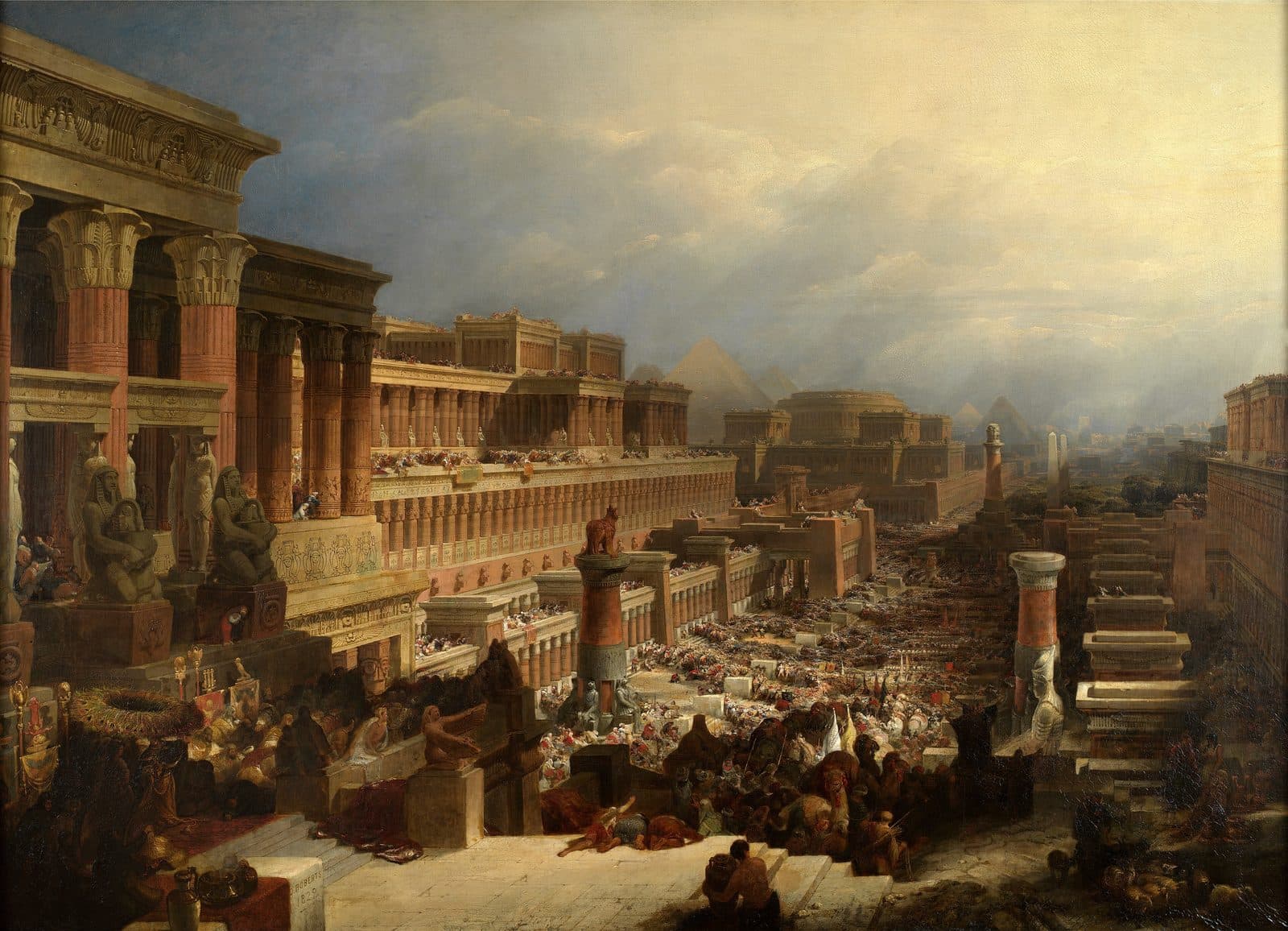
David Roberts, The Israelites Leaving Egypt, 1829, oil on canvas, Birmingham Museum and Art Gallery. Public domain.
THE ARTWORKRoberts painted the departure of Exodus 12:37 to 38 as a crowd pouring out through a city of temples, with the pyramids beyond. In the foreground Egyptians mourn on the steps of a palace while the column passes below them.
Moses told Israel that the LORD loves the foreigner and gives him food and clothing.
Summary
The mixed multitude were the people of other nations who went up from Egypt with Israel, and the ger was any man of another people who came to live among Israel.
- A foreigner could celebrate the Passover once all the males in his household were circumcised.
- The law sets the native and the foreigner under one statute in the Passover, in the courts and in the offerings.
- The rabble among the people began the craving for meat that Numbers 11 records.
- Caleb son of Jephunneh, one of the two men of his generation who followed the LORD wholeheartedly, is called the Kenizzite.
The Company That Went Up from Egypt
Two verses count the men of Israel and name a second company beside them.
The Israelites journeyed from Rameses to Succoth with about 600,000 men on foot, besides women and children.The count of about 600,000 men on foot is the number every reading of the company's size has to explain.
And a mixed multitude also went up with them, along with great droves of livestock, both flocks and herds.The verse is the only mention of the company in Exodus, so every reading of who they were begins from these few words.
Rashi of France (1040 to 1105), in his commentary on Exodus, reads the men of verse 37 as the males aged twenty and over.
The words erev rav and asafsufExodus 12:38; Numbers 11:4
The Hebrew of Exodus 12:38 is erev rav, a great mixture of people. Numbers 11:4 calls the rabble asafsuf, a word Adam Clarke renders as the collected or gathered people.
Rashi derives asafsuf from the root asaf, to gather.
The Law of the Foreigner
Each command about the foreigner comes with a reason or a rule beside it, often Israel's own years in Egypt.
| Text | What the law says | What the text adds |
|---|---|---|
| Exodus 12:43 to 45 | No foreigner, temporary resident or hired hand eats the Passover, and a purchased slave eats after he is circumcised | This is the statute of the Passover |
| Exodus 12:48 to 49 | A foreigner who resides with Israel may celebrate the Passover when the males of his household are circumcised | He shall be like a native of the land |
| Exodus 22:21 | Do not exploit or oppress a foreign resident | You were foreigners in the land of Egypt |
| Exodus 23:9 | Do not oppress a foreign resident | You know how it feels to be foreigners |
| Leviticus 19:33 to 34 | Treat the foreigner as native-born and love him as yourself | You were foreigners in Egypt, and I am the LORD your God |
| Leviticus 24:22 | The same standard of law for the foreign resident and the native | I am the LORD your God |
| Numbers 9:14 | A foreigner who observes the Passover keeps its statute and its ordinances | One statute applies to the foreigner and to the native of the land |
| Numbers 15:15 to 16 | The same statute and ordinance for the assembly and the foreign resident | It is a permanent statute for the generations to come |
| Deuteronomy 10:18 to 19 | Israel must love the foreigner | You yourselves were foreigners in the land of Egypt |
- What the law says
- No foreigner, temporary resident or hired hand eats the Passover, and a purchased slave eats after he is circumcised
- What the text adds
- This is the statute of the Passover
- What the law says
- A foreigner who resides with Israel may celebrate the Passover when the males of his household are circumcised
- What the text adds
- He shall be like a native of the land
- Text
- Exodus 22:21
- What the law says
- Do not exploit or oppress a foreign resident
- What the text adds
- You were foreigners in the land of Egypt
- Text
- Exodus 23:9
- What the law says
- Do not oppress a foreign resident
- What the text adds
- You know how it feels to be foreigners
- What the law says
- Treat the foreigner as native-born and love him as yourself
- What the text adds
- You were foreigners in Egypt, and I am the LORD your God
- Text
- Leviticus 24:22
- What the law says
- The same standard of law for the foreign resident and the native
- What the text adds
- I am the LORD your God
- Text
- Numbers 9:14
- What the law says
- A foreigner who observes the Passover keeps its statute and its ordinances
- What the text adds
- One statute applies to the foreigner and to the native of the land
- What the law says
- The same statute and ordinance for the assembly and the foreign resident
- What the text adds
- It is a permanent statute for the generations to come
- What the law says
- Israel must love the foreigner
- What the text adds
- You yourselves were foreigners in the land of Egypt
The commentators on the Passover statuteExodus 12:43 to 49
Albert Barnes judges that these instructions were needed once the mixed multitude had joined Israel, and that they were probably given at Succoth on the morning after the departure from Rameses. He adds that the circumcised slave became a true member of the family.
John Gill says the foreigner and the hired servant were not obliged to be circumcised, and so had no right to eat the Passover. Jamieson, Fausset and Brown see in verse 49 the liberal spirit of the Hebrew institutions, under which any foreigner might obtain the privileges of the nation by keeping its sacred ordinances.
Matthew Henry carries verse 47 forward to the Lord's Supper.
“All that share in God's mercies should join in thankful praises for them. Though it was observed in families apart, yet it is looked upon as the act of the whole congregation; for the smaller communities constituted the greater. The New-Testament passover, the Lord's supper, ought not to be neglected by any who are capable of celebrating it.”
Matthew Henry · Commentary on the Whole Bible · on Exodus 12:47Puritan
The Company on the Road
Leviticus, Numbers and Judges name members of the company who came from other peoples.
Now the son of an Israelite mother and an Egyptian father went out among the Israelites, and a fight broke out in the camp between him and an Israelite.The case of this son of an Egyptian father led to the ruling of verse 22 for the foreign resident.
Meanwhile, the rabble among them had a strong craving for other food, and again the Israelites wept and said, “Who will feed us meat?Rashi and Adam Clarke read this rabble as the mixed multitude of the departure, which is why the verse belongs to their story.
Matthew Henry turns the craving into counsel for the reader, with Psalm 78 and Paul's warning in 1 Corinthians 10.
“We should not indulge ourselves in any desire which we cannot in faith turn into prayer, as we cannot when we ask meat for our lust, Ps. lxxviii. For this sin the anger of the Lord was kindled greatly against them, which is written for our admonition, that we should not lust after evil things as they lusted, 1 Cor. x.”
Matthew Henry · Commentary on the Whole Bible · on Numbers 11:4Puritan
Hobab and the KenitesNumbers 10:29 to 32; Judges 1:16; 4:11
Then Moses said to Hobab, the son of Moses’ father-in-law Reuel the Midianite, “We are setting out for the place of which the LORD said: ‘I will give it to you.’ Come with us, and we will treat you well, for the LORD has promised good things to Israel.” “I will not go,” Hobab replied. “Instead, I am going back to my own land and my own people.” “Please do not leave us,” Moses said, “since you know where we should camp in the wilderness, and you can serve as our eyes. If you come with us, we will share with you whatever good things the LORD gives us.”Hobab knew the camping places of the wilderness, and that knowledge is the help Moses asks of him.
Now the descendants of Moses’ father-in-law, the Kenite, went up with the men of Judah from the City of Palms to the Wilderness of Judah in the Negev near Arad. They went to live among the people.Judges records that the invitation of Numbers 10 was accepted by the family of the man Moses asked.
Now Heber the Kenite had moved away from the Kenites, the descendants of Hobab the father-in-law of Moses, and had pitched his tent by the great tree of Zaanannim, which was near Kedesh.This verse names the Kenites as Hobab's descendants, which ties the clan of Judges 1 to Numbers 10.
Albert Barnes reads Hobab as the brother-in-law of Moses, since the Hebrew word rendered father-in-law means any relative by marriage. He holds that Hobab went with Israel in the end and settled in Canaan.
Caleb the KenizziteNumbers 13:6; 32:12; Genesis 15:19
not one except Caleb son of Jephunneh the Kenizzite and Joshua son of Nun—because they did follow the LORD wholeheartedly.’The title ties Caleb to a people outside Israel, though Numbers 13:6 counts him from the tribe of Judah.
the land of the Kenites, Kenizzites, Kadmonites,The Kenizzites are first named among the peoples whose land was promised to Abram.
Adam Clarke holds that the title Kenezite belonged to Jephunneh and that Kenaz was probably Jephunneh's father.
The foreigners in the camp at MoabDeuteronomy 29:11; 23:7 to 8
your children and wives, and the foreigners in your camps who cut your wood and draw your water—The foreigners who cut wood and draw water stand with Israel when the covenant is renewed in Moab.
Do not despise an Edomite, for he is your brother. Do not despise an Egyptian, because you lived as a foreigner in his land. The third generation of children born to them may enter the assembly of the LORD.The law governs the place of Egyptian households such as the one in Leviticus 24:10, whose grandchildren could enter the assembly.
Four Words for the Outsider
Keil and Delitzsch define the four Hebrew words of the Passover statute for a man outside Israel.
BEN NEKAR, THE FOREIGNER
The word applies to any foreigner springing from another nation, and no such man ate the Passover.
TOSHAV, THE SETTLER
A toshav settled among the Israelites without being received into their religious fellowship.
SAKIR, THE HIRED HAND
A sakir was a man outside Israel who worked for an Israelite for wages, and a priest's hired hand was barred from the sacred offering as well.
GER, THE RESIDENT FOREIGNER
A ger lived among the Israelites for a shorter or longer time, and he could keep the Passover once circumcised.
How Large the Company Was
Readers divide over the size of the company, and over whether the census thousands count men or families.
And all those counted totaled 603,550.The census at Sinai gives the exact figure that stands behind the round number of the departure.
The number as writtenKeil and Delitzsch, Biblical Commentary on the Old Testament: The Pentateuch (1864); John Wesley (1765)
Keil and Delitzsch count only the men who could bear arms in the 600,000 and reckon that the whole people may have numbered about two million souls. They reach 603,550 men by ten generations of ordinary births over the sojourn in Egypt. John Wesley, in his Explanatory Notes, put the women and children at no fewer than twelve hundred thousand more.
The objection: W. M. Flinders Petrie judged that no more than about 5,000 people could have been taken out of Goshen or into Sinai. He reckoned that 600,000 men would mean at least three million people, as many as the whole Delta held.
The thousands as familiesW. M. Flinders Petrie, Researches in Sinai (1906)
Petrie notes that the Hebrew alaf means both a thousand and a group or family. He reads the thousands of the census as families or tents and the hundreds as the people living in them, which gives totals of 5,550 and 5,730 in the two lists of Numbers.
The objection rests on the silver of the census.
The silver from those numbered among the congregation totaled 100 talents and 1,775 shekels, according to the sanctuary shekel— a beka per person, that is, half a shekel, according to the sanctuary shekel, from everyone twenty years of age or older who had crossed over to be numbered, a total of 603,550 men.The weight of silver is reckoned from each counted man paying his half shekel, so the sum assumes the full figure.
What the Text Leaves Unsaid
Scripture leaves three questions about the mixed multitude open.
Exodus names no nation among the mixed multitude and gives no number for them.
Exodus does not say whether any of them ate the first Passover in Egypt, since the statute for the foreigner follows the account of the departure.
The book of Numbers calls them the rabble among the people and does not say where they came from.
Who the Mixed Multitude Were
Commentators give three readings of the mixed multitude, each with its holders.
Converts from many nationsRashi, Commentary on Exodus; Keil and Delitzsch, Biblical Commentary on the Old Testament: The Pentateuch (1864)
Rashi calls the mixed multitude a mingling of various nations who had become proselytes. Keil and Delitzsch see in them a typical fulfilment of the promise of Genesis 12:3, drawn by the signs and wonders the LORD did in Egypt. They hold that the company later became a snare to Israel and took a low place among the people as hewers of wood and drawers of water.
The objection: Exodus names no rite by which they joined Israel.
The old Semitic population of the deltaAlbert Barnes, Notes on the Old Testament
Albert Barnes takes the mixed multitude as probably the remains of the old Semitic population of the region, whether or not the Hyksos first brought them there. He reasons that the Egyptians who had lately become masters of the country distrusted them, so that they were eager to escape after the plagues.
The objection: Barnes calls the tie to the Hyksos uncertain himself, and Leviticus 24:10 names an Egyptian father in the camp.
Families joined to Israel by marriageJamieson, Fausset and Brown, Commentary Critical and Explanatory (1871)
Jamieson, Fausset and Brown hold that the mixed multitude makes it likely that marriages like the one in Leviticus 24:10 were fairly common. They judge it natural that in such a marriage the father was an Egyptian and the mother an Israelite.
The objection: Leviticus names one such family, and the text gives no count of the others.
Books to Read Next
Four works treat the company that left Egypt and the law of the foreigner.
Commentary on the Torah
Rashi · eleventh century
Rashi reads Exodus 12 and 22 and Numbers 11 verse by verse, with the rabbinic sources behind each reading.
Read Rashi on Exodus 12:38 at SefariaBiblical Commentary on the Old Testament: The Pentateuch
C. F. Keil and F. Delitzsch · 1864
Keil and Delitzsch reckon the number of the people, and they define each word the Passover statute uses for an outsider.
Read volume 2 at archive.orgResearches in Sinai
W. M. Flinders Petrie · 1906
Petrie weighs the numbers of Exodus against the water supply of the road and the size of Goshen.
Read it at archive.orgCommentary on the Bible
Adam Clarke · 1832
Clarke gives the Hebrew word behind the rabble of Numbers 11 and weighs the title Kenezite in Numbers 32.
Fellow Citizens with the Saints
Henry reads the Passover rule for the foreigner forward to the Gentiles.
“If in sincerity, and with that zeal which the thing required and deserves, we give up ourselves to God, we shall, with ourselves, give up all we have to him, and do our utmost that all ours may be his too. Here is an early indication of favour to the poor Gentiles, that the stranger, if circumcised, stands upon the same level with the home-born Israelite.”
Matthew Henry · Commentary on the Whole Bible · on Exodus 12:48Puritan
On Numbers 9:14 Henry carries the rule further: as there was then one law for the stranger and the native, so in the days of the Messiah there would be one gospel for both.
remember that at that time you were separate from Christ, alienated from the commonwealth of Israel, and strangers to the covenants of the promise, without hope and without God in the world. But now in Christ Jesus you who once were far away have been brought near through the blood of Christ.Paul sets the Gentile believers where the foreigner of the law stood, and he names Christ as the One who brings them in.
Therefore you are no longer strangers and foreigners, but fellow citizens with the saints and members of God’s household,This verse shows that the change is complete, since the Gentile believer now has full standing among God's people.
Leviticus 19:34 and Deuteronomy 10:19 ask the reader to love the foreigner who lives beside him, as one who was himself taken in.
Keep studying
Studies7