
Deuteronomy 34 · A Story
The death of Moses
The account of Deuteronomy 34, read with the sentence of Numbers 20, the handover of Numbers 27 and Deuteronomy 31, and the first words of Joshua.
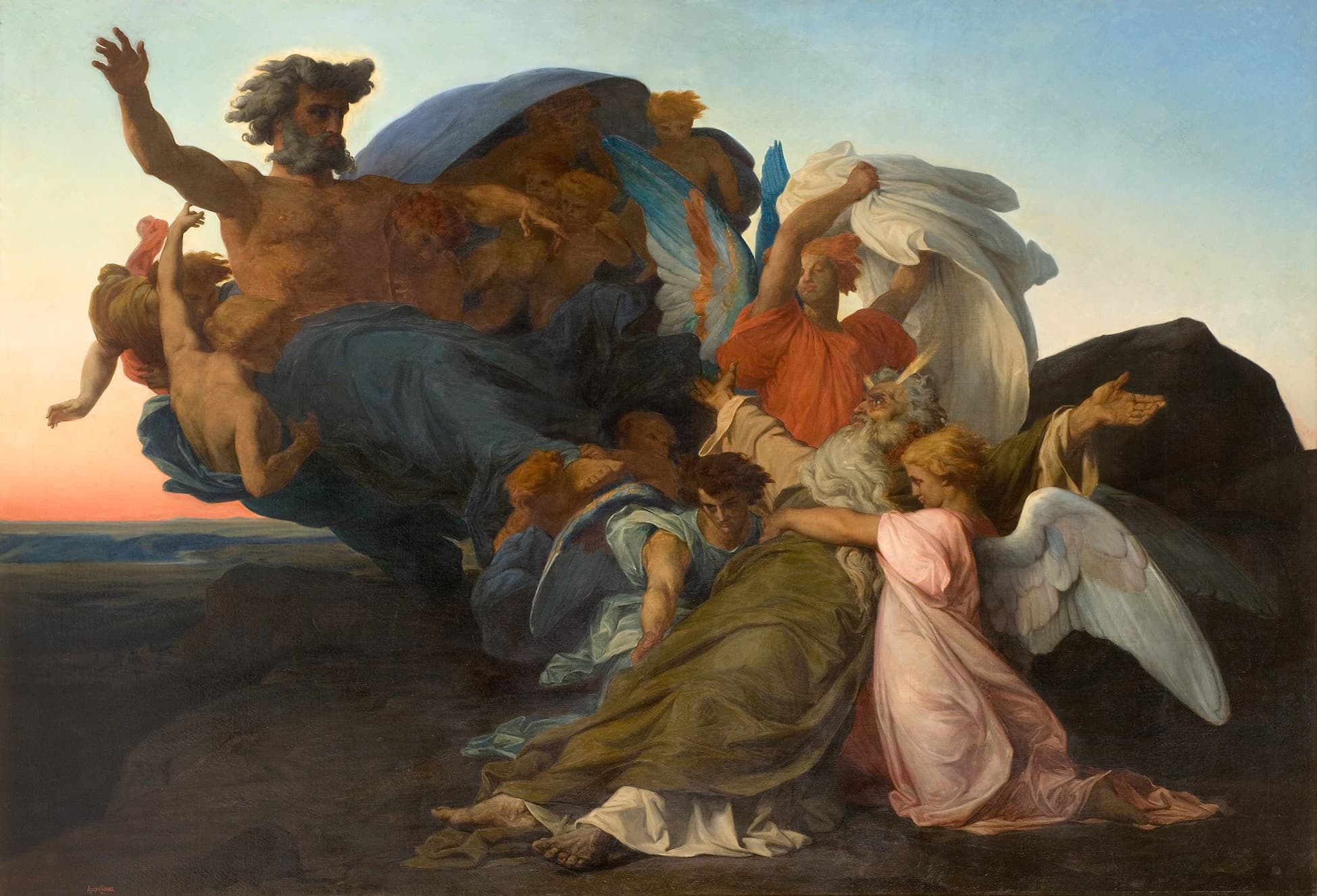
Alexandre Cabanel, The Death of Moses, oil on canvas, 1850. Public domain by date. Wikimedia Commons, File:Alexandre Cabanel - Death of Moses.jpeg.
THE ARTWORKCabanel painted the death of Moses in 1850 on a dark summit with a plain in the distance. Angels hold Moses as he sinks, and a bearded figure in a blue mantle sweeps overhead with a crowd of winged children.
The servant who led Israel for forty years to the edge of Canaan never set foot on the far bank of the Jordan.
Summary
Moses died on Mount Nebo in Moab at a hundred and twenty, after the LORD showed him the land promised to Abraham (Deuteronomy 34:1 to 7).
- The LORD had barred him from the land after he struck the rock at Meribah (Numbers 20:12).
- The LORD buried him in a valley facing Beth-peor, and no one knows where the grave is (Deuteronomy 34:6).
- The Israelites grieved for him thirty days on the plains of Moab (Deuteronomy 34:8).
- Joshua, on whom Moses had laid his hands, led the people across the Jordan (Deuteronomy 34:9; Joshua 1:2).
The Last Day of Moses
Deuteronomy 32:48 to 34:12, told plainly
Moses had spoken his last words to the people on the plains of Moab, across the Jordan from Jericho. That same day the LORD told him to climb Mount Nebo, look at the land, and die on the mountain as his brother had died on Mount Hor.
He blessed the tribes one by one and went up. From the top of Pisgah the LORD showed him the country from the north to the south and reminded him of the oath to Abraham, Isaac and Jacob.
The reason the LORD gaveDeuteronomy 32:51 to 52
For at the waters of Meribah-kadesh in the Wilderness of Zin, both of you broke faith with Me among the Israelites by failing to treat Me as holy in their presence. Although you shall see from a distance the land that I am giving the Israelites, you shall not enter it.”The LORD names the fault at Meribah-kadesh, and a distant sight is all that is left to Moses.
The death, the burial and the mourningDeuteronomy 34:5 to 8
So Moses the servant of the LORD died there in the land of Moab, as the LORD had said. And He buried him in a valley in the land of Moab facing Beth-peor, and no one to this day knows the location of his grave. Moses was a hundred and twenty years old when he died, yet his eyes were not weak, and his vitality had not diminished. The Israelites grieved for Moses in the plains of Moab thirty days, until the time of weeping and mourning for Moses came to an end.The verses keep Moses in Moab to the end, on the east side of the Jordan.
The Days in Order and the View from Nebo
His three forties and last days on a timeline, and the land of Deuteronomy 34:1 to 3 on an old atlas plate
Moses lived three forties, and his last day ran from the song on the plains to the summit of Nebo.
- Age 40Moses visits his brothers in Egypt, kills an Egyptian who was oppressing one of them, and flees to live in MidianActs 7:23 to 29
- Age 80After forty years in Midian an angel appears to him in a burning bush near Mount Sinai and sends him back to EgyptActs 7:30 to 34
- Forty yearsHe leads Israel out of Egypt and through the wilderness, with wonders and signs from the Red Sea onwardActs 7:36
- At KadeshHe strikes the rock at Meribah, and the LORD rules that he will not bring the assembly into the landNumbers 20:11 to 12
- In the AbarimThe LORD tells him to see the land and die, and he asks for a shepherd for the peopleNumbers 27:12 to 17
- Before EleazarMoses lays his hands on Joshua and commissions him in front of the whole congregationNumbers 27:22 to 23
- Age 120On the plains of Moab he tells Israel he will not cross the Jordan and charges Joshua to be strongDeuteronomy 31:2 to 7
- At the tentThe LORD appears in the pillar of cloud and commissions Joshua son of NunDeuteronomy 31:14 to 23
- That same dayAfter the song the LORD orders him up Mount Nebo to view Canaan and dieDeuteronomy 32:48 to 50
- Before his deathHe pronounces the blessing of the twelve tribesDeuteronomy 33:1
- On the summitHe climbs to the top of Pisgah, and the LORD shows him the land from Gilead to ZoarDeuteronomy 34:1 to 4
- Thirty daysThe Israelites grieve for him on the plains of Moab until the time of mourning endsDeuteronomy 34:8
- After the mourningThe LORD tells Joshua that Moses is dead and sends the people over the JordanJoshua 1:1 to 2
A timeline of thirteen stops, from Acts 7:23 to Joshua 1:2, each with its verse.
From Nebo the view ran north to Dan, west to the sea and south past Jericho to Zoar, across the river he did not cross.
- Located: the site is known
- Identified: the point stands for an area, or is rounded
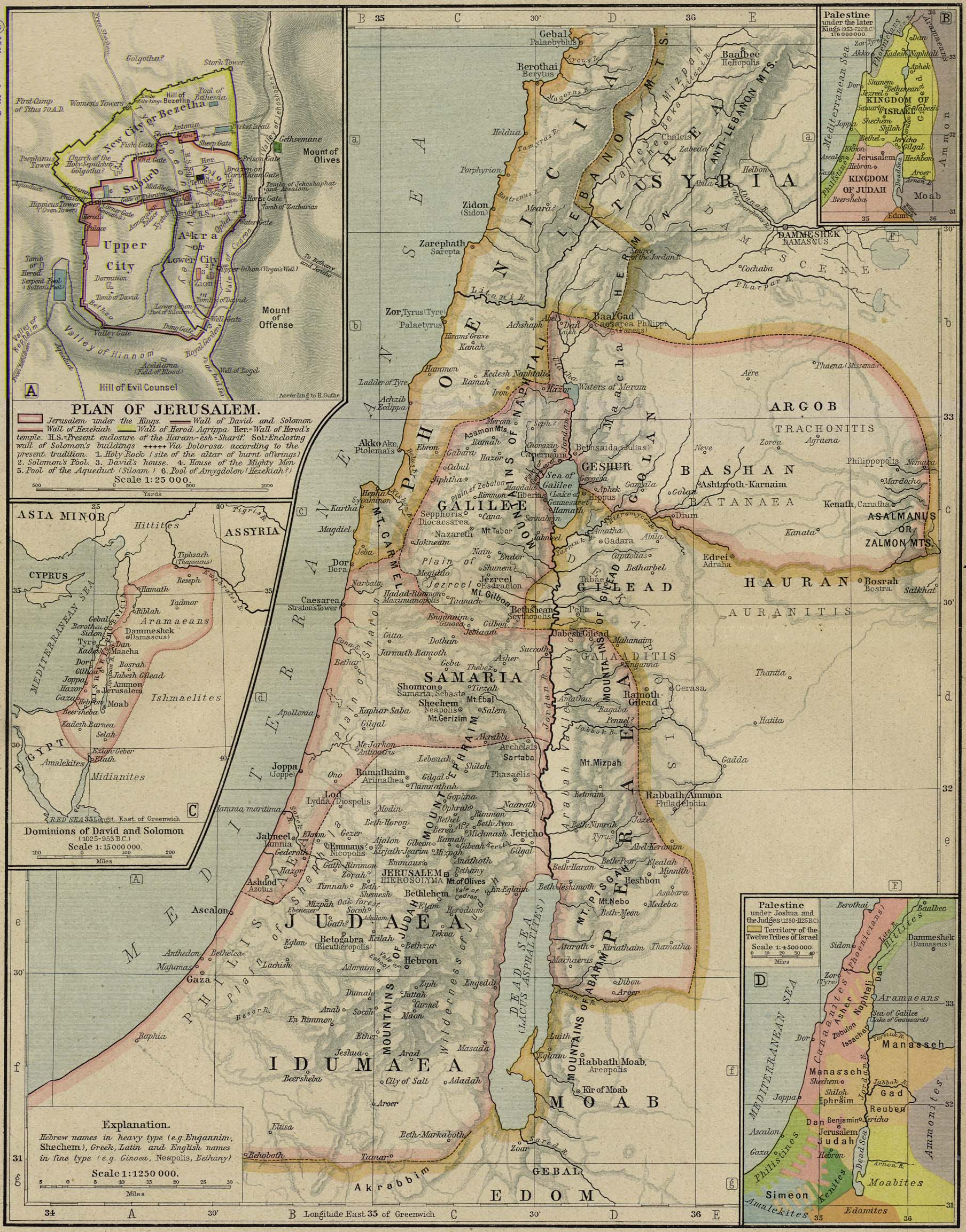
- 1Mount Nebo, Moses climbed from the plains of Moab to the top of Pisgah, the headland of Nebo that faces Jericho, and saw the land from there. Deuteronomy 34:1
- 2Dan, The view reached north from Gilead as far as Dan, the farthest town named in the sweep. Deuteronomy 34:1
- 3Jericho, The City of Palms in the valley below the mountain, where the southern sweep begins. Deuteronomy 34:3
- 4The Jordan River, The river the LORD told him he would see across and not cross. Deuteronomy 34:4
- 5Gilead, The highlands east of the Jordan where the view starts, running north. Deuteronomy 34:1
- 6Naphtali, Ephraim and Manasseh, The northern and central tribal lands west of the river. Deuteronomy 34:2
- 7Judah to the Western Sea, The southern hill country out to the Mediterranean coast. Deuteronomy 34:2
- 8The Negev and Zoar, The dry south, and the town at the far end of the valley of Jericho. Deuteronomy 34:3
- 9Beth-peor, The valley of his grave faces it, near the camp of Deuteronomy 3:29. Deuteronomy 34:6
Not placed: Gilead (5), Naphtali, Ephraim and Manasseh (6), Judah to the Western Sea (7), The Negev and Zoar (8), Beth-peor (9).
Base map: Reference map of ancient Palestine, Rand McNally reference map (1926), public domain. Each place stands at its place page's coordinates, set on the plate by Jerusalem and Damascus, as the plate prints them.
The places of Deuteronomy 34:1 to 6 on an old atlas plate, with Mount Nebo where Moses stood. The plate itself prints Gilead, Mount Pisgah, Beth-peor and Zoar, and the regions the site cannot pin are named beneath.
What the Text Says and What Is Said of It
Three retellings set beside the verses, and the two Hebrew names of the summit
“HE DIED WORN OUT WITH AGE”
His eyes were not weak and his vitality had not diminished.
“HE WAS SENTENCED ON THE MOUNTAIN”
The sentence was given at Meribah in the Wilderness of Zin. Nebo is where it was carried out.
“THE PEOPLE BURIED HIM”
The verse names the LORD as the one who buried him, and no human hand is named in the burial.
| Name | Sense in this account | Where |
|---|---|---|
| Nebo (h5015) | The mountain of the Abarim range where Moses died. A Moabite town and a Babylonian god bear the same name, and both are distinct from the mountain. | Deuteronomy 32:49 and 34:1 |
| Pisgah (h6449) | The headland or summit of Nebo, whose slopes run down toward the Arabah and the Salt Sea, and the point from which Moses looked out. | Deuteronomy 3:27 and 34:1 |
The Sentence and the Successor
The fault at Meribah, the plea that was refused, the shepherd Moses asked for and the charge at the tent
In the last year in the wilderness, at Kadesh, the LORD told Moses to speak to the rock. He struck it twice and called the people rebels, and the sentence followed at once.
Moses later begged to cross over and see the good land, and the LORD refused him.
Joshua son of Nun was chosen to lead after him, and Moses laid his hands on him before Eleazar the priest.
The ruling at MeribahNumbers 20:12, with Basil of Caesarea on the fault
But the LORD said to Moses and Aaron, “Because you did not trust Me to show My holiness in the sight of the Israelites, you will not bring this assembly into the land that I have given them.”The LORD states the fault and the penalty together, and both reach to Nebo.
“The people were murmuring because there was no water. Moses merely had said to his people, ‘Can we bring you forth water out of this rock?’ Thus he wavered only slightly, yet for this alone he immediately received the threat that he should not enter into the land of promise, which was at that time the chief of all the promises made to the Jews.”
Basil of Caesarea · Preface on the Judgment of God · on Numbers 20:10Patristic
The plea refusedDeuteronomy 3:26 to 27, with Jerome on the waters
But the LORD was angry with me on account of you, and He would not listen to me. “That is enough,” the LORD said to me. “Do not speak to Me again about this matter. Go to the top of Pisgah and look to the west and north and south and east. See the land with your own eyes, for you will not cross this Jordan.Moses recalls his request and the answer that sent him to Pisgah to look and not to enter.
“If Aaron and Moses (who seemed to waver at the waters of contradiction) did not deserve to enter the Promised Land, does it not stand to reason that we, bent under the burden of sin, shall be far less able to cross the river Jordan and reach Gilgal, the place of circumcision, if we shall cause one of these little ones to sin?”
Jerome · HOMILY 90 · on Numbers 27:14Patristic
The shepherd he asked forNumbers 27:16 to 18, with Matthew Henry on the laying on of hands
“May the LORD, the God of the spirits of all flesh, appoint a man over the congregation who will go out and come in before them, and who will lead them out and bring them in, so that the congregation of the LORD will not be like sheep without a shepherd.” And the LORD replied to Moses, “Take Joshua son of Nun, a man with the Spirit in him, and lay your hands on him.Told of his death, Moses prays for the people's leader before anything for himself.
“This was done in token of Moses' transferring the government to him, as the laying of hands on the sacrifice put the offering in the place and stead of the offerer; also in token of God's conferring the blessing of the Spirit upon him, which Moses obtained by prayer. It is said ( Deut. xxxiv. 9 ), Joshua was full of the spirit of wisdom, for Moses had laid his hands on him.”
Matthew Henry · Commentary on the Whole Bible · on Numbers 27:18Puritan
The charge at the tentDeuteronomy 31:14
Then the LORD said to Moses, “Behold, the time of your death is near. Call Joshua and present yourselves at the Tent of Meeting, so that I may commission him.” So Moses and Joshua went and presented themselves at the Tent of Meeting.The LORD calls both men to the Tent of Meeting so that the handover is made in His presence.
What the Text Leaves Unsaid
The chapter reports the death in one verse and leaves four questions open.
Where is the grave?Deuteronomy 34:6
No tomb of Moses has ever been identified, and the verse says no one knew the spot when it was written.
How did he die?Deuteronomy 34:5
The text gives no illness and no cause beyond the word of the LORD.
Did anyone go up with him?Deuteronomy 34:1
No companion is named on the climb, and no witness of the death is recorded.
What did Moses say on the summit?Deuteronomy 34:4 to 5
Only the LORD speaks on the mountain. No answer of Moses is given.
Faithful as a Servant
The verdict that closes the Torah, and where the New Testament takes it
Since that time, no prophet has risen in Israel like Moses, whom the LORD knew face to face—The last lines of Deuteronomy set Moses above every later prophet because the LORD knew him face to face.
Deuteronomy calls him the servant of the LORD at his death, and Joshua 1:2 repeats the title. Hebrews 3:5 takes up the same title in its comparison of Moses with Jesus.
Moses did not enter the land in his lifetime, and the Gospels place him there once, on the mountain of the Transfiguration.
Hebrews on the servant and the SonHebrews 3:5 to 6, with Irenaeus
Now Moses was faithful as a servant in all God’s house, testifying to what would be spoken later. But Christ is faithful as the Son over God’s house. And we are His house, if we hold firmly to our confidence and the hope of which we boast.The letter commends Moses' faithfulness and sets the Son over the house he served in.
“And Moses himself, being a man of God, was indeed given as a god before Pharaoh; but he is not properly termed Lord, nor is called God by the prophets, but is spoken of by the Spirit as ‘Moses, the faithful minister and servant of God,’ which also he was.”
Irenaeus · Irenaeus Against Heresies Book 3 · on Hebrews 3:5Patristic
Moses on the mountain of the TransfigurationMatthew 17:3, with Jerome
Suddenly Moses and Elijah appeared before them, talking with Jesus.Moses and Elijah talk with Jesus, and the voice from the cloud then tells the disciples to listen to Him.
“It is to be remembered also, that when the Scribes and Pharisees asked signs from heaven, He would not give any; but now, to increase the Apostles' faith, He gives a sign; Elias descends from heaven, whither he was gone up, and Moses arises from hell; (Is. 7:10.) as Ahaz is bidden by Esaias to ask him a sign in the heaven above, or in the depth beneath.”
Jerome · Catena Aurea by Aquinas · on Matthew 17:3Patristic
Michael and the body of MosesJude 1:9, with Jerome
But even the archangel Michael, when he disputed with the devil over the body of Moses, did not presume to bring a slanderous charge against him, but said, “The Lord rebuke you!”Jude reports a dispute over the body in one sentence and draws a lesson on restraint from it.
“For he does not say to blaspheme no man: but absolutely no one: not an angel, nor any creature of God. Because everything that was made by God is very good. For when Michael the Archangel disputed with the devil over the body of Moses, he did not dare to bring a judgment of blasphemy, but said, ‘May God rebuke you’ (Jud. 9). If Michael therefore did not have the audacity to bring judgement upon the devil, certainly deserving of a curse, for blasphemy: how much more should we be pure from every curse?”
Jerome · Commentary on Titus 3:1-2 · on Jude 1:9Patristic
Wesley on the prophet greater than MosesJohn Wesley on Deuteronomy 34:12
“But as far as the other prophets came short of him, our Lord Jesus went beyond him. Moses was faithful as a servant, but Christ as a son: his miracles more illustrious, his communion with the father more intimate: for he is in his bosom from eternity. Moses lies buried: but Christ is sitting at the right-hand of God, and of the increase of his government there shall be no end.”
John Wesley · Explanatory Notes upon the Old Testament · on Deuteronomy 34:12Evangelical
How the Teachers Read His Death
Teachers from the first century to the eighteenth on the hidden grave, his age, the hands laid on Joshua and the cloud of Josephus' account
Aphrahat on the hidden tombAphrahat the Persian Sage, Demonstration 8.9 (345)
“Two godly benefits did his Lord accomplish for Moses in not making known his tomb to the children of Israel. He rejoiced that his adversaries should not know it and cast forth his bones from his tomb; and in the second place, that the children of his people should not know it and make his tomb a place of worship, for he was accounted as God in the eyes of the children of his people.”
Aphrahat the Persian Sage · DEMONSTRATION 8.9 · on Deuteronomy 34:6Patristic
Henry on dying at a hundred and twentyMatthew Henry on Deuteronomy 34:7
“He was old, it is true, but he had not yet attained to the years of the life of his fathers; his father Amram lived to be 137; his grandfather Kohath 133; his great grandfather Levi 137; And why must Moses, whose life was more serviceable than any of theirs, die at 120, especially since he felt not the decays of age, but was as fit for service as ever?”
Matthew Henry · Commentary on the Whole Bible · on Deuteronomy 34:7Puritan
Cyril of Jerusalem on the hands laid on JoshuaCyril of Jerusalem, Catechetical Lecture 16.26 (386)
“It is written, ‘Now Joshua, the son of Nun, was filled with the Spirit of wisdom, since Moses had laid his hands upon him.’ Note the same ceremonial everywhere, both in the Old and the New Testament. In Moses' day the Spirit was given by the imposition of hands; and Peter imparted the Spirit by the imposition of hands. Upon you also, who are to be baptized, the grace will come.”
Cyril of Jerusalem · Catechetical Lecture 16.26 · on Deuteronomy 34:9Patristic
Josephus on the cloud at AbarimJosephus, Antiquities of the Jews 4.8.48 (about 94)
Josephus adds that Moses wrote of his own death in the holy books for fear that people would say he had gone to God. None of these details stands in Deuteronomy.
Where the Readers Divide
Readers divide on three questions: who wrote the account of his death, what kind of sight he was given, and whether he died at all.
Who wrote the last verses of the TorahThe Babylonian Talmud, Bava Batra 14b and 15a
A baraita in Bava Batra 14b assigns the eight verses on the death of Moses to Joshua. On Bava Batra 15a Rabbi Yehuda holds that Moses wrote up to his death and Joshua wrote the rest. Rabbi Shimon answers that the Torah lacked no letter, so the LORD dictated these verses too and Moses wrote them with tears. The page on who wrote the Pentateuch argues the wider question with its holders.
What Moses saw from the summitDeuteronomy 34:1 to 4
Then Moses went up from the plains of Moab to Mount Nebo, to the top of Pisgah, which faces Jericho. And the LORD showed him the whole land—from Gilead as far as Dan, all of Naphtali, the land of Ephraim and Manasseh, all the land of Judah as far as the Western Sea, the Negev, and the region from the Valley of Jericho (the City of Palms) all the way to Zoar. And the LORD said to him, “This is the land that I swore to give Abraham, Isaac, and Jacob when I said, ‘I will give it to your descendants.’ I have let you see it with your own eyes, but you will not cross into it.”The sweep of the view and the oath it confirms are the ground of both readings.
Albert Barnes, in his Notes on the Old Testament, held that the sight was supernatural, like the showing of the kingdoms in Luke 4:5. Jamieson, Fausset and Brown, in their Commentary Critical and Explanatory (1871), answered him from the lie of the land.
“Immediately below him was ‘the circle’ of the plain of Jericho, with its oasis of palm trees; and far away on his left, the last inhabited spot before the great desert ‘Zoar.’ The foreground of the picture alone was clearly discernible. There was no miraculous power of vision imparted to Moses.”
Jamieson, Fausset & Brown · Commentary Critical and Explanatory on the Whole Bible · on Deuteronomy 34:1Reformed
Whether Moses died or was taken upDeuteronomy 32:50 and 34:5 to 6
“And therefore, we do not read about him as we do about others, because he died in a state of deficiency: but he died through the word of God (Deuteronomy 34:5). For God neither experiences defection or diminution, nor does he undergo addition. Hence, the Scripture also adds: 'For no one knows his burial place until this day' (ibid. 6), so that you understand it as a translation rather than his demise. For death is a certain separation of the soul and body.”
Ambrose of Milan · On Cain and Abel, Book 1, Chapter 2, Section 8 · on Deuteronomy 34:5Patristic
Adam Clarke, in his Commentary on the Bible (1832), answered that reading from Deuteronomy 32:50, that whatever is said of the death of Aaron is said of the death of Moses.
The Great Books on This Story
Commentary on the Whole Bible
Matthew Henry · 1710
Henry comments on the handover to Joshua in Numbers 27 and on the last chapters of Deuteronomy.
Read it free at CCELExplanatory Notes upon the Old Testament
John Wesley · 1765
Wesley reads the view of Deuteronomy 34:2 by its four quarters, in short notes on each verse.
Read it free at CCELAntiquities of the Jews
Flavius Josephus, translated by William Whiston · about 94
Book 4, chapter 8 retells the laws of Deuteronomy and ends with Josephus' own account of how Moses left the people.
Read it free at Project GutenbergMoses My Servant Is Dead
Now Joshua son of Nun was filled with the spirit of wisdom because Moses had laid his hands on him. So the Israelites obeyed him and did as the LORD had commanded Moses.The handover the earlier chapters prepared is complete, and Israel follows its new leader.
“Moses My servant is dead. Now therefore arise, you and all these people, and cross over the Jordan into the land that I am giving to the children of Israel.The LORD's first word to Joshua turns the death into the order to cross.
Keep studying
Studies8
Symbols4
Doctrines5
Peoples and groups1