
Deuteronomy 26 · Subject · Featured Study
The Farmer's Creed
A law of Deuteronomy gave the worshipper set words to speak over two gifts, the firstfruits and the tithe of the third year.
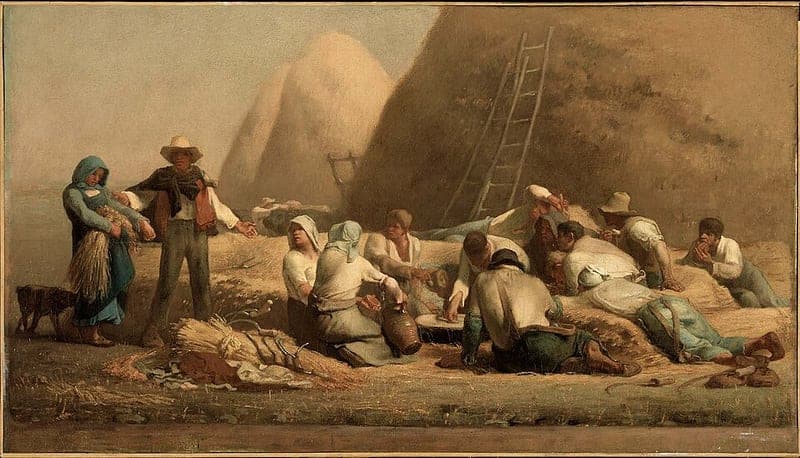
Jean-François Millet, Harvesters Resting (Ruth and Boaz), from 1851, Museum of Fine Arts, Boston. Public domain (PD-old-100-expired; PD-Art), via Wikimedia Commons, File:Harvesters_Resting_(Ruth_and_Boaz),_Jean-François_Millet.jpg.
THE ARTWORKMillet painted reapers resting at their meal in a harvested field, among stacks of sheaves taller than the men. At the left a man in a straw hat stands beside a young woman who holds a sheaf, and he points her toward the meal. The painting stands here because Deuteronomy 26 is spoken over the first fruit of such a harvest.
A basket of fruit and a short creed turned each harvest into a telling of the exodus.
Summary
Deuteronomy 26 tells each Israelite to carry the first of his harvest to the place the LORD would choose and to say over it who had given him the land.
- The law waits for the land to be held, since the gift is the first of its harvest.
- The creed goes down from a wandering Aramean into Egypt and comes back up to the land after the LORD hears the people's cry.
- Protestant commentators such as Henry and Wesley read the wandering Aramean as Jacob, and Rashi reads an Aramean, Laban, who sought to destroy him.
- In the third year the farmer gave his tithe to the Levite, the foreigner, the fatherless and the widow, and declared before the LORD that he had done it.
The Basket and the Words
Deuteronomy 26 gives the farmer a basket to carry and words to say before the LORD.
you are to take some of the firstfruits of all your produce from the soil of the land that the LORD your God is giving you and put them in a basket. Then go to the place the LORD your God will choose as a dwelling for His Name,The basket is carried to the one place of worship that Deuteronomy 12:5 commands Israel to seek.
to the priest who is serving at that time, and say to him, “I declare today to the LORD your God that I have entered the land that the LORD swore to our fathers to give us.”His first words are spoken to the priest, before the creed is said to the LORD.
So you shall rejoice—you, the Levite, and the foreigner dwelling among you—in all the good things the LORD your God has given to you and your household.The feast takes in the Levite, who has no portion or inheritance in Israel by Deuteronomy 14:29.
The rite as the rabbis kept itRashi on the basket, the waving, the voice and the season
Rashi, Rabbi Shlomo Yitzchaki of Troyes (1040 to 1105), the standard medieval Jewish commentator on the Torah, explains each step of the rite from the Talmud and the midrash. He limits the basket to the seven kinds of produce of Deuteronomy 8:8, after the midrash Sifrei Devarim and the Talmud, Menachot 84b.
On Deuteronomy 26:4 he says the priest put his hand beneath the hands of the owner and waved the basket with him, after Sukkah 47b. John Gill, on the same verse, reports the waving from Rashi under his Latin name, Jarchi.
On Deuteronomy 26:5 he takes the word for declare to mean speaking in a raised voice, after Sotah 32b. On Deuteronomy 26:11 he records the law that the words were said only from Pentecost to the Feast of Tabernacles, the season of gathering in, after Pesachim 36b.
The declaration of the third yearDeuteronomy 26:12 to 15; Rashi
When you have finished laying aside a tenth of all your produce in the third year, the year of the tithe, you are to give it to the Levite, the foreigner, the fatherless, and the widow, that they may eat and be filled within your gates.The second declaration, in the next verse, reports this gift to the LORD.
Then you shall declare in the presence of the LORD your God, “I have removed from my house the sacred portion and have given it to the Levite, the foreigner, the fatherless, and the widow, according to all the commandments You have given me. I have not transgressed or forgotten Your commandments.The farmer answers for the whole tithe under the commandments.
Look down from Your holy habitation, from heaven, and bless Your people Israel and the land You have given us as You swore to our fathers—a land flowing with milk and honey.”The declaration ends in a prayer for the people and for the land.
Rashi reads this prayer as the worshipper telling God that he has done what God laid on him, and asking God now to do what He promised.
The Creed Goes Down and Comes Up
The seven movements of the creed in order, and the six acts of the rite as numbered stops.
Each row is a clause of the creed in the Berean text, in the order it is spoken, and links to its verse.
The rite of the firstfruits runs in six acts, from the basket filled to the feast shared.
- The basket filledDeuteronomy 26:2
- The words to the priestDeuteronomy 26:3
- The basket before the altarDeuteronomy 26:4
- The creedDeuteronomy 26:5 to 10
- The bowDeuteronomy 26:10
- The feastDeuteronomy 26:11
The stops follow the order of the text, and each carries its verse.
The Story Told Four Times
Moses gives the story twice, and Joshua and Stephen each tell it again.
| Recital | Who speaks, and to whom | Where the story runs |
|---|---|---|
| Deuteronomy 6 | A father, answering his son | From the slavery under Pharaoh in Egypt to the commandments kept as our righteousness |
| Deuteronomy 26 | A farmer, before the LORD at the chosen place | From an Aramean ancestor going down to Egypt to a gift from the harvest of the land |
| Joshua 24 | Joshua, giving the LORD's words to the tribes at Shechem | From Terah and the other gods beyond the Euphrates to a land on which you did not toil |
| Acts 7 | Stephen, answering the high priest | From the God of glory appearing to Abraham in Mesopotamia to the charge that his hearers resist the Holy Spirit |
Of the four, only the farmer speaks to the LORD, and only he speaks over a gift. The father, Joshua and Stephen speak to people.
A father's answer to his sonDeuteronomy 6:20 to 23; Henry
In the future, when your son asks, “What is the meaning of the decrees and statutes and ordinances that the LORD our God has commanded you?” then you are to tell him, “We were slaves of Pharaoh in Egypt, but the LORD brought us out of Egypt with a mighty hand.The question about the commandments is met with the story of the rescue from Egypt.
“The children must be often told of the deplorable state their ancestors were in when they were bondmen in Egypt, the great salvation God wrought for them in fetching them out thence, and that God, in giving them these peculiar statutes, meant to perpetuate the memorial of that work of wonder, by which they were formed into a peculiar people.”
Matthew Henry · Commentary on the Whole Bible · on Deuteronomy 6:21 to 23Puritan
Stephen's telling of the promiseActs 7:5 to 7; Henry
He gave him no inheritance here, not even a foot of ground. But God promised to give possession of the land to Abraham and his descendants, even though he did not yet have a child.Stephen begins where the land was still only promised, before a child was born.
“When Abraham had neither inheritance nor heir, yet he was told he should have both, the one a land of promise, and the other a child of promise; and therefore both had, and received, by faith. That God's promises, though they are slow, are sure in the operation of them; they will be fulfilled in the season of them, though perhaps not so soon as we expect.”
Matthew Henry · Commentary on the Whole Bible · on Acts 7:7Puritan
What the Text Says
Two points the passage itself settles, each with its verse.
THE FARMER SAYS US
From Deuteronomy 26:6 the worshipper speaks in the plural, so the slavery and the rescue are told as his own.
TWO GIFTS AND TWO DECLARATIONS
The basket and the creed belong to the chosen place, and this second speech answers for the gift of the third year.
The Firstfruits in the Law
Exodus commands the gift, Leviticus gives the sheaf, and Deuteronomy gives the basket its words.
Bring the best of the firstfruits of your soil to the house of the LORD your God. You must not cook a young goat in its mother’s milk.Deuteronomy 26 turns this older command into a rite with spoken words.
Henry, on Deuteronomy 26:1 to 2, sets this basket apart from the sheaf of Leviticus 23:10, which was offered for the whole land. In his reading every man brought a basket for himself at the feast of Pentecost, when the harvest was ended.
Jamieson, Fausset and Brown add that no Israelite was free to use the produce of his field until the offering had been made. They say it was repeated each year at one of the great feasts.
The tithe of the third yearDeuteronomy 14:28 to 29; Adam Clarke; John Wesley
At the end of every three years, bring a tenth of all your produce for that year and lay it up within your gates. Then the Levite (because he has no portion or inheritance among you), the foreigner, the fatherless, and the widow within your gates may come and eat and be satisfied. And the LORD your God will bless you in all the work of your hands.Deuteronomy 26:12 refers back to this law of the third year.
Adam Clarke, on Deuteronomy 26:12, reads the letter of both passages to mean a tithe drawn once in three years. John Wesley, on Deuteronomy 26:13, places the declaration at home, since this tithe was given out in the farmer's own gates and not at Jerusalem.
The tithes in Jewish reckoningJamieson, Fausset and Brown; Rashi on Deuteronomy 26:12
Jamieson, Fausset and Brown set out the first tithe as the Levites' due under Numbers 18:21. The second was the tenth of what remained, carried to Jerusalem in kind or turned into money there, under Deuteronomy 14:22 to 23.
Rashi fixes the clearing of the third year's tithes from the house, and the declaration that goes with it, for the eve of Passover in the fourth year. He argues it from the words at the end in Deuteronomy 14:28, after Sifrei Devarim and the Jerusalem Talmud, Maaser Sheni 5:6.
The Words of the Creed
Four Hebrew words from the lexicon, on three cards, each card with its verse.
ARAMMI OVED, A WANDERING ARAMEAN (H761, H6)
The lexicon glosses arammi an Aramite or Aramaean and counts eleven uses. It glosses abad to wander away or lose oneself, and by implication to perish; in its causative form it means to destroy.
RESHITH, THE FIRST (H7225)
The lexicon glosses the first in place, time, order or rank, and specifically a firstfruit. It is the word for the firstfruits in this verse and in the command to fill the basket.
BIKKUR, THE FIRSTFRUITS (H1061)
The lexicon glosses the first-fruits of the crop and counts seventeen uses, none of them in Deuteronomy. In this verse it stands after reshith, the best of the firstfruits.
The Day and the Name
Two questions the chapter hands to its readers.
The chapter sets the basket at the harvest and leaves its day to the commentators, and Henry and Rashi each name a season for it.
The creed calls the ancestor my father and leaves his name to the commentators.
Why a Basket Tells the Exodus
The fruit in the basket is the proof that the oath to the fathers was kept.
The creed ends with the land and its fruit, the two things the worshipper has in hand, and it names both as given by the LORD.
Henry's note sets the basket against the bricks Israel was made to deliver in Egypt.
“This was a great salvation, fit to be remembered upon all occasions, and particularly upon this; they need not grudge to bring a basket of first-fruits to God, for to him they owed it that they were not now bringing in the tale of bricks to their cruel task-masters.”
Matthew Henry · Commentary on the Whole Bible · on Deuteronomy 26:7 to 8Puritan
The Mishnah gives the same words a place in the Passover meal. At Pesachim 10:4 it directs the father to begin with shame and end with praise, and to expound this passage to its end.
Henry on the Gift
Three notes from Henry's commentary of 1710, on the land, the feast and the tithe.
Henry widens the thanks from one year's crop to the whole land.
“Observe, He must not only give thanks for his own lot, but for the land in general which was given to Israel; not only for this year's profits, but for the ground itself which produced them, which God had graciously granted to his ancestors and entailed upon his posterity.”
Matthew Henry · Commentary on the Whole Bible · on Deuteronomy 26:9Puritan
Joy in every good giftOn Deuteronomy 26:11
“It is the will of God that we should be cheerful, not only in our attendance upon his holy ordinances, but in our enjoyments of the gifts of his providence. Whatever good thing God gives us, it is his will that we should make the most comfortable use we can of it, yet still tracing the streams to the fountain of all comfort and consolation.”
Matthew Henry · Commentary on the Whole Bible · on Deuteronomy 26:11Puritan
Giving after the law of tithesOn Deuteronomy 26:13 to 14
“It is fit that God, who by his providence gives us all we have, should by his law direct the using of it, and, though we are not now under such particular appropriations of our revenue as they then were, yet, in general, we are commanded to give alms of such things as we have; and then, and not otherwise, all things are clean to us.”
Matthew Henry · Commentary on the Whole Bible · on Deuteronomy 26:13 to 14Puritan
Who the Father Was
The father is read as Jacob or as Laban, and Clarke records three further renderings.
Jacob, who wandered and nearly perishedMatthew Henry; Albert Barnes; John Wesley; Jamieson, Fausset and Brown; Adam Clarke
Matthew Henry, Albert Barnes, John Wesley, Adam Clarke, and Jamieson, Fausset and Brown take the father to be Jacob. Barnes says the context shows it, since in Jacob the family of Abraham began to grow into a nation.
“Jacob is here called an Aramite, or Syrian, because he lived twenty years in Padan-Aram; his wives were of that country, and his children were all born there, except Benjamin; and perhaps the confessor means not Jacob himself, but that son of Jacob who was the father of his tribe.”
Matthew Henry · Commentary on the Whole Bible · on Deuteronomy 26:5Puritan
Wesley calls Jacob a Syrian by his parents, by his upbringing and by his wives. Jamieson, Fausset and Brown render the phrase a wandering Syrian, since the fathers were nomad shepherds, and Clarke takes ready to perish to mean the hard service Jacob gave Laban.
Jacob fled to the land of Aram and Israel worked for a wife—for a wife he tended sheep.Hosea places Jacob in Aram, the ground on which this reading stands.
Against this reading Rashi takes the verb in the sense the lexicon gives its causative form, to destroy, and so finds Laban in the verse.
Laban, who sought to destroy himRashi; the Targum and the Vulgate, as Adam Clarke reports them
Rashi reads the clause as a Syrian destroyed my father. Laban wished to destroy the whole nation when he pursued Jacob, and God counted his intention as though he had carried it out. Rashi cites the Haggadah for Passover, the midrash Sifrei Devarim and Onkelos.
Adam Clarke reports the same sense in the Targum, which renders Laban the Syrian endeavored to destroy my father, and in the Vulgate, which renders a Syrian persecuted my father.
So he took his relatives with him, pursued Jacob for seven days, and overtook him in the hill country of Gilead.Laban's pursuit of Jacob is the event this reading has in view.
Against this reading Adam Clarke holds that the text shows the Syrian to be Jacob, the father who went down to Egypt. Rashi himself meets the point that Laban did not carry out his intent, for God, he says, reckons the intention of the nations as the deed.
Other renderings Clarke recordsAdam Clarke, Commentary on the Bible, on Deuteronomy 26:5
Clarke gives the Septuagint as my father abandoned Syria, and the Syriac as my father was led out of Syria into Egypt. Father Houbigant moved one Hebrew letter and read famine oppressed my father, who went down into Egypt.
The word Aramean in GenesisGenesis 25:20 to 31:24
| Verse | Who is called the Aramean |
|---|---|
| Genesis 25:20 | Bethuel, Rebekah's father, and Laban, her brother |
| Genesis 28:5 | Bethuel, the father of Laban |
| Genesis 31:20 | Laban, whom Jacob left without telling him |
| Genesis 31:24 | Laban, warned by God in a dream |
Books on the Creed
Four commentaries that read Deuteronomy 26 verse by verse.
Commentary on the Whole Bible
Matthew Henry · 1710
Henry reads the basket, the creed and the tithe as lessons in thanks and in giving.
Explanatory Notes upon the Old Testament
John Wesley · 1765
Wesley explains in short notes who the Syrian was and where each declaration was made.
Commentary on the Bible
Adam Clarke · 1832
Clarke sets out how the ancient versions and the Targums rendered the wandering Aramean.
Pentateuch with Rashi's Commentary
M. Rosenbaum and A. M. Silbermann · 1929 to 1934
The translation gives Rashi's notes on the rite and his reading of Laban in English.
Read Rashi on Deuteronomy 26 at SefariaThanks Said in Words
The law put words in the farmer's mouth when he handed over the basket, and the words named the LORD as the giver of the land and its fruit.
Through Jesus, therefore, let us continually offer to God a sacrifice of praise, the fruit of lips that confess His name.The offering asked of a Christian is thanks spoken with the lips, through Jesus.
John Gill, on Deuteronomy 26:4, calls the basket set before the altar an emblem of the sacrifice of praise, which is accepted upon the altar Christ.
The reader is asked to name what he has received, to say aloud who gave it, and to share it with those who have no field of their own.
Keep studying
Places2
Doctrines12
Peoples and groups1