
1 Samuel 17 · An Iconic Story
David and Goliath
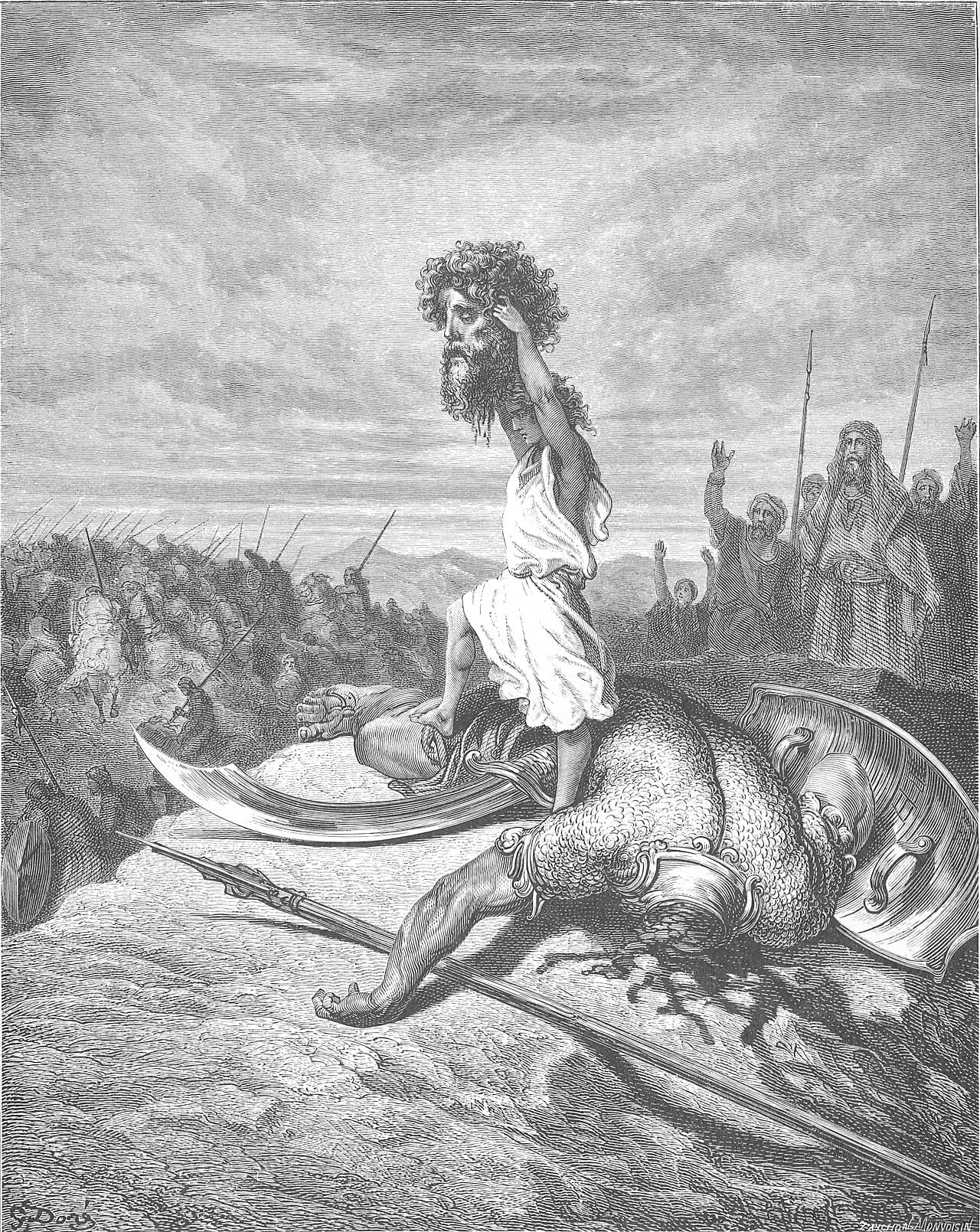
Gustave Doré, David Slays Goliath, 1866. Public domain.
THE ARTWORKDoré draws the moment after. David stands on the giant's chest with the severed head held up in one hand, the great sword lying where he dropped it, the armour still strapped to a body that fills the bottom of the plate. Behind him one ridge lifts its arms and the other breaks and runs. The chapter says the Philistines fled when they saw that their champion was dead, and this is the instant they saw it.
Summary
Summary
A seven-verse chain traces Goliath's line from Genesis 3:15 through the Nephilim of Genesis 6 to the named Anakim remnant in Gath, with the disputed height question kept as a clearly secondary footnote. The page also opens the rabbinic reading of the chapter at Sotah 42b and names four things the text leaves silent.
- A seven-link chain of verses, Genesis 3:15, 6:4, Numbers 13:33, Deuteronomy 2:10-11, Joshua 11:22, 1 Samuel 17:4, and 2 Samuel 21:20-22, traces Goliath's descent from the Nephilim line to Gath.
- Goliath's height is treated as secondary: both the Masoretic six cubits and a span and the Septuagint's four cubits and a span are given, with neither argued over.
- The rabbinic lane opens the Babylonian Talmud, Sotah 42b, on the word ish habbenayim and the naming of the four sons of ha-rapha, quoted and dated, never bare-cited.
- Four commentators, Wesley, Clarke, Barnes, and Henry, are shown disagreeing on the armor's weight, and the Elhanan problem at 2 Samuel 21:19 is shown rather than smoothed over.
- Four silences are named and left open: why five stones, how Goliath's parentage actually worked, what the Philistines thought, and David's age.
Forty Days, and Nobody Would Go Down
1 Samuel 17, told plainly
Two armies are camped on facing ridges above the valley of Elah, and neither will come down. Every morning for forty days one man walks out into the empty ground between them and shouts the same offer: send one man down to fight me, and let the whole war be decided by the two of us. Nobody goes. Israel's king, who is himself a head taller than anyone else in the country, does not go.
And Goliath stood and shouted to the ranks of Israel, “Why do you come out and array yourselves for battle? Am I not a Philistine, and are you not servants of Saul? Choose one of your men and have him come down against me. If he is able to fight me and kill me, then we will be your servants. But if I prevail against him and kill him, then you shall be our servants and labor for us.” Then the Philistine said, “I defy the ranks of Israel this day! Give me a man to fight!”The offer, in his own words: and the last verb in it is the one the chapter will keep returning to: he defies.
A shepherd arrives with bread and cheese for his brothers and hears the shout. What offends him is not the size of the man but what the man is saying: who is this uncircumcised Philistine, that he should defy the armies of the living God? He is brought to Saul, tries on the king's armour, and takes it off again because he has never walked in it. He picks up five smooth stones from the brook and goes down with a sling and a shepherd's staff.
David asked the men who were standing with him, “What will be done for the man who kills this Philistine and removes this disgrace from Israel? Just who is this uncircumcised Philistine, that he should defy the armies of the living God?”David's first recorded words in the chapter are a question about God's reputation, not about the giant's height.
The Philistine looks at him and is insulted. David tells him exactly what is about to happen and why: you come to me with a sword and a spear and a javelin, but I come to you in the name of the LORD of Hosts. Then he runs: the text says he ran toward the battle line: and the stone goes into the giant's forehead, and the giant falls on his face toward David. Years later, when David is an old king who has grown faint in battle, the sons of the same Gath family come out one after another, and David's men kill every one of them.
But David said to the Philistine, “You come against me with sword and spear and javelin, but I come against you in the name of the LORD of Hosts, the God of the armies of Israel, whom you have defied.The chapter's hinge sentence: an inventory of bronze on one side, and a name on the other.
Thou comest to me with a sword - I come to thee with the name (בשם beshem) of Jehovah of hosts; the God of the armies of Israel. What Goliath expected from his arms, David expected from the ineffable name.
Adam Clarke · Commentary on the Bible (1832), on 1 Sam 17:45
Where This Giant Came From
seven verses, in order: the chain the Bible builds itself
The story is usually told as an underdog story, and the chapter is not really telling one. It is telling the reader who the man in the valley was: and the Bible answers that question the way it answers most questions, by leaving a trail of verses that lead back to the beginning.
Goliath was a hybrid: a half-breed out of the Nephilim line, a product of a corruption that entered the human bloodline before the Flood and was still walking around in three Philistine cities long after it. That is not a legend laid over the chapter. It is the chain below, and every link in it is a verse you can open. Where the evidence runs out, this page stops.
And I will put enmity between you and the woman, and between your seed and her seed. He will crush your head, and you will strike his heel.”The enmity is announced: between the serpent's seed and the woman's seed. Everything after this runs on that line, and the wound named is a crushed head.
The Nephilim were on the earth in those days—and afterward as well—when the sons of God had relations with the daughters of men. And they bore them children who became the mighty men of old, men of renown.The Nephilim were on the earth in those days: and also afterward. The text's own three words are what keep the question open past the Flood.
We even saw the Nephilim there—the descendants of Anak that come from the Nephilim! We seemed like grasshoppers in our own sight, and we must have seemed the same to them!”The spies come back from Hebron saying they saw the Nephilim. That word appears three times in the whole Hebrew Bible, and two of them are in this one verse. The third is Genesis 6:4: the spies reached for Genesis 6's vocabulary.
THE HINGE: SCRIPTURE DOES THE CLASSIFYING HERE, NOT A COMMENTATOR
(The Emites used to live there, a people great and many, as tall as the Anakites. Like the Anakites, they were also regarded as Rephaim, though the Moabites called them Emites.Scripture's own equation, stated as a plain aside: the Emim were counted Rephaim, as the Anakim are. The Bible itself puts the Anakim inside the Rephaim category.
THE HINGE: THREE CITIES NAMED, AND ONE OF THEM IS GATH
At that time Joshua proceeded to eliminate the Anakim from the hill country of Hebron, Debir, and Anab, and from all the hill country of Judah and of Israel. Joshua devoted them to destruction, along with their cities. No Anakim were left in the land of the Israelites; only in Gaza, Gath, and Ashdod did any survive.Joshua cuts the Anakim out of the hill country: and the verse names the exceptions: none were left, only in Gaza, in Gath, and in Ashdod. A named remnant, in three named cities.
Then a champion named Goliath, who was from Gath, came out from the Philistine camp. He was six cubits and a span in height,The champion who comes out of the Philistine camp is named, and his city is named with him: Goliath, of Gath. The book of Joshua had already flagged that address.
And there was still another battle at Gath, where there was a man of great stature with six fingers on each hand and six toes on each foot—twenty-four in all. He too was descended from Rapha, and when he taunted Israel, Jonathan the son of David’s brother Shimei killed him. So these four descendants of Rapha in Gath fell at the hands of David and his servants.At Gath again, years later: a man of great stature with six fingers on each hand and six toes on each foot, one of four born to ha-rapha in Gath. The text counts the fingers. That title appears four times in eight verses and nowhere else in these two books.
THE HONEST NOTE
Not every commentator files these words in one drawer. Albert Barnes, working the vocabulary at 2 Samuel 21, kept the Rephaim and the Nephilim as separate categories:
Sons of the giant - The "giant" here 2Sa 21:18, 2Sa 21:20, 2Sa 21:22 is "ha-Raphah," whence, the "Rephaim" Gen 14:5; Deu 2:11. The sons of Ha-raphah, or Rephaim, are different from the "Nephilim," or Giants Gen 6:4; Num 13:33. The sons of Anak were not strictly Rephaim, but Nephilim.
Albert Barnes · Notes on the Old and New Testaments (1832-1869), on 2 Sam 21:16
That is a careful nineteenth-century lexical distinction, made by a man who read this material more closely than most: and it meets a verse that does not observe it. Deuteronomy 2:11 counts the Anakim among the Rephaim in so many words. The page gives Barnes his own words, sets Scripture's own classification beside them, and leaves the reader looking at both.
Barnes is not being argued against here. He is the source of the single most useful paragraph on this page: the one that ties Gath, Joshua 11:22 and 2 Samuel 21 together in one breath: and it is quoted in full further down.
A SECONDARY QUESTION: HOW TALL WAS HE?
The Masoretic reading
Six cubits and a span: roughly nine feet nine inches. This is the reading behind almost every English Bible, and Wesley, Barnes and Clarke all do the arithmetic on it.
The Septuagint, 4QSam-a and Josephus
Four cubits and a span: roughly six feet nine. The Greek Old Testament, the oldest surviving Hebrew manuscript of Samuel from the Dead Sea caves, and the first-century historian Josephus all read it this way.
Both readings are given here and neither is fought over. Either way he is the biggest man on the field and no Israelite will face him: and the chapter itself never makes his height the point. Where he came from is the point.
Six Places the Retellings Drift
what the text actually says, against what the story has become
FIVE STONES, FOUR BROTHERS: NEITHER HALF IS IN THE TEXT
Scripture never says why David took five, and it never says Goliath had four brothers. 2 Sam 21:22 says four were born to the giant in Gath, and Barnes reads it plainly: not necessarily brothers, but all of the race of the Giant. Only one man in that list is called Goliath's brother, and only in 1 Chr 20:5. The claim also fails its own arithmetic: the old source it is borrowed from counts Goliath himself among the four, which leaves three.
THE ARMOUR WEIGHT IS GENUINELY DISPUTED
Four public-domain commentators, four answers. Wesley makes five thousand shekels about seventy-eight pounds. Clarke, working from Bishop Cumberland's tables, gets one hundred and fifty-six pounds four ounces. Barnes says about 157. Henry offers a different reading altogether: that the number is the value of the coat, not its weight. All four are given below.
HE WAS NOT A LONE CHAMPION
He is one of a family, in a named city, in a line the book of Joshua had already flagged. Barnes ties it together in a sentence: Gath is one of the three places Joshua 11:22 names as still holding a remnant of the sons of Anak, and the same race turns up again in the account of David's Philistine wars in 2 Samuel 21 and 1 Chronicles 20.
A SLING WAS NOT A BOY'S TOY
Judges 20:16 has seven hundred left-handed Benjaminites who could sling at a hair and not miss. And Israel had almost nothing else: 1 Sam 13:19-22 says there was no smith in the land, that Israelites went down to the Philistines to sharpen their tools, and that on the day of battle only Saul and Jonathan carried a sword or a spear.
THE ELHANAN PROBLEM, SHOWN RATHER THAN SMOOTHED
2 Sam 21:19 as it stands says Elhanan killed Goliath; the parallel at 1 Chr 20:5 says Elhanan killed Lahmi, Goliath's brother. Clarke works the Hebrew and shows exactly how the copying slip happens, citing Kennicott; Barnes says flatly that the Hebrew text there is very corrupt. Two nineteenth-century commentators, and no apologetics required.
IT IS NOT A STORY ABOUT FACING YOUR FEARS
The chapter is about a real war on real ground, fought over a real border, by a nation that could not make its own swords. David's stated reason for going down is not courage and not ambition: it is that a man has defied the armies of the living God. The Hebrew verb behind defy appears five times in this chapter, and once more at 2 Sam 21:21, when the last of the Gath family does the same thing and dies for it.
Four - Not necessarily meaning that they were brothers, but that they were all of the race of the Giant, all Rephaim. The word "four" is omitted in the parallel passage, only the three last being mentioned in that chapter.
Albert Barnes · Notes on the Old and New Testaments (1832-1869), on 2 Sam 21:22
Elhanan the son of Jaare-oregim - slew - Goliath the Gittite - Here is a most manifest corruption of the text, or gross mistake of the transcriber; David, not Elhanan, slew Goliath. In 1Ch 20:5, the parallel place, it stands thus: "Elhanan, the son of Jair, slew Lahmi, the brother of Goliath the Gittite, whose spear-staff was like a weaver's beam." This is plain; and our translators have borrowed some words from Chronicles to make both texts agree. The corruption may be easily accounted for by considering that ארגים oregim, which signifies weavers, has slipped out of one line into the other; and that בית הלחמי beith hallachmi, the Beth-lehemite, is corrupted from את לחמי eth Lachmi; then the reading will be the same as in Chronicles.
Adam Clarke · Commentary on the Bible (1832), on 2 Sam 21:19
A Nation That Could Not Make a Sword
the champion, the bronze inventory, and the one weapon Israel could still build
The word the chapter uses for what Goliath was is barely Hebrew. He is the ish habbenayim (the man of the between), and the phrase occurs exactly twice in the whole Hebrew Bible, both times in this chapter. The language had to reach for a term it hardly has, for a man whose job was to stand in the empty ground between two armies and settle a war by himself.
There went out a champion - Our word champion comes from campus, the field; Campio est enim ille qui pugnat in campo, hoc est, in castris, "Champion is he, properly, who fights in the field; i.e., in camps." A man well skilled in arms, strong, brave, and patriotic. But is this the meaning of the original איש הבנים ish habbenayim, a middle man, the man between two; that is, as here, the man who undertakes to settle the disputes between two armies or nations.
Adam Clarke · Commentary on the Bible (1832), on 1 Sam 17:4
A champion - literally, "a man between the two camps:" i. e., one who did not fight in the ranks like an ordinary soldier, but came forth into the space between the hostile camps to challenge the mightiest man of his enemies to come and fight him. Goliath of Gath - One of the places mentioned in Jos 11:22 as still retaining a remnant of the sons of Anak; Gaza and Ashdod being the others. The race of giants (the Rephaim, from רפא râphâ' ) is mentioned again in the account of David's Philistine wars 2Sa 21:15-22; 1Ch 20:4-8. It appears from these passages that Goliath had a brother Lahmi. Four are named as being "born to the giant in Gath."
Albert Barnes · Notes on the Old and New Testaments (1832-1869), on 1 Sam 17:4
Then the chapter does something unusual: it stops and itemises his equipment, piece by piece, like a quartermaster's list. Bronze helmet, scale corselet, bronze greaves, bronze javelin slung between the shoulders, a spear shaft like a weaver's beam with an iron head, and a man walking in front carrying his shield. Barnes even names a surviving parallel for the corselet.
Coat of mail - Or breastplate of scales. A kind of metal shirt, protecting the back as well as the breast, and made of scales like those of a fish; as was the corselet of Rameses III, now in the British Museum.
Albert Barnes · Notes on the Old and New Testaments (1832-1869), on 1 Sam 17:5
And here is the background verse that almost every retelling misses. Four chapters earlier, 1 Samuel had explained why that inventory is terrifying: there was no blacksmith in Israel. The Philistines had seen to it. Israelites went down to Philistine territory to get their farm tools sharpened, and on the day of battle only the king and his son had a sword or a spear in their hands.
And no blacksmith could be found in all the land of Israel, because the Philistines had said, “The Hebrews must not be allowed to make swords or spears.” Instead, all the Israelites would go down to the Philistines to sharpen their plowshares, mattocks, axes, and sickles. The charge was a pim for sharpening a plowshare or mattock, a third of a shekel for sharpening a pitchfork or an axe, and a third of a shekel for repointing an oxgoad. So on the day of battle not a sword or spear could be found in the hands of the troops with Saul and Jonathan; only Saul and his son Jonathan had weapons.The iron monopoly. Goliath's kit is a catalogue of everything Israel could not manufacture: which is why the shepherd's weapon is the one a nation under that embargo could still make.
The sling was not a substitute for a proper weapon; in that country it was a proper weapon, and a specialist one. Judges records seven hundred Benjaminites who could sling a stone at a hair and not miss.
Among all these soldiers there were 700 select left-handers, each of whom could sling a stone at a hair without missing.Slinging was a trained military skill in Israel, not a shepherd's improvisation.
And David took his staff in his hand, selected five smooth stones from the brook, and put them in the pouch of his shepherd’s bag. And with his sling in hand, he approached the Philistine.Five stones out of the brook: and Clarke explains why smooth ones, for reasons that have nothing to do with symbolism.
Five smooth stones - 1. Had they been rough or angular, they would not have passed easily through the air, and their asperities would, in the course of their passage, have given them a false direction. 2. Had they not been smooth, they could not have been readily despatched from the sling.
Adam Clarke · Commentary on the Bible (1832), on 1 Sam 17:40
By this it appeared that his confidence was purely in the power of God, and not in any sufficiency of his own, and that now at length he who put it into his heart to fight the Philistine put it into his head with what weapons to do it.
Matthew Henry · Commentary on the Whole Bible (1710), on 1 Sam 17:40
What did the armour weigh? Four answers, all of them careful
The common shekel contained a fourth part of an ounce; and so five thousand shekels made one thousand two hundred and fifty ounces, or seventy- eight pounds: which weight is not unsuitable to a man of such vast strength as his height speaks him to be.
John Wesley · Explanatory Notes upon the Old Testament (1765), on 1 Sam 17:5
He was armed with a coat of mail - The words in the original, שרון קשקשים shiryon kaskassim, mean a coat of mail formed of plates of brass overlapping each other, like the scales of a fish, or tiles of a house. This is the true notion of the original terms. With thin plates of brass or iron, overlapping each other, were the ancient coats of mail formed in different countries; many formed in this way may be now seen in the tower of London. The weight - five thousand shekels - Following Bishop Cumberland's tables, and rating the shekel at two hundred and nineteen grains, and the Roman ounce at four hundred and thirty-eight grains, we find that Goliath's coat of mail, weighing five thousand shekels, was exactly one hundred and fifty-six pounds four ounces avoirdupois. A vast weight for a coat of mail, but not all out of proportion to the man.
Adam Clarke · Commentary on the Bible (1832), on 1 Sam 17:5
The coat is said to weigh 5000 shekels, and a shekel was half an ounce avoirdupois, a vast weight for a man to carry, all the other parts of his armour being proportionable. But some think it should be translated, not the weight of the coat, but the value of it, was 5000 shekels; so much it cost.
Matthew Henry · Commentary on the Whole Bible (1710), on 1 Sam 17:5-6
The shekel weight they are converting from is not fixed across their sources, which is the whole reason the answers diverge: and Henry raises a possibility the others do not consider, that the figure was a price rather than a weight. None of them is being careless. This page gives all four and does not pick.
How the Rabbis Read This Chapter
the Babylonian Talmud, tractate Sotah 42b — reception history, recorded as exactly that
The passage below comes from the Babylonian Talmud: the Bavli, compiled in the Jewish academies of Babylonia and brought to its final form by roughly the sixth century AD. It sits in tractate Sotah, and it is aggadah: the storytelling and homiletical side of the Talmud rather than its legal reasoning. It is here because it is the oldest sustained discussion of this chapter's strangest word, and because two of its lines are the actual source of things Christian readers repeat without knowing where they came from. It is recorded here as reception history: how one tradition read a text: and it is no part of what MannaFest confesses.
What is indicated by the term beinayim? Rav said: The word is related to the root beit, nun, heh, meaning build, and means that he is built [muvneh] perfectly and free of any blemish. And Shmuel said: The word is related to the word bein, meaning between, and means that he was the middle [beinoni] among his brothers. A Sage from the school of Rabbi Sheila said: The word is related to the root beit, nun, heh, meaning build, and means that he was made strong as a building [binyan].
The Gemara asks: What are the names of the four siblings mentioned here? Rav Ḥisda said: They are Saph, and Madon, Goliath, and Ishbi in Nob.
Rabbi Yitzḥak says: The Holy One, Blessed be He, said: The children of the one who kissed, referring to the four giants descended from Orpah, will come and fall into the hand of the children of the one who cleaved, referring to David, who was descended from Ruth.
The tradition that Goliath's mother was Orpah
Immediately before the passage above, the same page of the Talmud identifies Harafa of 2 Samuel 21:16 with Orpah of Ruth 1:4 as one woman under two names, with Rav and Shmuel disputing which name was original. That identification is the source of the tradition, and the exact reference is given here so that any reader can go and read it at Sefaria for themselves. The etymologies the passage attaches to the two names are sexually explicit and degrading, and this page does not reproduce them: not to hide what the passage says, but because printing coarse ancient polemic in the name of honouring a tradition would serve neither the tradition nor the reader. It is aggadah, homiletical narrative rather than law, and Jewish readers have always received that material differently from the Talmud's legal reasoning.
Read the whole page for yourself: Sotah 42b at Sefaria — the William Davidson Talmud, English translation by Rabbi Adin Even-Israel Steinsaltz, available under a Creative Commons licence.
Where the Evidence Stops
four silences, named as silence and left alone
The chain above runs as far as the verses run and no further. Past that point the Bible stops talking, and so does this page: because a reading that has to be propped up with invention was never standing on the evidence in the first place.
Why five stones
He picked up five smooth stones. That is the whole of what Scripture says about it. Every explanation ever offered: the brothers, the books of Moses, faith with margin, a shepherd's habit: is supplied from outside the verse. Clarke explains why smooth and says nothing about why five, which is the right instinct. This is a silence, and this page names it as one.
How Goliath's parentage actually worked
Scripture says he was of Gath. It says four were born to ha-raphain Gath. It says Anakim remained in Gath after Joshua's campaign, and it counts the Anakim among the Rephaim. What it never does is narrate a birth or name a father. The chain above is the whole of the evidence, and the page runs exactly that far. Anything past it: mechanisms, generations, family trees: would be invention, and the case does not need it.
What the Philistines thought they were fielding
The chapter is written entirely from the Israelite side of the valley. Goliath speaks, and that is the only access the reader gets to what the Philistine camp understood about the man they sent out every morning for six weeks. Whether they knew what he was or simply knew what he could do, Scripture does not say.
How old David was
He is called a na'ar(a young man, a term with a wide range), and he is old enough to have killed a lion and a bear by himself while keeping his father's sheep. The pictures that make him a small boy and the pictures that make him a young warrior are both drawing something the text does not give.
A Crushed Head, and the Promise It Belongs To
the New Testament's own use first: then the text's own theology
The New Testament handles David-the-warrior exactly once, and it handles him as an example of faith rather than as a picture of Christ. Hebrews puts him in a list of people who were strong out of weakness and turned foreign armies to flight.
And what more shall I say? Time will not allow me to tell of Gideon, Barak, Samson, Jephthah, David, Samuel, and the prophets, who through faith conquered kingdoms, administered justice, and gained what was promised; who shut the mouths of lions, quenched the raging fire, and escaped the edge of the sword; who gained strength from weakness, became mighty in battle, and put foreign armies to flight.The apostolic reading of this chapter, and the only one: a commendation of faith.
But the story does have a place in Scripture's own architecture, and it is the place the chain has been pointing at from the first link. In Genesis 3 God announces enmity between the serpent's seed and the woman's seed, and He names the wound: the head is crushed. In the valley of Elah the champion of the serpent's line goes down with a stone in his forehead, killed by the seed of the woman: by the man from whose family the promised Seed will come.
And I will put enmity between you and the woman, and between your seed and her seed. He will crush your head, and you will strike his heel.”The first link, read again at the end. This is not a curiosity about giants; it is the reason the Bible has a plot.
Thus David prevailed over the Philistine with a sling and a stone; without a sword in his hand he struck down the Philistine and killed him.No sword in his hand: the narrator says it twice, because the point is whose victory it was.
That is the founder's centre reaching its terminus. The seed war is not an odd sub-plot about unusually large men; it is the line the whole Bible is drawn along, and the day a shepherd from Bethlehem crushed the head of Gath's champion is a day on that line. The final crushing happens on a hill outside Jerusalem, and the man who does it comes out of the same Bethlehem family.
David addresses himself to this combat rather as a priest that was going to offer a sacrifice to the justice of God than as a soldier that was going to engage an enemy of his country.
Matthew Henry · Commentary on the Whole Bible (1710), on 1 Sam 17:47
The champion who stands in his people's place
Readers have long seen a second shape in this chapter, and it is worth naming generously. One man goes down alone into the ground between the armies on behalf of everyone standing behind him. The whole nation's standing rides on his single combat. When he wins, they win a victory they did not fight for: and then they pursue an enemy who has already been beaten. It is a beautiful reading and the church has loved it for a very long time.
It is devotional tradition rather than a claim the chapter makes, and this page keeps the two layers apart on purpose. Genesis 3:15 is Scripture's own line and carries the beat above. The champion reading is the church's, offered here as exactly that: and it stands stronger for not being dressed up as something the text says.

THE ARTWORK
Almost nobody illustrates the other half of this story, and Doré did. This is 2 Samuel 21: David is an old king, faint in battle, and Ishbi-benob of the sons of ha-rapha has him: until Abishai gets there. The boy who killed the champion of Gath ends up needing rescue from the champion's own family, decades later, on the same border. The chapter that opens with a giant closes with four of them, and the king does not kill any of these himself.
Gustave Doré, Abishai Saves David's Life (1866) — Public domain, via Wikimedia Commons.
The most powerful enemies are often reserved for the last conflict. David began his glory with the conquest of one giant, and here concludes it with the conquest of four.
Matthew Henry · Commentary on the Whole Bible (1710), on 2 Sam 21:20
The Voices on the Post-Flood Line
two modern teachers on the chain, and the four commentators who carry the chapter
Chuck Missler and Michael Heiser: on the giants after the Flood
Two teachers on MannaFest's roster have taught the exact chain this page walks, and both are still in copyright: so they are named here and pointed to, rather than quoted at length.
Chuck Missler taught the post-flood Nephilim presence directly from Numbers 13:33, the Anakim and the Rephaim, the same three-verse hinge the chain above turns on. His fullest treatment is the lecture series The Return of the Nephilim, and the argument also runs through Alien Encounters, written with Mark Eastman in 1997. He was Pastor Marc's formative teacher, and this is one of the subjects he is worth going to first on.
Michael S. Heiser, a Semitic-languages scholar, worked the same vocabulary from the manuscripts up. Reversing Hermon: Enoch, the Watchers, and the Forgotten Mission of Jesus Christ and The Unseen Realm (Lexham, 2015) are where he sets out how the Anakim, Rephaim and Nephilim terminology behaves across the Hebrew Bible and the Septuagint. Go to the books; this page will not put words in his mouth.
Albert Barnes on Gath, Joshua 11:22, and the race of giants
A champion - literally, "a man between the two camps:" i. e., one who did not fight in the ranks like an ordinary soldier, but came forth into the space between the hostile camps to challenge the mightiest man of his enemies to come and fight him. Goliath of Gath - One of the places mentioned in Jos 11:22 as still retaining a remnant of the sons of Anak; Gaza and Ashdod being the others. The race of giants (the Rephaim, from רפא râphâ' ) is mentioned again in the account of David's Philistine wars 2Sa 21:15-22; 1Ch 20:4-8. It appears from these passages that Goliath had a brother Lahmi. Four are named as being "born to the giant in Gath."
Albert Barnes · Notes on the Old and New Testaments (1832-1869), on 1 Sam 17:4
Everything the chain claims about Goliath's address is in that paragraph, written by a commentator who was not building a case about the seed war at all. He simply followed the cross-references the text gives, and they lead where they lead.
Wesley and the height
Six cubits - At least, nine feet, nine inches high. And this is not strange; for besides the giants mentioned in Scripture, Herodotus, Diodourus Siculus, and Pliny, make mention of persons seven cubits high.
John Wesley · Explanatory Notes upon the Old Testament (1765), on 1 Sam 17:4
Wesley works the Masoretic figure and then reaches for the classical historians to show that it is not unheard of. He is doing arithmetic on the reading in front of him, honestly. The Greek and Dead Sea manuscripts read four cubits rather than six, and this page gives both without adjudicating between them.
Where the roster does not appear
MannaFest names a teacher on a page when that teacher taught something worth the reader's time on that subject, and not because they are favourites. On this chapter the two above qualify and the rest of the roster does not, so the rest of the roster is not here. The chapter belongs to Christ, not to any modern teacher of it.
Read the Great Books
the works that have carried this teaching: go further than this page
Notes on the Old and New Testaments
Albert Barnes · 1832-1869
The best single paragraph anyone has written on who Goliath was: Gath, Joshua 11:22, the Rephaim and the later Philistine wars, all in one place: and the most careful treatment of the Hebrew behind 2 Samuel 21.
READ IT FREE AT CCEL →Commentary on the Bible
Adam Clarke · 1832
Clarke is the practical one: what a champion was, what the coat of mail was made of, why the stones had to be smooth, and how the Elhanan verse got copied wrong.
READ IT FREE AT CCEL →Commentary on the Whole Bible
Matthew Henry · 1710
Henry reads the combat as an act of worship rather than a duel, and closes the whole Philistine story at 2 Samuel 21 with the observation that the hardest enemies come last.
READ IT FREE AT CCEL →Reversing Hermon
Michael S. Heiser · 2017
A Semitic-languages scholar on the Watchers, the Nephilim and how that vocabulary behaves across the Hebrew Bible and the Septuagint: the technical groundwork under the chain this page walks.
In print: find it wherever books are sold.
The Stone Went Into His Forehead
Two armies watched a shepherd walk into the ground between them carrying nothing anybody recognised as a weapon, and what they saw was a boy losing. What the Bible shows its reader is the far end of a line that had been drawn in a garden: enmity between two seeds, a promise about a crushed head, a corruption that survived the Flood and settled in three Philistine cities, and a family in Gath with too many fingers. The champion of that line went down face-first with a stone in his forehead, killed by a man with no sword in his hand: and the family he came from would keep coming out of Gath until David's men had finished the work. The last crushing is still ahead of the chapter, and it belongs to Someone from the same town.
Notable art
— click a piece to enlargeKeep studying
Read it1
On this page