
Exodus 20:8 to 11 · Debate · Featured Study
Sunday and the Sabbath
Four readings of the Sabbath and the Lord's Day, with the teachers and confessions that hold each and the verses each one reads.
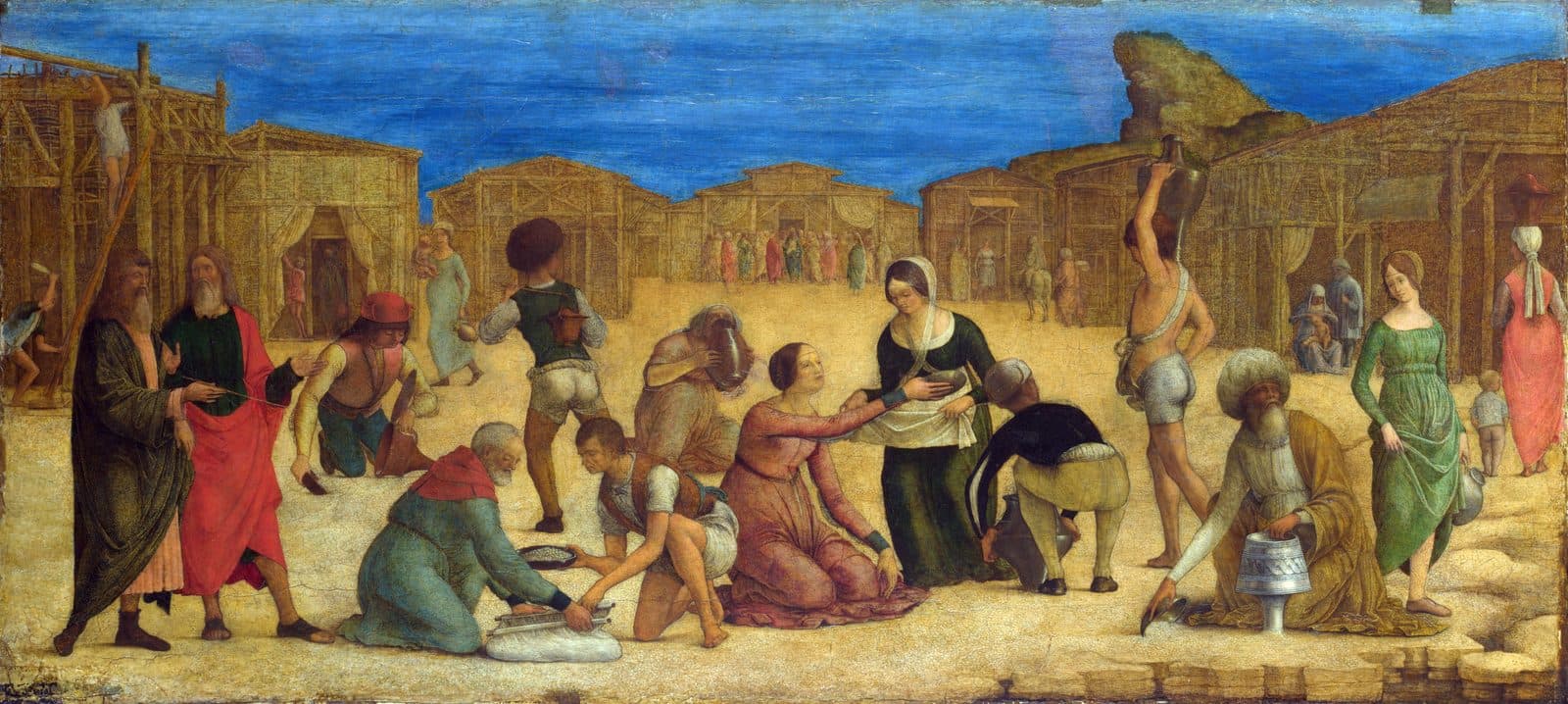
Ercole de' Roberti, The Israelites Gathering Manna, 1490s, National Gallery, London. Public domain by date, painted before 1930.
THE ARTWORKErcole de' Roberti painted the camp of Israel gathering the manna, the bread that the LORD gave on six days and that the people kept from the sixth day for the Sabbath.
The Sabbath is the longest of the Ten Commandments, and it is the only one of the ten that names a day of the week.
Summary
Christians agree that God blessed the seventh day and that Christ rose on the first, and they differ over which day the commandment asks of them.
- Seventh Day Baptists and Seventh-day Adventists keep the seventh day as the Sabbath God blessed at creation.
- The Westminster Confession calls the Lord's Day the Christian Sabbath, changed to the first day at the resurrection of Christ.
- Martin Luther held that Christ set Christians free of the day, and that they keep one for rest and for the Word.
- Thomas Aquinas held that the Church set the Lord's day in the Sabbath's place.
The Texts Every Side Reads
Six passages, from the week of creation to John's vision on Patmos, carry the weight of the question.
Then God blessed the seventh day and sanctified it, because on that day He rested from all the work of creation that He had accomplished.The seventh-day reading and the Christian Sabbath reading both hold that God blessed the day here, before there was an Israel to keep it.
For in six days the LORD made the heavens and the earth and the sea and all that is in them, but on the seventh day He rested. Therefore the LORD blessed the Sabbath day and set it apart as holy.The commandment rests on the six days of creation, and every side has to say how far that ground reaches.
The Israelites must keep the Sabbath, celebrating it as a permanent covenant for the generations to come. It is a sign between Me and the Israelites forever; for in six days the LORD made the heavens and the earth, but on the seventh day He rested and was refreshed.’”The LORD calls the Sabbath a permanent covenant and a sign between Him and the Israelites, and the positions differ over whether the sign was given to Israel alone.
One person regards a certain day above the others, while someone else considers every day alike. Each one should be fully convinced in his own mind.Paul leaves the regard of one day above another to each one's own conviction, and the readings differ over whether the weekly Sabbath is among those days.
Therefore let no one judge you by what you eat or drink, or with regard to a feast, a New Moon, or a Sabbath. These are a shadow of the things to come, but the body that casts it belongs to Christ.Paul names a Sabbath among the things that are a shadow of what was to come, and every position gives its own account of which Sabbaths he means.
On the Lord’s day I was in the Spirit, and I heard behind me a loud voice like a trumpet,The readings that keep the first day take John's words as a name for that day.
Four Answers on the Day
Each reading names its day, its law and its reason for the first day of the week.
| The question | The seventh day | The Christian Sabbath | The Sabbath fulfilled in Christ | The church's precept |
|---|---|---|---|---|
| Which day? | Saturday, the seventh day of the week. | Sunday, held as the Sabbath. | Sunday, held as a day of worship. | Sunday, held as the Lord's Day. |
| What does the command require today? | Rest on Saturday from all ordinary work. | One day in seven, which is now the first. | A day for rest and the Word, kept in freedom. | Its day was figurative and ceased with the old law. |
| Why the first day? | The church moved its worship to Sunday after the apostles. | Christ rose on it, and the day of rest moved with the resurrection. | Christ rose on it, and the church meets on it to worship Him. | Christ rose on it, and the Church instituted its keeping. |
Each Position in Its Own Words
Each of the four positions rests on its own reading of creation, of Sinai and of the resurrection.
The seventh dayAndrews, Bacchiocchi
The Seventh Day Baptists and the Seventh-day Adventists keep the seventh day as the Sabbath. J. N. Andrews, a Seventh-day Adventist, argued in his History of the Sabbath and First Day of the Week that the Sabbath was given to Adam, the head of the human family.
but the seventh day is a Sabbath to the LORD your God, on which you must not do any work—neither you, nor your son or daughter, nor your manservant or maidservant or livestock, nor the foreigner within your gates.The commandment names the seventh day itself as the Sabbath to the LORD your God, and the seventh-day reading finds no later text that names another.
Samuele Bacchiocchi argued in From Sabbath to Sunday that Sunday worship arose in the church of Rome, in conscious distinction from the Jewish Sabbath, under the pressure of imperial measures against the Jews.
The Christian SabbathWestminster, Henry, Clarke
The Westminster Confession holds that God appointed one day in seven by a moral and perpetual commandment binding all people in all ages. That day was the last of the week from creation to the resurrection of Christ, and from the resurrection it was changed to the first day. Scripture calls that day the Lord's Day, and it is to continue to the end of the world as the Christian Sabbath.
Remember that you were a slave in the land of Egypt, and that the LORD your God brought you out of there with a mighty hand and an outstretched arm. That is why the LORD your God has commanded you to keep the Sabbath day.Matthew Henry read the rescue from Egypt as a type of the redemption by Jesus Christ, which the Christian Sabbath was kept to remember.
Adam Clarke called the Lord's day of Revelation 1:10 the Christian Sabbath, which has taken the place of the Jewish Sabbath throughout the Christian world. He read the permanent covenant of Exodus 31:16 as a sign of the rest to come, to be kept perpetually until that rest arrives.
The Sabbath fulfilled in ChristLuther, Lincoln
This reading holds that the Sabbath belonged to the order of Moses that Christ fulfilled, and it lays no law of rest on the Lord's Day. Martin Luther taught in the Large Catechism that the commandment in its outward sense does not concern Christians, since it was an external matter. He kept a day for the rest of the body and for the hearing of God's Word, and he wrote that a true holy day is kept wherever the Word is heard and practised.
A. T. Lincoln, in the closing chapter of From Sabbath to Lord's Day, edited by D. A. Carson, held that the first day grew in importance through the resurrection and the appearances of the risen Christ, and that the duty of physical rest was never transferred to it.
The church's preceptAquinas
Thomas Aquinas taught in the Summa Theologiae that in the New Law the observance of the Lord's day took the place of the Sabbath. It did so by the institution of the Church and the custom of Christian people, rather than by force of the old law's precept. He held that the Lord's day carries no figure as the Sabbath did, so its bar on work is less strict.
The site's tradition is Wesleyan-Pentecostal, and its page Sabbath Rest names that stream among the holders of the reading of Romans 14:5 that leaves the day to each believer's conviction.
What the Letters Say of Days
Three groups of texts in Acts and the letters name the first day or the keeping of days, and the positions read each group in their own way.
Troas and CorinthActs 20:7 and 1 Corinthians 16:2
On the first day of the week we came together to break bread. Since Paul was ready to leave the next day, he talked to them and kept on speaking until midnight.The readings that hold to the first day point to this gathering to break bread as a settled custom.
Albert Barnes read the verse as showing that the first day was then kept by Christians as holy time, and he took the breaking of bread as the Lord's Supper.
On the first day of every week, each of you should set aside a portion of his income, saving it up, so that when I come no collections will be needed.John Gill noted that an ancient copy of Beza's adds the words "the Lord's day" to this verse, the name Revelation 1:10 gives.
Shadow and substanceColossians 2:16 to 17
Adam Clarke read the Sabbaths of Colossians 2:16 as the particular Sabbaths kept with more than ordinary solemnity, taken away and nailed to the cross with the rest of the ceremonial calendar. Matthew Henry read the verse as Paul's ruling on that calendar.
“Much of the ceremonies of the law of Moses consisted in the distinction of meats and days. It appears by Rom. xiv. that there were those who were for keeping up those distinctions: but here the apostle shows that since Christ has come, and has cancelled the ceremonial law, we ought not to keep it up.”
Matthew Henry · Commentary on the Whole Bible · on Colossians 2:16Puritan
Irenaeus of Lyons cited Colossians 2:16 against Christians who divided the church over its feast days.
“The apostles ordained, that ‘we should not judge any one in respect to meat or drink, or in regard to a feast day, or the new moons, or the sabbaths.’ Whence then these contentions? whence these schisms? We keep the feast, but in the leaven of malice and wickedness, cutting in pieces the Church of God; and we preserve what belongs to its exterior, that we may cast away these better things, faith and love. We have heard from the prophetic words that these feasts and fasts are displeasing to the Lord.”
Irenaeus · Fragments from the Lost Writings of Irenaeus · on Colossians 2:16Patristic
The keeping of special daysRomans 14:6 and Galatians 4:10
He who observes a special day does so to the Lord; he who eats does so to the Lord, for he gives thanks to God; and he who abstains does so to the Lord and gives thanks to God.Adam Clarke read the special days of this verse as festivals that some believers kept to honour God and others did not keep at all, which bears on whether the weekly Sabbath is among them.
You are observing special days and months and seasons and years!Paul's fear for the Galatians who kept special days raises the question whether keeping any day as a law is a work.
Jamieson, Fausset & Brown answered that question for the Lord's day.
“To regard the observance of certain days as in itself meritorious as a work, is alien to the free spirit of Christianity. This is not incompatible with observing the Sabbath or the Christian Lord's day as obligatory, though not as a work (which was the Jewish and Gentile error in the observance of days), but as a holy mean appointed by the Lord for attaining the great end, holiness.”
Jamieson, Fausset & Brown · Commentary Critical and Explanatory on the Whole Bible · on Galatians 4:10Reformed
The Sabbath in Exodus
John Wesley, Origen and Matthew Henry each read the Sabbath of Exodus 16 or Exodus 31 for the church.
Understand that the LORD has given you the Sabbath; that is why on the sixth day He will give you bread for two days. On the seventh day, everyone must stay where he is; no one may leave his place.”The LORD gives Israel the Sabbath in the wilderness before the law at Sinai, and the positions differ over whether He was giving it for the first time or reminding them of it.
John Wesley answered the question of when the weekly Sabbath began.
“Here is a plain intimation of the observing a seventh day sabbath, not only before the giving of the law upon Mount Sinai, but before the bringing of Israel out of Egypt and therefore from the beginning.”
John Wesley · Explanatory Notes upon the Old Testament · on Exodus 16:23Evangelical
Origen of Alexandria read the rule that no one leave his place for a sense beyond its letter.
“Moreover in regard to the celebrated sabbath, a careful reader will see that the command, ‘You shall sit each one in your dwellings; let none of you go out from his place on the sabbath day,’ is an impossible one to observe literally, for no living creature could sit for a whole day and not move from his seat.”
Origen of Alexandria · On First Principles 4.3.2 · on Exodus 16:29Patristic
Matthew Henry carried the sign of Exodus 31:13 over to the Christian who keeps the fourth commandment.
“Note, If God by his grace incline our hearts to keep the law of the fourth commandment, it will be an evidence of a good work wrought in us by his Spirit. If we sanctify God's day, it is a sign between him and us that he has sanctified our hearts: hence it is the character of the blessed man that he keepeth the sabbath from polluting it, Isa. lvi.”
Matthew Henry · Commentary on the Whole Bible · on Exodus 31:13Puritan
How the Day Came Down
Three church writers of the first two centuries name the day of gathering, and a Roman emperor, a church council and a seventeenth-century church at Newport later acted on the question.
The first witnessesthe Didache, Ignatius, Justin Martyr
The Didache is a church order that scholars date between AD 60 and 150.
“But every Lord's day do ye gather yourselves together, and break bread, and give thanksgiving after having confessed your transgressions, that your sacrifice may be pure. But let no one that is at variance with his fellow come together with you, until they be reconciled, that your sacrifice may not be profaned. For this is that which was spoken by the Lord: In every place and time offer to me a pure sacrifice; for I am a great King, saith the Lord, and my name is wonderful among the nations.”
Didache · The Didache, Chapter 14 · on Acts 20:7Patristic
Ignatius of Antioch, writing to the Magnesians about AD 110, spoke of those brought up in the ancient order who had come to a new hope. They no longer kept the Sabbath and lived by the Lord's Day, on which their life sprang up again through Christ.
Justin Martyr wrote about AD 150 that the Christians of the cities and the country met on the day called Sunday. There the memoirs of the apostles and the writings of the prophets were read, the president taught, and the people prayed and shared the bread and the cup. Justin gave two reasons for the day: God made the world on the first day, and Jesus Christ rose from the dead on the same day.
From Constantine to NewportConstantine, Laodicea, Mumford
- AD 321The emperor Constantine, His law bids judges, townspeople and every trade rest on the venerable day of the sun, and it leaves farm work free. Eusebius reports that he bade all his subjects keep the Lord's day as a day of rest.
- About AD 360The Council of Laodicea, canon 29, The council bids Christians work on the Sabbath and honour the Lord's Day, resting then if they can.
- 1664Stephen Mumford, He arrives at Newport, Rhode Island, from London, the first keeper of the seventh day there.
- December 1671Mumford and six others at Newport, They covenant together as the first Seventh Day Baptist church in America.
A timeline of four dated marks from AD 321 to 1671, each row naming who acted and what was done about the day.
What the Text Leaves Unsaid
The New Testament leaves three questions about the first day without an answer.
What Every Side Holds
The four positions share four teachings about the day and about Christ.
MADE FOR MAN
Every side holds with Jesus that the Sabbath was made for man.
LORD OF THE SABBATH
Every side confesses that the Son of Man is Lord even of the Sabbath.
RISEN ON THE FIRST DAY
Every side confesses that Christ was risen when the two Marys went to see the tomb.
A REST THAT REMAINS
Every side holds that a Sabbath rest remains for the people of God.
The Four Positions Weighed
Each position faces one objection that the other positions press hardest.
| Position | Held by | Tradition | Representative work |
|---|---|---|---|
| The seventh day | Stephen Mumford; J. N. Andrews; Samuele Bacchiocchi | Seventh Day Baptist and Seventh-day Adventist churches | Andrews, History of the Sabbath and First Day of the Week (1862); Bacchiocchi, From Sabbath to Sunday (1977) |
| The Christian Sabbath | The Westminster Assembly; Matthew Henry; Adam Clarke; Jamieson, Fausset & Brown | Reformed and Presbyterian churches and the Puritans | The Westminster Confession, chapter 21, sections 7 to 8 |
| The Sabbath fulfilled in Christ | Martin Luther; A. T. Lincoln | Lutheran churches | Luther, the Large Catechism, on the third commandment; From Sabbath to Lord's Day, edited by D. A. Carson (1982) |
| The church's precept | Thomas Aquinas; the Council of Laodicea | The Catholic Church | Aquinas, Summa Theologiae, second part of the second part, question 122, article 4; the Council of Laodicea, canon 29 |
John Gill's answerto the seventh-day reading
John Gill held that the Son of Man, as Lord of the Sabbath, had power to abrogate it with the rest of the rituals of the ceremonial law, and that He did so.
The answer of Andrews and Lutherto the Christian Sabbath reading
J. N. Andrews held that no text records the change of the day, and that the resurrection texts give Sunday no sacred title. Luther held that the ordinances of the Old Testament, with their customs, persons, times and places, have been made free through Christ.
Adam Clarke's answerto the fulfilled reading
The fourth commandment stands among the Ten, and Adam Clarke held the weekly Sabbath to be of perpetual obligation and above every other sabbath of the law.
Stephen Mumford's answerto the precept reading
Stephen Mumford held, as J. N. Andrews records, that the power which thought to change times and laws had moved the weekly rest to Sunday.
Read the Great Books
These six works, from the first centuries of the church to the twentieth, give the witnesses and the positions in their own words.
The Didache
Unknown · between AD 60 and 150
The church order gives its rules for baptism, fasting, prayer and the thanksgiving in sixteen short chapters, and the fourteenth orders the gathering of the Lord's day.
READ IT FREE →To the Magnesians
Ignatius of Antioch · about AD 110
Ignatius wrote to the church at Magnesia, and his tenth chapter warns it against Judaizing.
READ IT FREE →The First Apology
Justin Martyr · about AD 150
Justin ends it by asking those he addresses not to decree death against those who have done no wrong.
READ IT FREE →History of the Sabbath and First Day of the Week
J. N. Andrews · 1862
Andrews traces the Sabbath from creation to his own day, with pages on the English Sabbatarians and the Seventh Day Baptists of America.
READ IT FREE →From Sabbath to Sunday
Samuele Bacchiocchi · 1977
The Pontifical Gregorian University Press in Rome published it, with chapters on the church of Rome, on anti-Judaism in the fathers and on sun worship.
In print: find it wherever books are sold.
From Sabbath to Lord's Day
D. A. Carson, editor · 1982
Its writers treat the Sabbath in the Old Testament, in Judaism, in the Gospels, Acts and Paul, and in the church to the Protestant tradition.
In print: find it wherever books are sold.
Kept to the Lord
Each position calls the reader to honour the Lord on the day it keeps.
The Seventh Day Baptist, the Westminster divine, the Lutheran and the Catholic each read the Sabbath toward Christ, on their own terms.
Remember the Sabbath day by keeping it holy.Keep studying
Studies6
Symbols1