
Deuteronomy 18 · Subject · Featured Study
The prophet like Moses
Deuteronomy 18 promises Israel a prophet like Moses, and the New Testament names Jesus as that prophet.
Israel asked for a man to stand between them and the fire, and God promised one with His own words in his mouth.
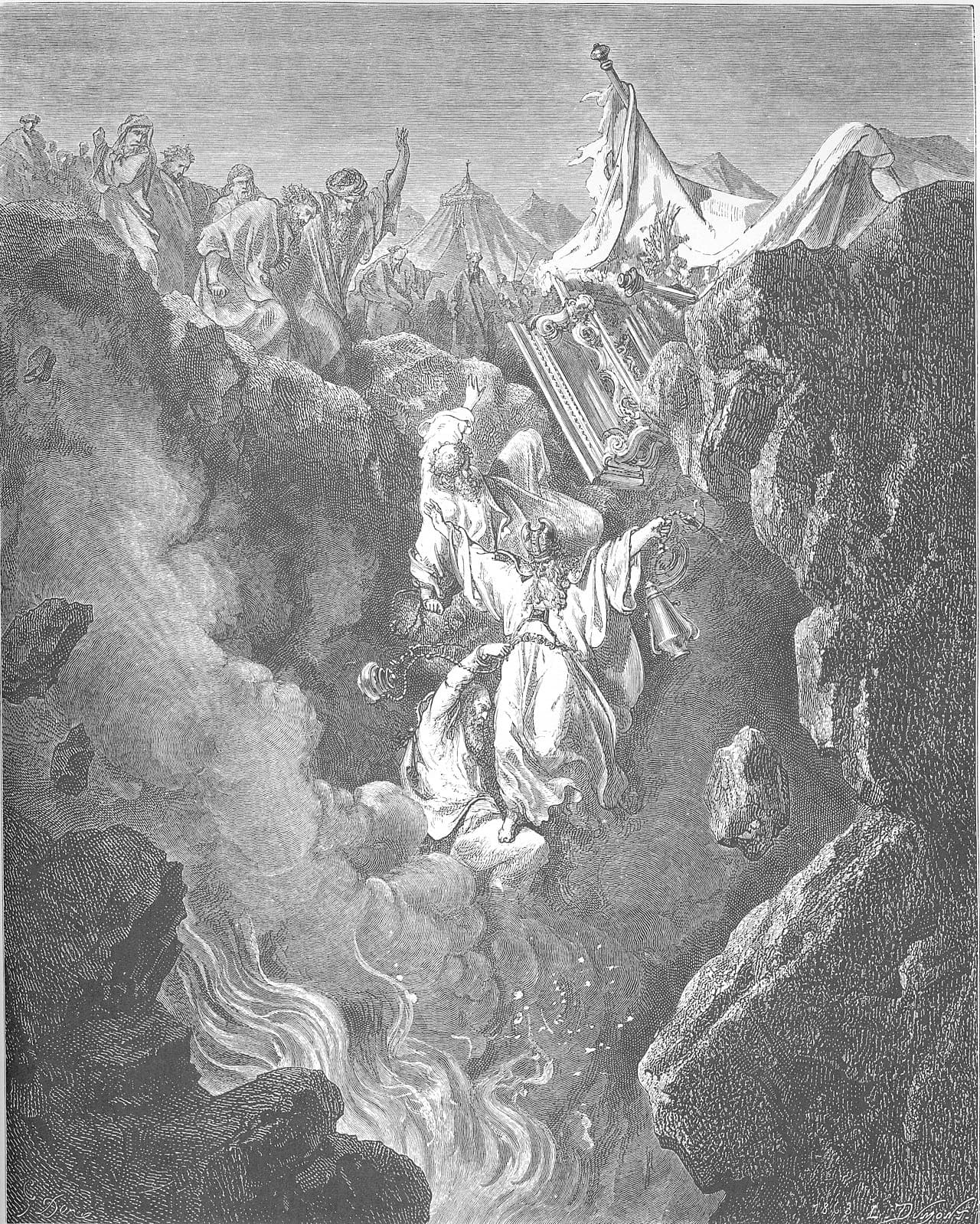
Gustave Doré, The Death of Korah, Dathan and Abiram, 1866, from Doré's English Bible. Public domain (published before 1930), via Wikimedia Commons.
THE ARTWORKDoré drew the ground opening under Korah's men as they fall with their censers. In Numbers 16:28 to 30 Moses said this act of the LORD would show whether the LORD had sent him, and Numbers 16:31 to 33 records that it came to pass.
Summary
In Deuteronomy 18:15 to 22 Moses tells Israel that the LORD will raise up a prophet like him from among their own people, and how to know a prophet the LORD has not sent.
- The promise answers the plea Israel made at Horeb not to hear God's voice out of the fire again.
- God approved their plea and warned that He would hold accountable anyone who did not listen to the prophet.
- A prophet whose word failed, or who spoke for other gods, had not been sent by the LORD.
- When Deuteronomy closes, no prophet like Moses has yet risen.
- Peter in Acts 3 and Stephen in Acts 7 apply the promise to Jesus.
The Promise and Israel's Request
Deuteronomy 18:15 to 19 gives the promise, the reason for it and the duty it lays on Israel
Moses spoke these words in the land of Moab, in the fortieth year after Israel left Egypt, just after forbidding the ways the nations of Canaan sought hidden knowledge (Deuteronomy 18:9 to 14).
In their place God promises Israel a prophet.
The LORD your God will raise up for you a prophet like me from among your brothers. You must listen to him.Moses speaks first, so Israel hears the promise from the man the prophet will be like.
The promise answers a request the people made nearly forty years before at Horeb, the mountain also called Sinai. When God spoke the Ten Commandments out of the fire, they were afraid they would die, and they asked Moses to hear God for them.
This is what you asked of the LORD your God at Horeb on the day of the assembly, when you said, “Let us not hear the voice of the LORD our God or see this great fire anymore, so that we will not die!” Then the LORD said to me, “They have spoken well.God's approval of these words is the ground of the promise that follows.
God then repeats the promise in His own voice.
I will raise up for them a prophet like you from among their brothers. I will put My words in his mouth, and he will tell them everything I command him. And I will hold accountable anyone who does not listen to My words that the prophet speaks in My name.These two verses make the prophet's words God's own, so that refusing him is refusing God.
What the people said at HorebDeuteronomy 5:27 to 28; Exodus 20:19; Albert Barnes; John Gill
Go near and listen to all that the LORD our God says. Then you can tell us everything the LORD our God tells you; we will listen and obey.” And the LORD heard the words you spoke to me, and He said to me, “I have heard the words that these people have spoken to you. They have done well in all that they have spoken.Moses gives the people's words in full in his first account of Horeb, with God's first approval of them.
“Speak to us yourself and we will listen,” they said to Moses. “But do not let God speak to us, or we will die.”Exodus records the same plea on the day itself, as the people stood at a distance.
Albert Barnes, in his Notes on Deuteronomy 5:23, says that Moses took on the work of carrying God's words to the people at their own pleading. He holds that God approved the request because it showed the people felt unworthy to come near Him. John Gill, on Deuteronomy 18:17, points back to Deuteronomy 5:28, where God first says the people have spoken well.
From the Promise to the Father's Voice
The argument in five steps, each with the verses that carry it
- Verses
- Deuteronomy 18:15 and 18:18
- What the text says
- God will raise up a prophet like Moses and put His words in his mouth.
- Verses
- Deuteronomy 34:10
- What the text says
- At the death of Moses no prophet like him had risen in Israel.
- Verses
- John 1:21 and John 6:14
- What the text says
- Envoys ask John whether he is the Prophet, and a crowd that Jesus has fed says that He is.
- Verses
- Acts 3:22 and Acts 7:37
- What the text says
- Peter adds the warning of Deuteronomy 18:19, and Stephen sets the promise beside the Moses Israel had rejected (Acts 7:35).
- Verses
- Matthew 17:5
- What the text says
- On the mountain of the transfiguration God speaks of His Son in the words Moses used of the prophet.
Step 3 came before the transfiguration, and step 4 after Pentecost.
The Promise Through Scripture
Numbers 12, Deuteronomy 34, Matthew 17, John 6, and Acts 3 and 7
The last chapter of Deuteronomy looks back over the life of Moses after his death.
Since that time, no prophet has risen in Israel like Moses, whom the LORD knew face to face—At the transfiguration Moses and Elijah talked with Jesus before Peter, James and John, and then a voice came out of a bright cloud.
While Peter was still speaking, a bright cloud enveloped them, and a voice from the cloud said, “This is My beloved Son, in whom I am well pleased. Listen to Him!”The command to listen to Him is the command Moses gave about the prophet, spoken with Moses standing by.
In John's Gospel the feeding of about five thousand men brought a crowd to a conclusion about Jesus.
When the people saw the sign that Jesus had performed, they began to say, “Truly this is the Prophet who is to come into the world.”The crowd reached this answer from a sign, and later in the chapter they set Jesus beside Moses and the manna (John 6:30 to 32).
In Acts 3 Peter spoke to a crowd that had seen a lame man healed at the temple gate.
For Moses said, ‘The Lord your God will raise up for you a prophet like me from among your brothers. You must listen to Him in everything He tells you. Everyone who does not listen to Him will be completely cut off from among his people.’In Acts 3:26 Peter calls Jesus the Servant God raised up and sent first to Israel.
Face to faceNumbers 12:6 to 8; Rashi; Bonaventure
He said, “Hear now My words: If there is a prophet among you, I, the LORD, will reveal Myself to him in a vision; I will speak to him in a dream. But this is not so with My servant Moses; he is faithful in all My house. I speak with him face to face, clearly and not in riddles; he sees the form of the LORD. Why then were you unafraid to speak against My servant Moses?”A prophet like Moses had to be more than an ordinary prophet, because God spoke with Moses face to face.
Rashi, Rabbi Shlomo Yitzchaki of Troyes (1040 to 1105), reads face to face in Deuteronomy 34:10 to mean that Moses was familiar with God and could speak with Him at any time he chose. He cites Exodus 32:30 and Numbers 9:8, where Moses goes up to the LORD or tells the people to wait while he hears what God will command.
Bonaventure, writing in 1257, reads these verses as a teaching on the kinds of vision God gives.
“The purely intellectual vision existed in the minds of the angels and of the Lawmaker. Moses was raised up to this vision more completely than any other prophet, for it is written: Should there be a prophet among you, in visions will I reveal Myself …”
Bonaventure · Collations on the Hexaemeron, Collation 9 · on Numbers 12:6 to 8Patristic
Stephen's speech in Acts 7Acts 7:37
This is the same Moses who told the Israelites, ‘God will raise up for you a prophet like me from among your brothers.’Stephen quotes the promise before the Sanhedrin, where he was charged with speaking against Moses (Acts 6:11 to 14).
The Tests of a Prophet
Deuteronomy 18:20 to 22 and 13:1 to 5, with Jeremiah 28
A man may claim to speak for God when God has not sent him, and Moses names two such offences that carry one penalty.
But if any prophet dares to speak a message in My name that I have not commanded him to speak, or to speak in the name of other gods, that prophet must be put to death.”The penalty is death, the penalty Deuteronomy 13:5 sets for the prophet who leads Israel to other gods.
Moses then gives Israel a way to recognize such a man.
You may ask in your heart, “How can we recognize a message that the LORD has not spoken?” When a prophet speaks in the name of the LORD and the message does not come to pass or come true, that is a message the LORD has not spoken. The prophet has spoken presumptuously. Do not be afraid of him.The first test is the outcome, and a word that fails need not be feared.
Deuteronomy 13 has already given a second test.
If a prophet or dreamer of dreams arises among you and proclaims a sign or wonder to you, and if the sign or wonder he has spoken to you comes about, but he says, “Let us follow other gods (which you have not known) and let us worship them,” you must not listen to the words of that prophet or dreamer. For the LORD your God is testing you to find out whether you love Him with all your heart and with all your soul.A true sign does not make a prophet true when his message turns Israel from the LORD.
Hananiah and JeremiahJeremiah 28; Rashi on Deuteronomy 18:20 and 18:21
Rashi, on Deuteronomy 18:20, reads a word God did not command as a word God may have given another prophet to speak, after the Talmud, Sanhedrin 89a.
Rashi, on Deuteronomy 18:21, names the occasion the verse foresees: the day Hananiah promised that the temple vessels would soon come back from Babylon, while Jeremiah said the rest would follow them there. He cites Sifrei Devarim 178:2.
As for the prophet who prophesies peace, only if the word of the prophet comes true will the prophet be recognized as one the LORD has truly sent.”Jeremiah applies the test of Deuteronomy 18:22 to Hananiah's promise of peace.
Therefore this is what the LORD says: ‘I am about to remove you from the face of the earth. You will die this year because you have preached rebellion against the LORD.’” And in the seventh month of that very year, the prophet Hananiah died.Hananiah's death within the year showed which of the two the LORD had sent.
Why the test looked to near eventsAdam Clarke; Albert Barnes
Adam Clarke, on Deuteronomy 18:22, observes that the prophets in general foretold things soon to come to pass, so that the people had the fullest proof that God had sent them. Albert Barnes, on Deuteronomy 18:21, takes the verse to assume a crisis such as a coming battle, when a prophet's word would soon be proved, and he cites 1 Kings 22:11.
What Israel Expected When Jesus Came
John 1 and John 7 show Israel still asking who the Prophet would be
Priests and Levites from Jerusalem put three names to John the Baptist, the Christ, Elijah and the Prophet, and he refused all three (John 1:19 to 25).
“Then who are you?” they inquired. “Are you Elijah?” He said, “I am not.” “Are you the Prophet?” He answered, “No.”The Greek reads ho prophetes, the Prophet, as of one man Israel was waiting for.
At the Feast of TabernaclesJohn 7:40 to 41
On hearing these words, some of the people said, “This is truly the Prophet.” Others declared, “This is the Christ.” But still others asked, “How can the Christ come from Galilee?The crowds divided over Jesus in the terms put to the Baptist, and some held the Prophet and the Christ to be two men.
The commentators on John 1:21Jamieson, Fausset & Brown; Albert Barnes
Jamieson, Fausset & Brown, on John 1:21, say the questioners seem not to have agreed whether the Prophet of Deuteronomy 18:15 was the same as the Messiah. Albert Barnes, on Deuteronomy 18:15, holds that the New Testament itself shows the Messianic reading to have been the accepted one among the Jews when the Christian era began. He cites John 5:45 to 47.
Every Use of Prophet in the Law
Each passage of the five books of Moses that uses the Hebrew navi, with its count
The Law says prophet fourteen times, and half of those uses teach Israel to test a prophet.
- A prophet from God
- A prophet to be tested
The 8 passage counts as a table
| Passage | Passage counts | What the passage says of the prophet | Verse |
|---|---|---|---|
| Genesis 20:7, Abraham | 1 | A prophet from God | Genesis 20:7 |
| Exodus 7:1, Aaron | 1 | A prophet from God | Exodus 7:1 |
| Numbers 11:29 | 1 | A prophet from God | Numbers 11:29 |
| Numbers 12:6 | 1 | A prophet from God | Numbers 12:6 |
| Deuteronomy 13:1 to 5 | 3 | A prophet to be tested | Deuteronomy 13:1 to 5 |
| Deuteronomy 18:15 to 18 | 2 | A prophet from God | Deuteronomy 18:15 to 18 |
| Deuteronomy 18:20 to 22 | 4 | A prophet to be tested | Deuteronomy 18:20 to 22 |
| Deuteronomy 34:10, Moses | 1 | A prophet from God | Deuteronomy 34:10 |
One bar for each passage, with the bar's colour set by what the passage says of the prophet.
The Hebrew of the Promise
Four Hebrew words of the promise, each with the verse it stands in
NAVI
The word for prophet stands 314 times in the Old Testament, and Strong's dictionary defines it as a prophet or, generally, an inspired man.
KAMONI
Moses says kamoni, like me, in Deuteronomy 18:15, and God says kamokha, like you, in Deuteronomy 18:18.
QUM
The verb of the promise, he will raise up, is the verb of has risen in this verse, so the last chapter answers the promise in its own word.
SHAMA
The verb of the command to listen, and of the warning in this verse, is shama, which Strong's defines as to hear intelligently, often with the sense of attention and obedience.
Like Moses, and the Greek of Acts 3:22kemosheh; prophetes; anistemi; akouo
Deuteronomy 34:10 joins the same prefix of likeness to the name of Moses in kemosheh, like Moses, when it says no prophet like him had risen.
Luke's Greek in Acts 3:22 renders the promise with prophetes for prophet and anistemi for will raise up. The command to listen is akouo, the verb the voice from the cloud uses in Matthew 17:5.
What the Text Leaves Unsaid
Three questions the promise leaves open
The promise gives the prophet no name, no tribe and no date.
The promise names no likeness to Moses beyond the words God would put in his mouth.
Moses does not say whether the prophet would also be a priest or a king.
Jesus, the Prophet Like Moses
What the New Testament sees in Jesus, set beside Moses likeness by likeness
| The likeness | Said of Moses | Said of Jesus |
|---|---|---|
| Given what to say | “I will teach you what to say” (Exodus 4:12) | “the Father who sent Me has commanded Me what to say” (John 12:49) |
| Face to face | “whom the LORD knew face to face” (Deuteronomy 34:10) | “at the Father’s side, has made Him known” (John 1:18) |
| Signs and wonders | “all the signs and wonders that the LORD sent Moses to do” (Deuteronomy 34:11) | “certified by God to you by miracles, wonders, and signs” (Acts 2:22) |
| Faithful in the house | “he is faithful in all My house” (Numbers 12:7) | “Christ is faithful as the Son over God’s house” (Hebrews 3:6) |
| A mediator at the mountain | “I was standing between the LORD and you” (Deuteronomy 5:5) | “Jesus the mediator of a new covenant” (Hebrews 12:24) |
Hebrews 3:3 sets a limit on the likeness, since Jesus has been counted worthy of greater glory than Moses.
Servant and SonJohn Wesley, on Deuteronomy 34:12
John Wesley closes his notes on Deuteronomy with this comparison.
“But as far as the other prophets came short of him, our Lord Jesus went beyond him. Moses was faithful as a servant, but Christ as a son: his miracles more illustrious, his communion with the father more intimate: for he is in his bosom from eternity. Moses lies buried: but Christ is sitting at the right-hand of God, and of the increase of his government there shall be no end.”
John Wesley · Explanatory Notes upon the Old Testament · on Deuteronomy 34:12Evangelical
The Word that requires itJohn 12:48; Matthew Henry, on Deuteronomy 18:19
Jesus claims for Himself the warning of Deuteronomy 18:19.
There is a judge for the one who rejects Me and does not receive My words: The word that I have spoken will judge him on the last day.The word Jesus speaks will judge the one who rejects it, as God said He would hold accountable anyone who refused the prophet.
Matthew Henry turns the warning of Deuteronomy 18:19 toward the last judgment.
“The Chaldee paraphrase here reads it, My Word shall require it of him, which can be no other than a divine person, Christ the eternal Word, to whom the Father has committed all judgement, and by whom he will at the last day judge the world. Whoever turns a deaf ear to Jesus Christ shall find that it is at his peril; the same that is the prophet is to be his judge, John xii.”
Matthew Henry · Commentary on the Whole Bible · on Deuteronomy 18:19Puritan
Grace in place of terrorMatthew Henry, on Deuteronomy 5:25 and 18:16 to 17
Henry carries the request at Horeb forward to the Word who became flesh in John 1:14. His note on Deuteronomy 5:25 follows.
“For who ever heard the voice of the living God, as we have, and lived? God's appearances have always been terrible to man, ever since the fall: but Christ, having taken away sin, invites us to come boldly to the throne of grace.”
Matthew Henry · Commentary on the Whole Bible · on Deuteronomy 5:25Puritan
Voices on the Prophet Like Moses
Four teachers of the early church, from Clement of Rome to Cyril of Jerusalem
Origen of Alexandria quotes the promise and its warning before he draws his conclusion.
“It is written in Deuteronomy, ‘[The Lord] your God will raise up a prophet like me for you from your brothers. You shall hear him; and it shall be that every soul which will not hear that prophet shall be destroyed from his people.’ Therefore some prophet was specially expected who would be similar to Moses in some respect, to mediate between God and humanity, and who would receive the covenant from God and give the new covenant to those who became disciples.”
Origen of Alexandria · Commentary on the Gospel of John 6.90 · on Deuteronomy 18:15Patristic
Clement of Rome on the humility of MosesLetter to the Corinthians 17
Clement of Rome holds up Moses to the church at Corinth as a pattern of humility.
“Moses was called ‘faithful in all God's house.’ God used him to bring his judgment on Egypt with scourges and torments. Yet even he, despite the great glory he was given, did not boast. But when he was granted an oracle from the bush, he said, ‘Who am I that you send me? I have a feeble voice and a slow tongue.’ And again he says, ‘I am but steam from a pot.’”
Clement of Rome · Letter to the Corinthians 17 · on Numbers 12:7Patristic
Irenaeus on the words of MosesAgainst Heresies, Book IV
Irenaeus, writing against the heresies of his day, draws from John 5:46 a rule for reading Moses and the prophets.
“But since the writings of Moses are the words of Christ, He does Himself declare to the Jews, as John has recorded in the Gospel: ‘If ye had believed Moses, ye would have believed Me: for he wrote of Me. But if ye believe not his writings, neither will ye believe My words.’ He thus indicates in the clearest manner that the writings of Moses are His words. If, then, [this be the case with regard] to Moses, so also, beyond a doubt, the words of the other prophets are His [words], as I have pointed out.”
Irenaeus · Against Heresies Book IV · on John 5:46Patristic
Cyril of Jerusalem on the fear of HorebCatechetical Lecture 12
Cyril of Jerusalem takes up the fear of Horeb in the lectures he gave to those he was instructing in the faith.
“If to hear the voice of God speaking is a cause of death, how will the sight of God not cause death? And why wonder? Even Moses himself says, ‘I am greatly terrified and trembling.’ What then? Would you that he who came for our salvation become a minister of destruction because men could not bear him? Or rather that he should temper his grace to our measure?”
Cyril of Jerusalem · Catechetical Lecture 12.13-14 · on Deuteronomy 5:26Patristic
One Prophet or a Line of Prophets
How Christian and Jewish readers have taken the promise
One prophet, fulfilled in JesusPeter; Stephen; Albert Barnes; Adam Clarke
Albert Barnes, in his Notes on Deuteronomy 18:15, reports that the ancient fathers of the Church and most modern commentators have held our Lord to be the prophet of these verses. Adam Clarke, on Deuteronomy 34:10, reads that verse as true until the coming of Jesus Christ.
The objection: Deuteronomy 18:20 to 22 sets rules for judging many prophets, which suggests the promise has more than one man in view.
Christ first, the later prophets left openMatthew Henry
Matthew Henry measures the prophets after Moses against him before he names the promise's first meaning.
“These prophets were like unto Moses in some respects, though far inferior to him, Deut. xxxiv. Whether a succession of prophets be included in this promise or not, we are sure that it is primarily intended as a promise of Christ, and it is the clearest promise of him that is in all the law of Moses.”
Matthew Henry · Commentary on the Whole Bible · on Deuteronomy 18:15Puritan
The objection: Deuteronomy 34:10 says no prophet like Moses arose after him, so the prophets who followed did not meet the measure of the promise.
A line of prophets after MosesRashi; Ramban
Rashi, on Deuteronomy 18:15, explains the promise as one prophet in the place of Moses, “and so likewise from prophet to prophet throughout all ages,” which makes it a promise of the whole line. His words are given in the translation of M. Rosenbaum and A. M. Silbermann (1929 to 1934). Ramban, also called Nachmanides, was a Spanish commentator of the thirteenth century. In his Commentary on the Torah he reads the request at Horeb as Israel's pledge to believe every prophet God would send after Moses, as they believed Moses himself.
Here this reading parts from the Christian confession that Jesus is the Messiah and the prophet Moses promised.
The objection: Peter, a Jew speaking to Jews in Jerusalem, quotes the promise of one prophet and names Jesus, the Christ appointed for Israel (Acts 3:20).
Books to Read Next
Three commentaries in the public domain that read the promise verse by verse
Commentary on the Whole Bible
Matthew Henry · 1710
Henry also comments on John 6:14, Acts 3:22 and Acts 7:37, where the promise is applied to Jesus.
Explanatory Notes upon the Old Testament
John Wesley · 1765
Wesley explains the false prophet of Deuteronomy 18:22 and the last verses of the book in short notes.
Commentary on the Bible
Adam Clarke · 1832
Clarke explains the test of a prophet and reads the end of Deuteronomy with Christ in view.
Listen to Him
See to it that you do not refuse Him who speaks. For if the people did not escape when they refused Him who warned them on earth, how much less will we escape if we reject Him who warns us from heaven?The one who warned them on earth is the voice that shook the earth in Hebrews 12:26, and now He warns from heaven.
In these last days God has spoken by His Son (Hebrews 1:2), and Hebrews closes its contrast of Sinai and Zion with a warning against refusing Him.
The passage asks its reader to hear Jesus as the one whose every word comes from the Father, and to obey Him.
Keep studying
Studies11
Symbols1
Doctrines11
Peoples and groups1