

Exodus 32–34 · Featured Study
The Golden Calf
The covenant is broken before Moses gets down the mountain with it. While God is describing a tent where He will live among them, Israel is at the foot of the same mountain melting its jewellery into a calf, and Aaron is holding the mould. What follows is the Bible's clearest picture of a mediator standing in the breach, and the moment God answers “Show me, I pray thee, thy glory” by proclaiming His own character: the sentence the rest of the Old Testament will quote back to Him for a thousand years.
Nicolas Poussin, The Adoration of the Golden Calf (1633-1634) — Public domain, via Wikimedia Commons
Summary
This page mirrors the covenant as made, broken, and remade across Exodus 32-34, then follows Moses's four-part appeal in the breach and the sentence about God's own character that the rest of the Old Testament keeps quoting back to Him.
- Lines up five elements of the covenant, tablets, words, days, gold, and glory, in all three states
- Numbers Moses's four appeals and the ground each one stands on, none of them Israel's merit
- Presents the full text of Exodus 34:6-7 and splits it into the half everyone quotes and the half most people drop
- Traces that sentence being prayed, confessed, sung, and once resented across eight later books
- Flags the popular 3,000/3,000 Pentecost comparison as a preached observation, not a New Testament claim
Made · Broken · Remade
every element of the covenant, in all three states
These three chapters are built as a mirror. Nothing that shatters in chapter 32 stays shattered, and nothing that is restored in chapter 34 comes back quite the same. Read the rows across, and the design does the argument for you.
The tablets
“the two tablets of the Testimony, tablets of stone inscribed by the finger of God” (31:18).
“he burned with anger and threw the tablets out of his hands, shattering them at the base of the mountain” (32:19).
“Chisel out two stone tablets like the originals” (34:1). God writes again, but this time Moses carries up the stone.
The hinge: The restoration costs the mediator something the first giving did not.
The people's words
“All the words that the LORD has spoken, we will do” (24:3, and again at 24:7).
“These, O Israel, are your gods, who brought you up out of the land of Egypt!” (32:4), said over a calf, within weeks.
“Behold, I am making a covenant” (34:10). The second time, no one asks the people to promise anything first.
The hinge: Israel's vow could not hold the covenant. God's initiative can.
The forty days
“he remained on the mountain forty days and forty nights” (24:18), receiving the pattern.
He comes down, and the noise in the camp is not the shout of victory (32:15–18).
Forty days again, and this time “without eating bread or drinking water” (34:28).
The hinge: The second ascent is fasting. Restoration is not a reset; it is intercession.
The gold
Gold was to be brought willingly for a sanctuary, “from every man whose heart compels him” (25:2).
“Take off the gold earrings that are on your wives and sons and daughters”, and Aaron makes a calf of it (32:2–4).
The same people bring gold again, so freely that Moses has to make them stop (35:21–29; 36:6).
The hinge: The same metal, the same hands. Worship is not about the material but the direction.
The glory
“the sight of the glory of the LORD was like a consuming fire on the mountaintop” (24:17), visible to all Israel.
“I will not go with you… otherwise, I might destroy you on the way” (33:3). The presence is withdrawn to a tent outside the camp.
“his face had become radiant from speaking with the LORD” (34:29), the glory comes back on a man's face.
The hinge: The crisis is never punishment. It is the question of whether God will still live among them.
A note on a familiar parallel: three thousand fall by the Levites' swords on the day of the calf (32:28), and three thousand are added to the church at Pentecost (Acts 2:41). The symmetry is often preached and is worth noticing, but the New Testament never draws it, and this page files it as a homiletical observation rather than a type. The honesty control matters more than the sermon.
Standing in the Breach
the anatomy of Moses' intercession, four appeals, and the ground each stands on
- 1
They are Your people, and Your work
Exodus 32:11 →“O LORD, why does Your anger burn against Your people, whom You brought out of the land of Egypt with great power and a mighty hand?”
God had just handed them to Moses, “your people, whom you brought up out of the land of Egypt” (32:7). Moses hands them straight back. The whole prayer turns on a pronoun.
- 2
Your name among the nations
Exodus 32:12 →“Why should the Egyptians declare, He brought them out with evil intent, to kill them in the mountains?”
Not “they deserve better”. Moses never argues that, and never will. He argues that Egypt is watching, and that what Egypt concludes about God matters more than what Israel deserves.
- 3
Your oath, sworn by Yourself
Exodus 32:13 →“Remember Your servants Abraham, Isaac, and Israel, to whom You swore by Your very self.”
The strongest ground available, and Moses saves it for last of the three: an oath God swore with no higher name to swear by. The intercessor's leverage is always God's own word.
- 4
My own place in Your book
Exodus 32:32 →“Yet now, if You would only forgive their sin.... But if not, please blot me out of the book that You have written.””
The sentence breaks off unfinished in the Hebrew. Moses cannot say what happens if God does not forgive. What he offers instead is himself, in their place. It is refused, and it is the closest the Old Testament comes to Calvary before Isaiah 53.
Notice what is absent from all four. Moses never pleads Israel's merit, never minimizes what they did, never offers a mitigating circumstance. Every appeal rests on something in God. His investment, His reputation, His oath, and the last one rests on nothing but Moses himself.
“the LORD relented from the calamity”
32:14 →The narrator's astonishing summary of what intercession does. Not that God changed His mind about right and wrong, but that a mediator standing in a breach is written into how God deals with a covenant people. Psalm 106:23 says it plainly: He would have destroyed them, “had not Moses His chosen one stood before Him in the breach.”
“perhaps I can make atonement for your sin”
32:30 →Moses uses the word the mercy seat is named from, kaphar, to cover, to ransom, to atone. He attempts it and cannot complete it: no man can offer a covering for another's idolatry. The office is real; the officer is insufficient.
“If Your Presence does not go with us… do not lead us up from here”
33:15 →God's concession is generous, an angel to lead, the land as promised, everything except Himself. Moses refuses the deal. He would rather stay in a desert with God than enter a land without Him, and that refusal is the theological centre of the book.
“Please show me Your glory”
33:18 →Having won presence, he asks for more. What he is given is not a sight but a proclamation. God passing by, and the answer to “Please show me Your glory” turning out to be a sentence about mercy.
The Name Proclaimed
34:6–7, the Bible's own definition of God, given in the wreckage
Exodus 34:6–7 (BSB), spoken by God, about God
“The LORD, the LORD God, is compassionate and gracious, slow to anger, abounding in loving devotion and faithfulness, maintaining loving devotion to a thousand generations, forgiving iniquity, transgression, and sin. Yet He will by no means leave the guilty unpunished; He will visit the iniquity of the fathers on their children and grandchildren to the third and fourth generations.”
The half everyone quotes
Mercy, grace, patience, steadfast love, faithfulness, forgiveness, and the scale is not symmetrical. Lovingkindness is kept for thousands; the visitation reaches the fourth generation. The proportion is the point.
The half most people drop
God will not pronounce the guilty innocent. Given where this is said, over a nation that has just committed idolatry, the second clause is not a qualification of the first but the reason the first is not cheap. Nahum, uniquely, quotes this half.
Moses asked to see glory. What passed before him was character, spoken aloud. Everything the Old Testament goes on to say about the mercy of God is a footnote to a sentence delivered at the site of the worst thing Israel ever did.
The Formula Echoes
the most-quoted self-revelation in the Old Testament, prayed, preached, and once resented
- Numbers 14:18
Moses uses it as a prayer at Kadesh, quoting God's self-description back to Him at the next national rebellion. The formula becomes a tool of intercession within one generation.
- Nehemiah 9:17
The post-exilic confession recites the whole national history and reaches for this line at the golden calf itself, “You are a forgiving God, gracious and compassionate.”
- Psalm 86:15
David, in trouble, prays the formula word for word. It has become the ordinary vocabulary of asking God for anything.
- Psalm 103:8
“The LORD is compassionate and gracious, slow to anger, abounding in loving devotion”, set inside the psalm that goes on to say how far the east is from the west.
- Psalm 145:8
In the alphabet-psalm of God's kingship, the formula appears as a settled article of praise rather than a plea.
- Joel 2:13
The ground of a call to repentance: rend your heart and turn, “For He is gracious and compassionate, slow to anger.” The formula is why repentance is worth attempting.
- Jonah 4:2
The most startling use in the Bible. Jonah quotes it as his reason for fleeing, “I knew that You are a gracious and compassionate God”, furious that it might apply to Nineveh. The formula is so well known by his day that a prophet can weaponize it against God.
- Nahum 1:3
The other half. Nahum, addressing the same city a century later, quotes “slow to anger” and then the clause everybody else leaves out: “the LORD will by no means leave the guilty unpunished.”
This is what it looks like when a text becomes a nation's liturgy. Exodus 34:6–7 is not merely described in the Old Testament; it is used: as a prayer at Kadesh, a confession after exile, a psalm of praise, an altar call in Joel, and a complaint in Jonah. And the chapters that generated it end with the same people building the tent they were told to build, exactly as commanded, and the glory coming down to fill it.
How it ends. Exodus 40 →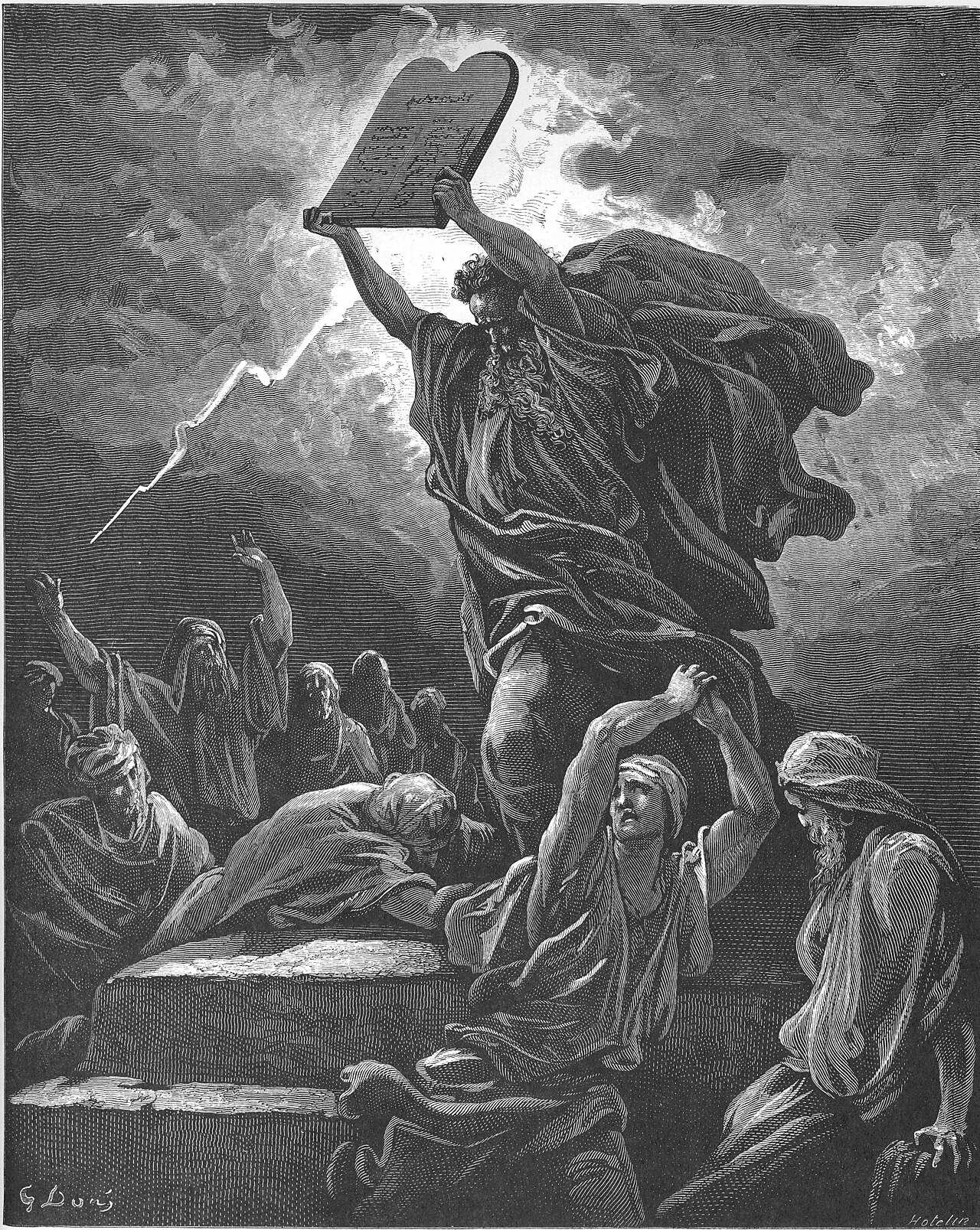
Word studies
The Hebrew and Greek under this study, each word in its own room.
Keep studying
Read it1
By subject
On this page
Symbols1