
Ruth 4:1 to 12 · Subject · Featured Study
The city gate as the court
How an Israelite town heard cases and settled sales at its gate, read from Ruth 4 and the laws of Deuteronomy.
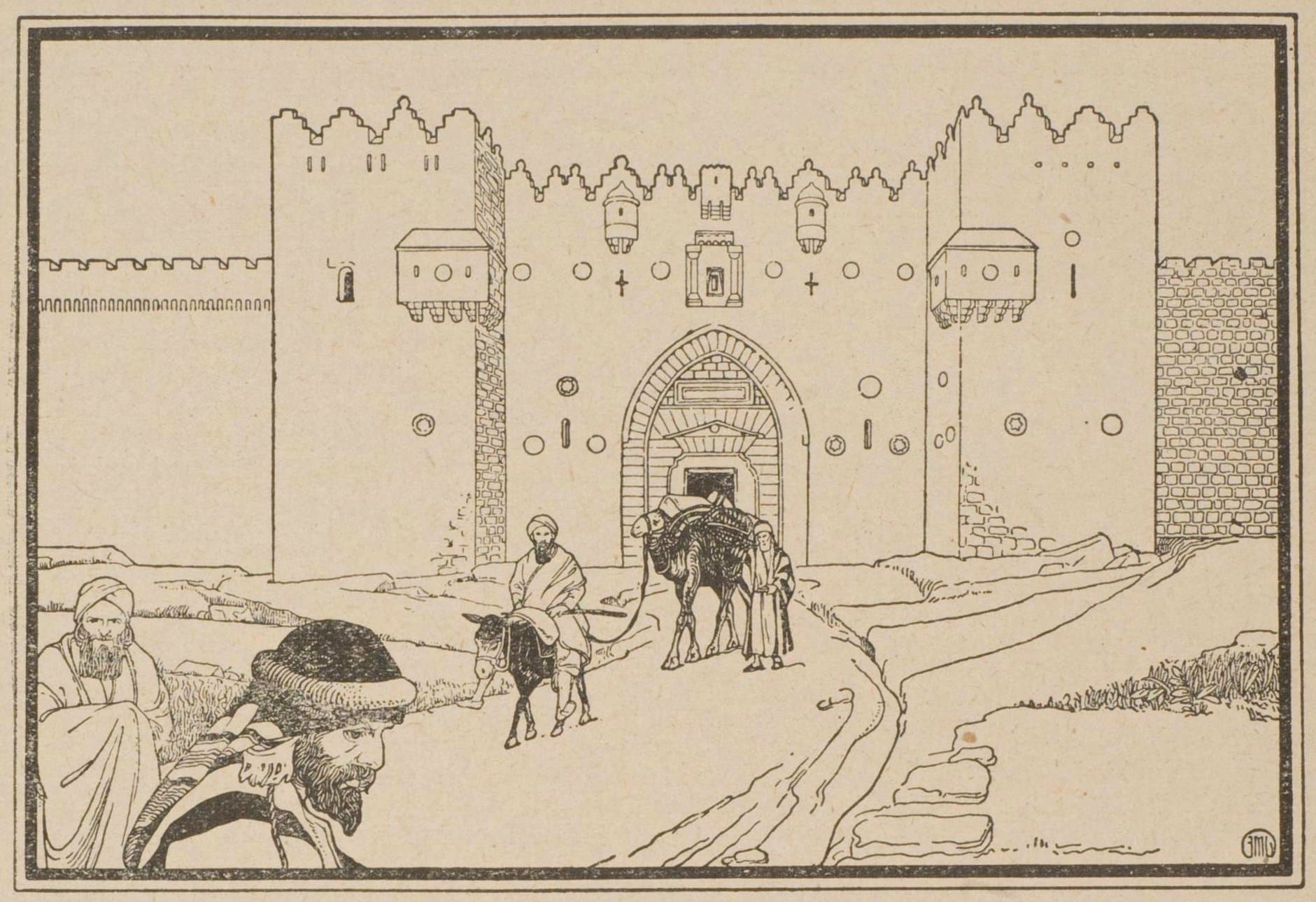
Ephraim Moses Lilien, Boas vor dem Tore (Boaz before the gate), 1914, from the Biblisches Lesebuch für den Schulgebrauch. Public domain (published before 1930), via Wikimedia Commons, File:Boas_vor_dem_Tore.jpg.
THE ARTWORKLilien drew a walled gate with towers and an arched doorway, with travellers on the road that leads into it. Ruth 4:1 says Boaz went to the gate and sat down there, and in the foreground Lilien set a bearded man beside an older one at the roadside.
“We are witnesses,” said the elders and all the people at the gate.
Summary
In Ruth 4 a field is redeemed and a marriage is agreed before ten elders at the gate of Bethlehem.
- Boaz sits at the gate, calls the nearer kinsman-redeemer, and takes ten of the elders of the city to sit with them.
- The nearer redeemer gives up his right, and a sandal handed from one man to the other confirms the transfer.
- The law of Deuteronomy sends a rebellious son, a slandered bride and a refused widow to the elders at the gate.
- Ezekiel 40 measures in cubits the gates of the courts of the temple, each with three chambers on each side of its passage.
Boaz Goes to the Gate
Ruth 4 opens at the gate of Bethlehem, where Boaz waits for the man with the first right to the land.
Meanwhile, Boaz went to the gate and sat down there. Soon the kinsman-redeemer of whom he had spoken came along, and Boaz said, “Come over here, my friend, and sit down.” So he went over and sat down. Then Boaz took ten of the elders of the city and said, “Sit here,” and they did so.Boaz settles the matter where the town's men pass, and he seats ten elders before he states it.
C. F. Keil and F. Delitzsch, in the English edition of their commentary (1872), call the open space before the city gate the forum of the city, where its public affairs were discussed. They note that the Hebrew of Ruth 4:1 has Boaz go up to the gate. They take the words as said of the place of justice, as in Deuteronomy 17:8, where a hard case goes up to the place the LORD will choose.
The Gate and the Hearing Drawn
One gate as Ezekiel measured it, and one hearing as Ruth tells it.
Ezekiel 40 measures a gateway fifty cubits long with three chambers on each side of its passage.
10 cubits
- ThresholdThe threshold of the gate is one rod deep.Ezekiel 40:6
- Gate chambersThree chambers stand on each side, each one rod long and one rod wide.Ezekiel 40:7 to 10
- PiersFive cubits stand between the gate chambers.Ezekiel 40:7
- Low wallA wall one cubit high stands in front of each gate chamber.Ezekiel 40:12
- PassageThe gateway entrance is ten cubits wide.Ezekiel 40:11
- Inner thresholdThe inner threshold by the portico is one rod deep.Ezekiel 40:7
- Portico and jambsThe portico is eight cubits deep and its jambs two cubits thick.Ezekiel 40:9
Ezekiel 40:6 to 16 gives every measure drawn here except the back walls, whose thickness the drawing supplies to make up the twenty-five cubits of Ezekiel 40:13; the low wall of Ezekiel 40:12 is drawn as a line before each row of chambers.
Seven numbered parts, each with the verse of Ezekiel 40 that gives its measure.
The nearer kinsman-redeemer says yes and then no, and the town witnesses the transfer to Boaz.
- Boaz sits at the gateHe calls the kinsman-redeemer over and has him sit down.Ruth 4:1
- Ten elders sitBoaz takes ten of the elders of the city and asks them to sit.Ruth 4:2
- The land is offeredNaomi is selling the land that belonged to Elimelech, and the nearer man may buy it back.Ruth 4:3 to 4
- The first answerThe kinsman-redeemer says that he will redeem it.Ruth 4:4
- The widow is namedWhoever buys the land must also acquire Ruth, the widow of the deceased.Ruth 4:5
- The right is given upHe says he cannot redeem it, or he would jeopardize his own inheritance, and he hands the right to Boaz.Ruth 4:6
- The sandalHe removes his sandal and says to Boaz, Buy it for yourself.Ruth 4:7 to 8
- Boaz declaresHe names what he has bought from Naomi and that Ruth will be his wife, before the elders and all the people.Ruth 4:9 to 10
- The town answersThey bless the marriage in the names of Rachel, Leah and Perez.Ruth 4:11 to 12
Nine numbered steps in the order of Ruth 4:1 to 12, each with the verse that records it.
The Hearing before the Elders
Boaz states the case in the hearing of the elders, and the nearer kinsman-redeemer answers twice.
I thought I should inform you that you may buy it back in the presence of those seated here and in the presence of the elders of my people. If you want to redeem it, do so. But if you will not redeem it, tell me so I may know, because there is no one but you to redeem it, and I am next after you.” “I will redeem it,” he replied.Boaz asks for a yes or a no in the presence of the elders, so the answer binds the man before the town.
The kinsman-redeemer replied, “I cannot redeem it myself, or I would jeopardize my own inheritance. Take my right of redemption, because I cannot redeem it.”The man withdraws his first answer and gives his right of redemption to Boaz in the same hearing.
Keil and Delitzsch explain the refusal from the redeemer's purse: a field bought for his own house would have passed to the son Ruth bore, so the price would have left his estate. The law of the redeemer and of the brother's widow behind this hearing is set out on the pages on the kinsman-redeemer and on levirate marriage.
The Sandal and the Witnesses
Ruth 4 and Deuteronomy 25 each tell of a sandal removed before the elders, in two different acts.
Now in former times in Israel, concerning the redemption or exchange of property, to make any matter legally binding a man would remove his sandal and give it to the other party, and this was a confirmation in Israel.The writer stops the story to explain the custom, which shows it had gone out of use by the time the book was written.
In Deuteronomy 25:9 the widow removes the sandal of a man who will not marry her and spits in his face before the elders. In Ruth 4:8 the sandal belongs to the man who gives up his right, and the act seals a sale with no shame attached to it.
The sandal and the landKeil and Delitzsch; Matthew Henry on Ruth 4:7
Keil and Delitzsch hold that a man took possession of land by treading on it, so handing over a shoe handed over the right. Matthew Henry reads the custom the same way and records an Aramaic tradition about a glove.
Whose sandal changed handsIbn Ezra on Ruth 4:8
Abraham ibn Ezra, on Ruth 4:8, says that Boaz drew off his own shoe and gave it to the kinsman, and he names the act chalifin, exchange. The Berean text of Ruth 4:8 gives the act to the nearer man himself.
Who Sat in the Gate
Elders, buyers, sellers and those seeking a hearing met in the gate in the books of Moses, the histories, Job and Proverbs.
Lot was sitting in the gateway of Sodom when the two angels came, and Hamor and Shechem went to the gate of their city to put a treaty to its men.
When I went out to the city gate and took my seat in the public square,Job recalls his seat in the public square at the city gate as the mark of the honour he once held.
Her husband is known at the city gate, where he sits among the elders of the land.The verse places the men of standing in the land at the gate, as Ruth 4:2 places the elders of Bethlehem there.
| The matter | What the text says |
|---|---|
| A son who will not obey | His father and mother bring him to the elders of his city, to the gate of his hometown. |
| A bride accused | Her father and mother bring the proof of her virginity to the city elders at the gate. |
| A widow refused | She goes to the elders at the city gate when her husband's brother will not marry her. |
| One who served other gods | The man or woman is brought out to the gates and stoned. |
| A manslayer | He stands at the entrance of the city gate and states his case before its elders. |
| A field and a cave | The field at Machpelah is deeded to Abraham before all who had come to the gate. |
| A field and a marriage | Boaz buys the land of Elimelech and takes Ruth as his wife before the elders at the gate. |
Absalom on the road to the gate2 Samuel 15:2 to 4
He would get up early and stand beside the road leading to the city gate. Whenever anyone had a grievance to bring before the king for a decision, Absalom would call out and ask, “What city are you from?” And if he replied, “Your servant is from one of the tribes of Israel,” Absalom would say, “Look, your claims are good and right, but the king has no deputy to hear you.” And he would add, “If only someone would appoint me judge in the land, then everyone with a grievance or dispute could come to me, and I would give him justice.”Absalom uses the men who came to the king for a hearing to turn the hearts of Israel from David.
The market at the gate of Samaria2 Kings 7:1
Then Elisha said, “Hear the word of the LORD! This is what the LORD says: ‘About this time tomorrow at the gate of Samaria, a seah of fine flour will sell for a shekel, and two seahs of barley will sell for a shekel.’”Elisha names the gate of Samaria as the place where flour and barley will sell for a shekel, so trade as well as judgment met there.
The Words of the Gate
Four Hebrew words carry the hearing of Ruth 4.
SHAʻAR
An opening, a door or a gate, and the word for the gate of Bethlehem where Boaz sat down.
ZÂQÊN
Old, and so an elder, the word for the ten men Boaz seated.
ʻÊD
A witness, the word Boaz uses twice and the people answer with in Ruth 4:9 to 11.
NAʻAL
Sandal, the word in both Ruth 4:7 to 8 and Deuteronomy 25:9.
What Ruth 4 Leaves Unsaid
The hearing at the gate leaves four questions open.
Ruth 4 does not give the nearer man's name, and Boaz calls him only my friend. Rashi, on Ruth 4:1, says his name was left out because he would not redeem.
The chapter gives no price for the field and records no written deed. Jeremiah 32:10, by contrast, records a deed signed and sealed before witnesses and silver weighed on the scales. Nor does the chapter say why Boaz took ten elders, which is the question of the readings below.
Justice in the Gate
Amos charges Israel with turning the place of judgment against the poor.
For I know that your transgressions are many and your sins are numerous. You oppress the righteous by taking bribes; you deprive the poor of justice in the gate.The prophet names bribes taken and the poor denied justice in the gate as the sins the LORD knows.
Hate evil and love good; establish justice in the gate. Perhaps the LORD, the God of Hosts, will be gracious to the remnant of Joseph.”The call to repent asks for justice to be set up again in the very place where it had failed.
The gate where Boaz kept the law for a widow is, in Amos, the gate where the righteous are oppressed. The same place could hold a just hearing or an unjust one, and the prophets judged a town by what was done there.
Voices on the Gate
A Father of the fifth century and a commentator of the nineteenth read the elders' place at the gate.
The blessing at the gateTheodoret of Cyrus on Ruth 4:11
“The elders confirmed the marriage with a blessing, saying, ‘The Lord made this woman,’ etc. Moreover, ‘So that she may be an example of virtue in Ephrathah,’ they predicted the salvific birth through which Bethlehem was made famous among all people.”
Theodoret of Cyrus · Questions on Ruth · on Ruth 4:11Patristic
A seat among the eldersAlbert Barnes on Proverbs 31:23
“The industry of the wife leaves the husband free to take his place among the elders that sit in councils.”
Albert Barnes · Notes, Explanatory and Practical, on the Old and New Testaments (1832-1869) · on Proverbs 31:23Evangelical
Why Ten Elders
Readers have given four reasons for the ten men of Ruth 4:2, and each reason meets an objection.
Witnesses of the businessKeil and Delitzsch; John Wesley
Keil and Delitzsch say Boaz called the ten as witnesses of the business, and John Wesley's Explanatory Notes upon the Old Testament, on Ruth 4:2, say the same. The objection is that Deuteronomy 19:15 settles a matter on two or three witnesses, so the number ten needs a further reason.
The number that made a full courtMatthew Henry; Albert Barnes
Matthew Henry thinks ten made a full court by the custom of the city, and that Boaz would not judge his own cause alone. Albert Barnes reasons the same way from the later practice of ten men for a synagogue. The objection is that no law of Moses fixes a court of ten, and Barnes offers his reason as probable.
A quorum for the blessing of the bridegroomRav Nahman, Babylonian Talmud, Ketubot 7b
In the Babylonian Talmud, Ketubot 7b, Rav Nahman derives from Ruth 4:2 that the blessing of the bridegroom is said before ten men. The objection the Talmud records is that men who were not elders would have served for a blessing.
A court to rule on the Moabite womanRabbi Abbahu, Babylonian Talmud, Ketubot 7b
Rabbi Abbahu reads the ten as a court that ruled the bar of Deuteronomy 23:3 to hold for a Moabite man and not for a Moabite woman. Rav Nahman answers that a ruling needs no ten, and the Talmud adds that Boaz gathered ten to make the matter public. Ruth 4 itself records no ruling on Moab.
Books on the Gate and Ruth 4
All four works on the hearing of Ruth 4 are free to read.
Biblical Commentary on the Old Testament: Joshua, Judges, Ruth
C. F. Keil and F. Delitzsch, translated by James Martin · 1872
The notes on Ruth 4 run from page 487 to page 491 of this volume.
Read on archive.orgBabylonian Talmud, Ketubot
The William Davidson Edition · 2017
Folio 7b sets out the readings of the ten elders of Ruth 4:2 and the answers to each.
Read on SefariaRashi on Ruth
Rashi, in the Metsudah Five Megillot · 2001
Rashi gives the withheld name of the nearer kinsman as Tov, from Ruth 3:13.
Read on SefariaIbn Ezra on Ruth
Abraham ibn Ezra · twelfth century
Ibn Ezra's commentary on Ruth goes through the book verse by verse.
Read on SefariaOutside the City Gate
Hebrews 13 names the gate in the death of Jesus.
At the gate of Bethlehem a town watched a man take up a duty another had refused, and it answered that it had seen. The question the gate puts to a reader is whose side he takes when a man is judged there.
And so Jesus also suffered outside the city gate, to sanctify the people by His own blood. Therefore let us go to Him outside the camp, bearing the disgrace He bore.The verse names where Jesus suffered and why, and the call that follows is to go out to Him.
Keep studying
People1
Doctrines9
Peoples and groups1